
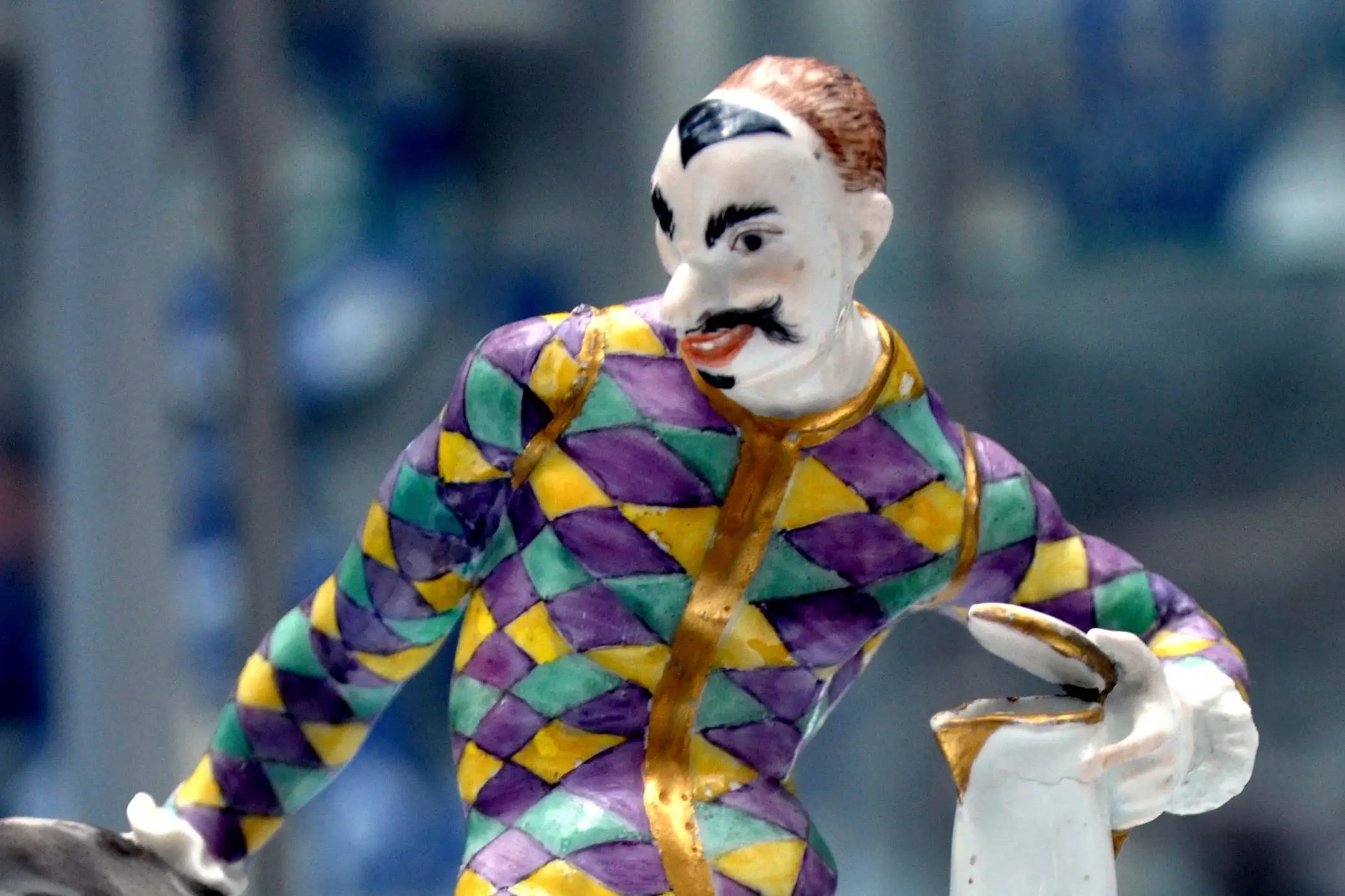
Meissen! The Saint-Denis of the 15th and 16th-century Saxon princes! Yet who thinks of anything funereal when this name alone evokes all the superannuated charm and contrived manner of the Vieux Saxe (Old Saxon) style, such an exact reflection of the gallant legends of Baroque Saxony under the Elector Augustus, King of Poland. Meissen! At the beginning of an epic of research and labor that lasted two centuries, our retrospective imagination discerns with what sharp relief the grimacing, fantastic silhouette of that odd fellow Johann Friedrich Böttger, the distiller of quintessence, hunched over his alembics.
He died at thirty-seven as much from his disorderly life as from the too-frequent inhalation of mercury vapors—the only indisputable benefit of his philosophical research.
A Storied Past: From Alchemy to Rococo
With great respect, we review Böttger's first red porcelains of 1704, made from the clay of Ockrilla, and then witness his definitive discovery of Europe's first true hard-paste porcelain, finally achieved with the help of the white porcelain earth from Aue, near Schneeberg in the Saxon Erzgebirge. And so we follow a chronicle as amusing as a novel, featuring a gallery of arcanistes (keepers of the secret formula) worthy of the humorous brush of the contemporary Englishman Joseph Wright of Derby, the painter of alchemists. A whole procession of grave or frolicsome courtly figures passes by, each deserving a ten-line portrait.
We see Baron von Tschirnhaus, a learned mineralogist and chemist to whom Saxony owes its first glassworks. We meet Commissioner Pœrner, a mining councilor who, at a time when France was struggling through the excesses of its Revolution, obtained the concession for the famous porcelain lotteries. Then there is the commercial councilor Hebig who, during the Seven Years' War, managed to support the manufactory against competition from Berlin by sacrificing considerable sums of his own money. Hebig repurchased the warehouse stock, which had been seized by the enemy and initially sold to the first bidder for 120,000 thalers (an old German silver coin), for 160,000 thalers.
And we cannot forget the gracious Count Marcolini who, at the beginning of the 19th century, presided over one of the most beautiful periods of production—the one whose products, marked with the rigid, crossed electoral swords with a star between the guards, are so sought after by collectors.
We can picture the proud and somber setting of Albrechtsburg castle on its escarpment, as depicted in one of the most beautiful etchings by Bernard Mannfeld. It was a dark feudal nest, well-suited to concealing the mysteries of a secret manufacturing process and to hiding, beneath the weight of its thick walls and high, storied towers, a whole century of empirical chemistry, a code of obsolete procedures, and venerable superstitions. In a word, it concealed the arcane—the magical, envied, and feared secret formula—of which the workers spoke in hushed tones and which haunted the public imagination, so much so that one fine day it was simply sold to the cunning Frederick the Great in Berlin.
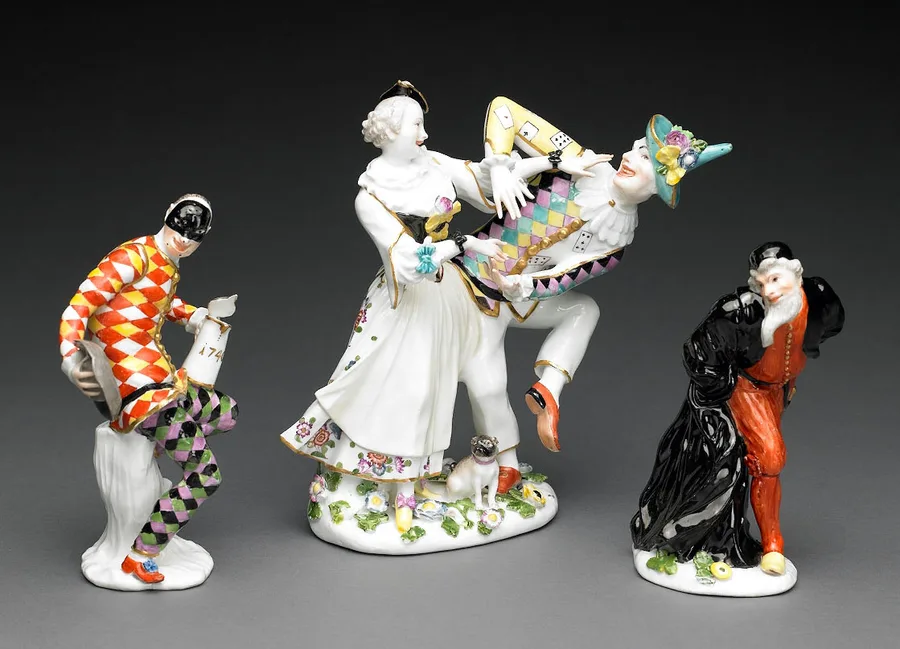
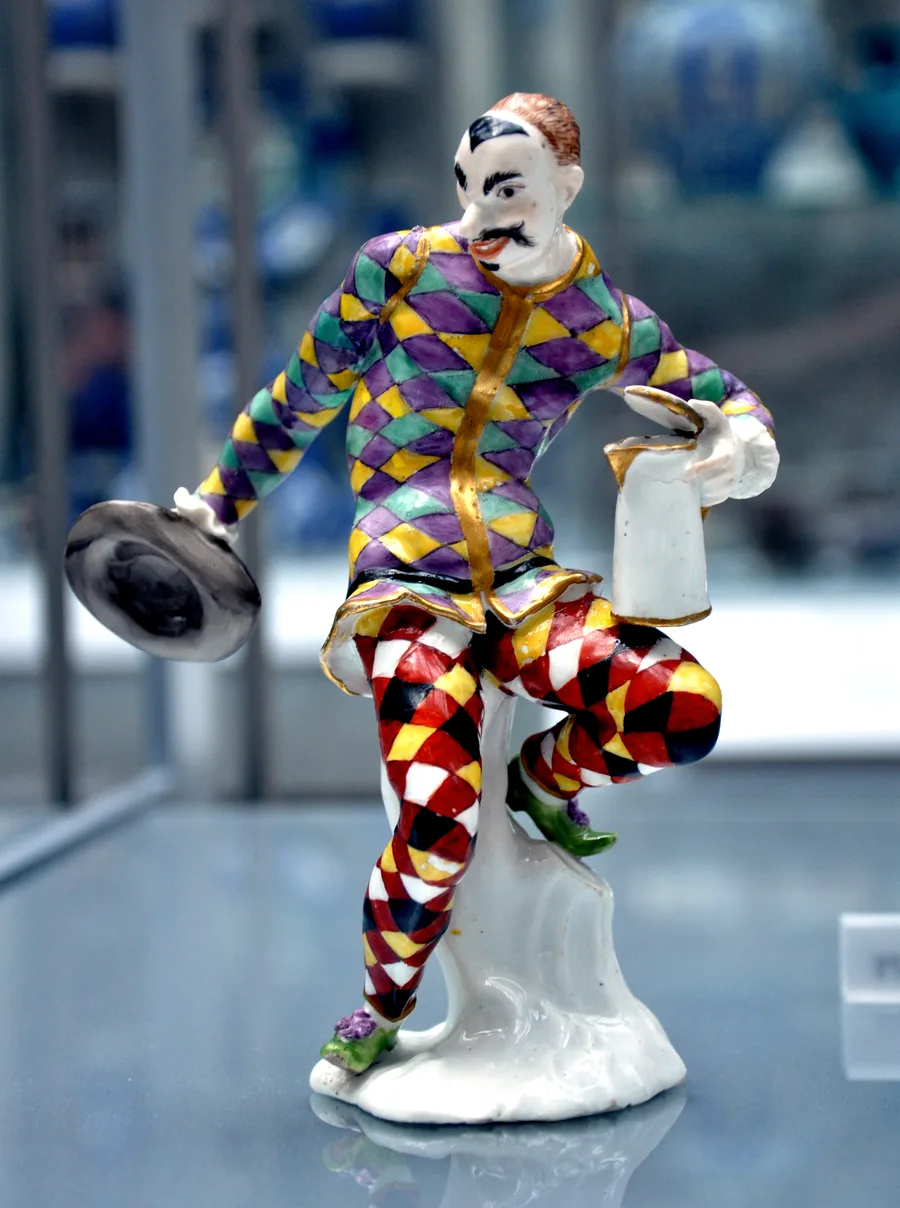
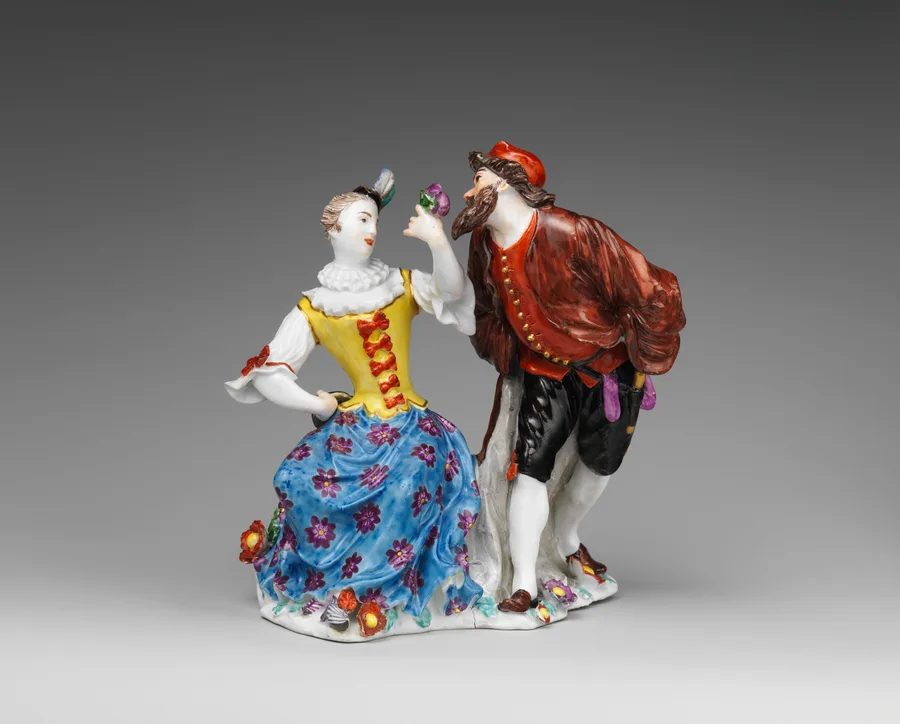
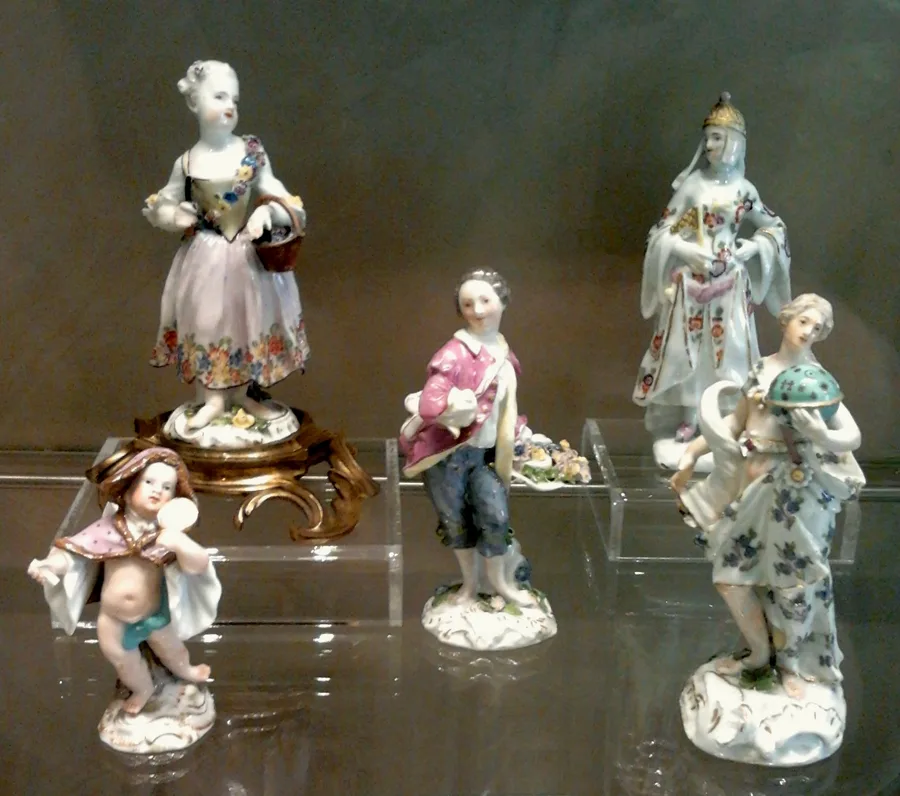
And now, all those exquisite little figures come back to life, with their powdered wigs, beauty spots, and pannier skirts, seemingly made to dance to the English and French Suites of the patriarch Johann Sebastian Bach. We see the small anecdotal groups modeled by Kändler, the creator of the Meissen Rococo, and painted by Hœrold. We see those modeled by the Versailles native Michel-Victor Acier, who inaugurated the Saxon Louis XV style, and painted by Ernst Dietrich. One can witness the curious spectacle of the great sales that took place at the Leipzig Fair and reread the accounts of bizarre orders from Russia and Poland, for whom the most convoluted tea and coffee services were reserved, and of the enormous exports to Turkey of so-called Turkish bowls.
The Louis XVI and Empire styles in turn became the object of general infatuation, so much so that to this day this immense, ever-expanding manufactory—which must provide revenue to the state rather than receive any subsidy—has struggled to meet the demand for objects based on the famous old models, whose popularity seemed destined never to wane.
The Turn Towards Modernism
And yet, we have now reached a moment when the old styles of French importation, even in Germany and Austria, are beginning to fall out of favor with the rising generations and the cosmopolitan world. Art Nouveau, or the new art, is triumphing in one German city after another. Meissen, under penalty of being overwhelmed by competition from Copenhagen and the Northern ceramicists, if not by the activity of those in Munich, must in turn venture into modern research. Thus begins a new, highly original, and unforeseen period, one which the ancient Royal Porcelain Manufactory of Saxony will one day be very honored to have added to the nine of which its history already boasts.
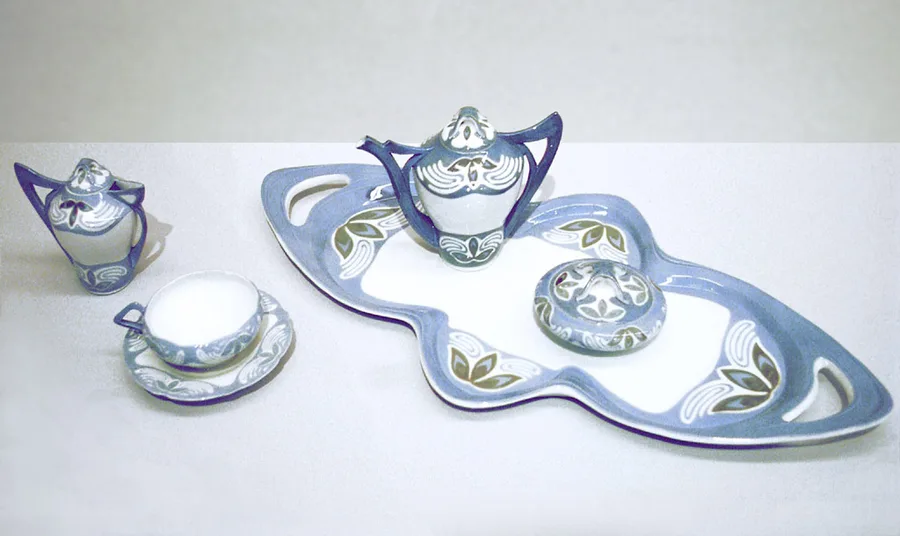
It is truly hard to believe that the beautiful vases with simple curves and sumptuous colors, adorned with a Böcklin-esque landscape or simply one or two beautiful decorative flowers—a few irises or a roundel, a cycle of cyclamens—share the same homeland as that population of dainty, old-fashioned biscuit figurines. These were idyllic, pastoral, and Florianesque figures: charming cupids, Marivaudian groups, and ribboned statuettes sketching the steps of a minuet or miming theatrical kisses, which for so long stormed every shelf and mantelpiece.
How can one suppose the same origin for these beautiful plates, as plain in form as they are tranquil in decoration, and for those libertine mirror frames, those scalloped sconces, those massive candelabra, those flowery lamps, those chimerical hanging baskets, and those overloaded jardinières? Or, after all that Baroque which recalls the salons and palaces of Dresden, the Zwinger, and the Brühl Terrace, how can we connect it to the austere, unadorned amphorae, or to the plates with painted classical compositions and openwork rims? Or even, more recently, to the porcelaines mousseline (muslin porcelain)?
Dethroned, then, is all that graceful but ultimately tiring bric-a-brac, never simple enough, which for two centuries filled the castles of Germany, Austria, Russia, and Poland, and adorned the consoles and shelves of the immutable apartments where three or four generations of our grandmothers succeeded one another.
Besides, in all these countries of large or small courts, the ingrained taste for Rococo and Baroque has always been, in its own way, a kind of loyalism, a protestation of fidelity to the old regimes. The aristocracies are still its last rampart today, and the heavy, opulent palaces of Vienna and Prague, for example, will cling to it all the more as the new art in Austria takes on more garish and revolutionary airs, and cavalier manners that, by contrast in this staid and dignified environment, smack of Americanism.
Technical Mastery and Innovation
The primary advantage of manufactories as magnificently established and equipped as Meissen, when they decide to courageously embark on the modern paths opened by solitary artists with private resources, is that they immediately surpass the initiators. From the very first attempt, they can confidently perform at the level of the best successes that others owe to chance. A centuries-old practice spares them from trial and error; they have a fully trained staff and raw materials they can use with certainty. No financial constraints limit their means, and alongside a group of excellent artists, they continuously maintain a corporation of specialists.
The incessant laboratory work of these specialists not only prevents any loss but also leads daily to some important discovery or technical improvement, both in practice and in results. Indeed, this research focuses as much on heating methods and kiln construction as on the composition of the clays, glazes, and enamels. The scientific history of Meissen from this point of view would be precious to study. If we are to believe the German literature on the subject, particularly the latest monograph on the Saxon factory published by Mr. Carl Meissner, Meissen's hard paste today possesses, perhaps even more so than in the last century, the qualities that founded its universal renown.
It is one of the most resistant pastes in existence, composed of fireproof kaolin intermixed with fusible feldspar. The thin layer of hard enamel that covers it is also essentially based on kaolin mixed with materials whose fusion is only obtained at an incandescent heat. This porcelain is fired at a temperature of 1600° C in a pure flame, which gives it an unfailing solidity and reduces most of the metallic oxides that color it. Only gold, which is used very prudently, is fired in an additional enameling kiln at 1000° C. In the last century, the palette of high-fire colors was rather meager; today, the new works prove that Meissen has succeeded in acquiring almost all colors for underglaze painting: deep green, vegetal green, reddish-brown of all shades, all yellows, etc.
Only a copper red has so far resisted. They have also produced examples of hard porcelain with a tortoiseshell-brown painted glaze. Finally, while perfecting the coloring pastes themselves, which it sells commercially, the manufactory has remained faithful to the beautiful clay of its beginnings, "the noble earth" as they say in German. It has adopted underglaze painting with little modeling from Copenhagen; but from the very first trials, Meissen has sought to go further. Not only have they enriched the high-fire colors—those that withstand the firing temperature of hard porcelain—but they have also combined this underglaze painting with pâte-sur-pâte painting using variegated colored slips.
A German Aesthetic: Color, Landscape, and National Character
The results have achieved enormous, astonishing success in Germany, where the supremely distinguished, somewhat monochrome, and suave elegance of Copenhagen could not be appreciated as well as in France and England. It is too contrary to the Germanic temperament. The German loves bold colors; before the intense and always major-key harmonies of Böcklin, before his exaggerations of local color, he will exclaim: "Here at last is color that rejoices a German soul!" He would almost call Copenhagen's style cloying. Meissen, therefore, has not sought delicate dissonances, decadent subtleties, or swooning nuances.
The most vibrant flowers retain their natural brilliance and their fullness of health.
The elongated, flat lines of Jutland and the Baltic Archipelago, the pale nature of the wintery, maritime north, are reflected in the products of Copenhagen. Those of Saxony, the latest creations, have the more southerly sumptuousness of the landscapes of Saxon Switzerland. Now, nothing in France, not even in the Swiss or Tyrolean Alps, can give an idea of the intensity of the green of the meadows and the red of the rooftops in the landscapes of Thuringia. For our part, we have seen on the Bohemian slope of the Erzgebirge flowering meadows of an intensity of tone that we have found nowhere else; the meadows of Marienbad and the Iglava valley, for example, are famous in this regard.
We fully concede to the inhabitants of this heart of Central Europe that the common botany of the temperate zones seems to have found its paradise there. In Saxony and Bohemia, the same flowers as in France, Hungary, or Romania double the intensity of their colors (whereas in Romania, for example, they double and triple their dimensions). The same rock pinks that we have picked pale pink in Switzerland or Franche-Comté are the most vivid carmine in the upper Elbe valley. We could give many more examples, peppered with barbaric and pedantic Latin words, but we only mean to insist on this: the French landscape can in no way serve as a criterion for judging German landscapes.
Just as Corot is accurate on the banks of the Seine, so are Böcklin, Hans Thoma, and Palmié true to life on the banks of the small rivers and in the mossy valleys of the Taunus and Saxon Switzerland. And I believe that the recognition of this truth may not be without importance, even when it comes to decorative art.
Masterpieces of the New Style
Moreover, the stylization of the motif—when it exists and is not merely a matter of a naturalistic, Japonisant decorative character—on the new ceramics of Meissen is generally so successful in its simplicity and freedom that, in most cases, distinction loses nothing to this violent coloring, or at least not much. The form and nature of the vase itself seem to us to authorize a modeling that we would only ever exclude from flat surfaces. I believe that on this account, the most severe purist would find nothing to criticize, despite its appearance of a Böcklin painting, in a certain spring round dance that unfolds on a meadow of the frankest vegetal green and a horizon where a few cypresses add a sense of contemplation.
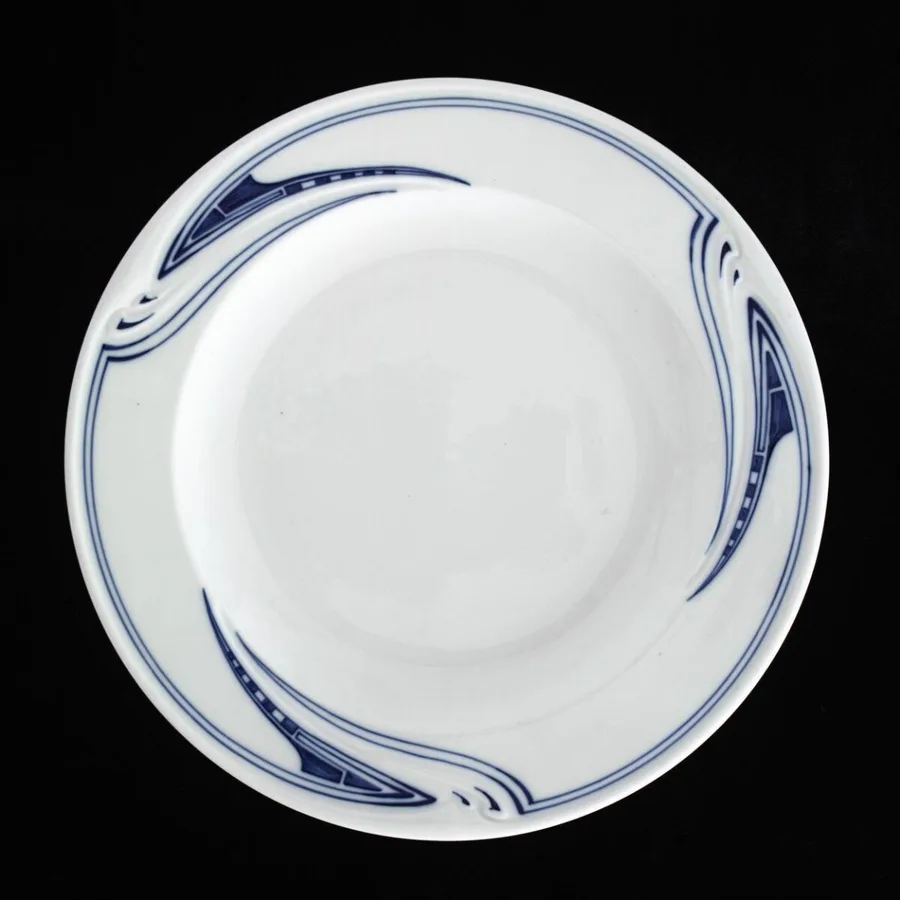
The effect of full-bodied coloration is achieved without any harshness in the way one tone reflects upon another.
In contrast, a vase with magnolias, of Chinese form, offers us harmonies with which we are more familiar: on a light blue background, branches with green leaves and white flowers, tinged with flesh tones, frame a female figure of a soft pink, with brown eyes and hair. Elsewhere, grave white swans glide upon their dark reflections, as if framed by the even darker shadows of the shore. Here, a peacock feather curves, with a high-fire colored glaze, where only the green and red eye is painted underglaze. We will not detail further; typical examples are reproduced here.
But besides the standard ceramic pieces, Meissen could not renounce the glory of biscuit porcelain and the small colored groups that won it such a large clientele in the last century. Here again, care is taken not to neglect the search for the new. Here is a Joueuse de boules (Bowl Player), of which we only regret the banal classical ornament of the base, and a witty group of Ulenspiegel and Nele. Both are well-suited to reassure lovers of this kind of trinket, and above all, they are far removed from the gallant and Rococo Saxon style of yesteryear!
Unfortunately, Meissen does not yet, like Copenhagen, release the names of its artistic collaborators; for we would have liked to inscribe them below the few unpublished reproductions we are publishing of some of the most recent works, which show us the ancient Royal Manufactory of Saxony so suddenly rejuvenated and renewed.
The Future of a National Style
The spring of Art Nouveau has passed over the upper Elbe valley, and if the products that emerge from it are true evidence of the artistic taste currently reigning in Germany, let us be the last to complain. The more an art is anchored in its national tradition, the more, by repercussion, it gives strength, reason for being, and sanction to the national tradition of its neighbor. It would be as much a pity for German artists and musicians to cease being German, as for the French to cease being French, or the Slavs to cease being Slavic. Industrial art, especially, will live by nationalities as long as they exist, its primary quality being to satisfy those to whom it is addressed long before pleasing their neighbors.
Indeed, we will only too often have the occasion to point out regrettable foreign influences in Germany, especially English ones. The furniture at recent exhibitions, for example, is too often a faithful copy of the types in favor in England. Since ceramics, on the contrary, already seem definitively engaged in paths significant of the tendencies and character of the race, we can only praise it for that.
It will henceforth be up to Meissen to become an educational force for Germany, just as Copenhagen has been for the Scandinavian countries. The rivalry that constantly exists between the old Royal Manufactory of Saxony and its... let's say illegitimate... daughter in Berlin can only lead to an emulation as fruitful in central and northern Germany as that already reigning in Munich and Karlsruhe. Let us wish all these well-intentioned ceramicists to remain firmly themselves, for if they truly create a modern German style, they will probably have helped us to clearly define its antithesis. And it is on the side of that antithesis that there will be a chance to discover, in turn, the modern French style.
WILLIAM RITTER.