
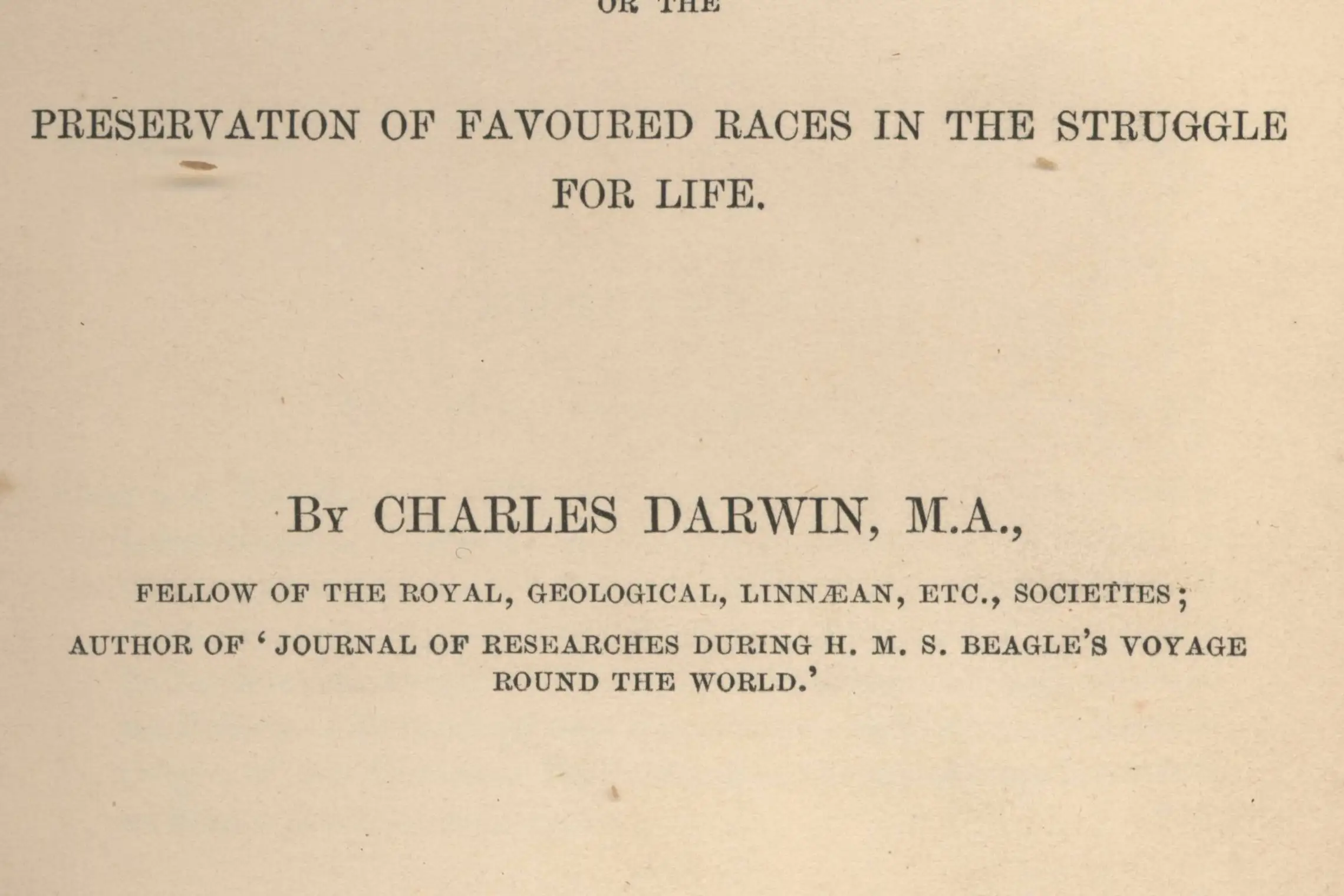
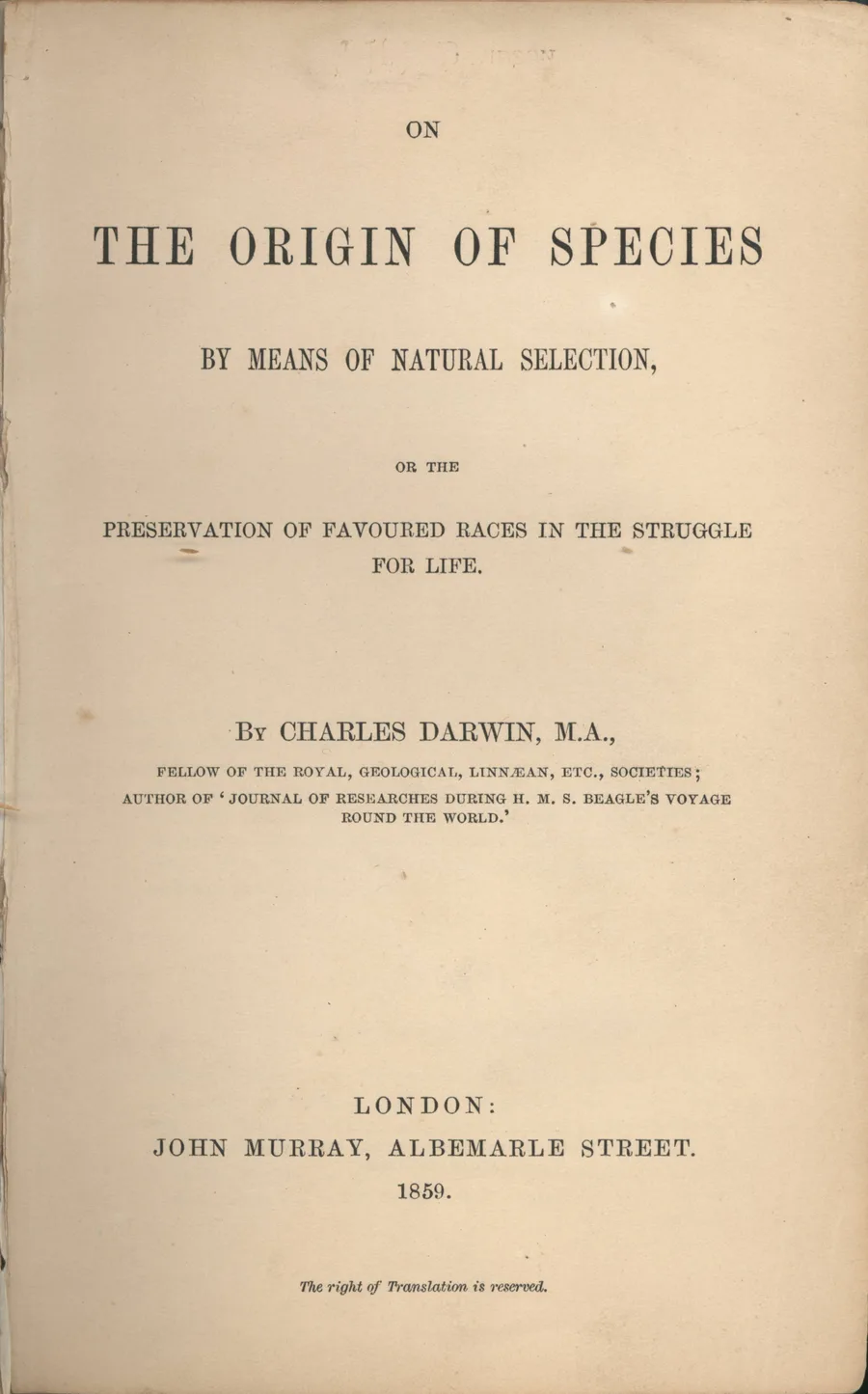
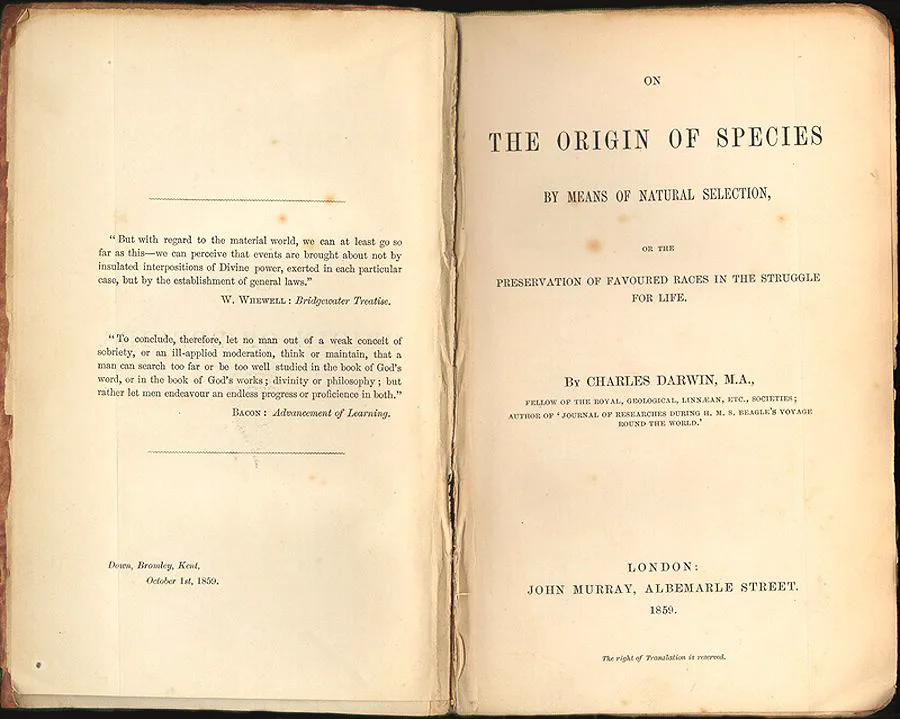
In the cold of January 1860, a new kind of cargo arrived in the port of New York. It was not cotton or timber or steel, but an argument, bound in unassuming green cloth and pressed into 432 pages. It carried no official bill of lading attesting to its explosive potential, but the ideas contained within were more volatile than gunpowder. This was the first American edition of Charles Darwin’s On the Origin of Species, and its arrival was not merely a matter of printing. It was a cultural event, a transatlantic drama of intellectual urgency, commercial opportunism, and philosophical vertigo played out in the final, anxious months before the United States tore itself apart.
The book that landed on American shores was already a legend. John Murray’s London edition, published just seven weeks earlier on November 24, 1859, had sold out its entire print run of 1,250 copies on the first day. News of its contents—a meticulously constructed case for evolution by natural selection—had crossed the Atlantic faster than the mail ships. For years, Darwin had been a quiet correspondent with a handful of American scientists, chief among them the eminent Harvard botanist Asa Gray. It was Gray who became the book’s American custodian, its champion, and, in a sense, its co-conspirator.
The Correspondent and the Pirate
The relationship between Darwin in his quiet Kentish village and Gray in the academic bustle of Cambridge, Massachusetts, is a testament to the invisible college of 19th-century science. Through years of letters, Darwin had shared glimpses of his “big book,” trusting Gray’s expertise and discretion. When publication was imminent, the problem was not scientific but commercial. In 1860, there was no international copyright agreement to protect a British author’s work in the United States. A literary pirate could simply acquire a London copy, set it in type, and flood the market, leaving the author with nothing.
This was the fear that spurred Gray into action. He was not an agent, but a believer. He understood the profound importance of Darwin’s work and was determined to see it presented to the American public fairly and accurately. He negotiated with Boston publishers Little, Brown and Company, who hesitated, wary of the book's controversial nature. Time was running out. He then turned to D. Appleton & Company of New York, a firm known for publishing ambitious scientific and philosophical works by figures like Herbert Spencer and Thomas Huxley. They saw the opportunity. Gray secured a deal for Darwin, a modest 5% royalty on a book he had no legal right to control in the American market. It was an act of intellectual integrity in a rapacious publishing landscape.
Appleton moved with remarkable speed. On January 10, 1860, their edition appeared in bookstores. The first printing of perhaps 1,250 copies, like its London counterpart, vanished almost immediately. By the end of the year, Appleton had produced four printings, totaling around 2,500 copies. The argument in green cloth was loose in the New World, and the New World was a place uniquely prepared, and unprepared, for what it had to say.
A Book for a Burning World
To understand the explosive impact of Origin in America, one must understand the America of 1860. It was a nation on a knife’s edge. The wounds of “Bleeding Kansas” were still fresh. John Brown’s raid on Harpers Ferry had occurred just weeks before the London publication. The country was a tinderbox of sectarian fervor, political radicalism, and social anxiety, with the question of slavery twisting every debate into a moral crisis. Into this charged atmosphere dropped a book that seemed to dethrone humanity’s divine right and suggest that life was a brutal, amoral struggle for existence.
The book was not read in a vacuum. It was interpreted through the lenses of the nation’s deepest obsessions. For abolitionists, natural selection offered a powerful, if sometimes misapplied, metaphor for the struggle against the institution of slavery. An early owner of one of these 1860 copies was Giles B. Stebbins, a noted anti-slavery activist and spiritualist—a perfect embodiment of the strange intellectual alliances Darwin’s work fostered. For proponents of Manifest Destiny, “survival of the fittest” (a phrase coined by Herbert Spencer, not Darwin, but quickly associated with his work) provided a grim justification for continental expansion.
And for the faithful, it presented a terrifying challenge. The book’s calm, relentless accumulation of evidence—from the finches of the Galápagos to the breeding of domestic pigeons—undermined the literal account of Genesis that served as a cornerstone of American Protestant life. Yet the response was not monolithic. Asa Gray himself was a devout Presbyterian who saw no conflict between his faith and Darwin’s theory, arguing that natural selection was simply the mechanism through which God chose to work. He became Darwin’s most eloquent American defender, engaging in public debates and writing influential reviews that helped shape a more nuanced reception among the intelligentsia.
The book, therefore, became more than a scientific text; it was a cultural mirror, reflecting the hopes, fears, and contradictions of a republic stumbling toward civil war. It offered a new and unsettling story about origins at the very moment the nation was questioning its own.
The Argument Unbound
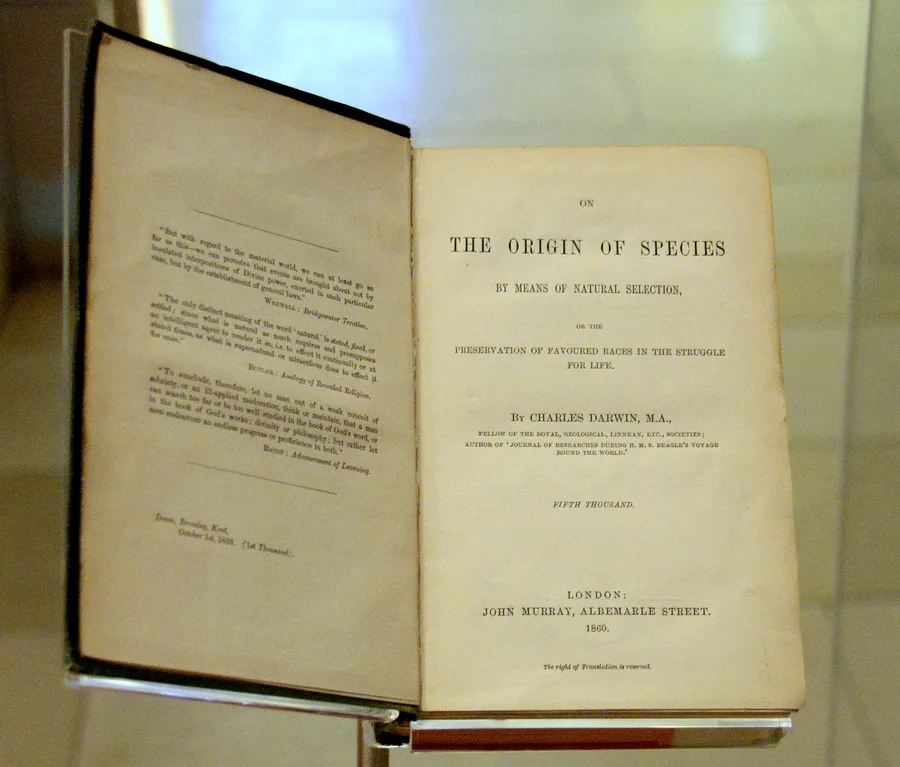
The physical object of the first American edition tells its own story. Bound in a simple, durable, dark green or brown pebbled cloth, with the title in gilt on the spine, it was built for reading, not for display. It was a tool, not a treasure. Its very plainness speaks to its purpose: the wide and rapid dissemination of a revolutionary idea. Many copies bear the faint embossing of booksellers like “S.C. Griggs & Co., Publishers Chicago,” a reminder of the vast distribution network that carried these ideas from the New York docks into the heartland.
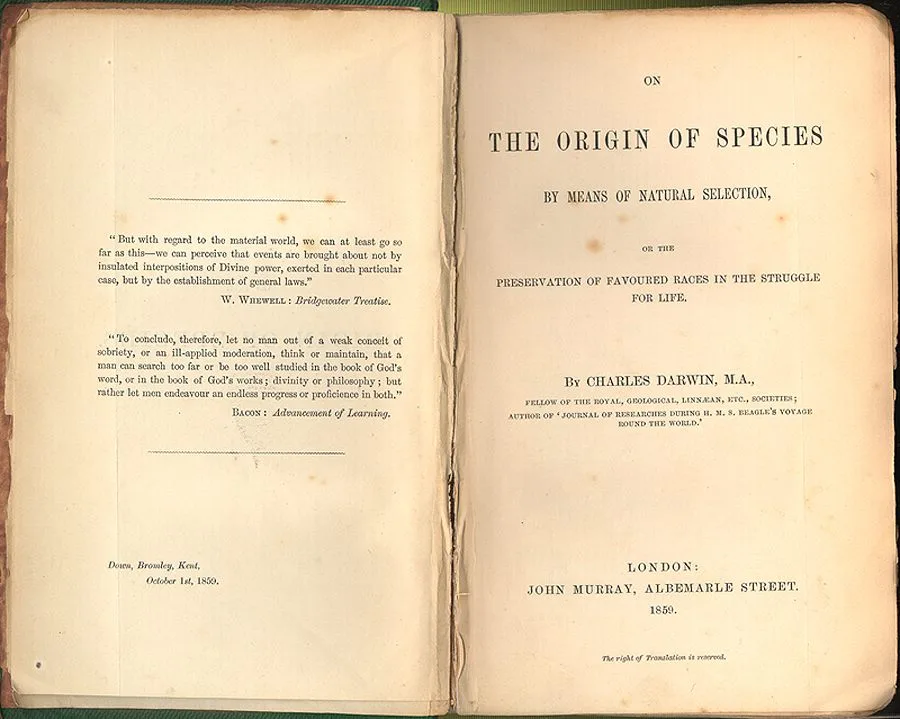
Inside, the text itself was not static. Darwin famously described Origin as “one long argument,” but it was an argument he continued to have with himself and his critics for the rest of his life. The American edition was based on the first London edition, but Darwin was already at work on revisions. One of the most famous passages he later removed was a speculative thought experiment about a black bear, seen swimming for hours with its mouth wide open, catching insects in the water. Darwin mused that a race of bears could, through natural selection, be rendered “more and more aquatic in their structure and habits, with larger and larger mouths, till a creature was produced as monstrous as a whale.”
Critics seized on this image as ludicrous, and Darwin, ever sensitive to scientific rigor, excised it from the second edition onward. But its presence in the first American copies is a fascinating glimpse into the scientific process. It reveals a mind willing to push logic to its furthest conclusions, to be provocative, and to then retreat and refine in the face of evidence and criticism. The book in the reader’s hands was not a finished dogma but a living document, a snapshot of an ongoing intellectual revolution. The inclusion of the crucial fold-out lithographed chart, the only illustration in the book, was essential. This stark, branching diagram visualized his theory of descent with modification, a family tree for all of life that was both intellectually elegant and profoundly unsettling.
The Anatomy of a Revolution
The story of this book is inseparable from the technology and commerce of its time. D. Appleton & Company was not just a printer; it was a cultural engine. In an era before academic specialization had hardened, they published works that moved fluidly between science, philosophy, and social commentary. They created a market for serious ideas, and in Origin, they found the ultimate expression of that mission.
The physical production of the book—the pebbled cloth, the blind stamping on the boards, the brown coated endpapers—was the standard for mid-century trade books. It signifies a democratizing impulse. This was not a folio destined for a nobleman’s library but an octavo volume meant to be bought, read, debated in parlors, and carried on journeys. Its very construction made it a vessel for an idea on the move.
The speed with which it was produced and distributed across a continent speaks to the maturity of the American publishing industry. It was a machine capable of absorbing a complex, controversial work from abroad and turning it into a national talking point in a matter of weeks. The book’s success confirmed that America was no longer a colonial backwater but a central arena for the great intellectual debates of the Western world.
The journey of a single copy, from the Appleton press in New York in 1861, perhaps through a Chicago bookseller, into the hands of a first reader grappling with its implications, and eventually, over a century and a half later, to find preservation in the estate of a collector like Anne Buffington in Tennessee, is a miniature history of an idea. It is the story of how an abstract theory becomes a physical artifact, how that artifact circulates through the culture, and how it is ultimately preserved as a testament to the moment it changed everything.
This modest volume of green cloth and gilt lettering is more than a rare book. It is a fossil of a particular historical moment—a record of a time when a single book could land with the force of an earthquake, shaking the foundations of science, religion, and society. It stands as quiet proof that sometimes, the most profound revolutions begin not with a bang, but with the turning of a page.
Seen at auction: Case Auctions