
A Performance of May
Before you read the names, you see the performance. An impossible bouquet, spilling from an ornate urn with a sculptor’s precision. Here is a ‘Bishop of Canterbury’ tulip, its feathered petals a statement of horticultural aristocracy. Beside it, an ‘Indian Queen Ranunculus’ unfurls in regal complexity, while a delicate ‘China pink’ leans out, a study in quiet grace. More than thirty distinct species, from the familiar ‘Cinamon Roʃe’ to the exotic ‘Blew Hyacinth of Peru,’ are packed into a single, breathtaking composition. This hand-coloured engraving, representing the floral abundance of May, is a masterwork of botanical art. But it is not, primarily, a work of art. It is a sales pitch. It is a page from what is arguably the most beautiful and influential seed catalogue ever produced: Robert Furber’s The Flower-Garden Display’d. The plate is a document that captures a pivotal moment in the early 18th century when gardening ceased to be merely agriculture and became a cultural obsession, a science, and a powerful expression of social status.
The Nurseryman's Gambit
By the 1720s, England was gripped by a fervor for gardening. New wealth from trade and empire fueled the expansion of country estates, while the intellectual currents of the Enlightenment encouraged a passion for classifying, ordering, and improving upon nature. At the center of this burgeoning world was Robert Furber (c. 1674–1756), a nurseryman and seed merchant in Kensington, then a fashionable village outside London. Like any good businessman, Furber needed to sell his wares—seeds, bulbs, and saplings sourced both locally and from the farthest reaches of the known world. The standard method was a simple printed list, a dry and uninspiring affair.
Furber envisioned something radically different. He understood that his clientele—the landed gentry, wealthy merchants, and their aesthetically minded wives—were not just buying plants; they were buying beauty, novelty, and prestige. In 1730, he embarked on an ambitious project that would transform the commercial catalogue into a luxury object. He commissioned Pieter Casteels III, a renowned Flemish painter living in London, to create twelve monumental paintings, one for each month of the year. Each painting would depict a grand bouquet in a classical urn, composed of the flowers that bloomed in that month and were, crucially, available for purchase from Furber's nursery.
These paintings were then meticulously engraved onto large copper plates by artists like Peter Smith (signing here as J.o Smith) and published as a subscription series titled Twelve Months of Flowers. The result was a sensation. Here was a catalogue that didn’t just list products; it demonstrated their potential, staging them in an idealized composition that was both a practical guide and an object of immense decorative appeal. It was an act of brilliant marketing, translating the abstract promise of a seed into a tangible vision of floral perfection.
The Science of Style
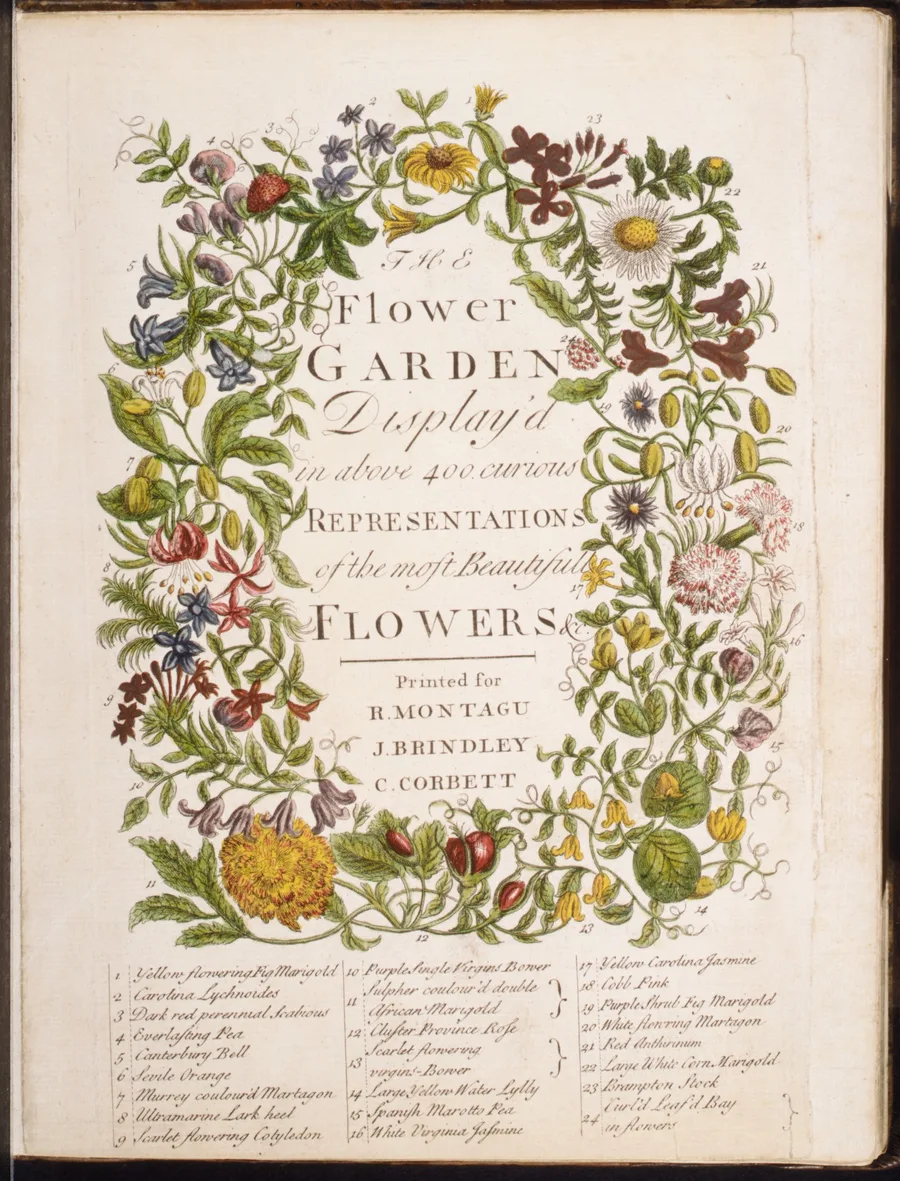
The project’s genius lay in its fusion of commerce, science, and art. Look again at the May plate. The arrangement, while artistically composed, is rigorously systematized. Each flower is carefully numbered, corresponding to a key printed at the bottom of the page. This was more than a simple legend; it was an act of scientific ordering. Furber was a member of the English Society of Gardners, a group dedicated to standardizing plant nomenclature. The whimsical, evocative names—‘Pheaʃants Eye’, ‘Embroider’d Cranes bill’, ‘Indian King Ranunculus’—were an attempt to bring order to a field rife with confusing folk names and regional variations. The catalogue was, in effect, a visual dictionary of the fashionable garden.
In 1732, an anonymous, cheaper quarto edition appeared, titled The Flower-Garden Display'd, which reproduced Furber's grand plates on a smaller scale. Though Furber initially denounced it as a pirated copy, a second, authorized edition in 1734 added extensive text by the respected Cambridge botanist Richard Bradley. This addition cemented the work's scientific authority. Bradley’s text provided a “description and history of each plant and the method of their culture,” offering practical advice on the latest horticultural technologies, including “stoves, green-houses, [and] hot-beds.”
Suddenly, the catalogue became an indispensable manual. It not only showed you the exotic ‘Virginian Columbine’ but also explained how to cultivate it in the damp English climate. It was an instruction book for a new kind of consumer, one who participated in the global exchange of species and the scientific project of the Enlightenment from their own backyard. The book was a tool for mastering nature, providing the knowledge needed to make these exotic beauties flourish far from their native soil.
A Pattern for the Age
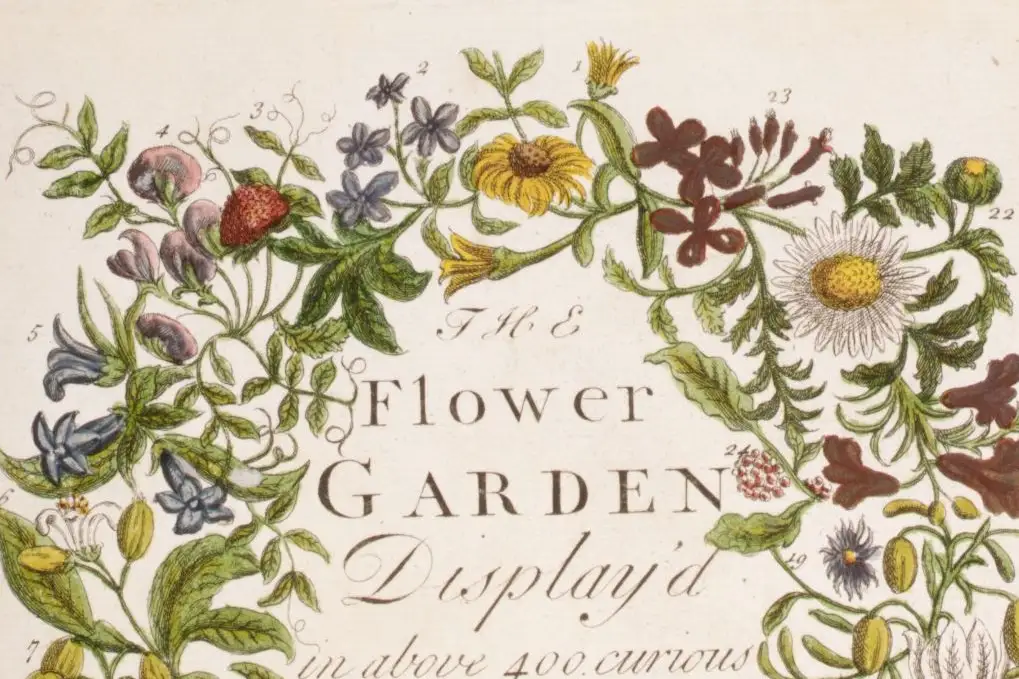
Furber’s publication did more than just sell seeds; it sold an aesthetic. The title page of The Flower-Garden Display'd announced its utility not just for gardeners but also for “painters, carvers, japaners, &c. also for the ladies.” This was no exaggeration. The book immediately became a pattern book, a source of visual inspiration that shaped the decorative arts of the Georgian era.
One can easily imagine a lady of fashion using the May plate to guide her needlework, or a ceramicist in Chelsea borrowing the form of the Double Orange Lily for a painted dish. The bouquets of Casteels, as engraved by Smith, provided a ready-made visual vocabulary of elegance and natural abundance. These flowers escaped the page and began to bloom across textiles, wallpapers, furniture, and porcelain. Furber’s catalogue did not merely reflect the taste of the time; it actively codified and disseminated it.
This broad appeal, particularly to a female audience, was significant. Botany and gardening were seen as genteel pursuits suitable for women, and Furber’s beautiful, accessible format played a crucial role in the popularization and “gendered consumption of botanical knowledge.” It was both a practical tool and an object of polite cultural currency, equally at home in the potting shed and the drawing room.
The Enduring Bouquet
The influence of Furber’s work was immediate and lasting. It set the standard for horticultural publishing, and its format was emulated across Europe in later, even grander, publications like the Dutch Flora Danica. It established the visual language of the seed catalogue that persists, in some form, to this day: the promise of a perfect result, beautifully illustrated.
Looking at the May plate now, centuries after its creation, one sees a document of remarkable density. It is a record of horticultural diversity in 1730s England, a testament to the reach of global trade, and a landmark in scientific publishing. Yet its power endures not because it is a list, but because it is a composition. The ‘Yallow Auʃtrian roʃe’ and the ‘Dutch yallow Ranunculus’ are not just specimens; they are characters in a drama of colour and form. Robert Furber’s great insight was that to sell the raw materials of nature, you first had to sell the dream. His catalogue was not a book of flowers; it was a book of bouquets, a series of masterful illusions that promised a world of cultivated beauty, all available for the right price.
Seen at auction: Forum Auctions