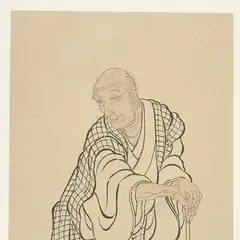
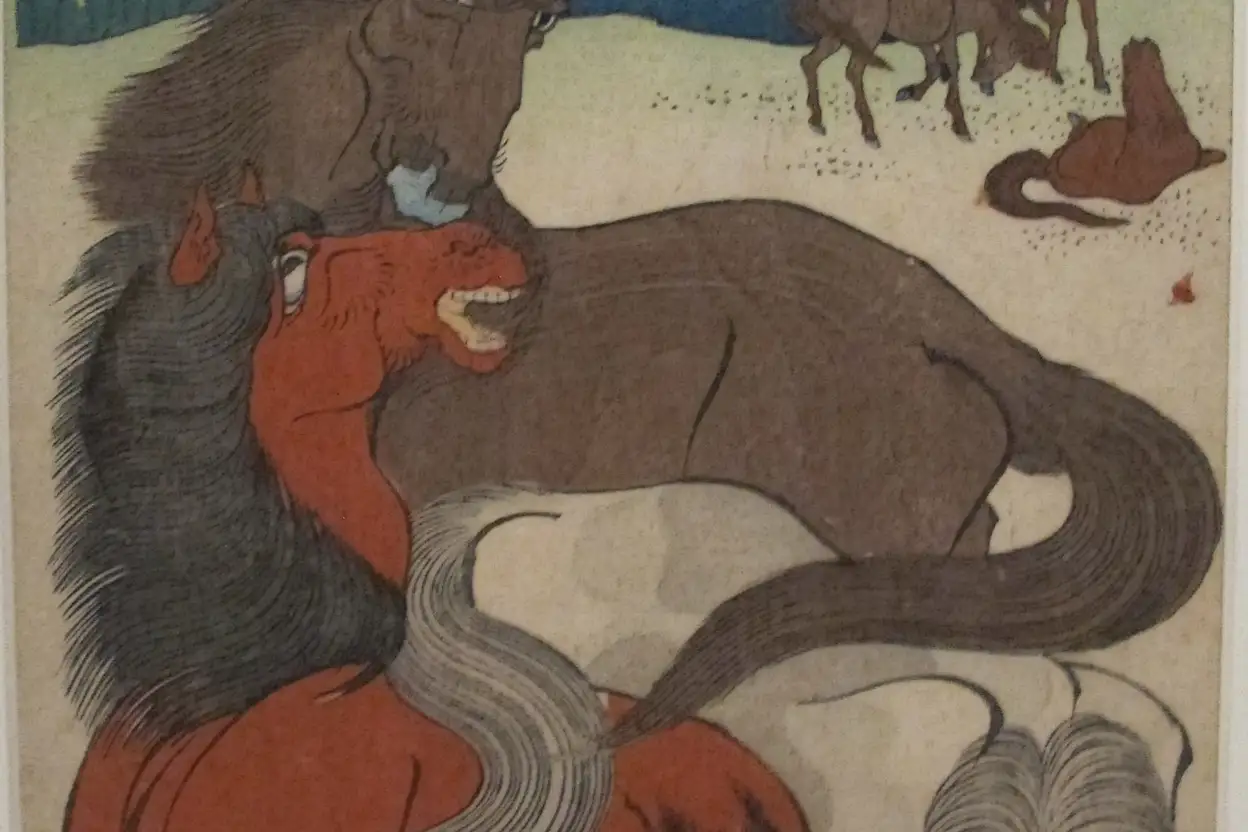
The fifth exhibition of Japanese prints, organized at the Pavillon de Marsan by the Union Centrale des Arts Décoratifs in January, aimed to present the complete works of Hokusai, an artist whose name is familiar even to those not specifically interested in Japanese art, to the general public.
Much has already been written about this artist, and we are far from the time when Théodore Duret could say, in 1882: "If we seek to know the man, we find only very meager documents." On the contrary, numerous and precise documents have emerged; and, a rare occurrence for Japanese documents, they are not contradictory.
Thanks to works like Goncourt's famous "Hokusai," to books like Michel Revon's thesis defended at the Sorbonne in 1898, and to studies like the one published by C. J. Holmes, we can form a precise idea of the life of a Japanese artist at the beginning of the 20th century.
Hokusai's Early Years and Training
Katsushika Hokusai, who received the given name Tokitaro, was born in Yedo, in the Hondjô district, in the autumn of 1760. His family was of very modest means. His father was Nakajima Icé, a metal mirror maker, one of those artisan artists whose works were appreciated, but whose personality was scorned by the proud samurai caste.
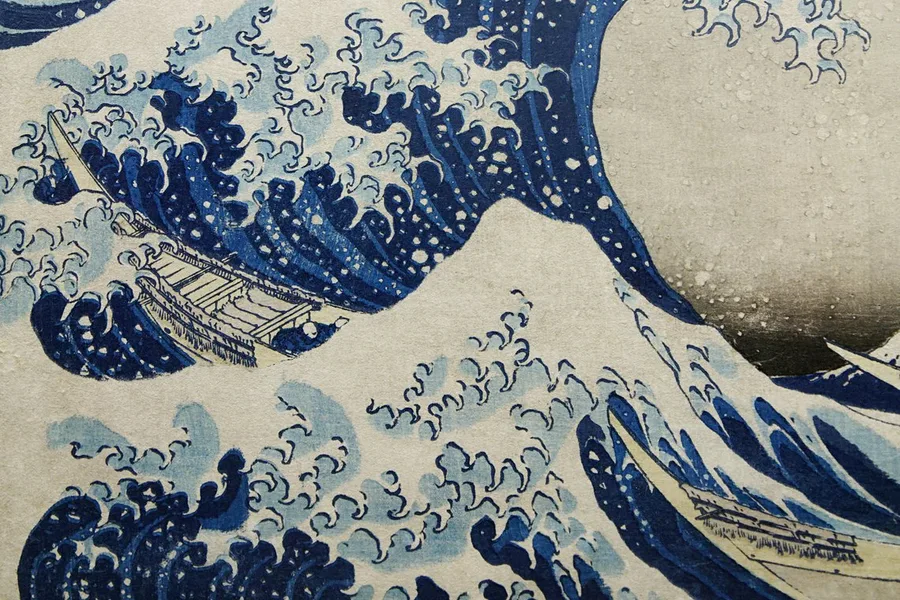
Very early on, Hokusai entered as an apprentice with an engraver, others say with a book lender, where he would have acquired a taste for images. Whatever the case, it is certain that the vocation that would make him famous revealed itself in him from his youngest years.
At 18, he abandoned the engraver's trade and entered the studio of Katsukawa Shunsho, a celebrated printmaker, whose actor portraits were featured in the second exhibition of Japanese prints at the Pavillon de Marsan. After a short time, his master, to show his satisfaction, authorized him, following the custom of Japanese painters, to take one of the characters from his own name to form his brush name, and it was then that Hokusai signed Shunro.
The Exhibition of Decorative Arts showed us some prints from this period, mainly actor portraits, signed Shunro, where, through the traditional type of Shunsho's actor, one could already discern the painter's personality in a greater fluidity of lines.
Break and Quest for New Styles
He remained in this master's studio until 1784, when, after learning all of Shunsho's techniques, he decided to study the classical and traditional Kano style. His irritated master expelled him from the studio, forbidding him henceforth to claim the name Katsukawa.
It was then that the young painter took the name Kusamura Shunro and announced to the public that the painter who signed thus belonged to no school. Shortly after, he adopted the name Sôri, out of admiration for a famous painter of the Tosa school who bore that name, and for some time he signed Sori, compositions generally in the Tosa style.
At this time, despite his ardor for work and although his drawings were already very personal, he could not earn enough to feed himself and had to become a red pepper merchant. He lived miserably until the day someone asked him for an image for a flag, which was paid two gold écus. This windfall gave the artist courage, and he returned to work with fervor.
From this moment date his first surimonos, in width. Surimonos were compositions generally of a nobler or more precious style than ordinary prints, produced with extreme refinements and printing feats; they served to commemorate a happy event, to make an invitation, to send on New Year's Day, etc. The first known surimono is dated 1793 and signed Kusamura Shunro.
At this period of his life, Hokusai sought to learn from all sides, consulting various masters, never satisfied with what he knew, always eager to learn something new. He changed his name several more times. In 1799 he adopted that of Hokusai Shiunsé which, mutilated, would remain definitively his, after he had also called himself Raïto, Raïshiun, Taïto, and Tokitaro Kako.
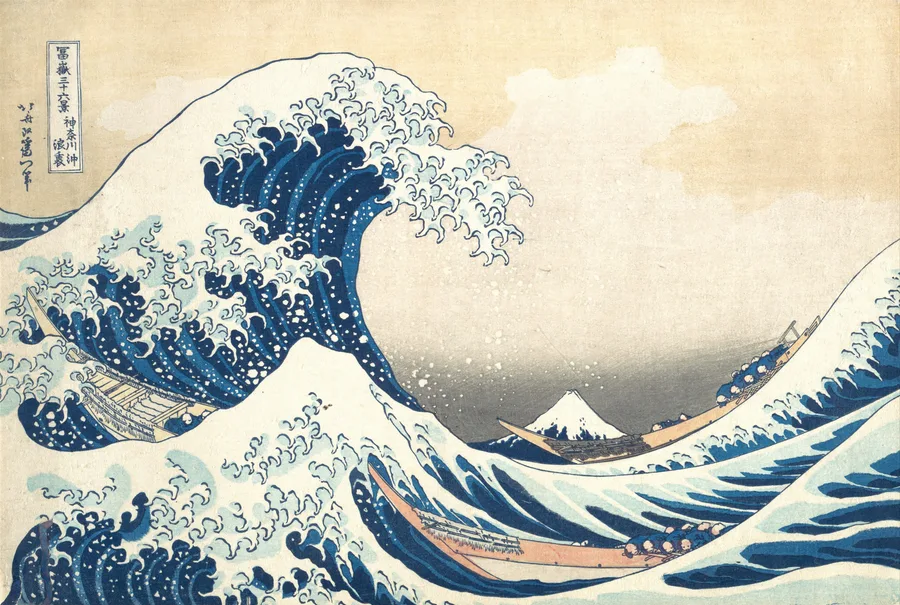
The Master's Ascent and Recognition
In 1804, Hokusai, on the occasion of the festival of the goddess Kwannon celebrated at the Gokokudji temple, painted a gigantic figure of Dharma on a giant sheet of paper, 200 square meters, using a broom dipped in a barrel of India ink; some time later he painted a monstrous horse in his Hondjo district and, near the Ekoïnn temple, he traced the colossal figure of one of the gods of Happiness, the stout Hoteï.
His fame grew day by day; word of his exploits reached the Shogun, who summoned him to request him to perform one of these feats before him. Hokusai, undaunted by the signal favor of being called, a man of the people, to the Shogun, spread a large sheet of paper on the ground on which he quickly traced some blue lines, then, opening a cage he had brought, he took out a rooster, whose feet he dipped in red color.
Placing the animal on the sheet of paper, he let it walk there for a moment, thus depicting, with the red imprints of its feet, maple leaves, reddened by autumn, carried away in the blue currents of the Tatsuta River.
In 1807, his collaboration with Bakin, the famous Japanese novelist, began, and with it, the great friendship that would unite them, a friendship often stormy where quarrels succeeded reconciliations. It is curious to note that these two great artists, despite their desire to collaborate and despite the intellectual sympathy that drew them to each other, had, during the five years their relationship lasted, continuous subjects of discord, which seem quite childish from a European point of view.
Shortly after, Hokusai abandoned his name Taïto to one of his disciples, Kaméya Saburo, who later tried to abuse it and, having settled in Osaka, attempted to pass himself off as Hokusai in person; his deception was, unfortunately for him, discovered, and he only succeeded in being called "Inu Hokusai," Hokusai's dog. This anecdote is reported in a letter from Hokusai himself, where he complains: "They say the true Hokusai is dead, but I know very well that I will live until I am a hundred years old."
The Manga and Study Travels
In 1813, Hokusai embarked on a journey and settled for six months in Nagoya, in Owari province, with one of his admirers, the painter Bokusen. He then painted another colossal Dharma, a worthy rival to the one he had painted a few years earlier in Yedo.
But he was to bring back something else from Nagoya than this ephemeral glory consecrated by popular enthusiasm. It was indeed in this city that he began to work on the first volume of his masterpiece: the Manga, the beginning of a series of 15 volumes, whose successive publications spanned his entire life; the fourteenth and fifteenth even appearing after his death.
Some European works give 1810 as the date of appearance of this first volume, others 1814. But the preface to this first volume, written by Hanshu, clearly indicates that the volume was composed in Nagoya, at Bokusen's; furthermore, the date of the trip to Nagoya is given to us by the dated publication of a small booklet that had appeared on the occasion of the painting of the colossal Dharma, which we mentioned above. It therefore seems infinitely probable that the authentic date is 1813.
In 1818, he resumed his travels, traversing the ancient province of Isé, that of Kii, passing through Osaka, to finally arrive in Kioto, the ancient capital of old Japan, preserver of classical art in all its forms. All these journeys were for him study trips, where everything interested him. Numerous notes in the volumes he published attest to this.
He stayed for some time in Kioto, then returned to his hometown, Yedo, and continued to work with tireless ardor. In 1828 — he was then 68 years old — he suffered an attack followed by paralysis which fortunately lasted only a short time.
We then find a precise date only for a stay, in 1831 or 1832, in Shinano, with one of his pupils, Sankuro, a wealthy sake manufacturer, very learned and who would have been captivated by Hokusai's prodigious genius during the latter's passage through Kioto. Hokusai stayed with him for an entire year.
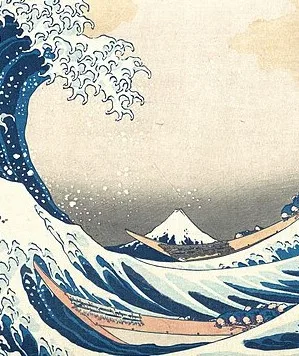
The Final Years: Resilience and Creation
He then returned to Yedo; it was then that he took the name Maniji (the old man of ten thousand years) with which he signed several works. In 1834 or 1835, he abruptly left the capital and took refuge in Uraga, in Sagami province. The reason for this flight is unknown; but it is certain that he was hiding under a false name, secretly coming to Yedo when he was obliged to.
His return to Yedo in the autumn of 1838 coincided with a famine, famous in the annals of Japan. Hokusai found neither publisher nor bookseller; he set to work with incredible ardor, which can be bewildering when one considers that he was seventy-eight years old at the time. But he needed money to eat, and thus, by selling his works at ridiculous prices, he managed not to starve.
Barely out of this difficult ordeal, at the age of seventy-nine, he was struck again by another scourge, fire. His house burned down in one of the innumerable fires that perpetually devastated Yedo and against which no other means of protection had been found than stone walls, separating the piles of old wooden and paper houses, easy prey for the flames, into districts.
He fled in haste with his daughter Oyei, taking only his brushes and losing in the fire heaps of studies he had kept since his youth. According to an eyewitness whose account is reported by M. Revon:
"As he no longer had any working tools, he broke a bottle found in the rubble, using the bottom as a cup to wash his brushes, the shards as a saucer for colors, rented a house on credit, and quickly consoled himself for his misery by furiously throwing himself back into his art."
We also borrow from M. Revon this description of Hokusai's studio, made from a drawing seen in Japan and the testimonies of various contemporaries.
"If you want to understand what his existence was like then, this laborious artist's life he had led in his youth and which his old age only made more ardent each day, come with us into his studio. In the middle of his room, a square brazier sunk into the floor where a few poor lumps of charcoal glow; the old man, leaning against this miserable hearth, a bedspread over his shoulders, remains bent over the small table where he draws. (In his youth he did not even own a table and worked on an overturned rice box.) All around, empty charcoal bags, bamboo cages that contained cakes, large dry leaves that served to wrap portions of rice and fish brought from the nearest restaurant, in short, in the opinion of his contemporaries, the appearance of a storage cabinet or a garbage corner... His daughter Oyei works with him, sitting near a column where you can see in a suspended orange box a statuette of Nichiren, the patron saint of the great Buddhist sect to which father and daughter belong. Elsewhere against a door, a sign informs you that 'Miuraga Hachiemon (the name Hokusai bore during his retreat in Uraga) refuses to draw fans as well as student models.'"
His extreme poverty certainly stemmed in part from the low prices paid for his works by Japanese publishers. He took a certain vanity from this poverty, and it is also to this disdain for the rich and powerful that the great misery in which he ended his life can be attributed.
A sign hung in his studio warned visitors: "No need to bow to me, no need to bring me gifts." When a commissioned work did not please him, for one reason or another, no power in the world, neither that of gold nor that of the Shogun, could have forced him to execute it.
He continued to live in Yedo until his death. One last time in 1848 he moved; for it is another characteristic trait to note in him, this perpetual need to move: he managed to move ninety-three times in a life of eighty-nine years. It was claimed that he preferred to move rather than clean his house.
On the occasion of this last change, the poet Baïgen, his friend, addressed him this short poem: "Your habit of moving is incurable; so move a hundred or two hundred more times, for when you no longer move, it means you are no longer alive."
In the spring of 1849, Hokusai fell ill, and doctors remained powerless to cure this 89-year-old man. He was greatly surrounded by all his pupils and friends who came to see him every day. His daughter Oyei was at his bedside. He bitterly regretted life and exclaimed: "If heaven would grant me ten more years... just five more years of life, I could become a truly great painter!" He died on May 10, 1849, and was buried at the Seikioji monastery, in the Hondjo district, and on his tomb these words were engraved by the priests of the monastery: "Hokusai, famous original, sincere man."