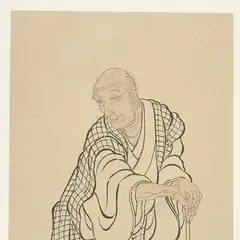
Keisai Yeisen stands as the principal emulator Hokusai had in the representation of popular types and humorous scenes. As early as 1808, he had published a volume full of little figures dashed quickly onto the paper, and it is not impossible that Hokusai took from this the idea for his Manga. In 1809 and the following years, Keisai published his Rigaku Gashiki in three volumes.
This publication is a triumph of impressionism. The men, animals, and plants depicted within are reduced to their simplest expression. One sees groups in motion, such as bonzes (Buddhist monks) in procession or soldiers on the march, where each individual is represented by a single, twisting brushstroke. At first glance, such a book has something of a childlike quality, but the few lines traced on the paper succeed so well in rendering the unique movement and characteristic attitude of each being that, beneath the apparent simplicity, one quickly comes to feel the master's hand and the difficulty he has overcome. From the same period, we also have from Keisai a color album of fish, beautifully drawn, and another of landscapes and views in the same impressionistic style, also in color.
Hokusai's School and Successors
When we turn to Hokusai's students, we find ourselves facing a whole band of artists. The number of just the "Hoku"—that is, those pupils who borrowed the first character of their master's name to identify themselves—is considerable, probably ten or twelve. Among them, Hokkei (an elision of Hokukei) unquestionably holds the first rank, as much for his talent as for the number and importance of his works.
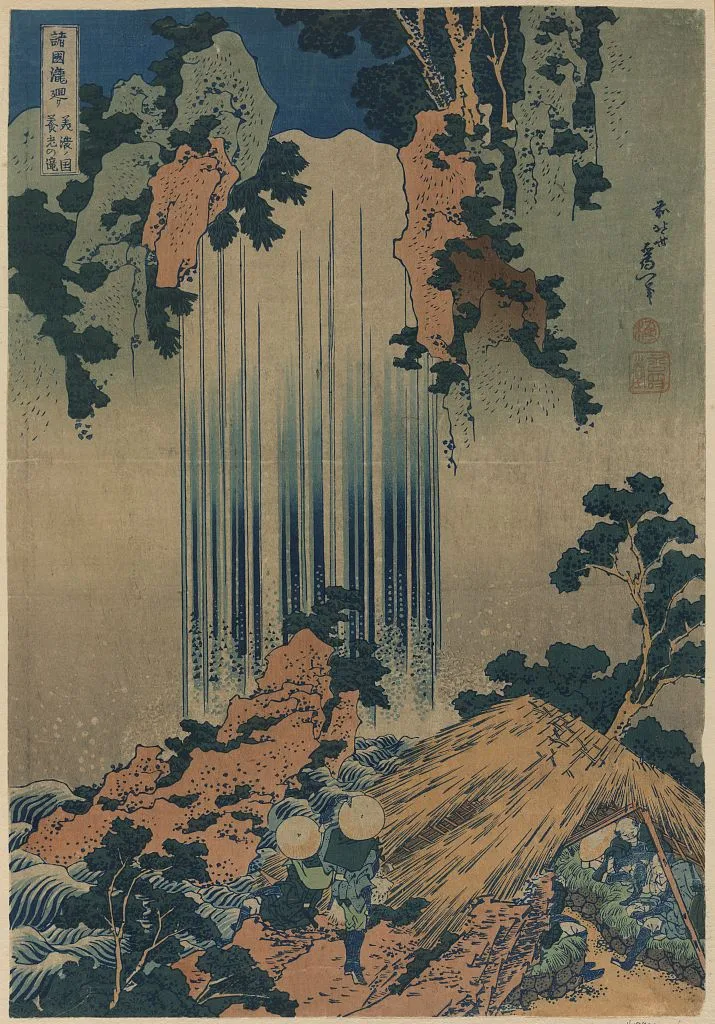
While following Hokusai's style very closely, Hokkei managed to develop an individual character. Less nervous and robust than his master, he possesses more grace and feminine charm. He appears to have been most productive around 1840. At that time, the art of color printing had reached its full perfection. Consequently, Hokkei's color-printed books and his small compositions on loose sheets, intended for the collections of artists or friends, are among the most delicate and exquisite things the art of printing has produced in Japan. Among Hokkei's books, we have a volume of genre scenes in the style of the Manga and the story of the one hundred and eight Chinese rebels, in three illustrated color volumes, among others.
This art of delicate impressions was maintained in Japan in a state of great perfection until recent times, when it was extinguished abruptly and irrevocably. From a year as recent as 1867, we have an album of silhouettes by Koua-Setsu that is, in its genre, a masterpiece. The silhouettes, printed in solid black, form a series of astonishingly lifelike portraits which, judging by the distinct character of each, must have been excellent likenesses. On each page, they are enhanced by a band of arabesques and an illustrated header, printed in color. This album was reportedly composed by Koua-Setsu for distribution to the people whose portraits it contains—mostly poets or artists who formed a sort of fraternity or society of friends.
We will not dwell on Hokumei, Hokkun, Hokuyei, Isai, and other students of Hokusai, to whom we owe various books, whether collections in the style of the Manga or illustrations for novels and histories. Let us simply mention in passing a few artists who, without being as closely tied to Hokusai as his direct pupils, are more or less dependent on the movement he initiated. These include Fukagenza, to whom we owe the Ippitsu Gafu (1 volume, 1835), in which the depicted figures and animals are formed from a single continuous line, traced by the artist without lifting the brush until the image is complete. There is also Bumpo, who, in his Kangua, represented a multitude of humorous scenes on a minuscule scale; Bokusen, who, around 1840, published a volume of figures in the most grotesque and comical poses; and Matsugawa-Hanzan, who left a collection of varied scenes in the genre of the Manga.