No one was better placed than M. Eugène Dutuit to write his Manuel de l'amateur d'estampes (A Handbook for the Print Collector).¹ The print collection of the celebrated Rouen amateur is known throughout the world. To assemble it required no less than forty years of searching; I will not speak of the financial sacrifices, as they add nothing to the collector's merit, although one is sometimes entitled to take pride in one's skill when it comes to acquisitions. Not all wealthy people who are consumed by a passion for paintings, engravings, or curios are equally suited to establishing a true cabinet d'amateur (collector's cabinet).
Beyond knowledge and taste, one must also possess the art of loosening one's purse strings at the opportune moment; that particular art is not within everyone's reach. M. Dutuit's record includes a number of truly heroic bids; I will cite only one. Not long ago, he was seen to throw down thirty-odd thousand-franc notes for a proof of Rembrandt's Piece with a Hundred Florins (The Hundred Guilder Print)!
The Work's Structure and Focus
The two currently published volumes of the Manuel de l'amateur d'estampes will constitute Volumes IV and V of the complete work. The author no doubt intends to later dedicate the first three volumes to the schools of the Latin countries. He has preferred to deal immediately with the Flemish and Dutch artists, who at once provided him with an ample harvest of famous works. These two volumes are not even sufficient to contain them all; a third is announced and will appear shortly.
In each of these volumes, the small army of engravers admitted for review is grouped around a great leader: here, it is Van Dyck who commands; there, it is Rembrandt; in the supplementary volume, it will be Rubens. One will note, in passing, that the honors of command are bestowed upon three artists who, outside of engraving, managed to acquire a certain reputation. One of them, if not two, might even feel that the prints attributed to his inspiration, if not his execution, add little to his glory. But M. Dutuit doubtless wished to demonstrate that the schools of engraving were formed under the direction of great painters; in this, he was perfectly right.
Method and Curation
M. Dutuit is not one of those who try to endow their work with an easy originality by deliberately confounding the similar works of their predecessors. He has bravely followed in the footsteps of Bartsch, Weigel, and Passavant, and his entire ambition is to be the successor to these distinguished iconographers. To simplify research and comparisons, he has adopted the catalog numbers they used in their nomenclatures; as for the artists' names, they are presented in alphabetical order. We strongly approve of this method—it simplifies matters and, in short, clearly highlights the innovations and discoveries attributable to the author, while respecting the work of those who came before him.
In the work we are discussing, however, one will not find all the names that appear in the Peintre-Graveur of Bartsch and his successors. M. Dutuit has rightly rejected a certain number of engravers who have fallen into a just oblivion. On the other hand, he has included others whom one was surprised not to find there: Van Dyck, de Frey, and van Goyen, to look no further than the first volume.
The author does not, moreover, claim to be publishing a universal collection of the works of engraving. Despite the importance of his work, it should be seen only as a handbook in which the study of the most excellent engravers has been given a place, especially those who have long enjoyed public favor. The task is nonetheless considerable, for the number of these favorites among print lovers has grown significantly over the past twenty years. The Gazette des Beaux-Arts knows something of this, having itself christened into celebrity certain unrecognized or forgotten masters.
In the first two volumes, dedicated to the Dutch and Flemish schools, M. Dutuit includes about eighty artists. A list of their names will not be useless, if only to inform us of the preferences of such an enlightened connoisseur.
Contents of the First Two Volumes
Volume I
The first volume covers the following artists: J. van Aken, J. Almeloveen, L. Bakhuisen, C. Bega, N. Berghem, G. Bleker, A. Blooteling, P. Boel, F. Bol, H. Bol, B. Bolswert, S. Bolswert, A. Both, J. Both, P. Bout, B. Breenberg, P. Breughel, Brosterhuisen, Th. de Bry, N. de Bruyn, M. de Bye, Claessens, A. Cuyp, C. van Dalen, A. Diepenbeeck, J. van der Does, A. Duhameel, K. Dujardin, C. Dusart, A. van Dyck, A. van Everdingen, J. de Frey, J. Fyt, Galle the Elder, Galle the Younger, J. de Ghein, H. Goltzius, H. Goudt, and J. van Goyen.
This volume is illustrated with nine etchings:
- A Seascape by Bakhuisen
- The Three Cows at Rest and The Bagpiper by Berghem
- Bust of an Old Man by F. Bol
- Single Cow and Herd of Cows by van Dalen
- The Stream Crossing a Wood by Everdingen
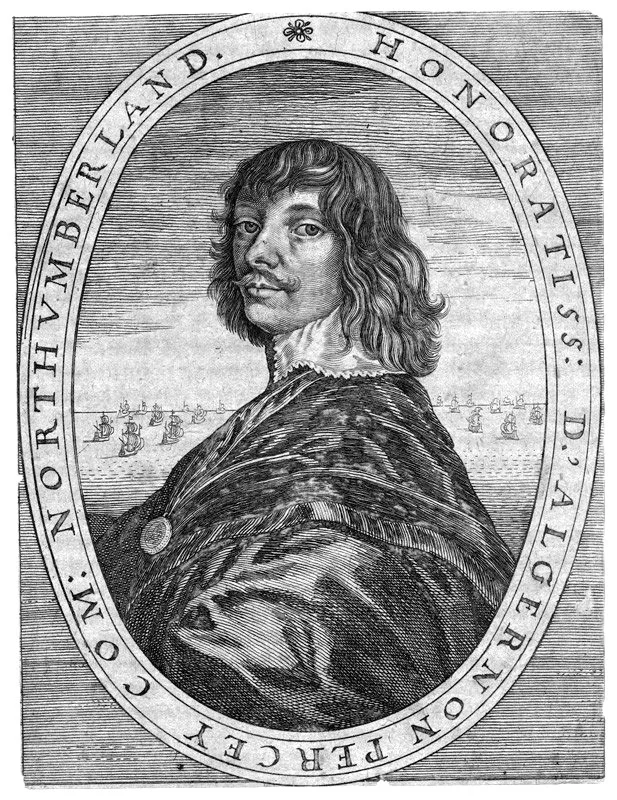
- Van Dyck's self-portrait, of which we provide a typographic reproduction in this letter
- The superb portrait of Antoine Cornelissen, finished by L. Vorsterman based on the drawing and under the direction of the master.
It is worth recalling that the original plate for the Cornelissen portrait is held at the Chalcographie du Louvre (the Louvre's printmaking department). As is known, the museum acquired Van Dyck's Iconography in 1851, comprising 124 plates of portraits of artists and famous figures, twelve of which were engraved by Van Dyck himself. The copper plates were purchased from M. Van Marke, a print dealer in Liège, for the total sum of 2,500 francs. Although they have undergone many printings, one can still pull passable proofs from them, which are offered to the public at the most modest prices (from 2 to 5 francs each).
Volume II
The second volume features: Hackaert, Haeften, van den Hecke, G. de Heusch, A. Hondius, R. de Hooge, J. van Huchtenburg, P.-V.-H. and Jonkheer, P. de Jode, S. Koninck, P. de Laer, N. Lauwers, J. Le Ducq, L. de Leyde, J. Lievens, several anonymous masters and masters with monograms, J. Marinus, J. Martss de Jonge, Meer de Jonge, J. Miele, C. de Moor, H. Naiwjnck, G. Neyts, J. van Nikkelen, P. Nolpe, J. van Noordt, J. van Ossenbeeck, A. van Ostade, P. Pontius, P. Potter, A. Pinacker, and E. Quellinus. Finally, it includes Rembrandt, whose prints occupy nearly half of this volume.
We note twelve full-page plates (hors texte) in this volume:
- View of Rome from the Colosseum by P. de Laer
- Rustic Tenderness by A. van Ostade, of which a very faithful heliogravure reproduction can be seen here
- From the same master, A Painter and The Violin and the Little Hurdy-Gurdy Player
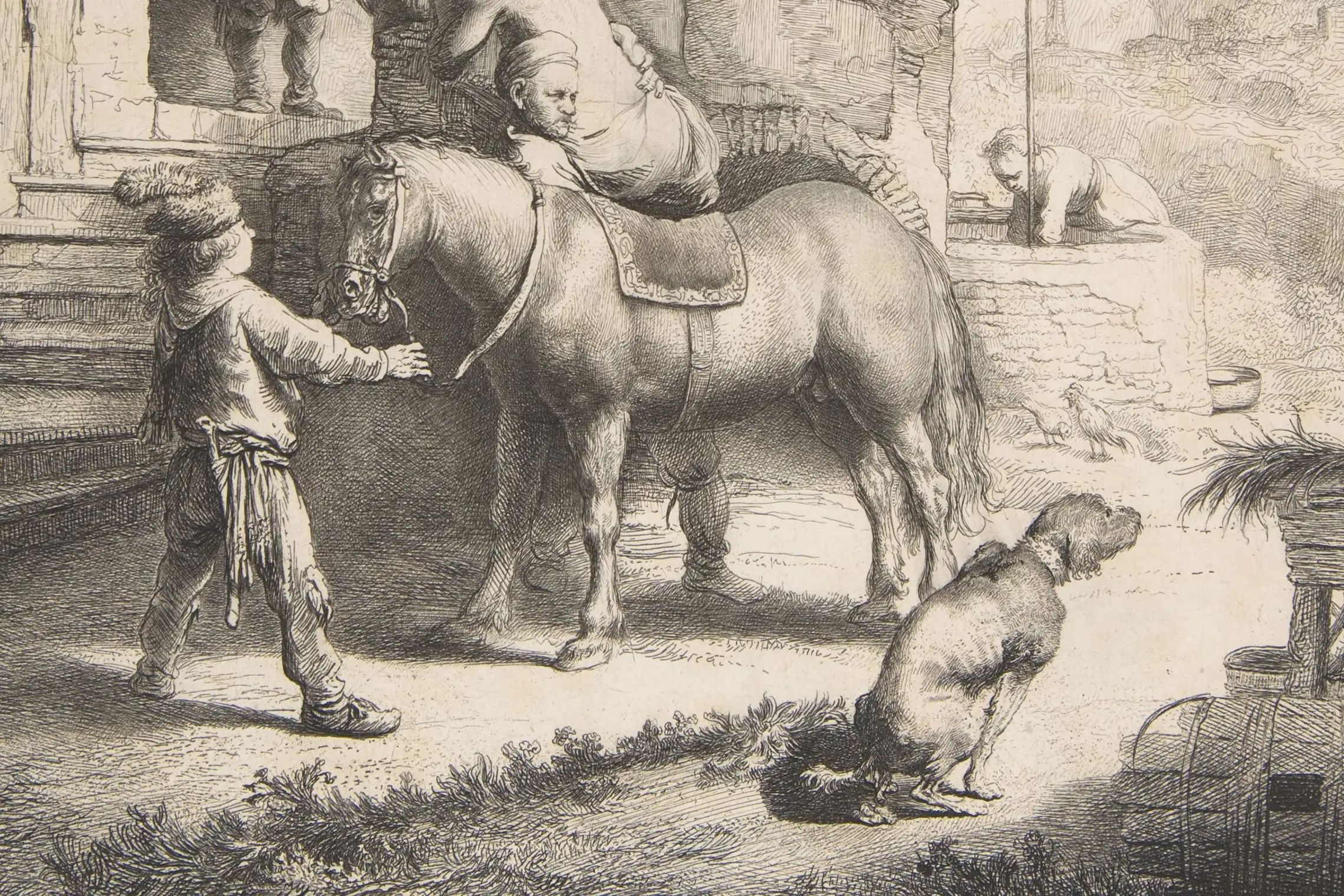
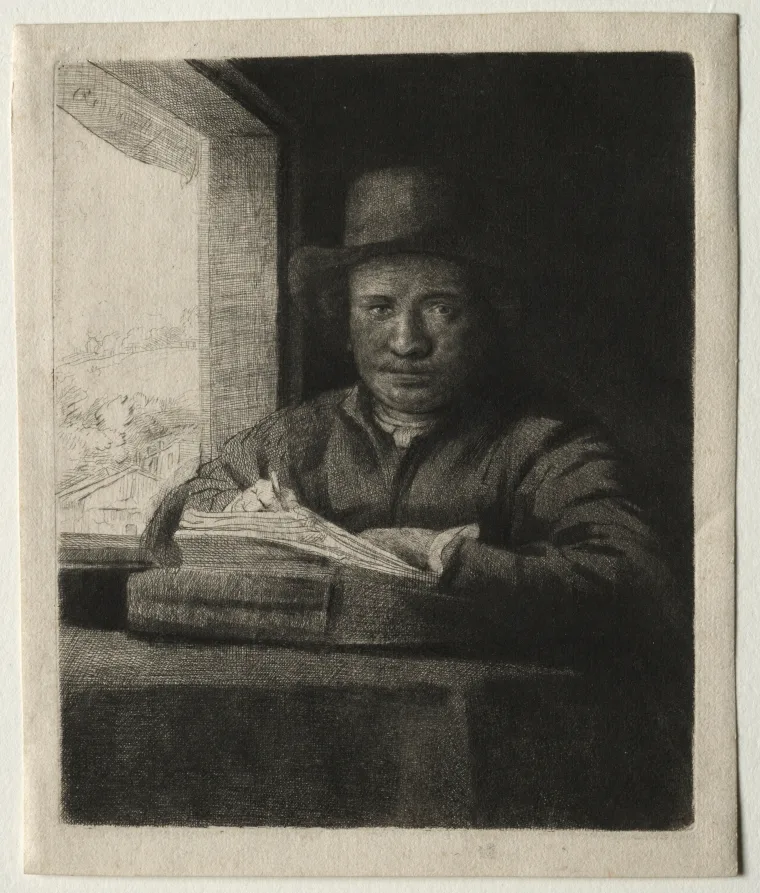
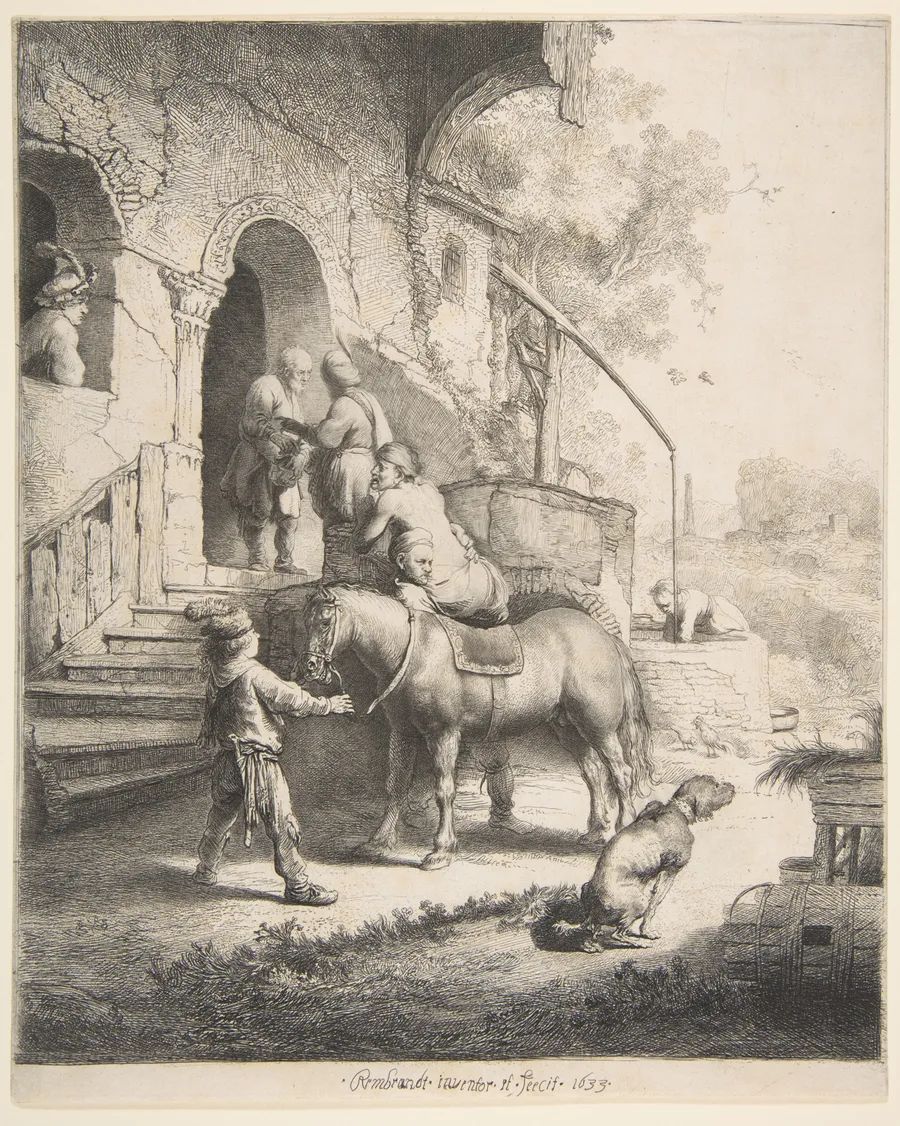
- From Rembrandt, we have nine excellent facsimiles: the celebrated Self-Portrait in a Cap, with a Feather; Joseph Telling His Dreams (a reproduction of this plate was published in the Gazette, vol. XI, 2nd period, page 468); The Virgin and Child in the Clouds; Christ Preaching (or La Petite Tombe); Three Beggars at the Door of a House; the famous Landscape with Three Gabled Cottages; Jacob Haaring (known as the Old Haaring); Clément de Jonghe, the Printseller; and the Great Jewish Bride.
Editorial Quality and Production
The editorial method employed by M. Dutuit is the one generally adopted today in the creation of catalogues. The work of each master is described meticulously through all the known states of the prints that comprise it. Sales prices are given with an indication of the collections from which the sold proofs originated; amateurs will appreciate the importance of this information as it deserves.
The publisher, M. Lévy, has done this excellent work the honor it was due by producing it with the greatest care. In terms of typographic layout, printing, and paper quality, the Manuel de l'amateur d'estampes is an irreproachable book. It may serve as a model for all future works of this nature.
ALFRED DE LOSTALOT.