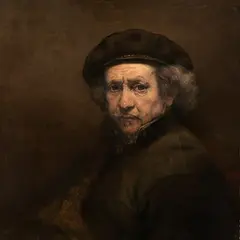
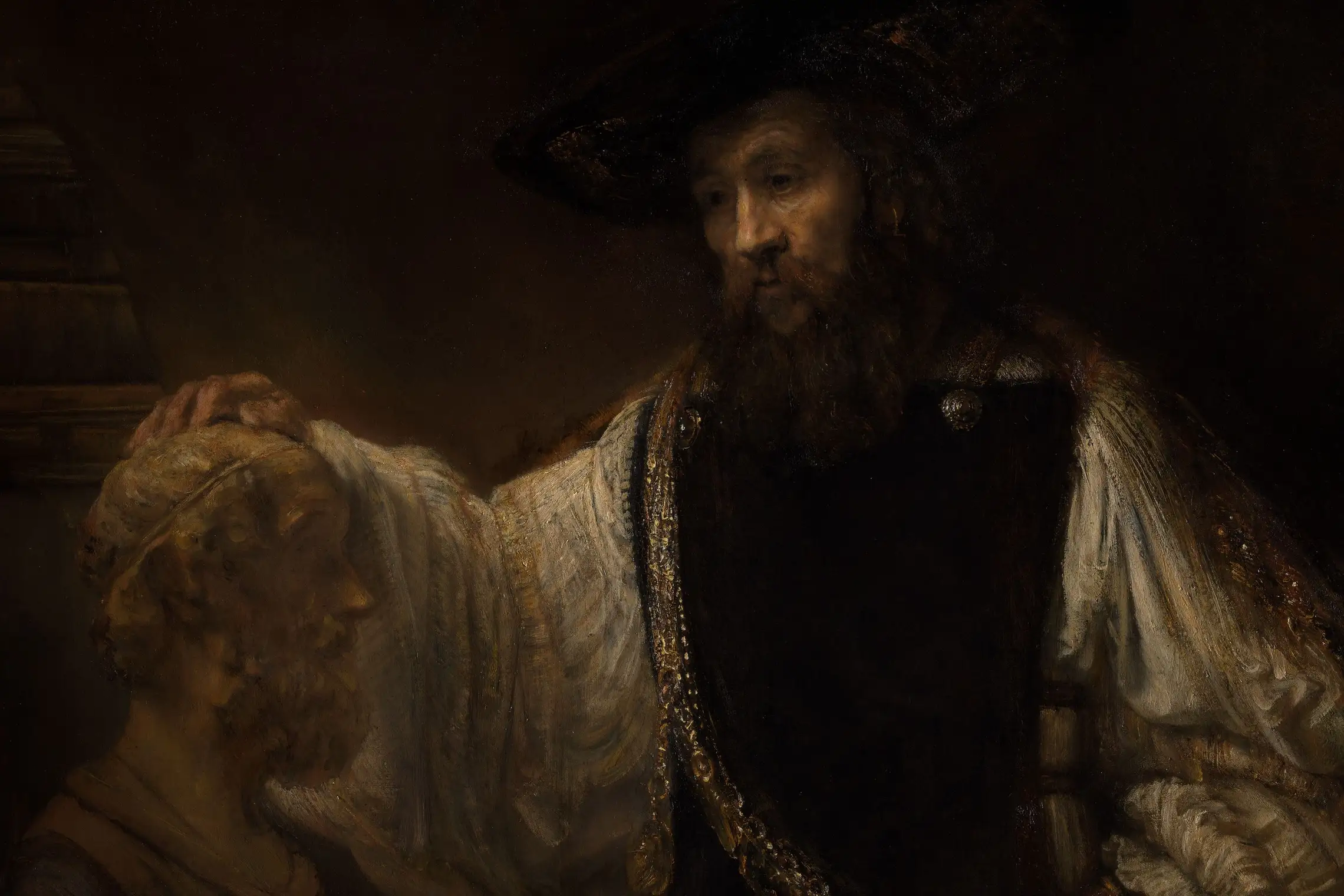

In publishing the notes I have been collecting for many years on the studies Rembrandt made after the Italian masters, I must first dispel a suspicion and preempt an objection. This is not the work of an "Italianizer" seeking to diminish the glory of the most independent representative of the Northern Schools. Rather, it is that of an inquisitive observer who, without bias, points out connections, noting and recording encounters—encounters, let us not forget, that belong to Rembrandt's mature age, not his adolescence. My sole concern is to complete, with a few details that have mostly escaped the master's biographers, the portrait of that dual nature so well defined by Fromentin: "the outer man, a clear but rigorous, logical, infallible mind, and then the romantic genius we know."
Rembrandt's Collection of Italian and Antique Art
For the sake of clarity, this essay will be divided into two parts. In the first, I will review the collections of antique sculptures, as well as Italian paintings, drawings, and engravings, that Rembrandt assembled. In the second, I will study the influence these same models exerted on his ideas and his style.
Before proceeding, it is important to note that Rembrandt's principal master, Pieter Lastman, was one of the leading champions of what is known as Italianism. He had spent an extended period in Rome and championed classical reminiscences against the realism that was then beginning to dominate Dutch painting, largely through the efforts of the great Frans Hals. A whole series of Rembrandt's works, among them The Ruin at the Museum of Cassel, betrays the influence of Lastman's lessons. In this painting, Mr. Émile Michel points out the rocks piled up one behind the other, the river with two swans swimming on it, and the classical ruin at the top of the hill. Rembrandt, however, would soon turn directly to the models of antiquity and the Italian Renaissance himself.
The inventory drawn up in 1656, at the time of the seizure of the unfortunate artist's belongings, mentions a considerable selection of antique statues and busts, some in marble, others in plaster casts. Among the statues, I will note those of Augustus, Tiberius, the "emperor" Agrippa (as the inventory calls him), and Aurelian, as well as a statue of an Empress, a statue of Cupid, a plaster cast of an ancient Greek figure, a Sibyl, and a Laocoön. The series of busts of the Caesars was complete or nearly so: Caligula, Nero, Galba, Otho, Vitellius, Vespasian, Titus, and Domitian were interspersed with Homer, Socrates, Aristotle, Seneca, Silius, Brutus, Faustina, a satyr's head, and a few other statues or busts without specific designation.
The antique series was completed by the almost complete works of Heemskerck, the Dutch artist who documented most of the monuments of Rome,1 a volume of drawings of Roman buildings and views, and finally a small chest containing medals.
Among the masters of the Italian Renaissance, Andrea Mantegna led the way with a volume described as precious, likely a collection of drawings ("Kostelycke Boeck van André de Montaine," or Precious Book of Andrea Mantegna). We will soon see that Rembrandt did not disdain to reproduce some of its pieces, notably the Calumny of Apelles, which entered the British Museum along with his copy. Of Michelangelo, Rembrandt owned a portfolio of engravings and also a small Child (whether marble or a cast is unclear). Of Raphael, he had a head ("een tronie"), about which the inventory unfortunately offers no further details, as well as four portfolios filled with engravings. Finally, he possessed a volume containing licentious subjects after Raphael himself, as well as Rosso Fiorentino, Annibale Carracci, and Giulio Bonasone.
The Venetians were represented by a large portfolio containing the almost complete works of Titian, a collection of portraits after the same master, a painting by Palma Vecchio (The Parable of the Rich Man), and another by Giorgione (The Good Samaritan). Rembrandt had not forgotten the Italians of his own time; he had filled three portfolios with engravings after Antonio Tempesta, and another with engravings after the Carracci, Guido Reni, and Jusepe de Ribera (known as "Lo Spagnoletto," or the Little Spaniard).