
Han van Meegeren and the end of pure connoisseurship
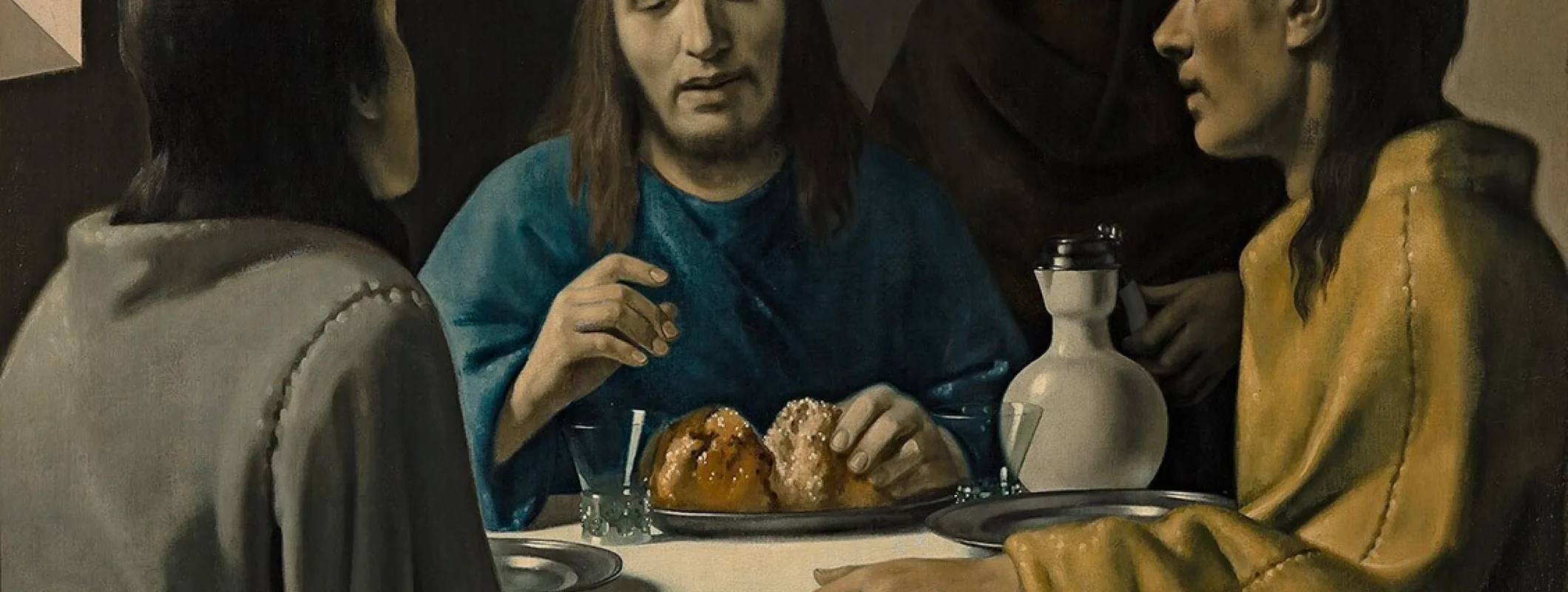
In 1937, a Dutch painting appeared in Rotterdam that would change the course of art authentication. Presented as a newly discovered work by Johannes Vermeer — a large religious composition titled Supper at Emmaus — it was examined by Abraham Bredius, then the world's leading authority on seventeenth-century Dutch painting. Bredius declared it "the masterpiece of Johannes Vermeer" and the most important Dutch discovery of the century. The Museum Boijmans Van Beuningen in Rotterdam paid 520,000 guilders for it. It was displayed with pride for seven years.
The work had been painted by Henricus Antonius van Meegeren (1889–1947), a technically accomplished but critically unsuccessful Dutch artist who had spent years perfecting the chemistry of historical forgery. His method was the product of serious material research: he used genuine seventeenth-century canvas (cut from authentic but minor period paintings), ground his own pigments from materials consistent with period practice, mixed them in linseed oil aged with Bakelite resin to achieve the hardness of centuries-old paint, and baked the finished paintings in an oven to produce authentic craquelure. He also incorporated the lead-white ground and the characteristic lapus-lazuli ultramarine of genuine Vermeers.
Van Meegeren's forgeries succeeded for a decade not because Bredius and his contemporaries were incompetent, but because they were working with a fundamentally limited method. Visual connoisseurship — the comparison of stylistic features between a questioned work and accepted comparanda — can identify inconsistencies, but it cannot determine whether the materials in front of the examiner are of the period claimed. When the materials are genuinely old and the execution is technically consistent, connoisseurship has no purchase.
The exposure: polonium-210 and the chemistry of deception
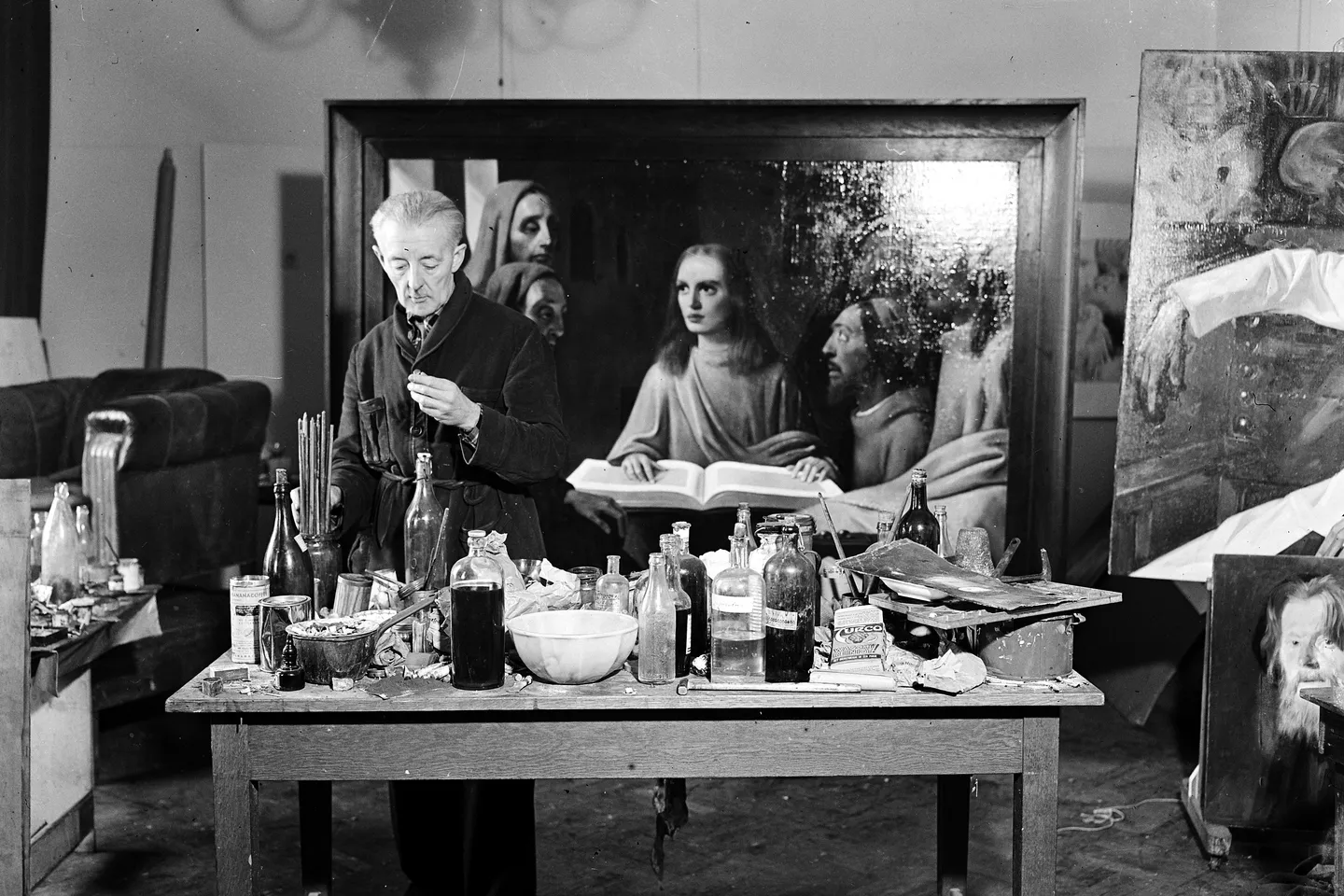
The exposure of Van Meegeren's forgeries came not through art historical research but through a war crimes investigation. After the liberation of the Netherlands in 1945, Allied investigators discovered that Van Meegeren had sold a 'Vermeer' — The Woman Taken in Adultery — to Hermann Göring for 1.65 million guilders. Van Meegeren was arrested for collaboration with the Nazi occupation through the sale of national cultural heritage. Faced with this charge, he made a remarkable defense: he claimed that he had not sold a national treasure to Göring, but had defrauded him with a modern forgery. To prove it, he offered to paint another 'Vermeer' in his prison cell, which he did.
The chemical confirmation came from a team of scientists including Paul Coremans of the Institut Royal du Patrimoine Artistique in Brussels. The key finding was the presence of polonium-210 and lead-210 in the lead-white pigment at a ratio inconsistent with paint of any great age. Polonium-210 is a decay product of lead-210, which is itself a decay product of radon. In freshly prepared lead white, the ratio of polonium to lead is near zero; over centuries, polonium builds up from the decay chain. Van Meegeren's relatively recent paint — made within the previous decade — had isotope ratios that could only indicate a paint age of under thirty years. No forger, however careful in his material research, had anticipated radiochemical analysis.
The Bakelite resin was a secondary confirmation. Phenol-formaldehyde resin, marketed as Bakelite from 1909, was not available in the seventeenth century. Its presence in the paint binder was an absolute anachronism that should have been detectable by chemical analysis at any point after its introduction. The failure to detect it before 1945 was a consequence of the absence of systematic scientific analysis in art market authentication — a gap the Van Meegeren affair permanently closed.
Van Meegeren was arrested for selling a Dutch masterpiece to a Nazi war criminal. His defense: he had defrauded Göring with a forgery. And he was telling the truth.
Elmyr de Hory and the dealer network problem
Elmyr de Hory (born Elemér Albert Hoffmann, 1906–1976) was a Hungarian-born artist who between the late 1940s and 1967 produced what is estimated at over 1,000 works in the styles of Picasso, Matisse, Modigliani, Renoir, and Dufy. Unlike Van Meegeren, who worked with historical period materials, de Hory worked almost entirely in the contemporary styles of living or recently deceased artists — which meant he did not need to fake aged materials. He worked quickly, often completing a 'Picasso' in a matter of hours, using genuine period paper or canvas obtained commercially.
De Hory's distribution network was his structural innovation. Rather than approaching major institutions directly, he worked through a chain of dealers — most importantly Fernand Legros and Réal Lessard — who sold to collectors in the United States, Europe, and South America. The dealer chain created a provenance fiction by default: each successive sale added a legitimate-seeming entry in the ownership history, and buyers who received works with a two- or three-link provenance chain had less reason to question authenticity. Many of his works eventually entered distinguished collections with references to reputable dealers who had themselves bought in good faith.
The Clifford Irving biography Fake! (1969), commissioned by de Hory from prison, remains the primary account of his method and is notable for its forensic detail. De Hory told Irving that major auction houses and gallery experts had examined his works and found them acceptable — and that the only reliable detection method was comparison with documented originals in person. He was partially right: without access to the physical originals and without scientific analysis of materials, his works were effectively undetectable. The de Hory affair established that authentication without scientific analysis was systematically vulnerable to anyone with sufficient technical skill and a functioning distribution network.
Wolfgang Beltracchi and the titanium white
Wolfgang Beltracchi (born 1951) operated the most commercially successful art forgery network of the twentieth century. Working with his wife Helene and two accomplices, he produced approximately 300 paintings over thirty years in the styles of Max Ernst, Heinrich Campendonk, Fernand Léger, and other early twentieth-century modernists. His estimated criminal proceeds were over 16 million euros.
Beltracchi's method was architecturally more sophisticated than de Hory's. He did not merely imitate style; he created entire provenance biographies for his works. He constructed fictional collector identities — most importantly the imaginary collection of Werner Jägers, a Cologne industrialist who had supposedly acquired works directly from the artists in the 1920s and 1930s. For photographic provenance, Helene Beltracchi posed in period costume before a painted backdrop and was photographed apparently in front of the 'Jägers collection' holdings. These photographs, artificially aged, were presented as family snapshots of a real collector — they were entirely fabricated.
The forgery network was exposed by a single material error. A 'Campendonk' titled Red Picture with Horses, sold for 2.9 million euros at Lempertz in 2006, was submitted for scientific analysis at the request of a subsequent buyer. Testing by the Doerner Institut in Munich found titanium white in the paint layer. Titanium white (titanium dioxide) was not in commercial use in artists' paint until 1921; the work was supposedly dated 1914. No paint analysis had been requested at the time of the Lempertz sale. The entire network unraveled from this one anachronistic pigment. Beltracchi was convicted in 2011 and sentenced to six years in prison.
The entire network — 300 paintings, 16 million euros, thirty years of fraud — unraveled from a single anachronistic pigment: titanium white in a 1914-dated canvas.
What the forgery crises established
The three cases collectively established principles that now define authentication best practice. First: visual connoisseurship alone is insufficient. Van Meegeren demonstrated that period-consistent material execution can satisfy the most authoritative eye. De Hory demonstrated that stylistic fluency without material analysis can circulate through the most reputable networks. Beltracchi demonstrated that documentary provenance can be fabricated in its entirety.
Second: no single scientific method is definitive. Van Meegeren's exposure required both isotope analysis and chemical identification of Bakelite. Beltracchi was caught by pigment anachronism, but his other canvases had passed XRF analysis and infrared reflectography. The only reliable detection is the combination of multiple independent methods — each method addressing a different aspect of the authentication question and each method capable of exposing what the others might miss.
Third: the authentication system is only as strong as its institutional independence. The experts who authenticated Van Meegeren's works had financial and reputational interests in confirming major discoveries. The dealers who circulated de Hory's works had commercial interests in efficient throughput. The auction houses that sold Beltracchi's works had incentives to accept provenance documentation at face value. Systematic authentication requires structures that separate the authenticating interest from the commercial interest — which is precisely what the twentieth-century authentication board system failed to do, and precisely why it collapsed.