The Dutch production explosion and the authentication problem
In the first half of the seventeenth century, the Dutch Republic produced between 70,000 and 100,000 paintings per decade. This figure, first systematically estimated by John Michael Montias and later refined by Neil de Marchi and Hans Van Miegroet, has no parallel in Western art history before or since. It was made possible by a structural transformation in the market: for the first time in Europe, paintings were produced speculatively without prior commission, for an anonymous buyer pool of merchants, craftsmen, and prosperous farmers.
The Italian and Flemish systems that preceded it had relied on the contratto — a binding commission document that specified materials, authorship ratios, and completion criteria before a brushstroke was laid. When a work was pre-contracted, its authenticity was guaranteed by the legal record of its making. The Dutch system abolished this mechanism. A painting sold at a Amsterdam fair or through a dealer's shop had no documentation of its origin. The buyer's only guarantee was the dealer's reputation and word.
This created what economic historians now call the "lemons problem" in its classical form: when buyers cannot verify quality, they are willing to pay only the average market price, which drives out high-quality goods, which lowers the average further. The early Dutch art market solved this problem not through certificates but through the physical reputation economy of dealers who staked their livelihood on the consistency of their attributions.
Sotheby's, Christie's, and the catalogue as certification
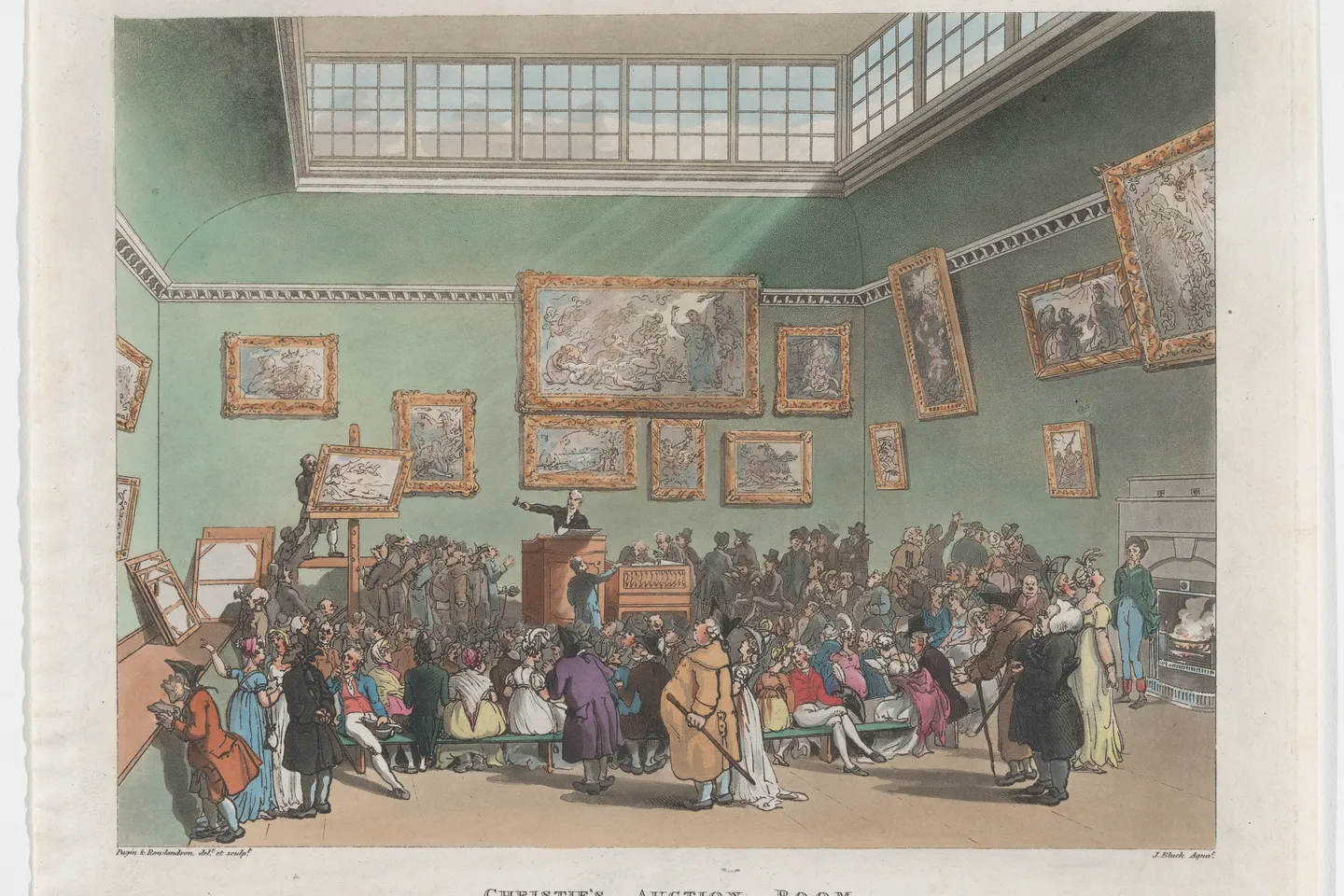
Samuel Baker held his first book auction in London in 1744; his successor George Leigh and Baker's nephew John Sotheby extended the business into artworks and manuscripts. James Christie opened his auction rooms in Pall Mall in 1766, holding his first documented sale of artworks in the same year. Both firms quickly recognized that the printed catalogue was their primary instrument of authentication: a work listed with a specific attribution in a Christie's or Sotheby's catalogue carried the house's reputational guarantee in a form that could be cited in future transactions.
The early auction catalogues were terse by modern standards: a typical entry gave title, dimensions, and a single line of attribution, sometimes with the previous owner's name. But even this minimal formalization was consequential. The inclusion of a work in a reputable sale catalogue created a paper trail that could be produced decades later as evidence of provenance. The 'auction house guarantee' was not a legal instrument in the eighteenth century; it was a reputational one. Its commercial weight derived entirely from the house's incentive to protect its own credibility.
The limitation of this system was identical to the limitation of dealer self-certification: it was only as reliable as the knowledge and honesty of the cataloguer. There was no independent verification, no external standard, and no liability beyond reputational damage. A work wrongly attributed by Christie's in 1780 could circulate with that attribution for a century before anyone noticed. The auction house model created the appearance of systematic certification while resting on the same subjective connoisseurship it was meant to supersede.
Gersaint and the invention of the catalogue raisonné
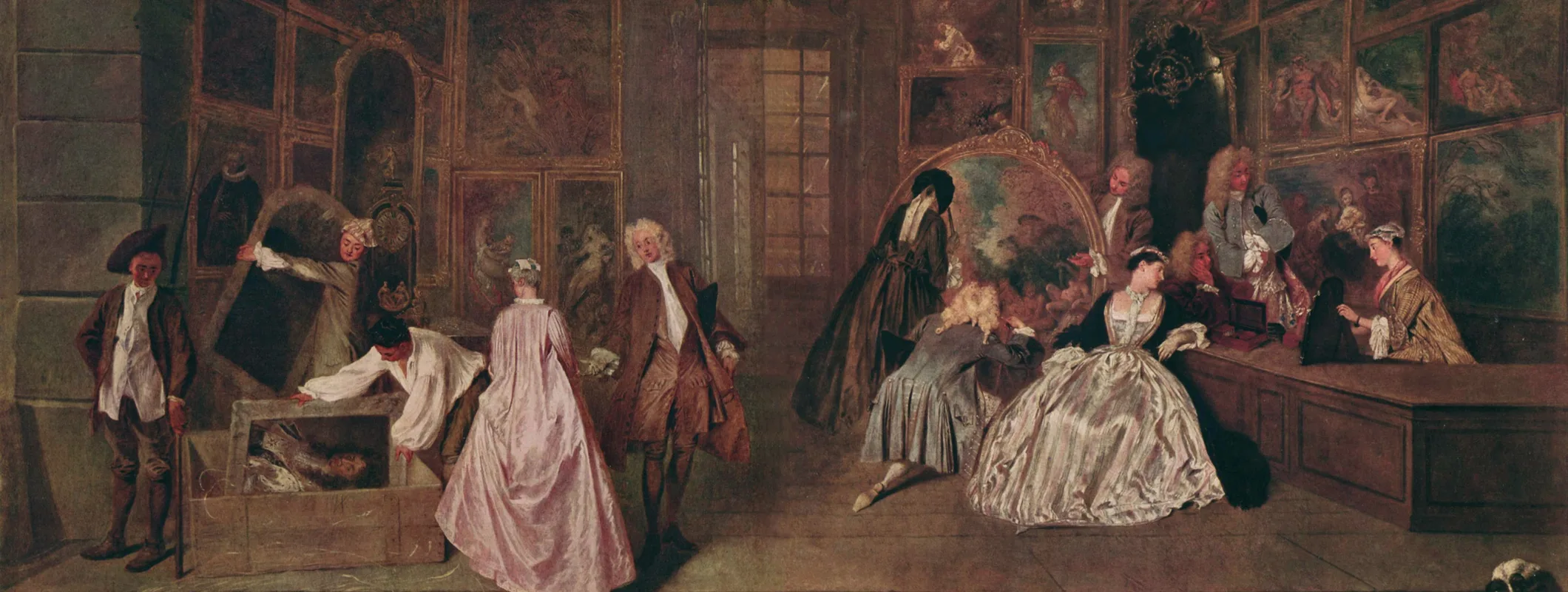
Edme-François Gersaint (1694–1750) was the Paris dealer who commissioned Watteau's famous shop sign, and who, a year after Watteau's death in 1721, embarked on the first systematic attempt to document the complete works of a single artist. Published in 1744 under the title Catalogue raisonné des diverses curiosités du cabinet de feu M. Quentin de Lorangère, it listed and described 140 paintings by Watteau, with notes on their condition, ownership history, and physical characteristics.
The term 'catalogue raisonné' — a reasoned, justified catalogue — implies not merely a list but an argument: each inclusion represents a scholarly judgment that the work is genuine and by the named hand. Gersaint's methodology was informal by later standards, relying primarily on his personal knowledge of Watteau's work and the testimony of contemporary collectors. But the structural innovation was decisive: the catalogue raisonné created an authoritative external standard against which future attributions could be measured. To be 'in the catalogue' became synonymous with being authenticated.
The commercial implications were immediate and lasting. Works included in a catalogue raisonné commanded a premium over unrecorded works. Dealers and buyers routinely cited catalogue inclusion in sale documents as the primary authentication credential. This premium created a corresponding pressure: those who wished to sell a work at catalogue-raisonné prices had reason to argue for its inclusion, and those who compiled catalogues had reason to be cautious about inclusions that might expose them to reputational risk. The tension between commercial incentive and scholarly rigor that would eventually destroy the twentieth-century authentication boards was structural from the genre's first publication.
To be 'in the catalogue' became synonymous with being authenticated — a premium that would eventually corrupt the very institutions it created.
John Smith and the systematic catalogue
John Smith (1781–1855) was an English dealer who between 1829 and 1842 published a nine-volume series titled A Catalogue Raisonné of the Works of the Most Eminent Dutch, Flemish and French Painters. Volume VII, published in 1836, covered Rembrandt and listed 588 paintings accepted as authentic. Smith's catalogue was the first systematic attempt to impose scholarly order on the Dutch market problem: too many works, too many attributions, and no independent verification mechanism.
Smith's methodology was more rigorous than Gersaint's. He personally examined as many works as possible, corresponded with collectors across Europe, and cross-referenced his attributions with earlier sources including Arnold Houbraken's De groote schouburgh (1718–1721), the closest thing to a primary literary source for Dutch seventeenth-century artists. His stated motivation was explicit: in the preface to the Rembrandt volume, he wrote that he undertook the work from a conviction that identifying authentic works was necessary 'to protect the integrity of the market' from the circulation of copies and misattributed works.
The 588 works Smith listed in 1836 can be compared with the current Rembrandt Research Project consensus, which accepts approximately 340 paintings as autograph. The discrepancy is instructive: it reflects not Smith's incompetence but the structural impossibility of the task he set himself. Without scientific analysis tools — without the ability to examine paint layers, pigment chemistry, or dendrochronological evidence — even the most conscientious connoisseur was working with an inherently incomplete methodology. The lesson that no single person, however expert, could establish definitive attribution lists was one the art market would take another century to learn.
The structural tension: commerce and scholarship
Throughout this period, the fundamental tension in art market authentication was between its commercial function and its scholarly aspiration. Dealers needed authentication to assign value and complete transactions; scholars needed independence from commercial pressure to maintain credibility. These two needs were structurally incompatible, and the history of the dealer era can be read as a series of attempts to manage this incompatibility without resolving it.
The most common resolution was the separation of roles: dealers certified for the market, scholars certified for the academy, and the two systems operated in parallel, occasionally converging when a scholarly attribution was commercially useful or when a controversial dealer attribution prompted academic response. This dual-track system persists in the modern market, though its institutional expression has changed: the catalogue raisonné committee has replaced the individual scholar, and the scientific laboratory has been added alongside the connoisseur.
What the dealer era established definitively was that authenticity in the art market is not a binary property. It is a probabilistic judgment, dependent on the evidence available, the methodology applied, and the authority of the person applying it. The modern certificate of authenticity, with its careful statutory language distinguishing "work by" from "attributed to" from "school of," is the direct descendant of the dealer's verbal attribution. What changed was the legal formalization of the probability gradient.