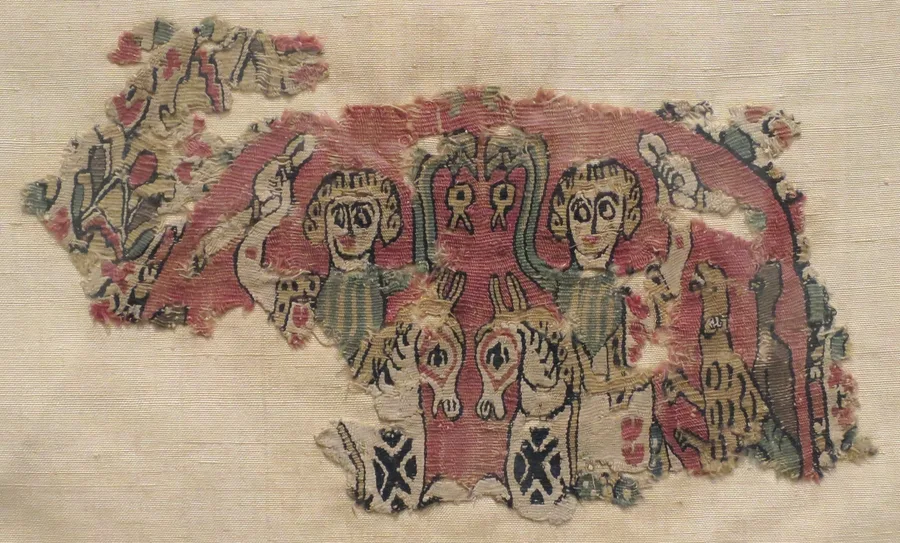
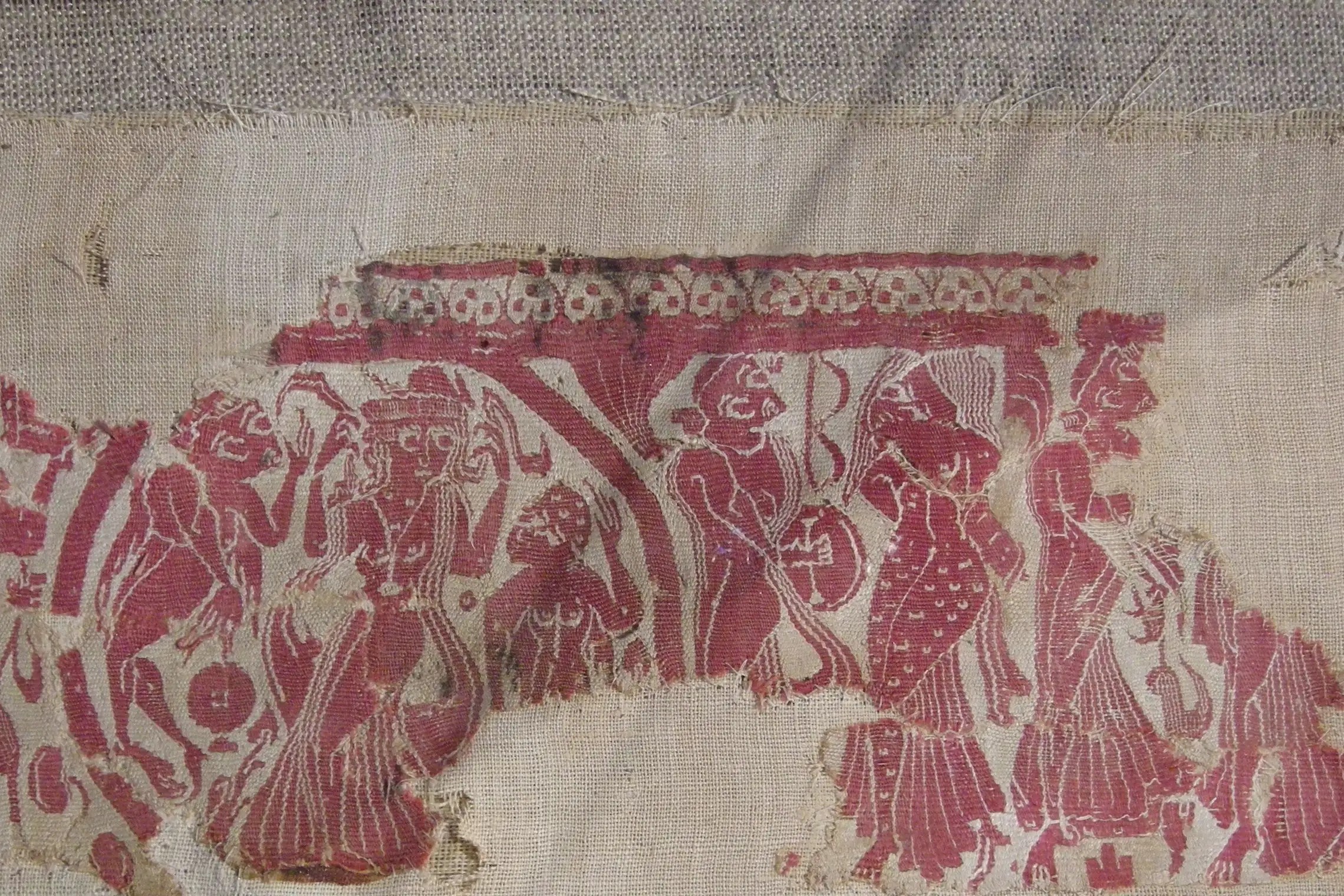
The Musée des Gobelins has just been enriched by a series of Egyptian tapestries. The owner of these objects asserts that they all come from the same excavation; while it is impossible to verify this fact, it is nevertheless very probable. These pieces are parts of costumes that I was able to acquire, with my selection focusing exclusively on the tapestries. It is from the perspective of tapestry-making that I have studied these curious documents with my collaborators.
In 1884, the illustrious archaeologist M. Maspéro discovered an intact Greco-Roman cemetery in Akhmim, ancient Panopolis. There, pagans and Coptic Christians were found buried together, placed in coffins in the upper layers and without coffins in the lower ones. Alongside these common graves, a few hypogea (underground tombs) were reserved for the aristocracy. The oldest bodies date from the time of the last Ptolemies, while those of the Coptic Christians range from the 5th to the 12th century. These individuals were dressed in civil or religious costumes.
The Discovery at Akhmim and Weaving Techniques
The tapestries were produced on a loom similar to the one depicted some three thousand years ago in the hypogeum of Beni Hassan. This loom is vertical and, in its essential components, shows a great analogy with the haute-lisse (high-warp) loom used at the Gobelins manufactory. Certain technical peculiarities suggest that the weaver, instead of being positioned behind the warp relative to the viewer as at the Gobelins, was seated in front of the warp, as in the workshops of the Savonnerie, which is known for its knotted-pile carpets.
The warp is formed of unbleached linen threads, while the weft is generally wool, though sometimes linen is used for finer sections. When setting up a tapestry, the warp threads are spaced according to the desired grain of the fabric. At the Gobelins, we currently work on warps with 8 or 9 threads per centimeter. In the Egyptian tapestries, the warp count is either 11 to 12, 6 to 7, or 8 to 9 threads per centimeter. This last type has an appearance absolutely identical to a Gobelins tapestry.
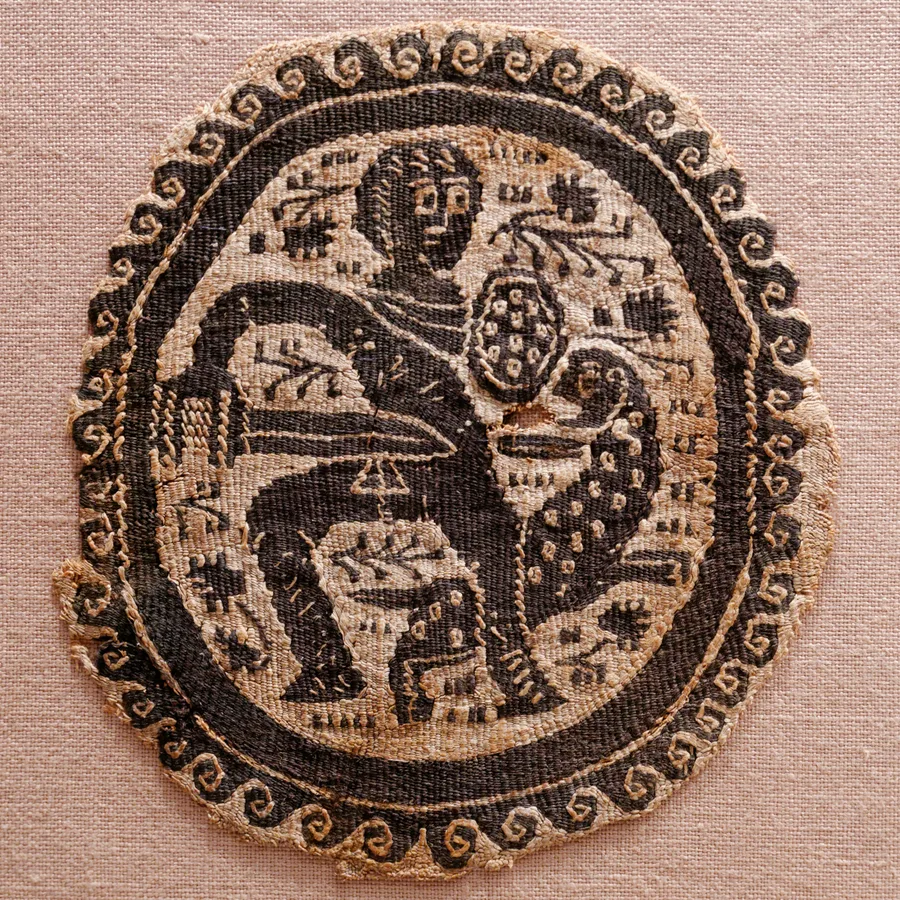
One can observe relais, or slits, in the Egyptian tapestries—that is, solutions of continuity necessitated by contours and certain color changes. One also notes the presence of liures, which are interlockings of weft threads. Both relais and liures are standard practice in modern manufacturing.
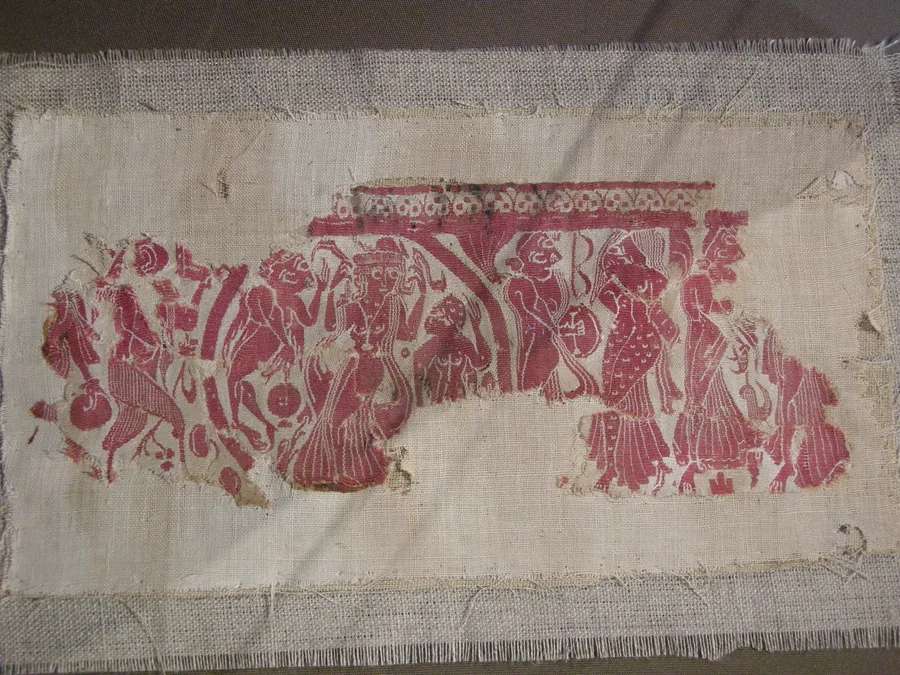
Certain well-characterized Egyptian examples show very delicate white designs on purple backgrounds. These designs are not applied with a needle, as one might first believe. They are produced by ressauts—known in workshop slang as crapauds ("toads")—a technique of floating the weft over the warp using a flying shuttle that the weaver makes jump from one point to another. This floating occurs only in the direction of the warp; when the design runs in the opposite direction, it is woven directly into the fabric, as it forms part of the weft itself.
From a technical standpoint, the tapestries of Akhmim are undoubtedly high-warp tapestries, similar to those of the Gobelins. If we were pursuing an identical result, we could easily tighten our weave to match the finest Egyptian stitch and work with floats. However, our purpose is not the same; we produce wall hangings, whereas all the Egyptian tapestries in the Musée des Gobelins, with perhaps one exception, were made to serve as garment trimmings or for sacerdotal decoration. These include braids, bands of the clavus type (a decorative stripe on a Roman tunic), squares or ovals of the segmentum type (an ornamental patch), as well as cuffs, collars, and various other ornaments that are difficult to identify, as the costumes of Coptic priests are not well known.
With the exception of a few pieces sewn onto the fabric, the tapestries are part of the base textile itself. When the weaver reached the spot that was to receive a tapestry ornament, he would group the warp threads in pairs. This gave the weft a more solid base, made fraying less of a concern, and allowed the body of the fabric to retain the suppleness necessary for a flowing garment. This base fabric is almost always unbleached linen; only a single sample is made of wool lightly dyed red.
Materials, Dyes, and Colors
In general, the tapestry weaver proceeded with flat tints. In a few pieces, however, one can see an intention to create modeling, manifested through slight gradations and transitional colors. The contours are often secured by an outlining, but this redrawing is not a systematic principle.
The oldest tapestries feature fine and delicate designs in unbleached linen thread on solid-colored backgrounds of purple. These backgrounds appear in various tones and diverse shades, the main ones being violet, dove-grey violet, and wine-colored violet. Some of these were obtained using a single coloring agent, undoubtedly derived from one of the murex shells so famous in antiquity, while others were created with mixtures in which indigo blue has been identified.1
After purple, and in the less ancient tapestries, red is the dominant color. This includes crimson red, scarlet red, and madder red, derived either from cochineal or kermes insects, or from plants of the Rubiaceae family, which is analogous to madder. The other colors are very limited in number. Within a single color, the shades vary little, and within those shades, there are at most two tones when they differ, which is quite rare.
The indigo blues—bleu de France (according to the old designation), violet-blue, and sky blue—are fixed by a process still in use on the coast of Guinea and in Europe, known as the Indian vat-dyeing method. The oranges, like the reds, seem to be dyed with plants similar to madder. The yellows—golden yellow and greenish-yellow—come from various plants. The greens—willow green, Russian green, and carnation green—are difficult to assess; carnation green is certainly not the result of a mixture. The blacks are more like very intense blues whose shade has been modified by a brown substance similar to henna.
The ashes of the black wools, which were rarely used, contain a small amount of iron.
In summary, all the materials that served as dyes for the skilled Coptic artisans are of organic origin. They exhibit an extremely remarkable resistance, at least equal to that of the best colors used at the Gobelins. The Coptic tapestries in our museum were worn in a country of intense sun. After a long burial that undoubtedly preserved them, they have again been exposed to the sun for a time sufficient for a conclusive experiment. The colors have resisted to such a degree that one might believe they have just left the workshop.
Artistic Styles and Historical Significance
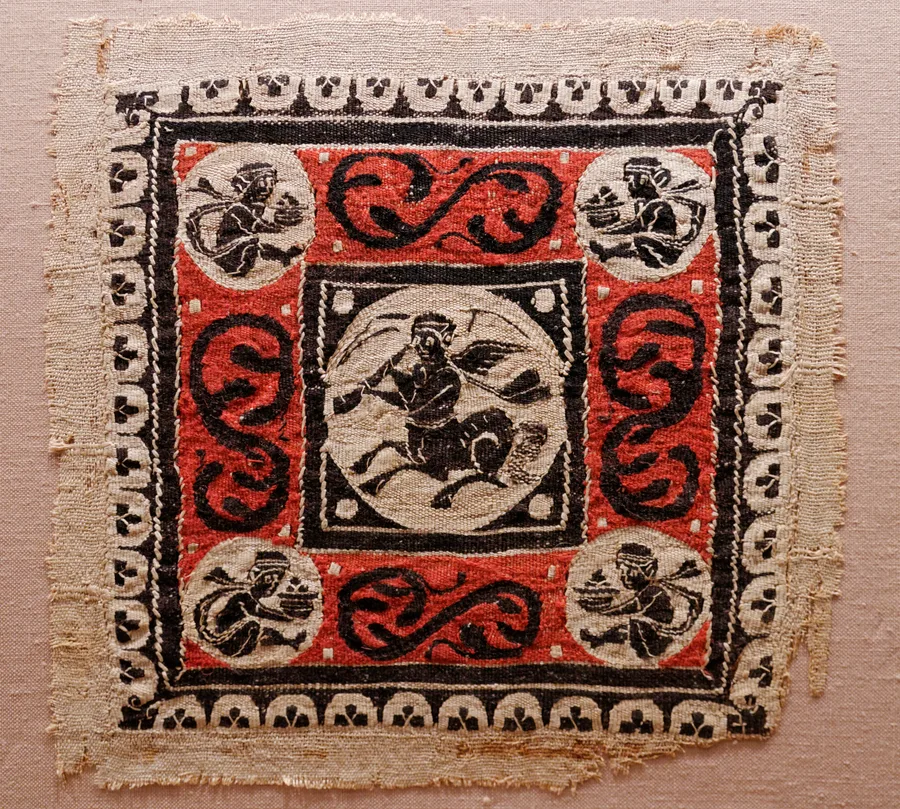
I cannot elaborate today on the style of the tapestries, as this study could be the subject of a separate work. I must, however, provide a few summary indications. The oldest pieces visibly reproduce ancient models: Andromeda and Perseus, a centaur playing the lyre, geometric ornaments, compartmentalized divisions, vases, plants, animals, grotesque figures, and so on.
Then comes a style in the spirit of the late Roman Empire, which is difficult to describe. It features stylized flowers, chimerical beings, animals drawn from nature or exaggerated, and bizarre designs. Some details in these pieces still adhere to antiquity, while others are of an Oriental style, bringing to mind Persia and the Arabs. With the possible exception of the long-eared hare and a certain fish, both particular to the country, nothing or almost nothing recalls classical Egypt.
The most recent tapestries show Christ with a cruciform nimbus, a saint with a disc-shaped halo, Saint George on horseback, and other Christian motifs. In general, the motifs are framed by small, well-proportioned, and very carefully executed borders. These are composed of Greek keys, interlaces, wave scrolls, cabochons (ornaments resembling polished gems), foliage, and faceted precious stones. All these motifs are adjusted with elegance and delicacy.
Whether the model is based on antiquity or on types from later periods, the tapestries are, without any exception, very true in tone, harmonious in arrangement, and as restrained as possible in their execution. In the ornamentation, the drawing is ingenious and sufficiently correct. It is rather weak in the depiction of figures, but this should not be surprising, since even in tapestries from centuries closer to our own time, one finds shocking aberrations in drawing.
Thanks to the discovery by M. Maspéro, to whom art and science owe so many conquests, we now possess tapestries five to six centuries older than those previously held to be the most ancient. We know that they come from the Copts, who were at the forefront of civilization in Egypt until the 11th century. With these pieces in hand, we can appreciate the sureness of their taste, their understanding of textile decoration, and their extreme skill in a technique perfected to a level equal to our modern manufacturing.
GERSPACH