
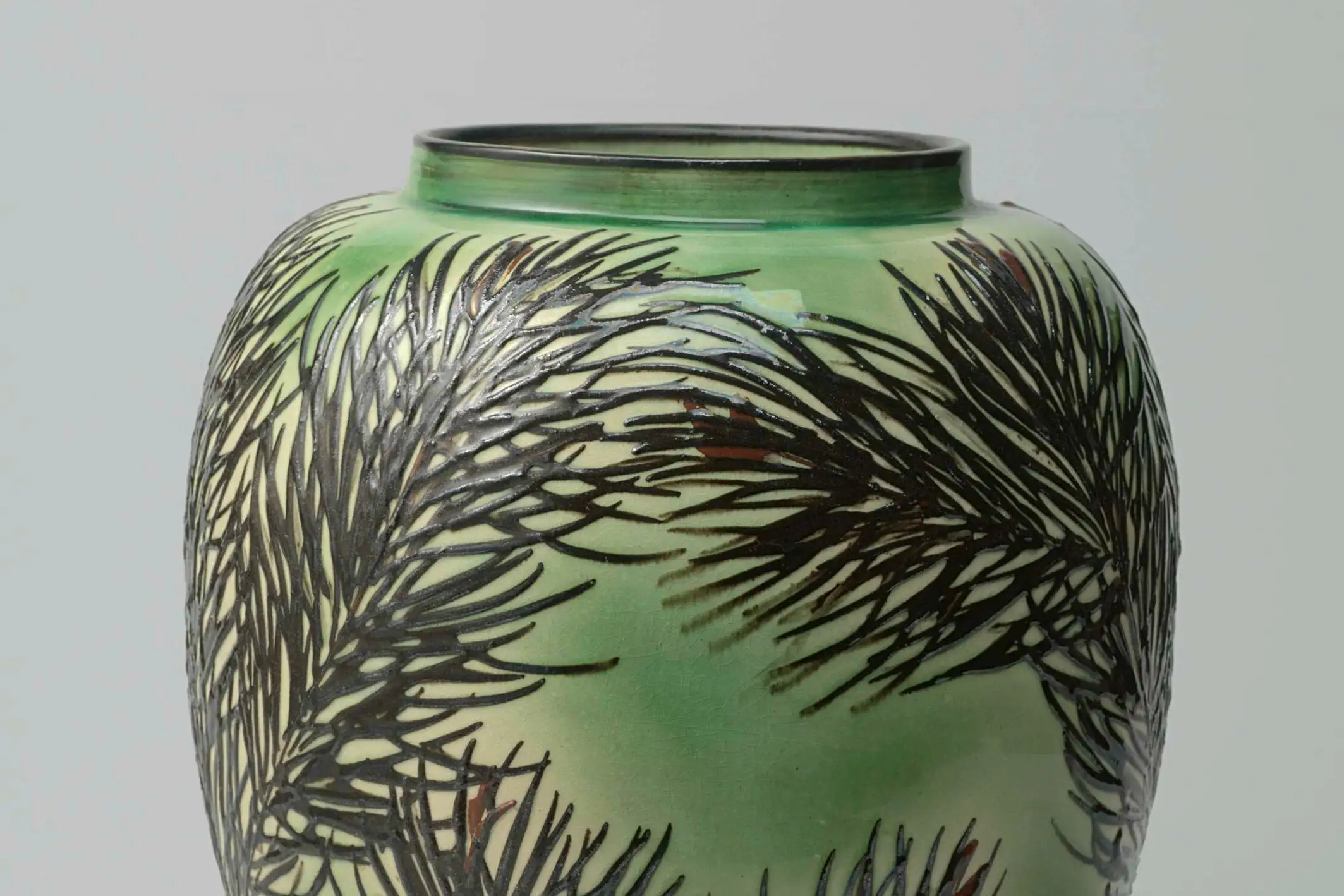

The work of Max Läuger of Karlsruhe is quite complex. In Paris, we know him almost exclusively through the pottery he once exhibited at the Maison Moderne, that interesting decorative art shop that disappeared a year or two ago, closely following its predecessor, Siegfried Bing's L'Art Nouveau. However, a visit to the artist quickly reveals a more complete and far-reaching talent.
And yet, after acknowledging the appeal of his diverse creations, I am not sure if it is not as a ceramicist that I prefer Max Läuger. It may well be that his ceramic production aligns with a keen desire of my own to see rustic pottery finally rehabilitated. This is perhaps why I took a greater interest in the vases than in the other works he presented to me with such amiable courtesy.
A Defense of Rustic Pottery
It seems to me, in fact, that our current ceramicists neglect pottery and faience (tin-glazed earthenware) far too much; to devote oneself to them would seem to be a kind of step down. They want to work only with indestructible materials that defy the ages, with "noble" materials, as they say—with stoneware or porcelain. And yet! What would they say of Persian, Italian, or Hispano-Moresque faience? Several centuries have passed, yet they have failed to tarnish their harmony, their brilliance, or their rare sumptuousness. Standing apart from both the roughness of stoneware and the elegant coldness of porcelain, pottery and faience bring us a more pleasant, more rustic, and also more intimate artistic note—a note of frank and genuine cheerfulness, of a certain charm that is, in a way, familial.
For the ceramicists are telling us quite a tale with their rare pieces, their precious glazes, and their one-of-a-kind vases! To place flowers on my table, give me a good faience vase with a cheerful design and a simple, sober form. Let it be beautiful, but let me also be able to touch it without trembling. Let it be part of the usual decor of my life, among the familiar objects that surround me; let me be able to use it without the fear of destroying a unique work of art that might never be replaced.
It seems to be one of the great failings of our artists that they conceive only of museum pieces. From the point of view of disseminating beauty, a good pottery vase at an affordable price has a greater educational effect than a flammé stoneware piece jealously guarded by a collector. And the true artist can put just as much beauty into it as into the famous rare piece! This vase will have the advantage of being able to be reproduced indefinitely; instead of being in the possession of a single person, it can satisfy the many enthusiasts who will share the different examples. In this way, the price becomes infinitely more affordable.
The Ceramics of Kandeln
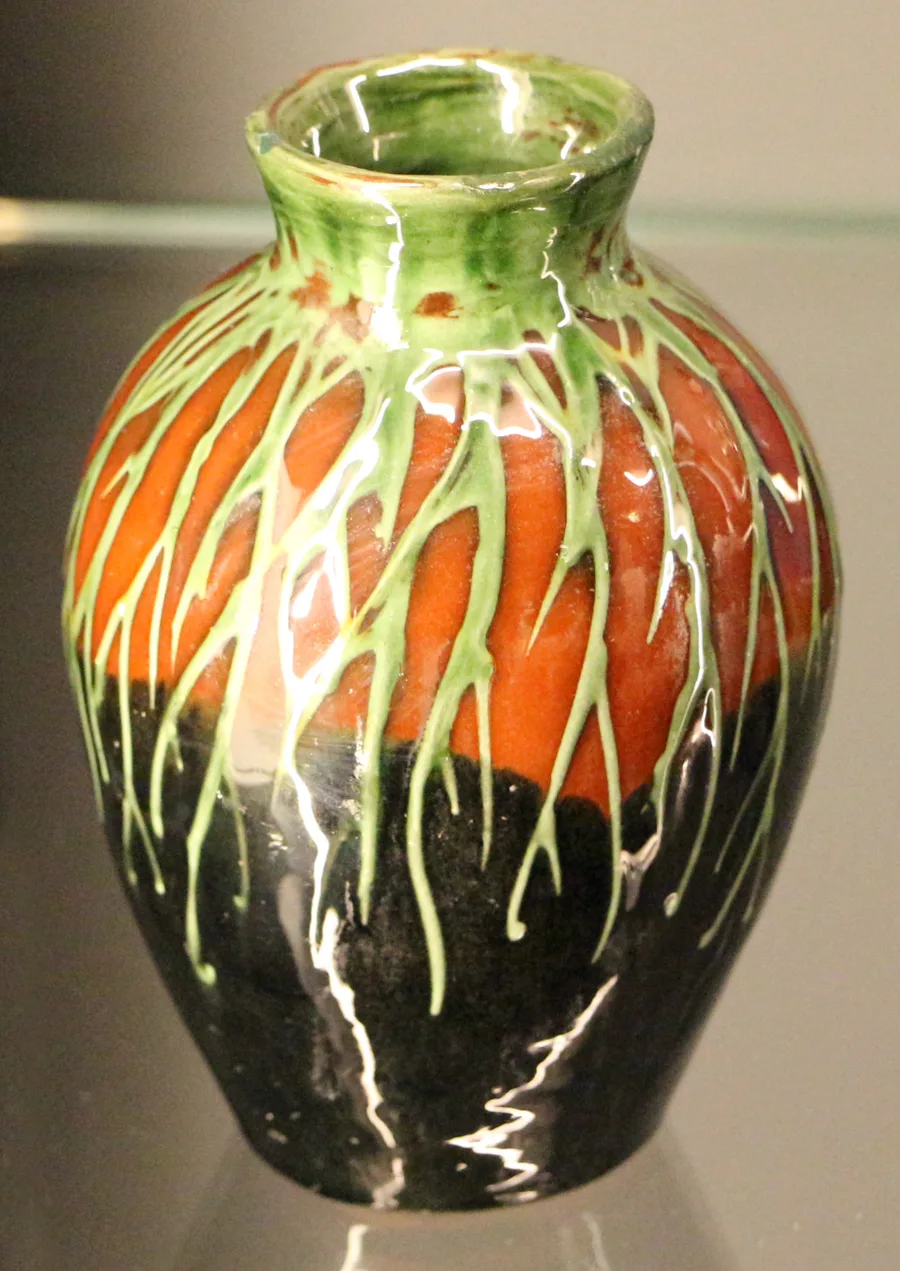
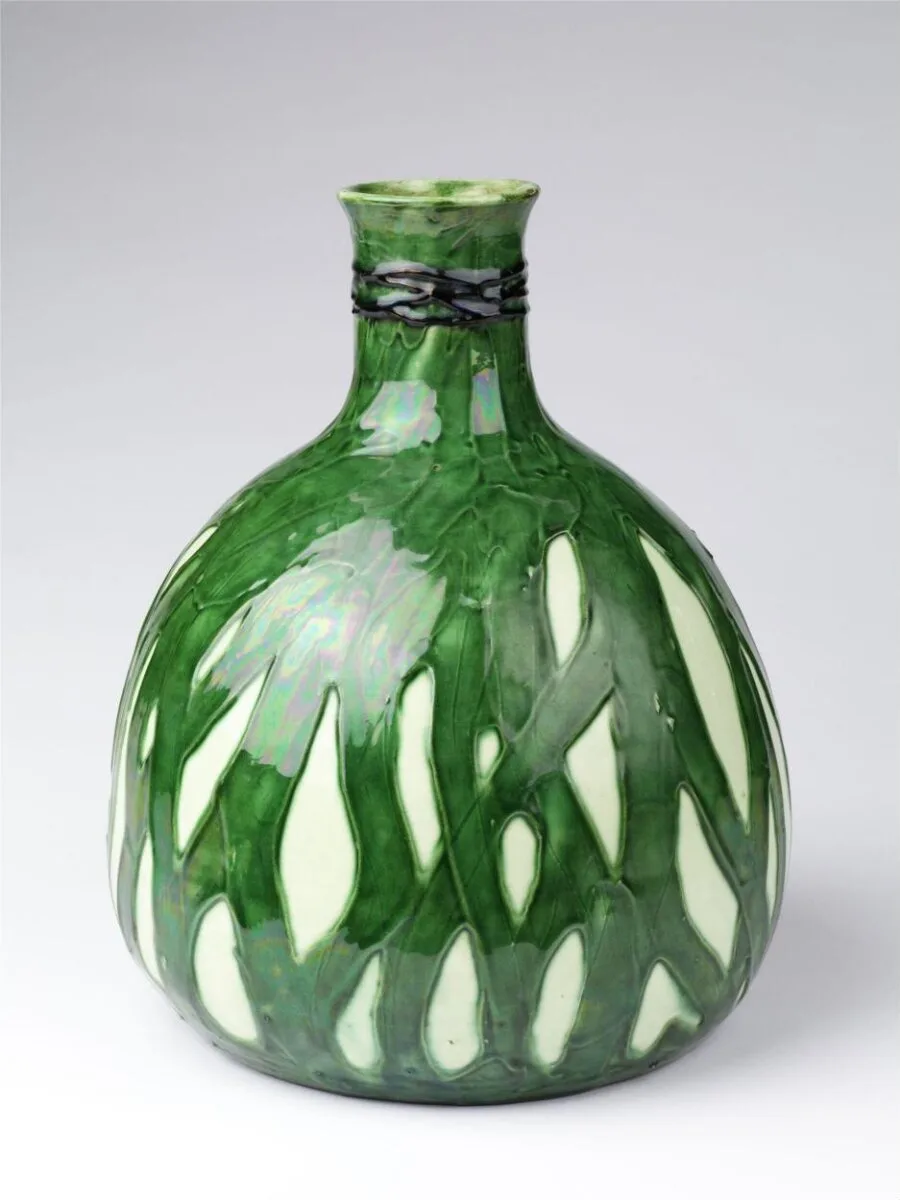
Max Läuger's vases present this advantage of being beautiful—with a rustic beauty that is perhaps a little heavy, but well-suited to their character—and at the same time, being of a readily accessible price. The artist here is not, strictly speaking, a ceramicist himself. He provides models to a factory that is dedicated to their perfect realization, under the skilled direction of Mr. C.-F.-O. Müller. This factory is located in the Grand Duchy of Baden, in Kandeln, near Badenweiler in the Black Forest. The artist can thus easily supervise the execution of his ceramics from the models he has supplied.
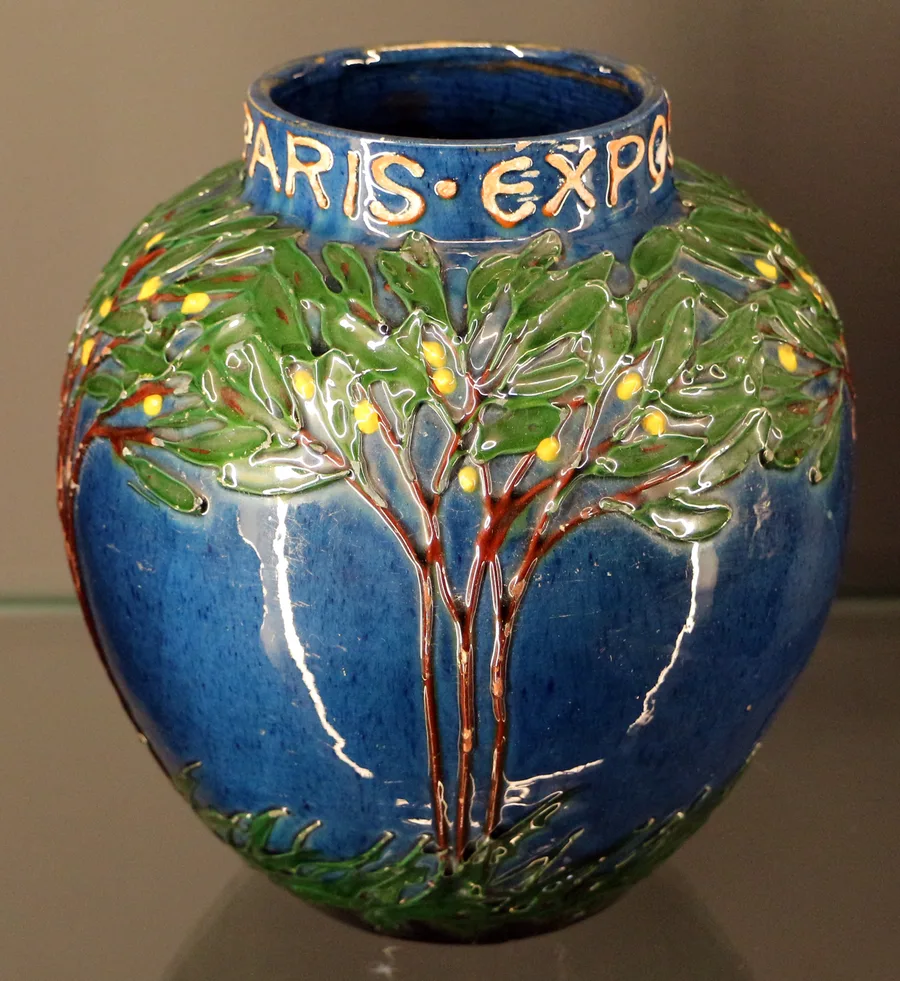
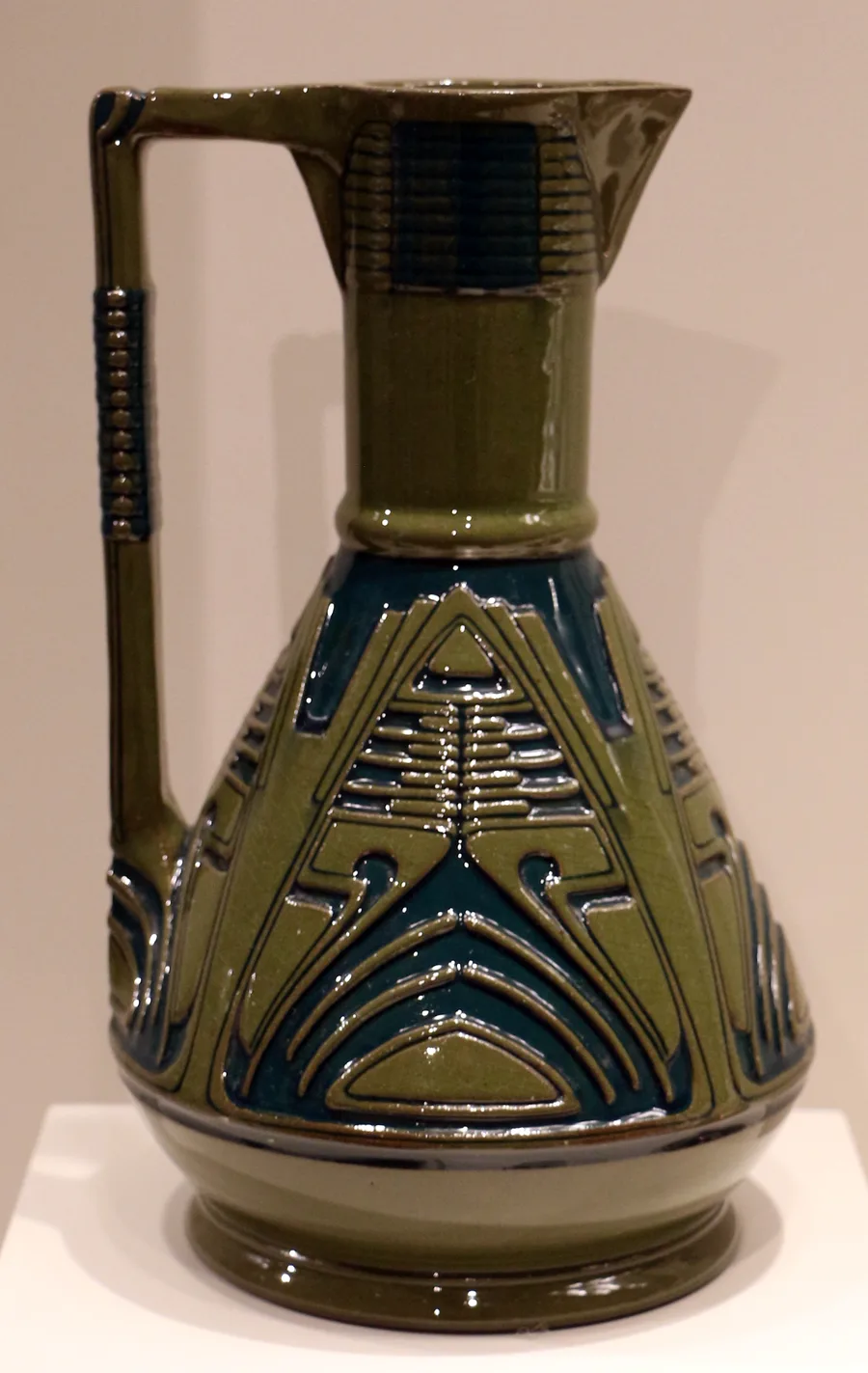
The number of his designs is considerable and is constantly growing. But although their variety of forms and decoration is great, all these vases clearly belong to the same family. As we mentioned earlier, their distinctive feature is the rusticity of their forms and decoration. If the forms are a bit heavy, if the decoration is broadly drawn without too much concern for cold perfection, one easily understands that the artist, in doing so, remains marvelously in harmony with the very material he employs. Let us not forget: each material, according to its flaws and qualities, calls for a different ornamentation of a different character.
Here, we are creating and adorning pottery. Unlike stoneware and porcelain, which require very high firing temperatures to acquire great hardness, these pieces are subjected to kiln temperatures that barely reach a thousand degrees Celsius. The clay remains, compared to stoneware and porcelain, less hard. It is therefore appropriate for pieces made of a more brittle clay to be given more solid, stockier forms, along with a broader decoration that is more in harmony with the less resistant and less durable material.
Our illustrations clearly show that although related, Max Läuger's forms are very distinct from one another and offer a pleasant variety. The decorations are very happily suited to them, whether they remain purely linear or whether the artist has inscribed more or less interpreted floral forms. What is certain is that our artist has managed to create a real personality for himself in the field of ceramics.
Beyond his vases, his decorated tiles are also most interesting, whether they form friezes and wainscoting or compose ornamental panels that often reach considerable dimensions. We reproduce one of them here, where a doe grazes on flowered grass beneath a tree. Another panel of the same kind adorns the fireplace built in the house "Le Chênois," constructed in France according to Max Läuger's plans.
An Architect of Unified Vision
For Läuger is an architect as well as a decorator. And in "Le Chênois," which he built in Belfort, one finds very interesting details. It seems, and rightly so, that the union in a single individual of the too-numerous, and thus often disparate, personalities of the architect and the decorators is to be recommended from every point of view. The unity of conception and composition can only gain from it, that goes without saying. But this requires numerous and diverse gifts that few artists possess in combination. While an architect can ordinarily draw a vase or furniture correctly, he is little prepared to compose cartoons for stained glass like those we reproduce here.
This is not essential, of course; an artist can create excellent plans without knowing how to draw a figure. But one could hardly blame him—quite the contrary—if his artistic culture is extensive enough to allow it.
But let us return to our artist and examine the two cartoons for stained glass, and the detail of one of them, which we reproduce here.
Stained Glass for a Karlsruhe Church
Composed and executed for a church in Karlsruhe, these two windows represent the Nativity and the Resurrection. The compositions are interesting, with a fine decorative scheme and a great ornamental effect. One might, however, fault the artist in certain details, especially in the Nativity. In the sketch, it is regrettable that Saint Joseph's head is cut by an iron bar of the frame; and in the detail of the window, that the hands of both the Virgin and Saint Joseph suffer the same fate. These are criticisms of some importance. The decorator's proper skill is to know how to bend his art to the technical necessities imposed upon him.
Here, the ironwork of the frame is an absolute principle; and within the panels of this ironwork, the artist must know how to inscribe his composition in such a way that no interesting part is sacrificed. For this, he must demonstrate the necessary ingenuity, and it is unacceptable that he not take sufficient care. This is why I critique this small negligence on Max Läuger's part. It takes no merit away from his composition, which remains very interesting, but a little more attention could have prevented a flaw with which the eye cannot be satisfied.
The composition of these two windows is, as we have just said, extremely interesting. The overall scheme is very ornamental; the masses are rigorously balanced, while the whole has a certain style that is very personal to the artist. Perhaps one might regret a slight overuse of lead lines cutting through the forms, when they often could have been concealed. Certainly, the lead is a technical requirement of stained glass, and one that accentuates the character of this beautiful ornamental process. But this necessity, which we must endure, we should not contrive to emphasize or overuse under the pretext of accentuating the character of the process itself.
The composition is weighed down by it, without gaining anything. This is, moreover, a slight flaw also present in many English stained-glass windows. That old, restored windows are like this is perfectly logical. But why seek to imitate that? Shall we break a vase to mend it afterward, hoping to give it a more artistic appearance? I believe that the cuts dividing the pieces should be used only when necessity imposes them, but no more than that.
This is, moreover, a critique not aimed particularly at Professor Läuger's windows, which are very beautiful in themselves, but rather at the workmanship of many English and German glassmakers.
The Art of Garden Design
Another facet of Professor Läuger's talent is garden architecture. He has created some very beautiful and impressive examples in Baden-Baden. We provide reproductions here of a part of one of them. Without achieving—and I imagine, without having intended to achieve—the grandiose allure of our beautiful old French gardens, the artist has managed to create pleasing motifs, even if the one we show here is not without a certain dryness. It is, however, a very interesting example of a difficult endeavor, one that was crowned with recognized success.
We can only mention here Professor Max Läuger's participation in the Mannheim Exhibition, where he debuted as an architect four years ago and revealed the fortunate gifts from which he knows how to draw excellent results. Young and in his prime, the artist is in a period of full productivity; and we should expect from him the most diverse and interesting manifestations in the many paths he has chosen, and where he has gradually revealed his talents.
The artist has other gardens to his credit. A few years ago, in 1907, I believe, at that same Mannheim Exhibition where, as we just mentioned, he revealed himself as an architect, he composed some extremely interesting ones. At the same time, Professor Peter Behrens was tasked with adorning another part of the grounds. I must confess my marked preference for Professor Läuger's gardens. The rigidity and extreme dryness of line in Behrens's compositions are even more shocking in a garden than in a purely architectural work. One would wish for something more amiable, more graceful, and nothing is further from that than the works of this artist.
In contrast, the gardens and architecture of Max Läuger were more pleasant, more intimate as well, without the icy coldness of Behrens's works—an extremely interesting artist, certainly, but far too absolute in the rigidity of his lines. In certain areas, Läuger skillfully combined sculpture and architecture with the masses of greenery in his gardens and the sheets of water in his fountains, all while reserving some wilder parts where the eye could rest. In short, he created an interesting work there, one that opened a new and certainly fruitful path for his activity.
Our artist is certainly very German in his artistic temperament, and we could not, far from it, blame him for that. But he is nevertheless closer to us, and thereby more comprehensible than the majority of German architects and decorators, whose coldness, rigidity, and dryness of line disconcert and repel us—we whose taste has been formed by our old French styles, so pure, so graceful, and so noble.
M. P.-Verneuil.