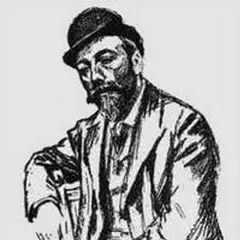
![Les meilleurs voeux de M. et Mme George Auriol. Noël 1930 : [estampe] / GA [George Auriol] [monogr.]](/_ipx/gravity_North&f_webp&q_64&fit_cover&s_2280x1520/api/content/artwork/2b7649dd-2be5-4e41-9244-3a0db6531d90.jpg)
George Auriol presents himself as a trinity: the writer, the painter, and the craftsman. The poor Jules Jouy so cheerfully and aptly called him "My Lord, the Bishop of the Bellflowers." The writer entertains the readers of Le Journal and other papers; the painter enchants the eyes of the refined; the craftsman vigorously shakes up the workshops, succeeding in introducing, by persuasion or by force, ideas and methods that are merely the great, forgotten, or misunderstood traditions of the past.
It is not my place here to speak of the whimsical and pleasant writer who serves up, "on the fly," so many burlesque scenes where lively and laughable puppets evolve. At most, I could say on this subject that this facet of his talent is also twofold. The observer of types and quirks becomes, when the wind carries memories of exotic music and intoxicating aromas from some distant ocean or wild moor, a fine singer of ballads, excelling at transcribing the reverie of the Breton or Scottish woman and the cry of the curlew.
Here too, one would find the same elements that have always inspired him, the same rules that have always guided George Auriol in his graphic work: the attentive and tender study of nature, simplicity in interpretation, and firmness in execution.
The Flâneur as Creator
We must therefore limit our discussion to the painter, lithographer, decorator, and typographer. The subject matter is already substantial enough that this study will remain too brief, and one will see, not without some surprise, the level of fecundity that the production of a flâneur can reach.
I choose this word flâneur by design; I hold it up as one of the highest praises I can bestow upon a man and an artist, as one of his claims to my sympathy and my envy. The man who strolls is the man who sees; the man who sees is the man who understands; the man who understands is the man who creates. The man who creates is the only one who leaves his mark amidst the banality of imitations, repetitions, and flat copies.
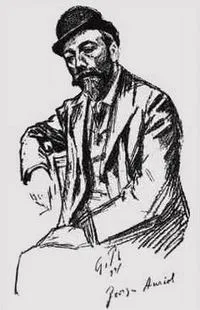
So here is My Lord, the Bishop of the Bellflowers, on a pastoral tour. He ventures deep into the forest and listens to the mosses, ferns, violets, and bindweeds recite their small and great lessons. He admires them with all his heart and blesses them without ceremony. Then, he sprawls in the grass of the plain to examine the blade of grass, the daisy, and the dandelion, drawing from them the subject of his next pastoral letter.