
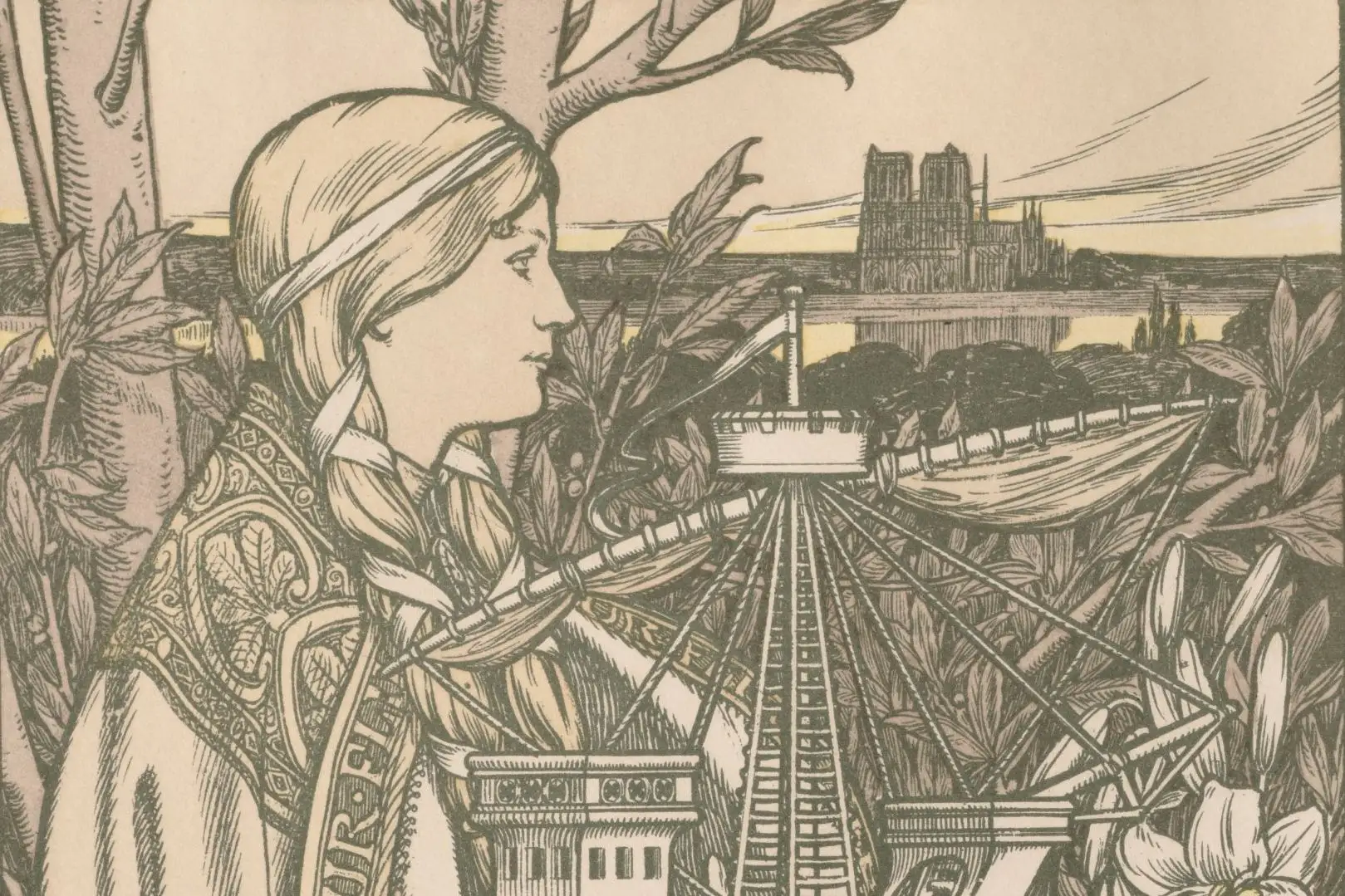
When we see sober and harmonious book covers displayed in a bookseller's window, with their soft tones, legible lettering, and elegant ornamentation, it is almost certain that Adolphe Giraldon is the artist responsible. As we shall see, Giraldon is practically a specialist in this field, given the considerable number of volumes he has so elegantly dressed.
It would be a mistake, however, to believe that Giraldon's considerable activity is limited to this. To do so would be to misunderstand him; while this is undoubtedly an important part of his work, he is a curious spirit who takes the greatest pleasure in trying his hand at everything, exploring all processes and all materials.
A Foundation in Decoration and a Passion for the Book
Giraldon began his artistic career around the age of fifteen as an apprentice decorative painter, a path he followed for seven or eight years. Soon, however, he felt drawn to the book and to typographic ornamentation, a field in which he was destined to carve out a preeminent place. In 1879, he made his debut with ornate letters in Le Livre, the beautiful review edited by Octave Uzanne. From that moment, he had found his true calling.
In the world of books, he has touched upon every aspect, and always with equal success. We have already mentioned his covers; to date, he has created more than four hundred of them for a wide variety of publishers. This number, more than any commentary, proves the artist's fecundity, his inexhaustible imagination, and the infinite resources he knows how to discover in his art, allowing him to constantly diversify and renew his motifs and their combinations.

Still in the service of the book, we also see him composing numerous gilding stamps (fers à dorer) for publishers, as well as creating bindings for collectors in mosaiced and gilded leathers.
The Giraldon Typeface
The body of the book itself was not to remain a stranger to him any more than its external decoration. Just recently, barely a month ago, an alphabet he designed was released by the Deberny type foundry. There is now a "Giraldon" typeface, just as there was a "Grasset" and an "Auriol." The appearance of the letters in his alphabet is distinctly different from that of the previous two. It is more classical, in a way. This is not to say that he brings no bold modernity to his composition. Rather, its beauty is calm and noble; it is less bold than the Grasset typeface and less fanciful than the Auriol.
By a rare stroke of fortune, Giraldon was able, thanks to this new typeface, to produce a book—a collector's book, we might unfortunately say—in which everything is his own creation: the characters composing the text and the illustrations accompanying or framing it. We will have occasion to return to this beautiful edition of Virgil's Eclogues.
A Prolific Illustrator
Ornamentation for books abounds in Giraldon's work: decorated letters, titles, half-titles, and tailpieces (culs-de-lampe), page borders, and endpapers—he has tried his hand at everything with ever-renewed imagination and equal mastery. In the meantime, he provided illustrations to Hachette for Tolla and Trente et Quarante; for various Bibliophile Societies, he illustrated Aspasie, Cléopâtre et Théodora, as well as a Chansonnier normand (Norman Songbook). Finally, for the publisher Plon, he composed the Eclogues. It is clear that he can adapt to any genre, each time bringing a charming note or a small, clever discovery. In the Norman songbook, for instance, he uses the titles as a pretext to introduce a picturesque history of the Norman headdress.
This is the great appeal of Giraldon's works: he makes every design say something. He offers us not just ornamentation for its own sake, but something more, which adds a new layer of interest to the work.
The Philosophy of Ornament
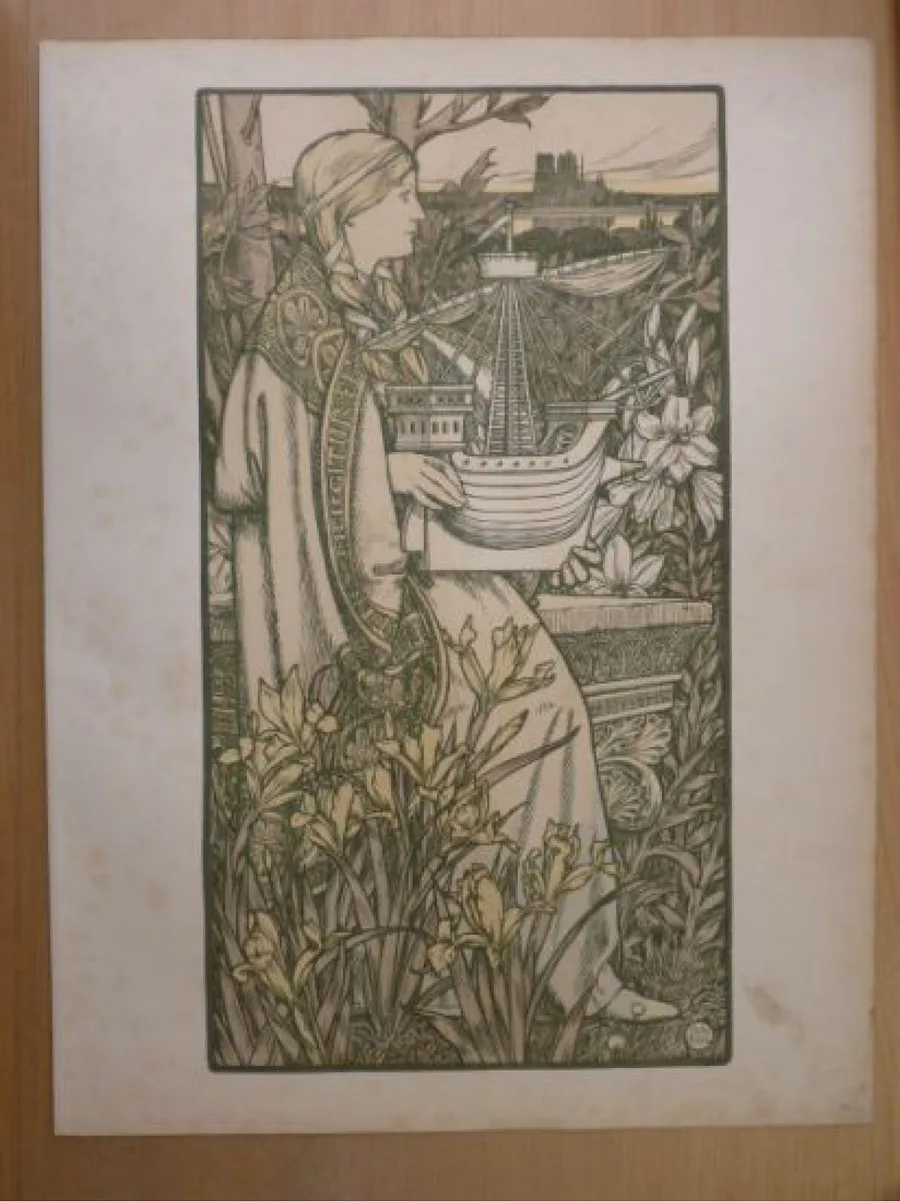
Consider the cover designed for the Mémoires of General Marbot. Against a background of flaming grenades, a laurel tree rises, its branches growing into wreaths, a symbol of glory. If this is symbolism, it is of a good kind, for the idea is simple, though ingenious. The appeal of the cover is in no way diminished if, by setting aside the conventional meaning of the laurel and wreaths, one retains only the ornamental arrangement of the foliage.
Besides, does ornamentation truly need a precise meaning? Is the cover of L'Art en France any less good because it is simply adorned with a cluster of oleander providing a backdrop for a cartouche and a medallion?
We should also mention an edition of Bourget's Pastels for the publisher Conquet, and a Missel (Missal) for Mame. As this brief enumeration shows, Giraldon's contribution to book ornamentation over the past twenty years is enormous and would suffice for the artistic legacy of many. And yet, how many other things has he created!
A Versatility Across Media
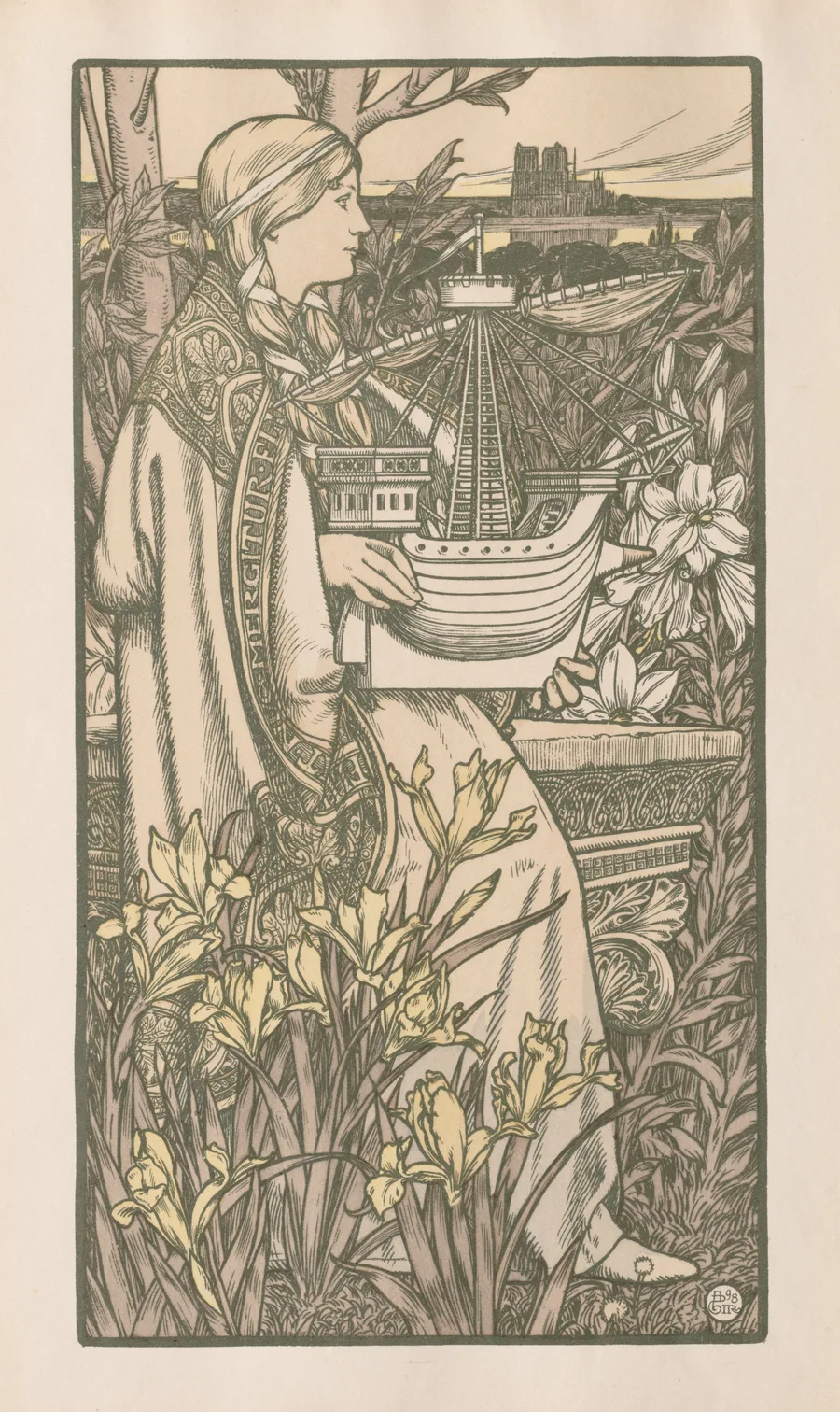
Among his woven fabrics—silks and velvets, where the elegance of his lines can unfold at ease—we will cite a textile designed for the interiors of official buildings. Here, uprights of laurel foliage enclose cartouches bearing the national initials. This was a fine opportunity to renew and enhance the interest of the wall decorations in our public edifices. Needless to say, although the fabric exists and is beautiful in appearance, it has not yet managed to open the doors of even a modest prefecture, let alone the Élysée Palace or a government ministry.
This is because official art seems essentially resistant to any attempt at novelty. And yet, should it not be the one to give the modern movement the support it lacks? Without rushing to follow imprudent and overly bold innovators, it could still leave the usual ruts and consider that beautiful things can exist outside of antiquated styles. For a long time to come, we are destined to see banal hangings in these spaces; and on holidays, some generic fabrics will be put up for the occasion by a designated contractor.
From Ceramics to Complete Interiors
Faience, a type of tin-glazed earthenware, has been more fortunate. A large sign-panel even adorns the storefront of a bakery on the Place Clichy, attracting attention with its unusual dimensions.
What else is there to mention? Embroideries and stained-glass windows; mosaics, too. Even entire interiors. The most recent, for a certain M. T., includes the complete decoration and furniture for a library-studio as well as a meeting room for the staff, for we are in the home of an industrialist. Then there is a rich mural decoration for the vestibule of M. D.'s mansion, consisting of graceful golden arabesques running directly over the white stone.
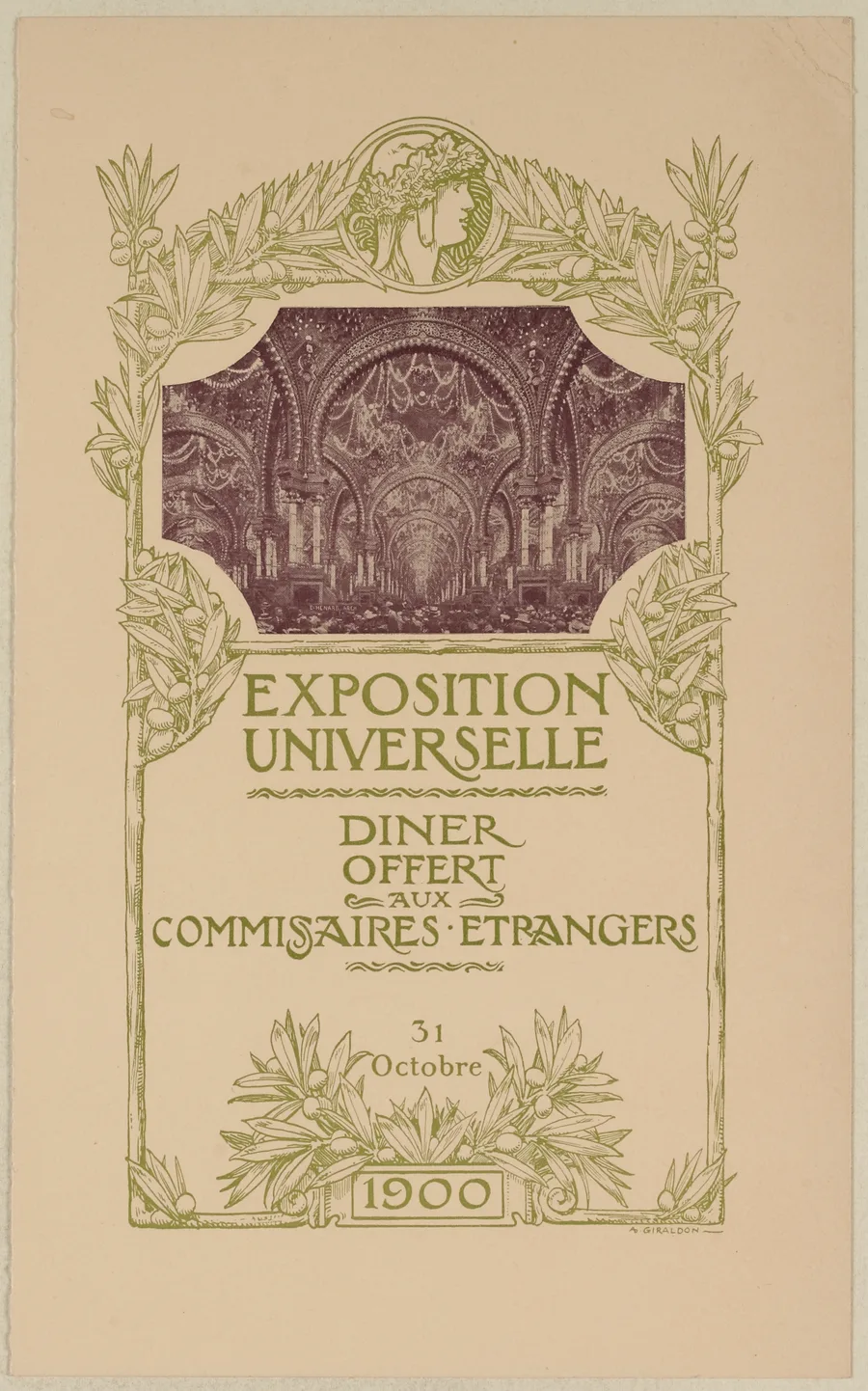
Are we at the end? Not at all. For here are innumerable jewels and numerous pieces of goldsmithing designed for Froment-Meurice; there are even medals; and also lighting fixtures for the publisher Beau; and wrought iron; and numerous models for Lincrusta wall coverings. Finally, connecting everything, is the host of programs, official and otherwise, menus, publisher's marks, ex-libris bookplates, and invitation cards. And to relax from this labor, the artist indulges in the joys of painting: landscapes of Brittany or Provence, as well as portraits.
We find ourselves, as this dry enumeration is enough to prove, in the presence of a tireless worker and a considerable body of work. One cannot help but admire the fecundity of our artist, who constantly renews his ornamentation without ever ceasing to be himself.
The Quintessence of an Artist: Virgil's Eclogues
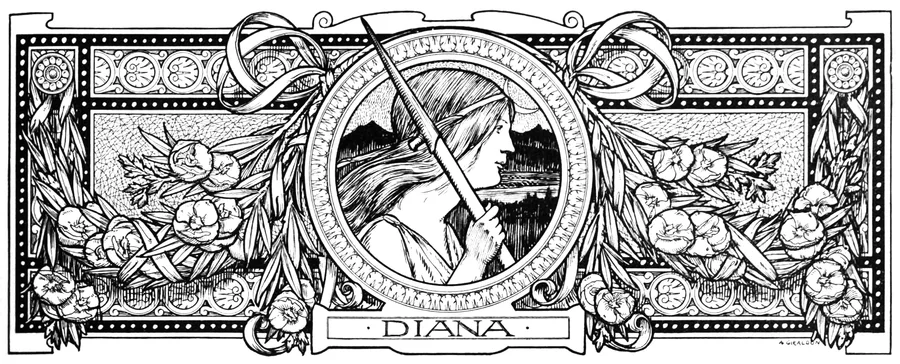
His entire art, moreover, is contained in his latest book, the Eclogues of Virgil, which we mentioned earlier. We can do no better here than to yield the floor to M. Paul Rouaix, a distinguished Latinist, who speaks learnedly of this book and its new presentation.
Giraldon has to illustrate Virgil's Eclogues. Is he going to depict the anecdotes, the minuscule incidents that form the subjects of each of these short poems? He would then be forced to add to Virgil, perhaps distorting him, for the poet does not say everything. And besides, is that what is important? Did Virgil not rather wish to study the souls of men in these shepherds, souls more open in their naivety, in their rustic sincerity? Moreover, among these ten eclogues, there is something common that dominates and hovers, so that, while not continuous and without a direct link, these pages are nonetheless parts of a whole. The characters change; not all are shepherds. Here, it is about the birth of a child who will bring a new era. There, it is Gallus being consoled, and Gallus is not a shepherd. All of this is lost, drowned, and melted into the soul of Virgil—or rather, it is the soul of Virgil that spreads through the diverse parts of this whole and gives it unity. It is this soul of Virgil that Giraldon first seeks, listens to with his eyes closed, and steeps himself in the dominant sensation, which then dictates to him, in drawn and colored forms, the translation of that sensation. A unity imposes itself on him, without his willing or knowing it, commanding his general tonality—that soft, serene, almost blonde tonality that I find everywhere and which, in turn, commands the rest through its reticence, its half-silences.
These eclogues are the singing soul of the countryside, with the same song sung by the diverse voices of plants, animals, and man. In these beautiful landscapes framed as friezes at the top of the first pages, Giraldon makes broad lines and masses reign, and does so in colorations whose warmth is softened by tendencies toward the violet. There are no figures. Barrias, in the lovely Virgil from Didot, had illustrated each idyll with a scene. It turns out that, in Giraldon's work, the void populates the scene more than figures would have done. From it emanates an impression of dreamy and serene melancholy, whether it is the mist veiling the trees near the river in gray, or whether, over there, far from the valley where the floating shadows of the uncertain twilight lull the colors to sleep, the sun's farewell, behind the violet mountain, bloodies the sky with the purples of sunset.
Then, little nothings, small, ingenious, clever details, abound. They are almost like hints, allusions, the famous "lines," the unforgettable quotations, translated by the pencil: the barbarian's sword in the sheaf of wheat he will have, the hedge that counsels sleep with its murmuring bees, and, next to it, the straight, elongated smoke, a sign of peace and calm, a symbol of the decoration itself—a decoration for which Giraldon had a most remarkable collaborator in the talent of the engraver Florian.
This book, as we were saying, truly summarizes Giraldon's art. We reproduce two pages from it here, at the beginning and end of this article. His qualities appear clearly in them, as they do in the least of his compositions. Whether we take a cover or a program, a fabric or an ex-libris, we find the conscientious and balanced artist who leaves nothing to chance. His composition is sound, logical, and well-balanced, with nothing disheveled, nor any of that wild independence that, in similar productions, often borders on incoherence. His coloration is sober and harmonious, without extreme audacity, but also always in good taste. The dominant qualities of Giraldon's ornamental art seem to be clarity and elegance, distinction and logic.
Guiding Principles: Nature, Form, and Material
While not shunning allegory and symbol, he nevertheless makes them only an accessory part of his composition. And how right he is not to fall into the trap of excessive symbolism, which dictates that in a composition, however simple, everything has or must have a meaning. One then finds oneself in the presence of a rebus rather than a work of ornamentation, and a key is necessary to be able to appreciate its supposed flavor. The interpretations, moreover, can vary and even contradict one another for the same symbol. But what does it matter! Does beauty need so many meanings? Is a flower beautiful because its proportions are pleasing, its lines slender and pure, its colors harmonious, or because it symbolizes some vague sentiment? The one does not preclude the other, of course, and a motif can be very pleasing while also symbolizing something. But, in my opinion, in ornamentation, the beauty of the form must come long before the symbol; for only the form is visible to us and charms our eyes, whereas the symbol is but a vague convention, often quite childish, when it is not, for most people, simply incomprehensible.
But let us return to our artist and the characteristics of his art. His drawing is sure and precise. His interpretation of natural forms avoids an overly accentuated naturalism without, however, falling into extreme stylization, which deforms rather than interprets. He wants a lily to be a lily, and a rose to remain a rose. He strives to bring out the purity of the forms of that lily, of that rose, to render these forms beautiful and ornamental through a deliberate arrangement, through a balance of movements and masses. But he does not grant himself the right to strip the lily of the slenderness of its curve, nor the rose of the delicacy of its petals. Is that not where their beauty lies? His interpretation is logical in the sense that it is inspired directly by the study of nature, by knowledge of execution processes, and by the demands of the material; but it always preserves the chosen natural element's particular, constitutive, and distinctive character. These are precious qualities.
As a good decorator, when faced with a new work to create, he seeks out and enumerates the difficulties that present themselves. He is careful not to seek out new ones, as if for pleasure. What would be the point? But once these difficulties are known, whether artistic or technical, he knows how to overcome them one by one, bending his motifs and forms to the demands of the resistant material.
Giraldon was called upon to formulate these guiding principles when he was entrusted with his professorship in Glasgow a few years ago. He strives to instill them in his students, and the results obtained are there to prove to him, once again, that his path is the right one, and that only the eternal study of nature is the sole life-giving source of artistic inspiration. He has made this his creed, and his works are there to tell him how right he was to make it the immutable rule of his life and his work as an artist.
M. P.-VERNEUIL.