

The Tyranny of Custom
Before the book, there was chaos. To travel through The France of the Ancien Régime was to navigate a bewildering legal labyrinth. The laws, Voltaire famously quipped, changed as often as one changed one’s horse. A patchwork of more than 360 local codes, rooted in feudal custom, Roman law, royal edicts, and canonical precedent, governed the lives of French subjects. A man could be a legal adult in Paris and a minor in Normandy; a marriage contract valid in Brittany could be void in Provence. This was not merely an inconvenience; it was the architecture of inequality, a system where rights and obligations were tied to place, class, and guild, preserving ancient privileges and frustrating the emergence of a unified nation.
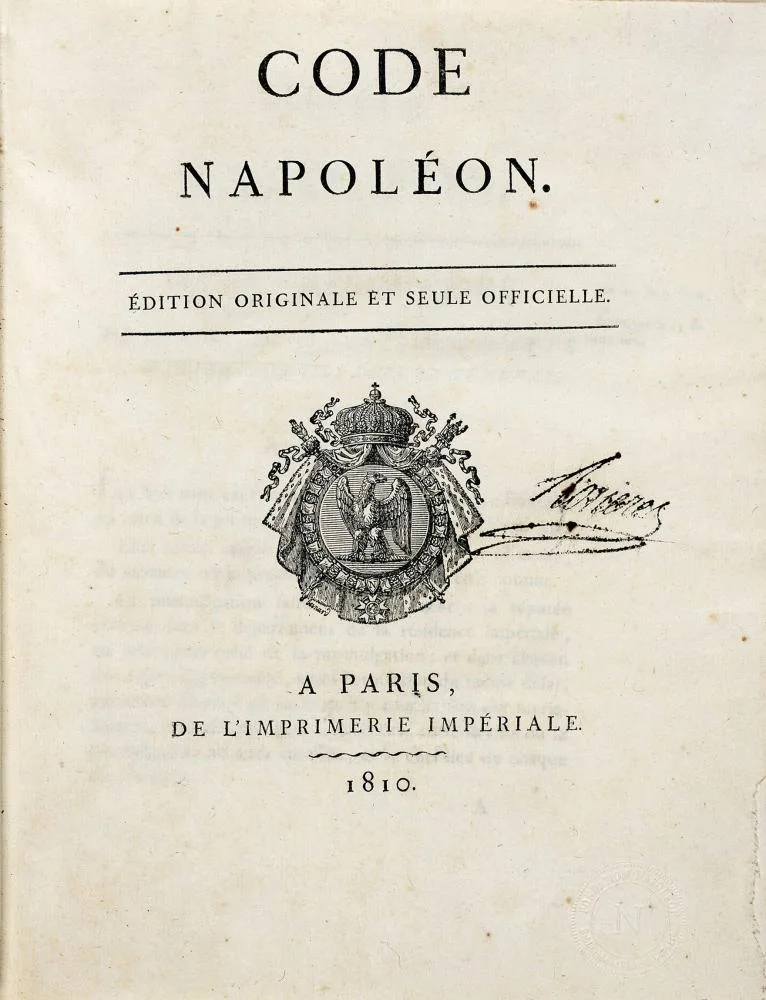
The Revolution of 1789 tore down the Bastille, but it failed to demolish this invisible fortress of legal tradition. The revolutionaries dreamed of a single, rational code for all citizens, a testament to liberty, equality, and fraternity. Yet, draft after draft foundered in the turbulent politics of the Convention and the Directory. The dream of legal unity remained just that: an enlightened ideal trapped in the wreckage of the old world. It would take a different kind of force, one of military genius and titanic ambition, to transform the ideal into ink and paper. The arrival of Napoleon Bonaparte on the political stage was the catalyst. He saw in the legal chaos not just a problem to be solved, but an opportunity to cement his own power and remake France in his image. The tool he would use was a book—a volume whose austere title page from 1808, printed by the Imprimerie Impériale and declared the “sole official edition,” announces its purpose not as a proposal, but as a fact. This was the Code Napoléon, and it was designed to be nothing less than the operating system for a new world.
Four Men and an Emperor
The creation of the Code was an act of focused, authoritarian will. In August 1800, shortly after seizing power as First Consul, Napoleon appointed a commission of four eminent jurists to finally realize the revolutionary project. They were not radicals, but seasoned legal pragmatists: Jean-Étienne-Marie Portalis, François-Denis Tronchet, Félix-Julien-Jean Bigot de Préameneu, and Jacques de Maleville. Under the direction of the Second Consul, Jean-Jacques Régis de Cambacérès, a brilliant legal mind in his own right, they were tasked with synthesizing centuries of jurisprudence—from Roman law and royal ordinances to revolutionary statutes—into a single, coherent document.
What set this effort apart from all previous attempts was the relentless involvement of Napoleon himself. He was no passive observer. Of the 87 sessions held by the Council of State to review the draft, the First Consul presided over 36. Lacking formal legal training, he brought an outsider’s intolerance for jargon and a soldier’s demand for clarity and utility. He would cut through abstruse legal arguments with piercing, practical questions: “Is this just? Is it useful?” He pushed the jurists to abandon theoretical purity for workable solutions, often shaping key articles on family, property, and the state with his own conservative and patriarchal instincts. His interventions were decisive, bullying the commission past ideological deadlock and forcing the pace of the work. He understood, with a clarity that had eluded his predecessors, that law was not merely a matter for lawyers; it was the fundamental grammar of a nation, the means by which a state speaks its values into existence.
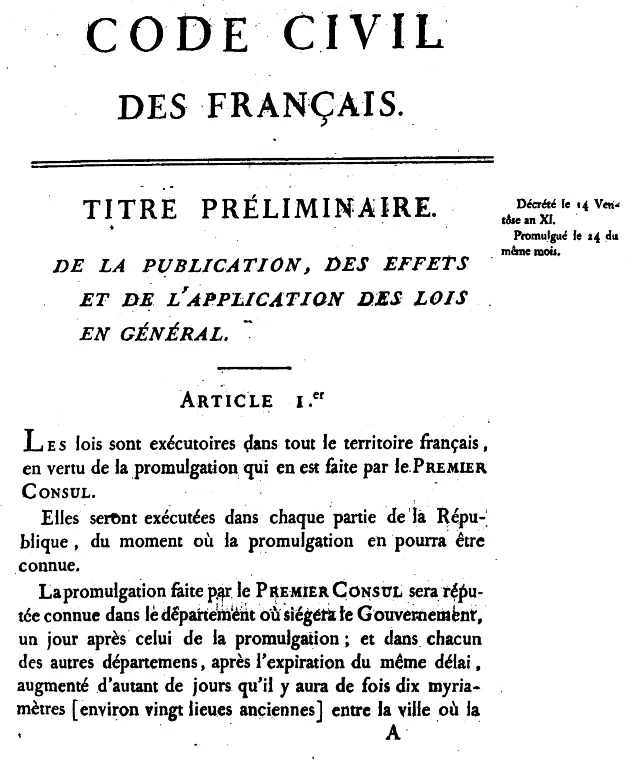
The result, promulgated on March 21, 1804, as the Code civil des Français, was a marvel of lucidity. Its 2,281 articles were written in a spare, elegant French, a style so clear and powerful that the novelist Stendhal later claimed to read it daily to absorb its “force and logic.” It was a book intended to be understood not just by judges, but by every citizen. This accessibility was itself a revolutionary act, a departure from the obfuscating language of the old legal orders that had kept power in the hands of a select few. The Code made the law visible, knowable, and, in theory, applicable to all.
The Citizen on the Page
At its heart, the Code Napoléon was a machine for creating a new kind of person: the modern citizen of a secular state. It systematically dismantled the legal foundations of feudalism and established three pillars that would define the modern world.
First and foremost was the consecration of property rights. The Code made private property an absolute, almost sacred right, protecting it from arbitrary seizure by feudal lords or even the state. This was the central demand of the bourgeoisie, the class that had powered the Revolution and now formed the bedrock of Napoleon’s support. It guaranteed that the gains of the Revolution—particularly the purchase of confiscated church and aristocratic lands—were secure. In doing so, it created a stable, predictable environment for commerce and capitalism to flourish.
Second, it enshrined legal equality. All male citizens were granted the same civil rights, and the law was to be applied uniformly, regardless of birth or class. The last vestiges of aristocratic privilege and guild monopolies were swept away. The jury system was established, and a clear hierarchy of courts ensured a due process. This principle of equality, however, was starkly limited. The Code was a product of its time and of its primary author’s worldview. It famously subjected women to the authority of their fathers and husbands, declaring them legal minors incapable of entering into contracts, suing in court, or controlling their own property without male consent. The family, in the Code’s vision, was a microcosm of Napoleon’s empire: a rigid hierarchy with an unquestioned male authority at its head.
Third, the Code was a powerful engine of secularization. It decisively separated civil life from religious authority. Marriage became a civil contract, not a sacrament, and divorce, though restricted, was permitted. The registration of births, deaths, and marriages was transferred from the Church to the state. This wresting of control over the fundamental milestones of human life was a profound shift, establishing the state, not God, as the ultimate arbiter of civil identity. It was a declaration that France would be a nation of citizens, not a congregation of the faithful. The Code was, in effect, a secular scripture for a secular age.
An Empire's Operating System
The 1808 edition’s proud declaration—ÉDITION ORIGINALE ET SEULE OFFICIELLE—is a crucial key to understanding the Code’s purpose beyond France’s borders. Printed at the Imprimerie Impériale, the state’s official press, this was not just a book but an instrument of centralized power. Napoleon ensured there would be no competing versions, no regional interpretations. There was one law, one text, emanating from one authority in Paris.
As Napoleon’s armies marched across Europe, the Code followed in their baggage train. It became the legal blueprint for the territories he conquered and the satellite states he established. It was imposed on Italy, the Netherlands, Belgium, parts of Germany, and Poland. For Napoleon, the Code was a more effective tool of conquest than the bayonet. It dissolved ancient feudal structures, rationalized administration, and bound conquered territories to the French model of governance. It was, in essence, the portable operating system for his empire, designed to create a uniform legal and economic space from the Atlantic to the Vistula.
The imposition was not always welcome, but its effects were transformative. In the German Rhineland and northern Italy, the Code’s introduction of legal equality and predictable commercial law spurred economic development and nurtured a rising middle class that would, ironically, later form the core of nationalist movements against French rule. Even after Napoleon’s defeat at Waterloo in 1815, the Code often remained. The monarchs restored to their thrones might despise the Revolution, but they could not ignore the efficiency and power the Code offered. Many chose to keep it, or versions of it, solidifying its place as a permanent feature of the European legal landscape.
The Afterlife of an Idea
The Code’s influence radiated far beyond the reach of Napoleon’s armies. Throughout the 19th century, it became the world’s most widely exported legal model. Newly independent nations in Latin America, from Bolivia to Chile, saw it as a ready-made template for a modern republic, a way to break decisively with their Spanish colonial past. It shaped the legal systems of Quebec and Louisiana in North America, and its principles were adopted or adapted in Egypt, Turkey, and even Japan during the Meiji Restoration, where it served as a model for rapid modernization.
For nearly a century, historian Robert Holtman’s claim that it was “one of the few documents that have influenced the whole world” held true. It established the preeminence of the civil-law tradition, based on comprehensive, written codes, in contrast to the Anglo-American common-law tradition, based on judicial precedent. Its very existence promoted the idea that law could be a rational, systematic, and accessible product of human reason.
Yet, its legacy is not uncomplicated. By the turn of the 20th century, its star began to wane. The German Civil Code of 1900 and the Swiss Civil Code of 1907, seen as more technically sophisticated and better adapted to a modern industrial society, began to supplant it as the dominant model for new legal systems. Critics, both then and now, point to its profound shortcomings: its rigid patriarchalism, its limited protection for workers, and its focus on property over broader social rights. Recent scholarship, as seen in papers like “The Overemphasized Legacy of the Napoleonic Code,” argues that its direct influence has declined and that its revolutionary impact has been overstated in a world with more complex legal needs.
And yet, the Code endures. It remains the foundation of civil law in France and dozens of other nations. Its core principles—legal equality, religious freedom, and the sanctity of contract—are so deeply embedded in the fabric of modern life that we often take them for granted. The debates it continues to provoke about the balance between individual liberty and state authority, or between tradition and reform, are the central debates of our time.
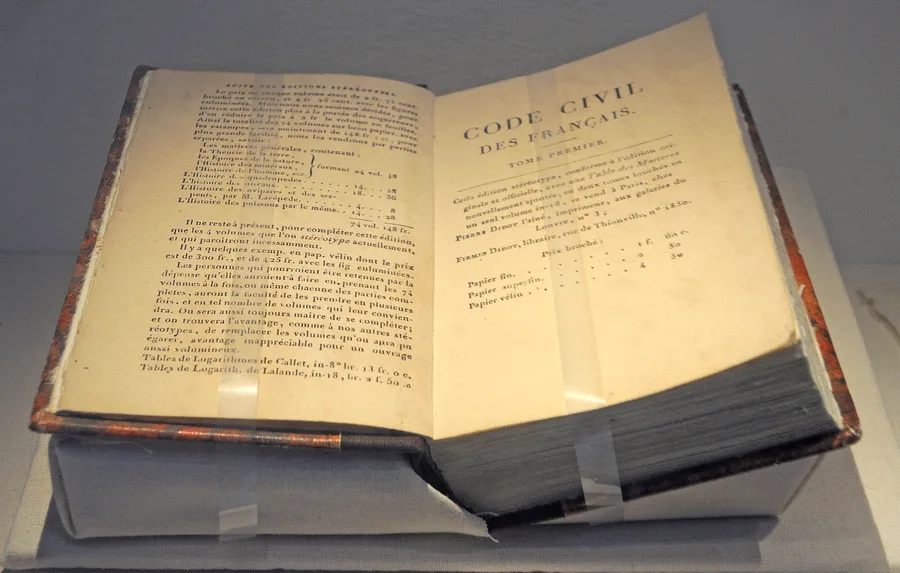
Looking again at the spare, functional object of the 1808 edition, one sees not a relic, but a piece of immensely powerful technology. It is a book designed not for aesthetic pleasure but for practical application. Its clean typography and official stamp are the physical manifestation of an idea: that a society can be consciously designed and rationally ordered, that a nation can be written into being. Two centuries on, we still live in the world that this book, and the revolution it codified in black ink, helped to build.
Seen at auction: Jura Enchères