
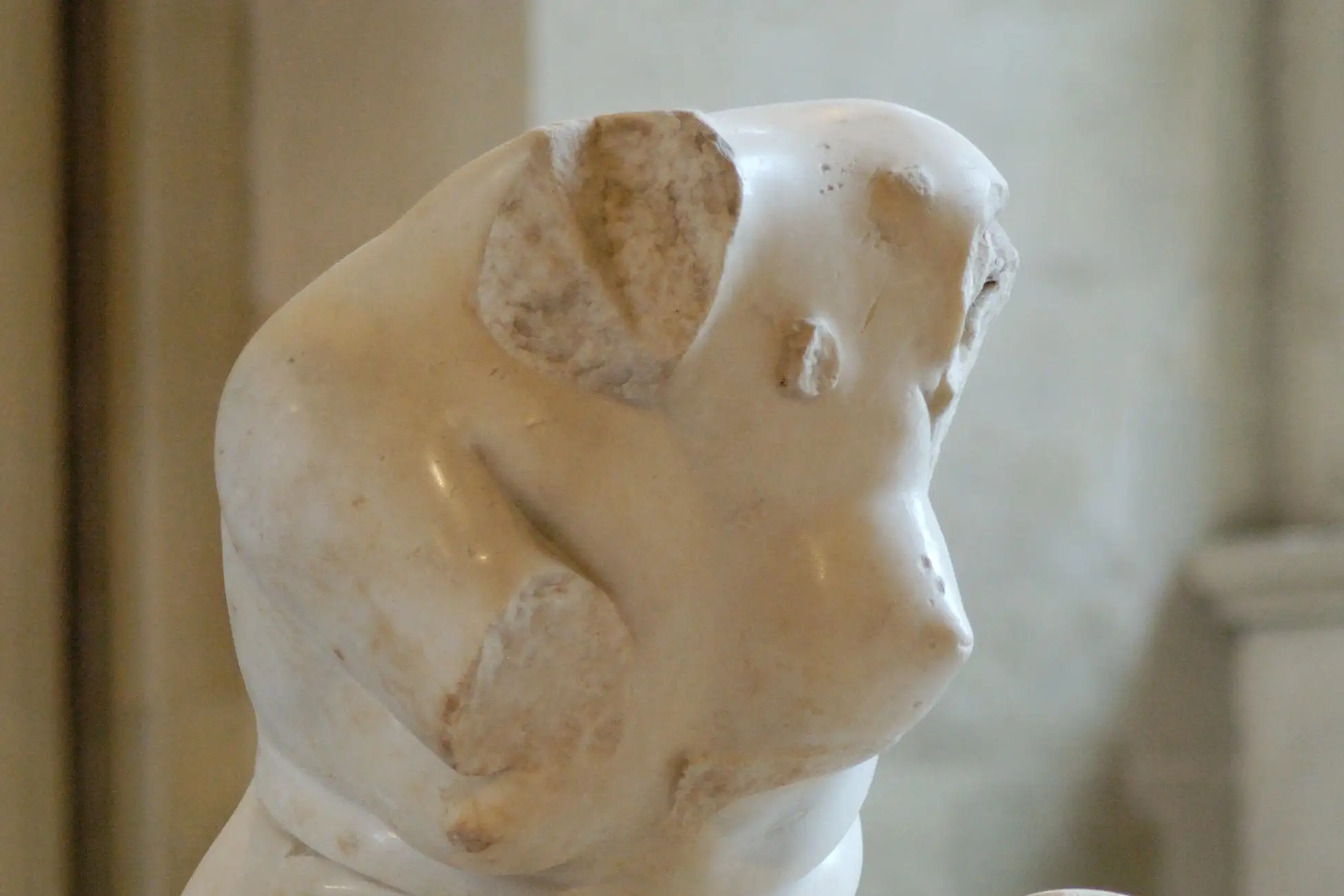
The fragment of a statue of a nude woman, which we reproduce here from various angles, was discovered about half a century ago on a property in Sainte-Colombe, a suburb of Vienne in the Dauphiné region, on the right bank of the Rhône. Prosper Mérimée spoke of it with admiration in his Notes d'un voyage dans le midi de la France, and Henri Beyle (Stendhal) celebrated it after him in his Mémoires d'un touriste.
Discovery and Identification
In 1877, the fragment was featured at the Exposition Rétrospective in Lyon, where it was identified as part of a statue of Latona. Monsieur Héron de Villefosse, an attaché at the Louvre Museum, was passing through Lyon at the time and was struck by the beauty of the piece. He brought photographs of it back to the Museum.
Based on these photographs, it was easy to recognize that the supposed Latona was, in fact, a beautiful replica of a type undoubtedly renowned in antiquity, given how often it was reproduced: the Crouching Venus. Our learned sculptor Coysevox had once believed he had found in this type the Venus that Phidias had made for the city of Elis, which, according to Pausanias, had one foot resting on a tortoise.
Indeed, inspired by one of the surviving replicas of the Crouching Venus, Coysevox executed a marble version, to which he added a tortoise and inscribed in Greek the name of Phidias with a dedication to the Eleans. After being one of the principal ornaments of the gardens of Versailles, this statue now stands in our Museum of Modern Sculpture, sheltered from the ravages of time, with a bronze copy in the Tuileries Garden.
The curator of Antiquities traveled to Lyon to examine the fragment from Vienne, which he deemed worthy of a place among the masterpieces we possess. The precious piece was shipped to the Louvre, and its acquisition was immediately decided. However, it could not be displayed in the galleries right away. It was largely covered with a kind of yellowish crust, contracted from a long stay in soil likely mixed with some iron oxide.
Freeing it from this crust required a lengthy effort by the workers of the Louvre's workshop known as the Atelier des Marbriers. This work consisted of removing the crust by wearing it down with pieces of soft wood, which could not damage the marble it concealed. Once this operation was completed, the fragment still had to be mounted on a pedestal in a position as close as possible to the one it must have had when the statue was whole.
After a few trials, it was recognized that it would be nearly impossible to succeed without restoring the two feet, which are missing today. Fortunately, their position could be easily determined from the replicas of the same type held in various collections.