The nineteenth century will leave its mark on the history of French sculpture. During this period, the art form underwent evolutions that consistently led to a more expressive truth. From Houdon to Rude, from Rude to Carpeaux, and from Carpeaux to Rodin, the era produced a succession of unforgettable creations. It matters little if, alongside these great names, a few mediocre artists prospered. Around the robust oak, the fern flourishes for a season. But when spring returns, who remembers the russet grasses glimpsed during the last autumn?
A New Path After Rodin
It seemed that after the triumphal labor of a figure like Rodin, everything that could be said in statuary had been said for a long time. Through his will, the conventional poses advocated by the Academic School had given way to movements derived from life and passion. A powerful modeling replaced the soft, impersonal craftsmanship that satisfied the studio masters. Yet that is not all; the Master, ever restless and in search of new expressions, indicated in certain works that the field he had so extensively cleared could still reveal surprises. He showed that young talents, even after him, had a fine opportunity, provided they worked with sincerity and a profound, complete knowledge of the statuary arts.
Lucien Schnegg fulfills all the required conditions of skill and taste. Little seduced by easy successes, he has slowly but surely conquered his place—perhaps the first among the young talents who seek to achieve beauty through a learned and free art. Compelled by the necessities of life to simultaneously pursue personal research and take on the jobs offered by decorators' workshops upon leaving the École, he trained himself in both fine art and decoration.
Forced to earn a living, like many less fortunate artists, he extended his activity, his personal mark, and his rare sense of modernism to all manner of statuary work. This applied whether he was creating a well-balanced figure, a bust of profound character, or a decorative group whose value lies as much in its color as in its purely sculptural qualities.
From Apprentice to Artist
Born in Bordeaux in 1864, Lucien Schnegg entered the workshop of an ornamentalist at a very young age. His master was a craftsman of the old school who loved his trade. This master was capable, after tracing a few brief indications on stone, of carving directly into the material—in the manner of eighteenth-century artists—one of those supple, ingenious ornamentations that the flourishes of Art Nouveau have not managed to replace. The apprentice quickly acquired a real skill that allowed him to try his luck in Parisian life, not as an artist, however, but as a craftsman.
In 1880, he was in Paris, working as a woodcarver in the Faubourg Saint-Antoine. When the workday was over, he prepared for his artistic education by attending evening classes. A sculpture of Saint Sebastian earned him a scholarship from his native city, allowing him to leave the workshop in the faubourg for the École des Beaux-Arts, where he became a student of Falguière.
Schnegg frequented the Rue Bonaparte as little as he could. He loved life and sought it outside: in the faubourgs, where one could still find handsome boys and girls with supple figures. He roamed the Louvre, the sculpture museum at the Trocadéro, and sometimes also the Rue de l'Université, where Rodin had his studio. However, he was not admitted into the master's inner circle until much later, on the recommendation of his already excellent works, which Rodin had noticed.
Whether in the open street under the free light, at the École des Beaux-Arts, or in the decorators' workshops where his gifts were quickly appreciated, his education was perfected, leading him toward mastery. Besides, when clay and the modeling tool were not at hand, he always found a pencil and a sheet of paper to note his projects, to capture attitudes glimpsed or imagined. He has drawn a great deal and still draws on every occasion. I know of nude studies by him that are of admirable quality. His works are always preceded by numerous sketches of both ensembles and details. The work of execution is thus simplified, for the eye has fixed the volumes and the hand, the lines.
The Emergence of a Master
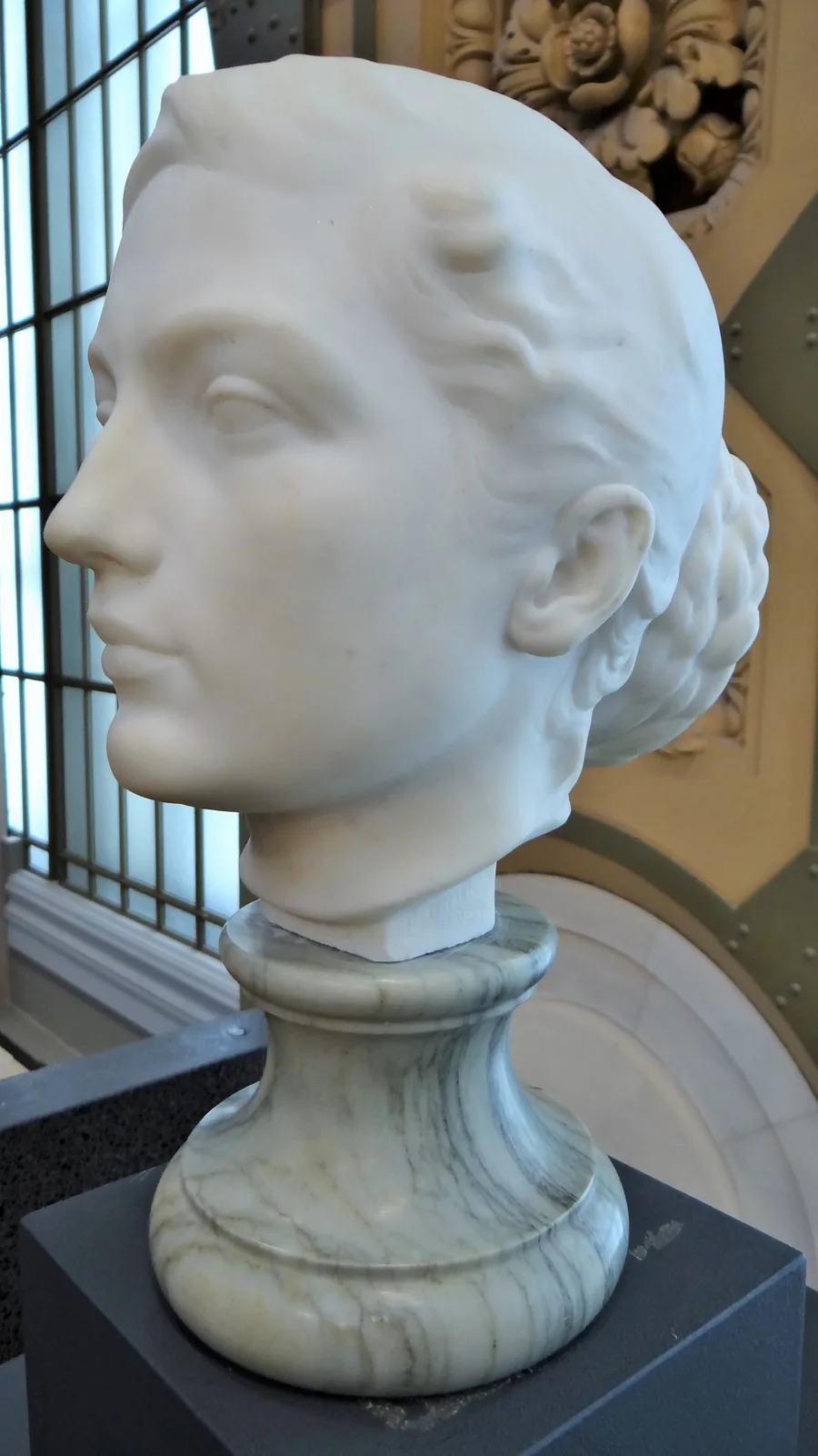
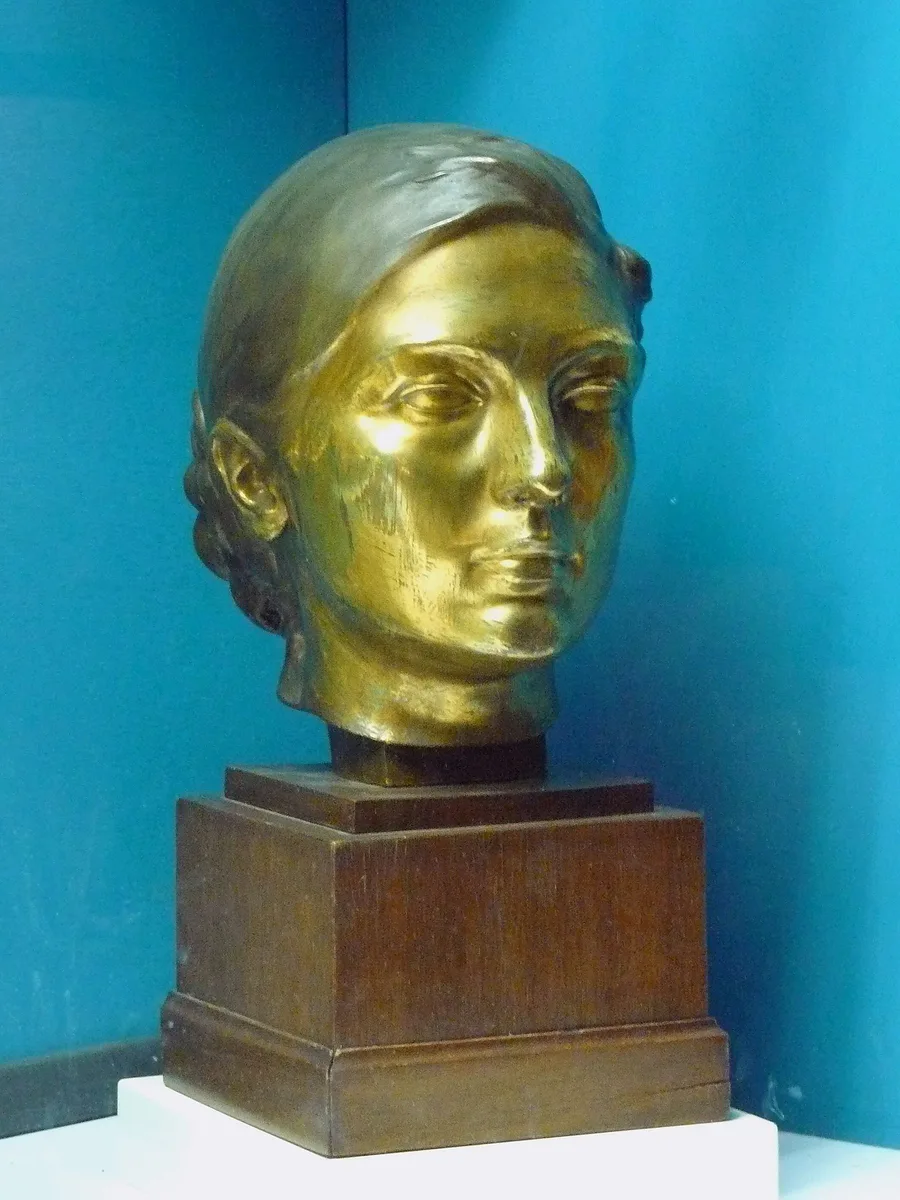
When he made his debut at the Salon of 1887 with the bust of his brother, the sculptor Gaston Schnegg, he was still a student. When, in 1894, he presented a Fontaine décorative (Decorative Fountain) to the Société Nationale des Beaux-Arts, his submission already revealed a distinct personality. A few years later, he would definitively be a master. The Buste de Jeune femme (Bust of a Young Woman), executed in 1899 and placed in the Musée du Luxembourg since 1902, is proof of this: it is as simple as an ancient Greek work from the great classical period.
Let us return to the fountain exhibited at the Salon of 1894. It had been the subject of a competition organized by the city of Toul, which had inherited a sum of 30,000 francs. Lucien Schnegg won the first prize. The artist undertook this work with great joy. Until then, he had worked a great deal for others, mainly in the building trade. But these jobs had not been without profit. He sensed what beautiful works would still be possible if there were a close link between statuary and architecture.
Thus, once the main lines were established and the slightest projections carefully studied, he executed the entire monument himself, tending with equal love to the sculptural part and the ornaments that complemented it. The result was a work of rare decorative unity, a close relative, in its elegant simplicity and the perfection of its details, to works of the same kind bequeathed by the sculptors of the early French Renaissance.
This success was followed by a harsh reality. After the transport contractors were reimbursed and the labor paid, Schnegg found himself still indebted to the marble worker for a hefty sum. He had to return to the contractors, to the construction sites, to free himself from the debt he had incurred. It was a sad obligation that took several years of his life and prevented him from realizing the works he dreamed of: the lovely fountain La Vigne (The Vine), which he hoped to erect in Bordeaux, and a more colossal composition where four robust athletes, bent to the will of the supple Mercury, symbolized the natural forces disciplined by human industry.
It was indeed impossible to undertake large pieces while executing for himself, for the purpose of study, those fine statuettes that, when revisited, would become exquisite pieces, and above all, those admirable busts where the observation of the type and the demands of form and modeling are pushed to their ultimate limits.
The Soul in Sculpture
His models were his wife, his friends, and especially his two little girls. Here is a baby of a few months, with a high forehead, a bumpy skull, fresh and full cheeks, a greedy mouth, and a look of wonder. The little face takes shape, lights up, speaks: it is life itself.
Should a veil come to protect the fragile little being's head, framing its features, the effect becomes different. Without abolishing the resemblance, the veil, with its broad masses, gives the bust a decorative amplitude, bringing to mind, without resembling it, some marvelous creation by Houdon, who also knew how to make the most of a trifle. But the child grows. The unconscious delight of early age is succeeded by will, then by reflection. The little girl who still expresses herself with difficulty, whose gait is unsteady, already has worries, daydreams. With her hand supporting her little head, she thinks.
Then there are the two little girls brought together in a lovely group: the elder already maternal, the other regretting the inaction required by the pose and warding off boredom by sucking on her little hands. These highly successful pieces are not an accident in the sculptor's body of work. One should not believe that if Schnegg has risen so high, it is because the little beings he represented were a part of himself, that he recognized himself in them, finding in the sketch of a gesture the indication of his own will.
When he was faced with the face of a man or a woman, he also successfully expressed the moral character of the model along with the physical resemblance. Once this was achieved, he increasingly avoided getting lost in extreme detail, preferring the essential to particular accidents. But this essential is made of scrupulous observation, of accents blended into a superior modeling, so refined that the work disappears and is summed up in a figure of light whose masses present such an accent of truth that one has the impression of living, mobile life.
Portraits of Truth and Light
The Musée du Luxembourg possesses a Buste de Jeune Femme by Lucien Schnegg, which is admired by knowledgeable connoisseurs, sincere artists, and scholars to whom Hellenic art has been extensively revealed. Yet the young woman has not adorned herself to be beautiful; no curl disturbs the line of her abundant hair, gathered at the back of her head in a thick braid. Her gaze is direct and a little haughty, but her pure features speak of moral balance.
The muscles of her face reveal energy, her forehead is beautiful, her nose straight, and her mouth delicate and kind, though serious. For those who can see, this bust is a magnificent lesson in art, a work that is profoundly of our time. But for the instinctive, who are entirely in the impression of the moment, it will be above all a moving piece of sculpture worthy of the most beautiful eras.
Who would believe it? This work, which is one of the prides of the Musée du Luxembourg where it entered in 1902, was presented to the jury of the Exposition Universelle of 1900 and was rejected. And yet, this jury included a number of artists and writers with innovative pretensions. Whom can one trust? I must acknowledge, however, that this same jury—augmented by foreign jurors, it is true—awarded a gold medal to Lucien Schnegg during the prize-giving vote.
I also seem to find some of the features of the same young woman in the beautiful figure of Aphrodite, emerging enigmatically from a block of marble. Do this pure face and this far-seeing gaze truly belong to Aphrodite? Does this work not rather evoke Pallas, the wise and just goddess who emerged pure from the brow of Zeus, just as this figure emerges perfect from the fine-grained marble? In any case, the importance lies not in a title but in the merit of the figure, in the perfection of its modeling, which resolves into a work made entirely of light.
There are no harsh shadows, nor any broken lines simulating the ardor of execution, in another delicate bust of a woman whose intelligent and distinguished profile reveals her moral qualities. The same is true of a very recent bust of a young girl on the verge of womanhood: a troubling moment for a being whose destiny is about to change. She is very much of this time, this child; her costume, her hair, almost still reveal the schoolgirl. However, one hesitates a little, one thinks in spite of oneself of certain figures from Chartres Cathedral that have this harmony of lines, this candor in their expression.
But once this is noted, a small detail, essential nonetheless, reveals the powerful modernity of the work.
The Character of Men and Women
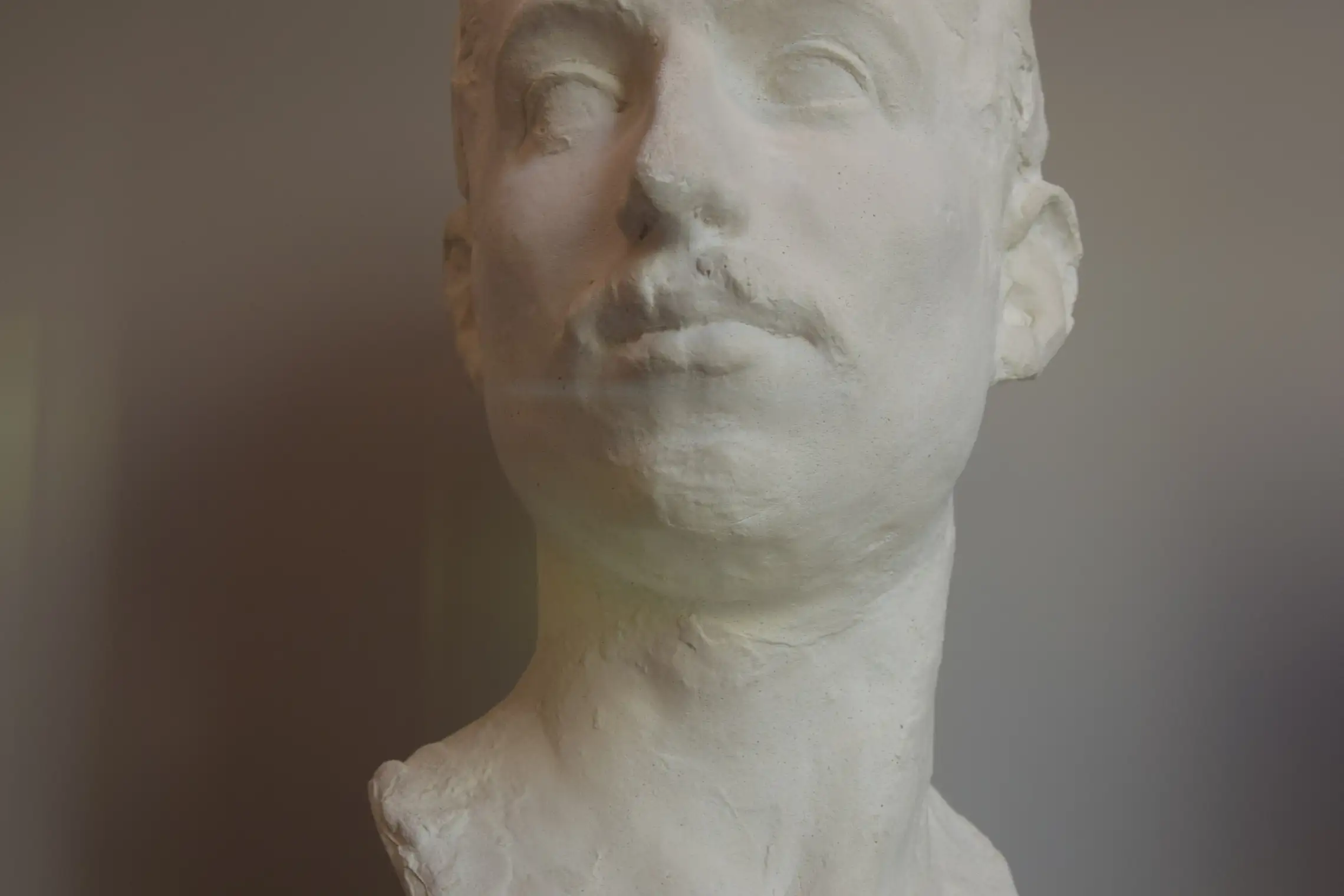
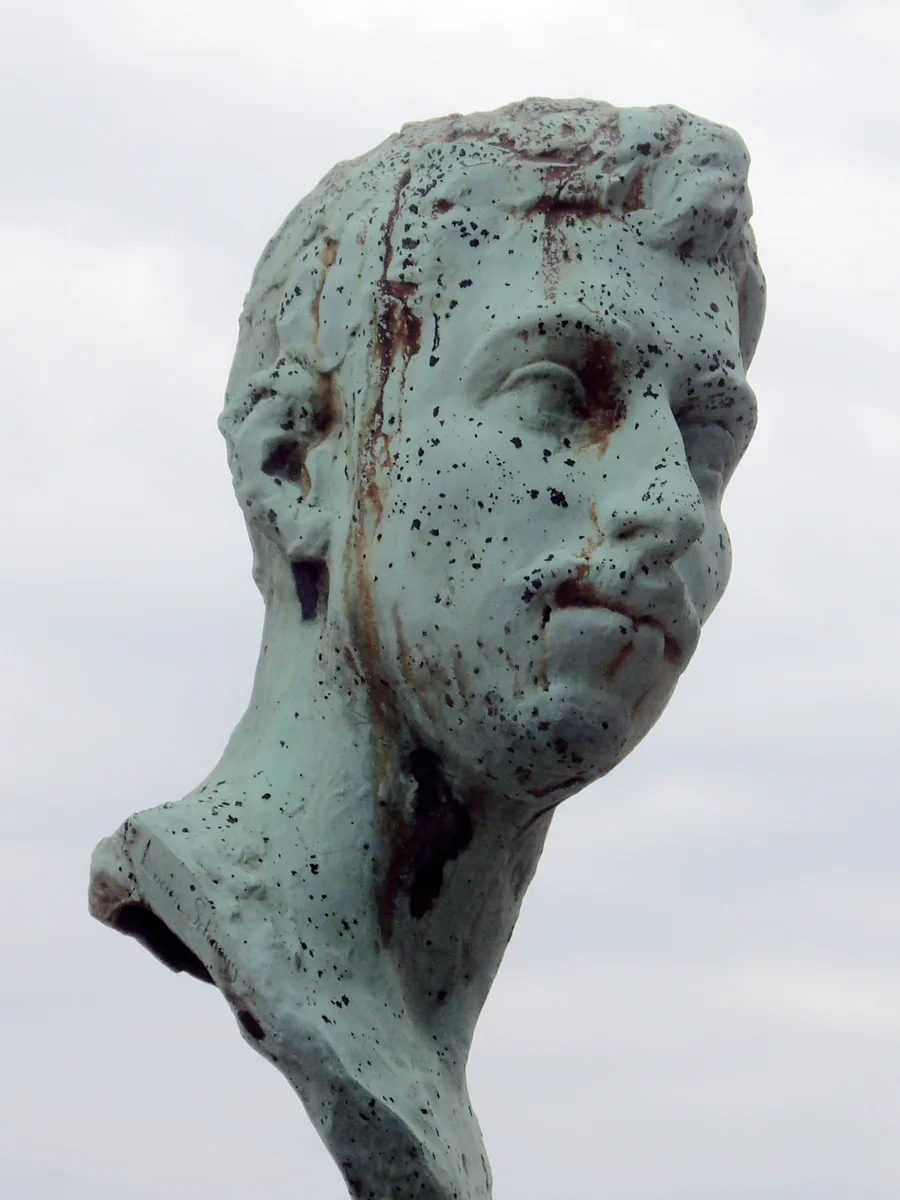
The face of a woman is imbued with a mysterious reserve, which prevents one from freely scrutinizing her inner life. In that of a man, there is no more frankness, but more impulsive will. The Buste de M. D..., modeled in 1898, is particularly characteristic of Schnegg's work. The model's ardent, sensual temperament, capable of kindness nonetheless, is entirely revealed in this physiognomy with its well-defined features: the strong nose, the thick lip, the heavy eyelids, the premature crow's feet.
The marvel of all this is that Lucien Schnegg has no pretensions to psychology. If his sculpture reveals certain moral characteristics, it is because of its extreme perfection. Schnegg models with the same scrupulousness that Ingres brought to his lead-pencil drawings. Both arrive at the same surprising result.
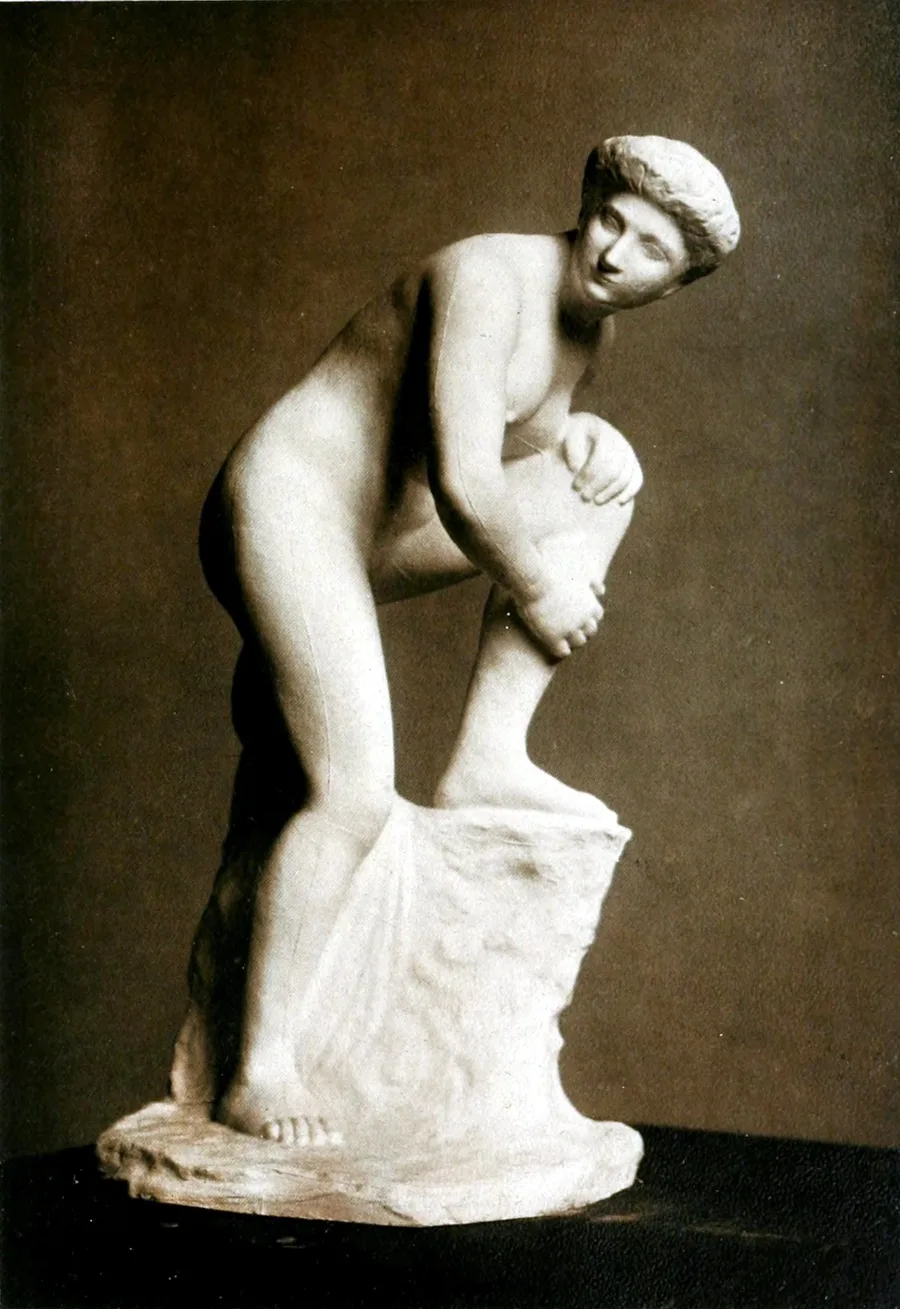
Alongside these busts, Lucien Schnegg has executed numerous statuettes and a few figures. Here, the intellectuality of the model and the essential character of a face no longer hold the same importance. He allows himself to be captivated by the elegance of forms, the graceful balance of a pose. Under his thumb, living silhouettes of ineffable charm are born. I know of a statuette of a Landaise woman—a slender figure with sinewy legs and a firm chest—a type that would have enchanted a Jean Goujon or a Germain Pilon, from which Schnegg has drawn a marvelous effect.
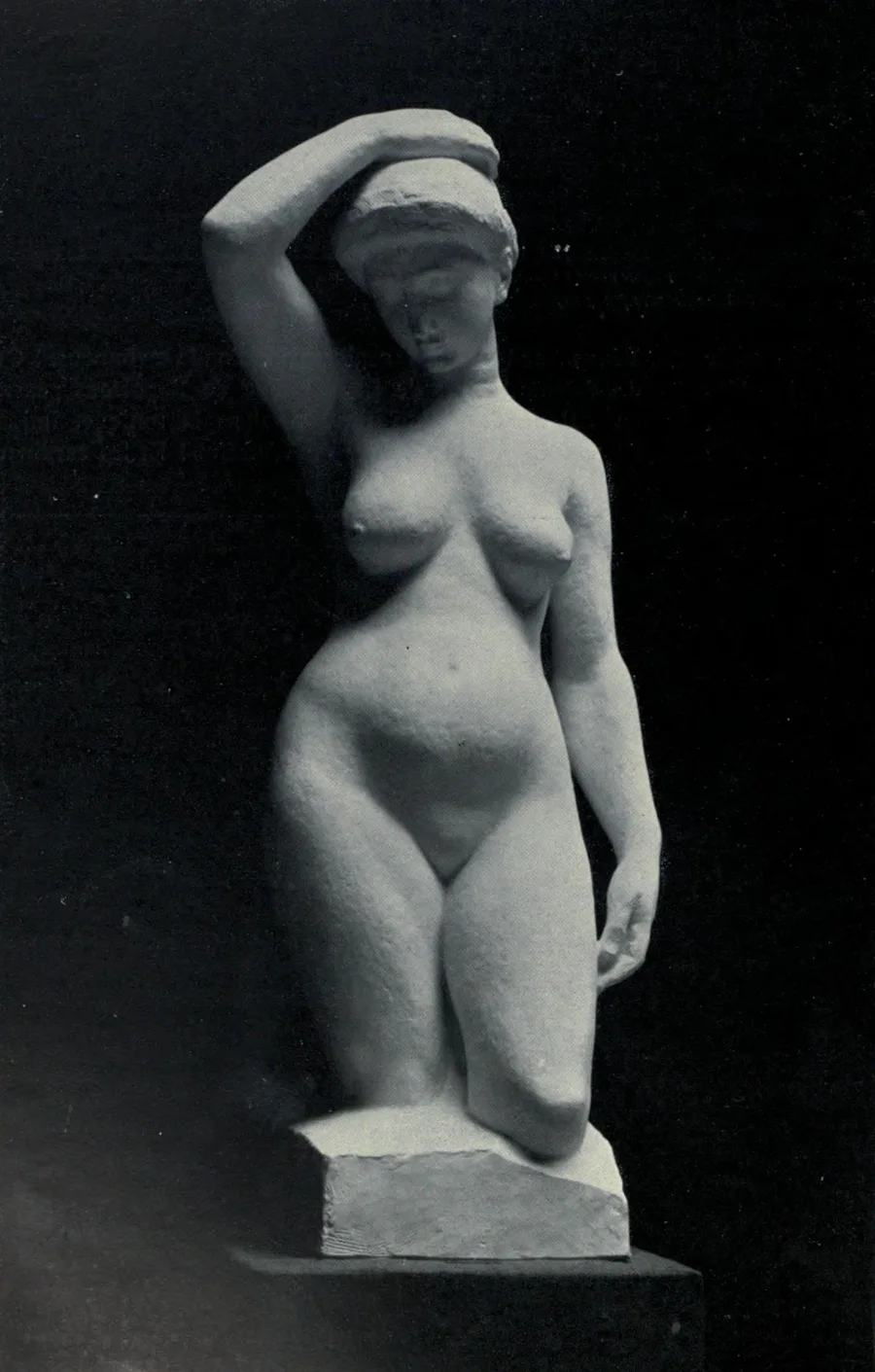
In contrast, here is a nature of a completely different kind, plump and chubby. Light envelops her silhouette, caresses her full forms, her gentle face that leans forward, a little embarrassed by the gazes fixed upon her nudity. It is charming. These studies, which have no other purpose than to allow the artist to remain in direct contact with nature even when executing decorative works where the truth of detail is subordinated to the necessities of the whole, have rarely been exhibited. Revisited, they nonetheless allow him to create imposing realizations like the large female figure, Vénus, which appeared at the Salon of 1906.
It is a piece of high character that, with its deliberate mutilations, seemed torn from the altar of an Attic temple. These mutilations are provisional, for Schnegg has little esteem for works that derive part of their interest from the contrast between perfect parts and loosely rendered or absent ones. Thus, he intends to make this statue a woman of our time, a complete creature whose arms will have a function and whose posture will have a purpose.
The Sculptor as Decorator
The sculptor Lucien Schnegg, as we know, is also a decorator. As early as 1894, regarding the fountain of Toul, he declared to Mr. Paul Leroi:1
I have the satisfaction of executing a complete work in which I am both the ornamentalist and the sculptor. I am happy to marry sculpture to architecture. That has been and always will be my great preoccupation.
And the works he has executed since, however arid they may have been, prove that he has always been concerned with respecting the essential principles of decorative sculpture. Thus, the pieces for which the "building" trade is indebted to him are valuable not only for the ingenuity of their composition and the excellence of their forms, but also for the pleasing effect they produce on the bare surfaces of the construction. Colorful and legible, they appear indispensable.
One has proof of this when examining the sober decoration he executed for the building constructed by Charles Plumet at 50 Avenue Victor-Hugo, and particularly the frame of the entrance door, where two elegant figures stand out in a happy rhythm. He achieved similar success with Le Printemps (Spring), a high-relief that decorates the perimeter of the inner courtyard of the Hôtel Dufayel on the Avenue des Champs-Elysées. The figure of the woman and that of the child retain all their grace against the background of foliage, indicated in half-tone without any harsh shadows.
Grand Architectural Projects
When he had to draw inspiration from past styles, as he was constrained to do in the exterior decoration of a private mansion on the Rue des Belles-Feuilles, he nevertheless retained his fine qualities and rejuvenated aged motifs with ingenious arrangements.
Finally, Lucien Schnegg is currently executing the two pediments of the Hôtel Astora, a luxurious caravanserai built by the architect Rives at the roundabout of the Arc de Triomphe. On the side of the Avenue des Champs-Elysées, it will be Psyché abordant les rives fleuries de la Seine (Psyche Arriving on the Flowered Banks of the Seine), and on the Avenue Marceau, La Ville de Paris encourageant les sciences et les arts (The City of Paris Encouraging the Sciences and the Arts).
The allegory is clear, without being overloaded. On each pediment, the main figure, elegant and fine, accompanied by two nude children presenting the essential attributes, will stand out in light against the background, which, through well-placed projections, will cast a soft shadow around the groups.
And these rhythmic and colorful allegories will appear as favorable omens to the travelers who will be drawn to the monument they dominate. It is so well situated! A stone's throw from the triumphal Arch, beyond which, each evening, the sun comes to die. A glorious agony that adorns the skies of Paris with an ever-new splendor and transfigures the city, its monuments, its fountains, its statues, its people!
CHARLES SAUNIER.