
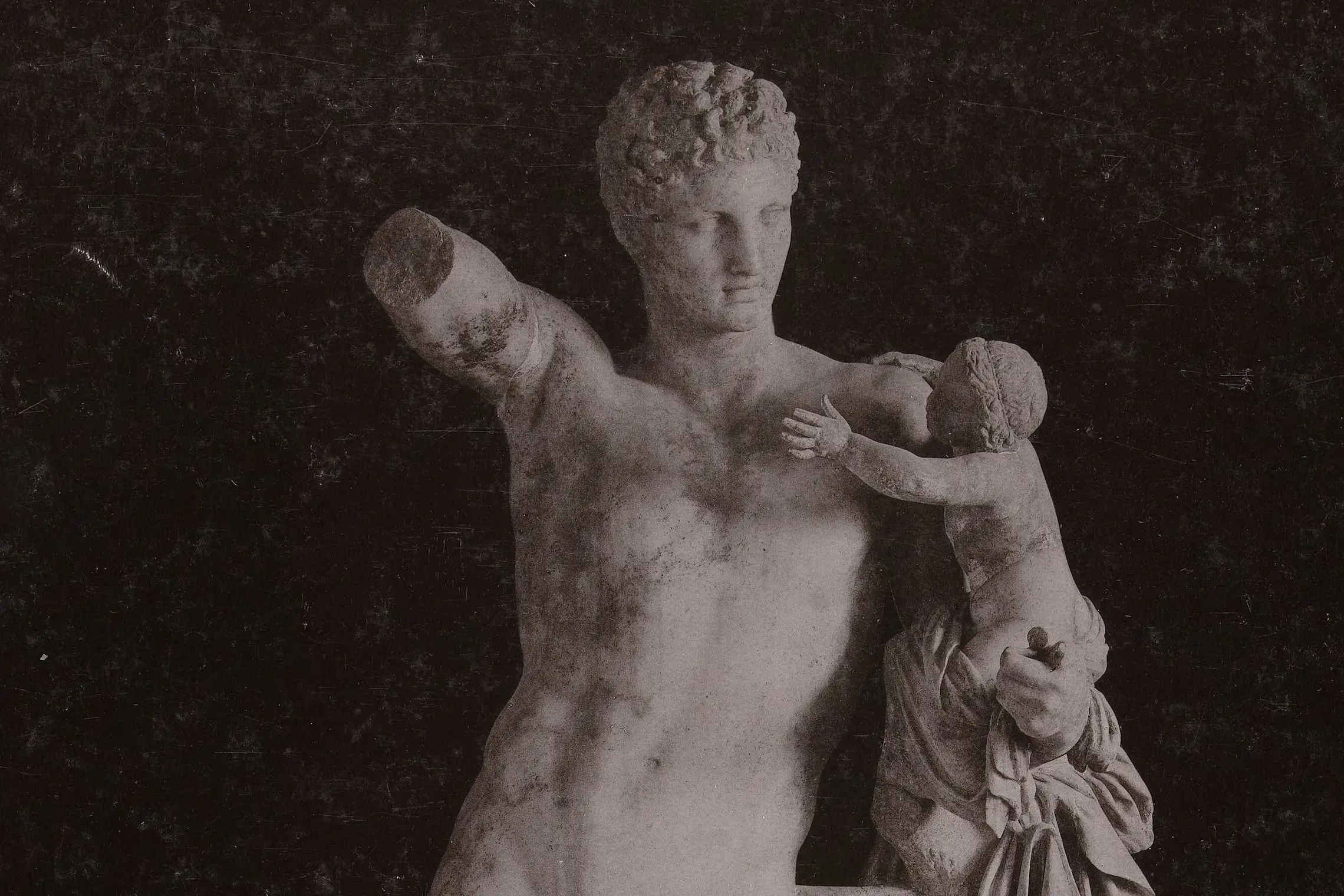
The attribution of the Hermes of Olympia to the great Praxiteles rests on the testimony of Pausanias. In his description of the Heraion, or temple of Hera, the Periegete mentions a marble group by Praxiteles, representing the infant Dionysus carried by Hermes, which corresponds in every respect to the statue discovered in May 1877. The identity of the work being indisputable, the attribution by Pausanias was eagerly accepted, without even a thought of verifying it.
A Contested Attribution
The attribution of the Hermes of Olympia to the great Praxiteles rests on the testimony of Pausanias. In his description of the Heraion, or temple of Hera, the Periegete mentions a marble group by Praxiteles, representing the infant Dionysus carried by Hermes, which corresponds in every respect to the statue discovered in May 1877. The identity of the work being indisputable, the attribution by Pausanias was eagerly accepted, without even a thought of verifying it.
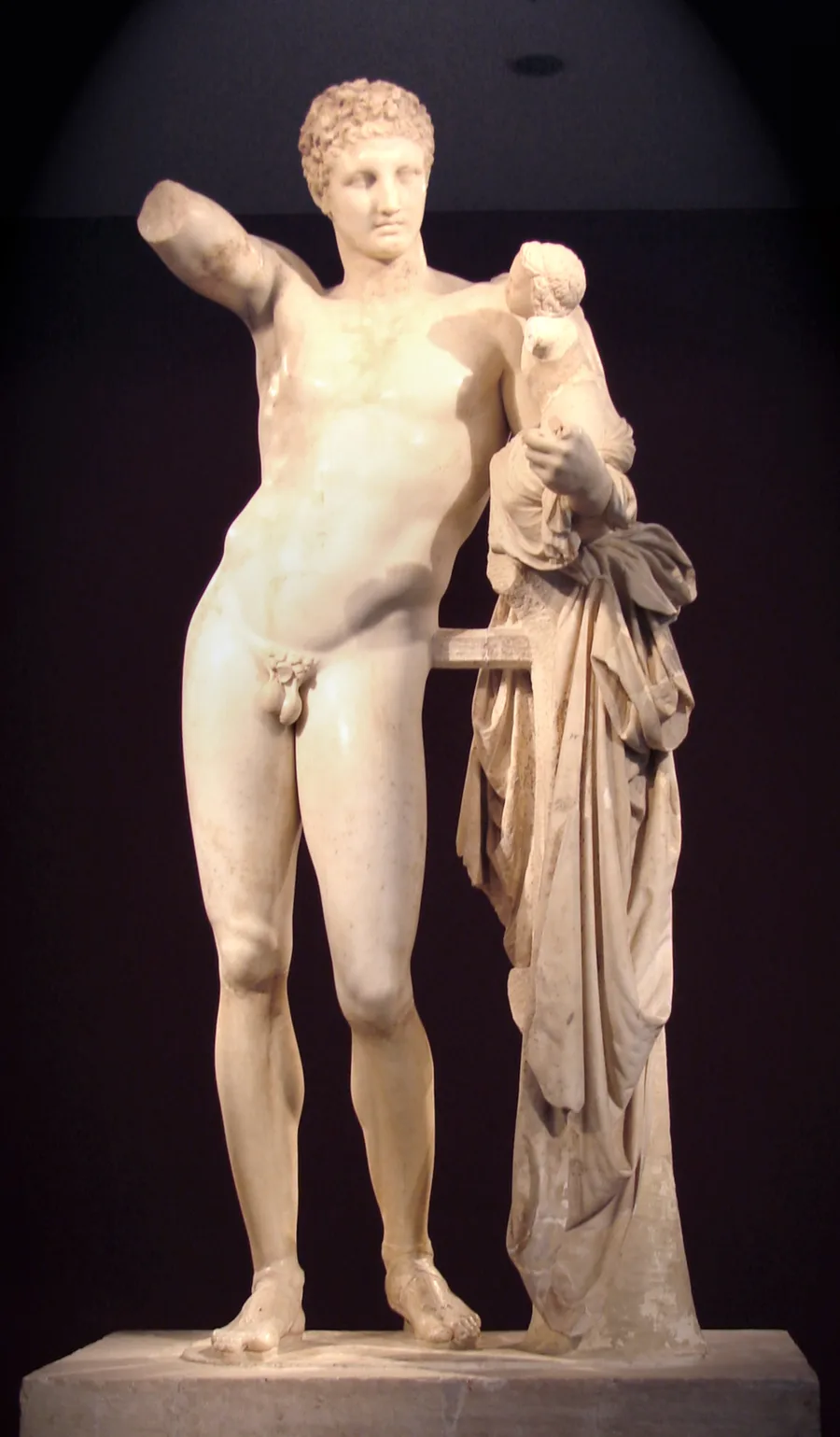
Only Olivier Rayet, in an 1880 article in the Gazette des Beaux-Arts on the then-recent excavations at Olympia, presented another opinion.1 For lack of having been developed, however, it did not receive the attention it deserved. Rayet had very astutely noted that the statue is mentioned not only by Pausanias but also by Pliny the Elder; the latter attributes it not to Praxiteles, but to Cephisodotus. The French scholar believed this latter attribution was the more trustworthy. Here are his own words:
Pausanias mentions this statue (the Hermes) and informs us that local tradition attributed it to Praxiteles; Pliny, on the contrary, speaks of it as the work of Cephisodotus. It goes without saying that the Germans have enthusiastically adopted the first attribution. The sight of the marble itself would incline me, I confess, toward the second and less glorious one; there are, in fact, in this work, alongside a dazzling skill, certain poverties and drynesses of which I would be sorry if Praxiteles were capable. But I will return to this question in another article.
Unfortunately, the illustrious archaeologist died without writing that final article. I therefore propose to take his reflections as the starting point for the following research into the true author of the Hermes. This is a problem one would certainly wish to be able to approach from an aesthetic point of view; but for that, we lack the true touchstone: authentic originals by Cephisodotus and Praxiteles that could guide us in these very delicate questions of morphology, upon which the exact attribution of a work primarily depends. On the other hand, objective criticism forbids any attribution based solely on what ancient texts tell us about the art of Praxiteles.