
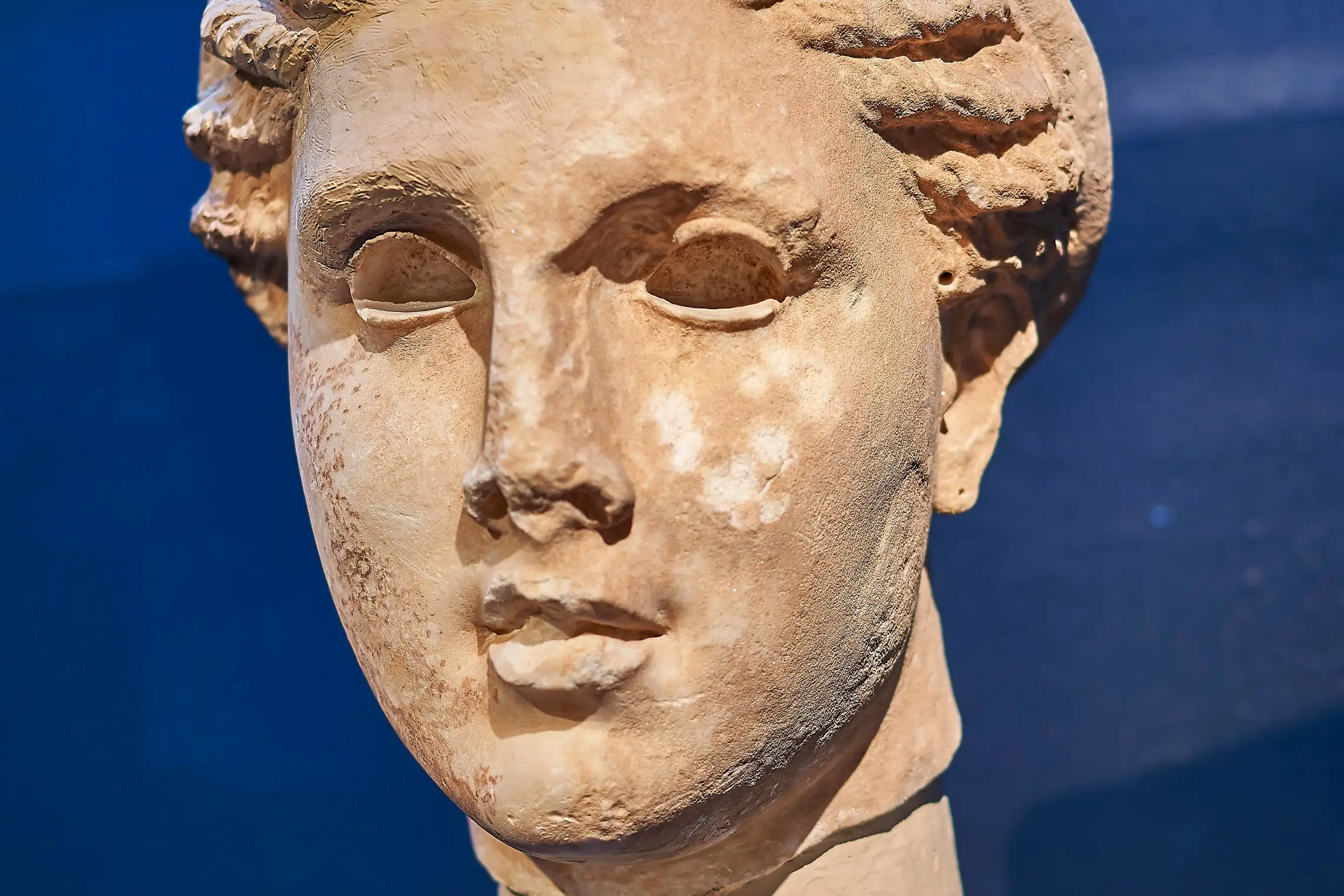
We would have liked to publish, in this tenth installment of the "Courrier de l'Art Antique," some examples of the beautiful sculptures that the excavations of our French School at Delphi have brought to light since April 1893.1 Unfortunately, while photographs of them exist, they have not yet appeared in archaeological publications. Before reproducing them here, we must wait for the excavators to make them known, exercising a right that, after the joy of discovery, is the greatest satisfaction for explorers. These sculptures all belong to the Archaic period, which is to say that a certain initiation is required to appreciate them. A dozen marbles at most, in the vast collection of the Louvre, can give an advance idea of their style.
Consider, for example, the stele of Philis brought back from Thasos by Emmanuel Miller, which is placed in the same room as the sculptures from the Parthenon and Olympia; it will prepare you to understand the metope fragments from the Treasury of the Athenians at Delphi, which were discovered by the French School. The Treasury of the Athenians was a temple of the Doric order, built around 485 BCE with the spoils from the victory at Marathon. It is, therefore, a rather precisely dated edifice, belonging to a period all the more interesting to the historian because one can sense in it the transition between the florid archaism of the Peisistratids and the austere archaism of the time of Cimon, from which the masterpieces of Phidias emerged. The subjects of the sculptures relate to Theseus and Heracles, the Athenian heroes par excellence. There are exquisite pieces among them, notably an Athena, unfortunately headless, and a torso of Heracles, admirable in its finesse and vigor. As M. Homolle has said, "the archaic dryness is tempered by a suppleness of modeling, rare in works of the time, by something rich and enveloped that surprises and charms."2 Let us hope that our readers will soon be able to judge for themselves! The French School has every interest in satisfying, through prompt publications, the impatient curiosity of a public that does not spare its sympathy for its work.
It is not only underground, in museums, or in what is called the "dust of archives" that patient investigation uncovers new documents on the monuments of ancient art. The Greek and Latin texts that describe them have long been collected, commented upon, and even partially translated. And yet, the comparison of these texts, the meticulous study of their content, has not, it seems, had its final say. Strange as it may seem, it was not until 1893 that an Austrian scholar, M. Gurlitt, reconstructed the history of one of the most famous statues of antiquity, the great bronze Minerva of Phidias, using passages from authors already published but not yet utilized. The matter is worth examining in detail; it is, in fact, one of the most ingenious discoveries of our time.
The Lost Athena Promachos of Phidias
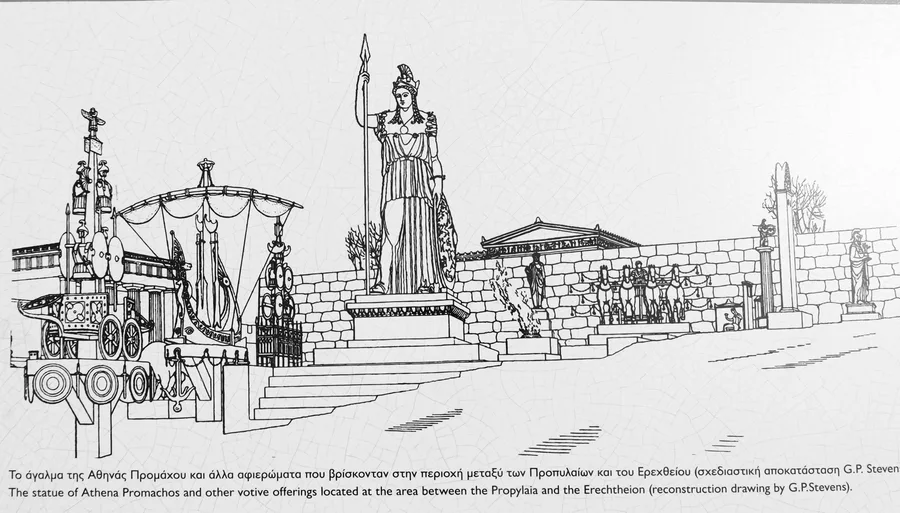
If one opens the first volume of M. Collignon's Histoire de la sculpture grecque (History of Greek Sculpture), published in 1892, one finds roughly the following: Under the government of Cimon, Phidias was commissioned to execute a colossal bronze statue of Athena, which was placed on the Acropolis. There, it later received the surname Promachos, meaning "she who fights in the front rank," or rather "the sentinel." A few Roman coins give us an idea of this statue. The sculptor had not constrained himself to reproducing the archaic type known from small bronzes predating the Persian Wars; the Promachos did not have a combat stance. Standing, motionless, clad in a double tunic forming straight and regular folds, she held in her right hand a spear that rested on the ground, its point level with her head; the straps of the shield were passed over her left arm. The direction of her head shows that she lowered her gaze toward the north flank of the Acropolis, as if to contemplate the city. The overall aspect of the statue was calm and severe. If we are to believe the historian Zosimus, when Alaric's Goths besieged the Acropolis, they were seized with terror at the sight of the armed goddess, who seemed to rise before them to repel them.3
The invasion of the Goths into Attica occurred in the year 396. Until now, it was believed that this date marked the last mention of Phidias's Promachos. Let us see how M. Gurlitt managed to establish that it survived in Constantinople for another eight centuries and the circumstances under which it perished there.4