The "tranquil harmony" and "grave dignity" found in Henri Martin's compositions borrow from no speculative language. Martin does not, like René Ménard, resort to the concepts of Greek culture to evoke images of an abolished cult on a deserted shore. His human figures and allegorical forms are born of his native light. They inhabit a well-irrigated, fertile French meadow, enlivened by the breaths of spring and the gentle palpitation of foliage. A love of life and a reverence for nature: these two terms seem to best define the personality of Henri Martin.
If one had to penetrate it more intimately, however, to mark it with a more individual seal, I would say that it strives, through natural means, toward a supernatural harmony, toward an aerial equilibrium that finds in its essence a perpetual renewal. I would say that there is in it less certainty than aspiration. This word satisfies the mind because in it one feels strength united with trembling, constancy with restlessness, and I know not what fever with I know not what serenity. In the very person of Henri Martin, in his face, in the tranquilly exalted figures with which he populates his principal compositions, in the gestures of his muses and the slender surge of his pines and poplars, I perceive the same tension toward the heights, the same premonition of a realm where fresher air and purer light might nourish souls with a more immaterial sustenance.
From Academicism to Impressionism
Henri Martin first received instruction from Jean-Paul Laurens. Under such a master, whom he never ceased to venerate, the artist was bound to absorb a commanding sense of concrete forms, a taste for grand character, and a rigorous approach to composition. It cannot be said that traditional practices led his early efforts astray. By imposing a constraint upon him, they made the development of his originality more laborious, more considered, and thus more valid. His break with the academic school was not, moreover, as abrupt as one might believe, and it only became definitive late in his career.
As early as 1885, however, Martin was turning toward a new horizon. Impressionism had won him over; or rather, he had annexed the technical conquests of Impressionism to his own conceptions.
The writer Jules Laforgue summarized these conquests quite well in a three-part formula:
The forms obtained not by contour-drawing but solely by the vibrations and contrasts of color;
Theoretical perspective (or: drawn perspective) replaced by the natural perspective of the vibrations and contrasts of colors;
Studio lighting—that is, the picture painted, whether it represents the street, the countryside, or an illuminated salon, in the even light of the studio and worked on at any hour—replaced by the open air (plein air).1
But let us not forget that the Impressionists were, above all, technicians, and in that capacity, creators of novelty. Their enterprise is therefore limited by an aesthetic that defines them. A direct emulation pits these artists against nature. They measure themselves against it, confronting it not to dominate it but to equal it by borrowing its own means. Their lyricism, constantly provoked, is incessantly expended. Nothing frees them from study. They pursue the relative, the instantaneous, in its most precarious manifestations.
This, however, is not at all the ambition of Henri Martin in principle. He is enamored of grand art and a grand style. He is drawn to vast syntheses, to a broad, simplifying idealization of nature, rather than to its deceptive transience. Though a lover of reality, he does not intend to let it dictate all his emotions; rather, he uses it to transfigure his dream of beauty with a more precise and living eloquence. As Camille Mauclair said of Ernest Laurent, one can say of Henri Martin that he "used Impressionist technique to reveal a wholly subjective art."2 Impressionism provides Martin with his language; it does not impose its inspiration.
It invites him to break free from the academy and helps him to renew tradition, but without separating him from it. His declared tendency is to ground intellectual evocations in reality. His temperament, entirely oriented toward the external world, does not repudiate the acquisitions of classical culture. If you enter his studio, you will find pinned to the wall drawings by Ingres and reproductions of the Greek marbles of the Parthenon, as well as works by Bellini, Carpaccio, Velázquez, and Whistler. It is quite significant that a painter whose most apparent preoccupation was the chromatic enrichment of the palette should be admired above all, in his paintings, for "the happy simplicity of the arrangements, the freshness of the poetic sentiment," and be designated by the great Puvis de Chavannes himself as his potential successor.
A Personal Approach to Divisionism
In any case, we must insist on Henri Martin's technical research, since it was the aspect of his work that was longest debated and that delayed his acceptance by the general public. In 1886, at the last exhibition of the Impressionist group, Camille and Lucien Pissarro, Paul Signac, and Georges Seurat were featured alongside Degas, Forain, Gauguin, and Guillaumin. Seurat, in particular, with his famous painting A Sunday on La Grande Jatte, established a new technique following the Impressionists, known as Neo-Impressionism or Chromo-Luminarism, based on the principle of division, or the substitution of optical mixing for pigmentary mixing.
Henri Martin adopted this divided touch—which claims descent from the "hatching-style modeling" of Constable and Delacroix, and whose equivalent can be found in the work of Turner, Fantin-Latour, and in the comma-like strokes of Jongkind—of his own accord, but not without reservations. That is to say, he drew a resource from it but did not become a slave to it. "Once the law of complementaries is known," wrote Charles Blanc, "with what sureness the painter will proceed." With too much sureness, perhaps. An excess of a-priorism (preconceived notions) would enter into his execution. He would know nature by heart, so to speak.
He would analyze it, decomposing it almost mechanically. A foolproof technique would henceforth be placed at the service of even mediocre talent. The importance of the subjective individual would be diminished in favor of an objective, absolute academic canon. With all empiricism excluded,3 it is spontaneity itself, and taste, that would be held in suspicion. A cliché of divisionism would soon be established, replacing manual skill with something just as dangerous: a sort of scientific infallibility. For it is indeed "a methodical and scientific technique" that Paul Signac contrasts with the "technique of instinct and inspiration" of the Impressionists.
Well, Henri Martin would not consent to have his instinct or his inspiration diminished. Within the limits imposed by the laws of his art and traced by his personal experience, he maintains a free and almost adventurous spirit. I think it is worthwhile to indicate how, as a close relative of a dual family of artists, he escapes what is overly exclusive and restrictive in both. Between Impressionism and Neo-Impressionism, if we must find him an elder brother, it is Pissarro who should be named for the finesse and coherence of his painted surface. It was Pissarro whom Signac reproached for having become dull in his later works, writing of him: "A direct descendant of Corot, he does not seek brilliance through opposition, like Delacroix, but softness through harmonies."
The Vibrating Softness of Light
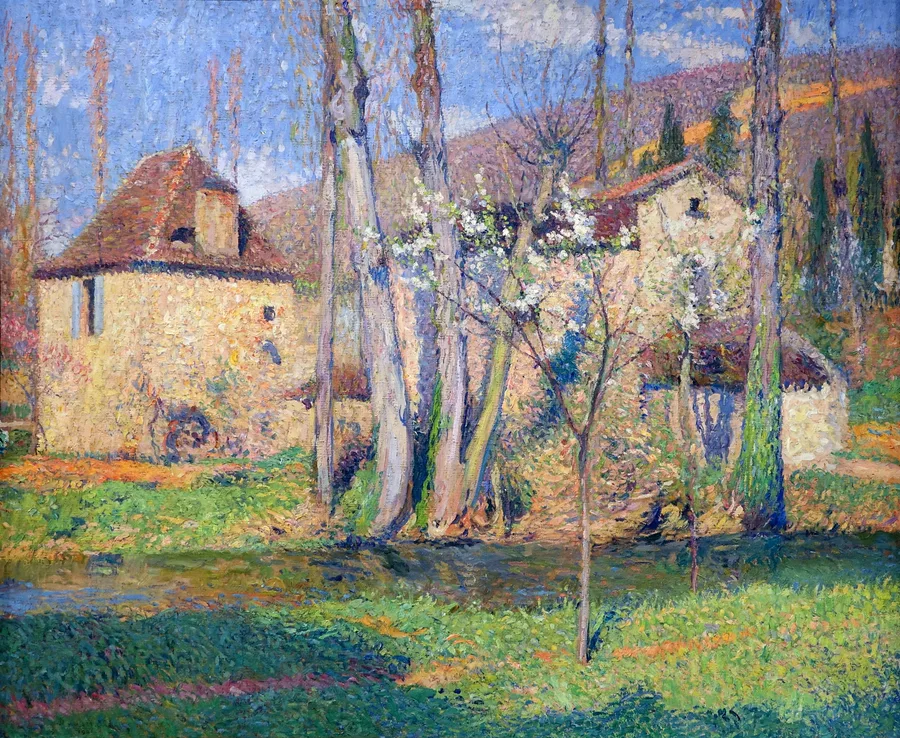
It is this vibrating softness that I would especially like to praise in Henri Martin. A painter of the open air and broad daylight, he knows how to guard against all brutality. His strength is delicate and nuanced. Consider the portrait of My Son Jacques: a young man stands against the light on the threshold of a garden. The form is luminous, both through the shadow and in spite of it. There is an encounter—not a clash, but a fusion—between light and shadow. The local color struggles gently against the atmospheric lighting. Each molecule of shadow seems to wage its own battle against a molecule of light that seeks to unite with it.
Henri Martin's painting expresses this continuous conflict. It rediscovers the mellow magic of chiaroscuro within the frank lighting of the plein air. See, in Sérénité (Serenity), how all the whites are tempered by a half-tint, and how in all the master's great compositions, the dematerialization of the figures is achieved through imperceptible transitions. Martin leads them toward the light, just as Carrière drew his figures toward the shadow.
In his depictions of undergrowth, shaded faces, and waters that would be dazzling if not for a veiling cloud, nowhere does an earthy color appear. Instead, one finds everywhere the infinitely nuanced range of grays, strongly saturated yet light. With its softness and freshness, this palette corrects crudities and mutes tones without discoloring them. There are blue-grays, green-grays, and violet-grays; slate, pewter, and silver grays; amber and golden grays. We see a powerful gray, like that of a Venetian palace that bears, without flinching, the immediate vicinity of a red and a yellow. The most vivid polychromy is never discordant because it is always supported by close relationships.
Flashes of precious stones are subordinated to the atmosphere that envelops them. And pressing in on all sides, modeling the forms, is indeed the lightness of the southern day and air. Martin has not only appreciated them with his eyes; he has breathed them, bathed in them. He knows them as the very substance of which he is made; he knows how they decompose and according to what subtle values objects are arranged within them.
An Intimate Vision of the French Landscape
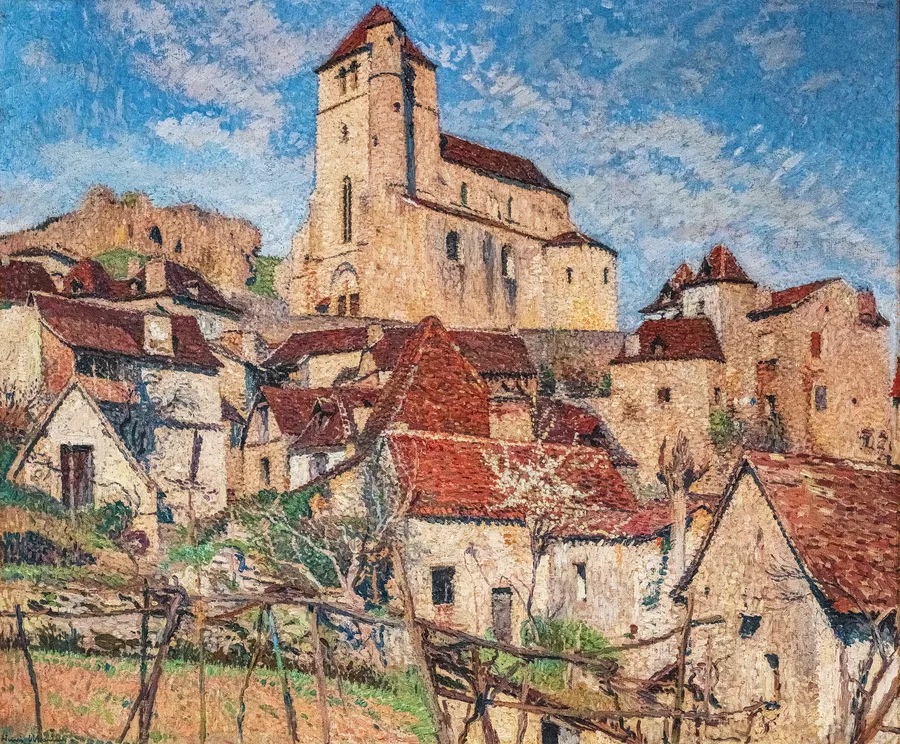
There is nothing mechanical, however, in his emotion, nothing repetitive in his brushwork. It involves neither supposition nor hearsay. The attention is always just as keen, the eye just as swift; the structure remains exact without servility, the color original without virtuosity. This is because at every step, the experience is renewed, along with the discovery, the astonishment, and the invention. Hence the individuality of his landscapes, according to the season, the day, and the hour in which they manifest. But the painter does not limit himself to the accuracy of an impression. Beneath the transience of effects, he knows how to observe the feeling of permanence.
Stripped of its finery, nature here would retain a mute eloquence, a "faded splendor."
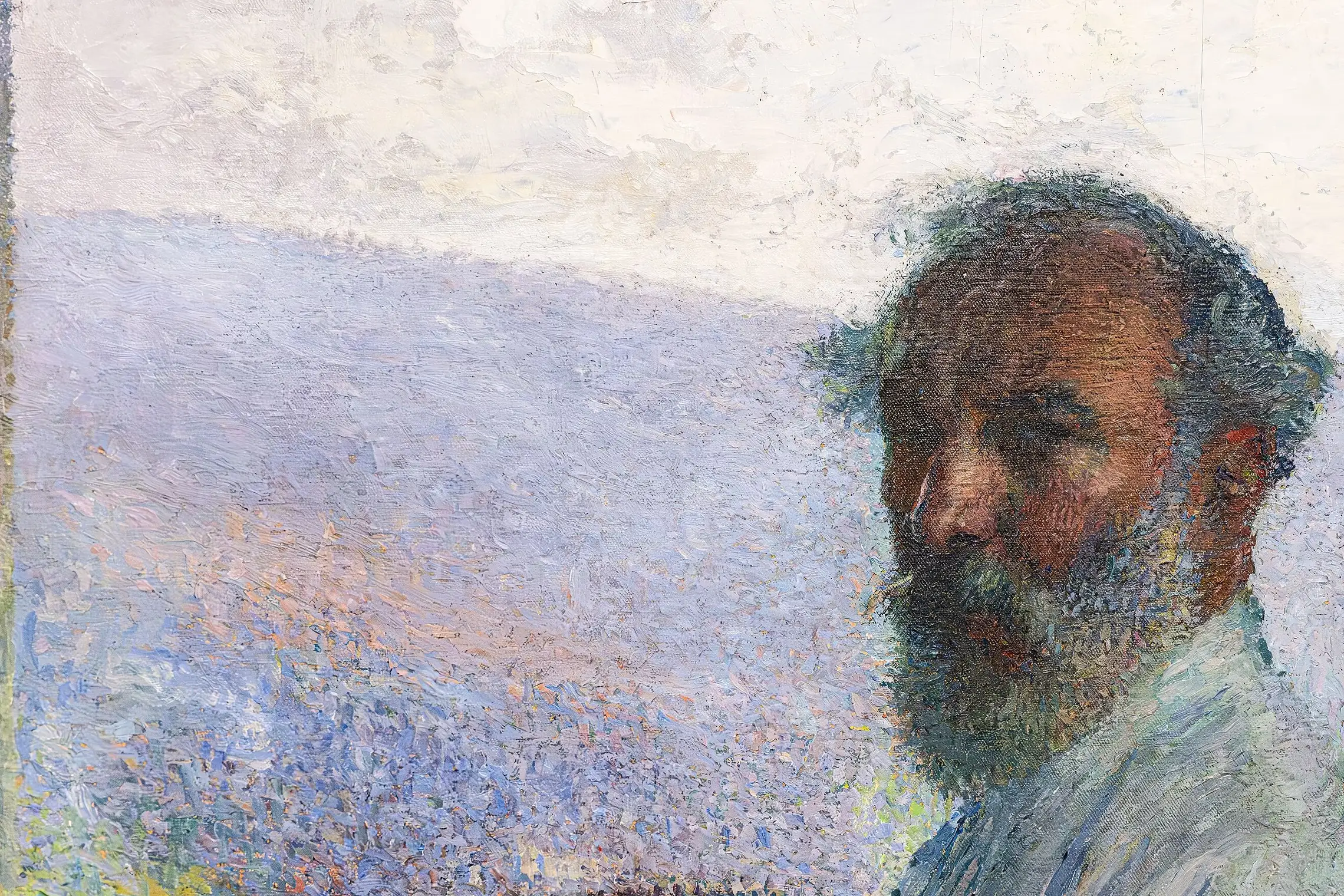
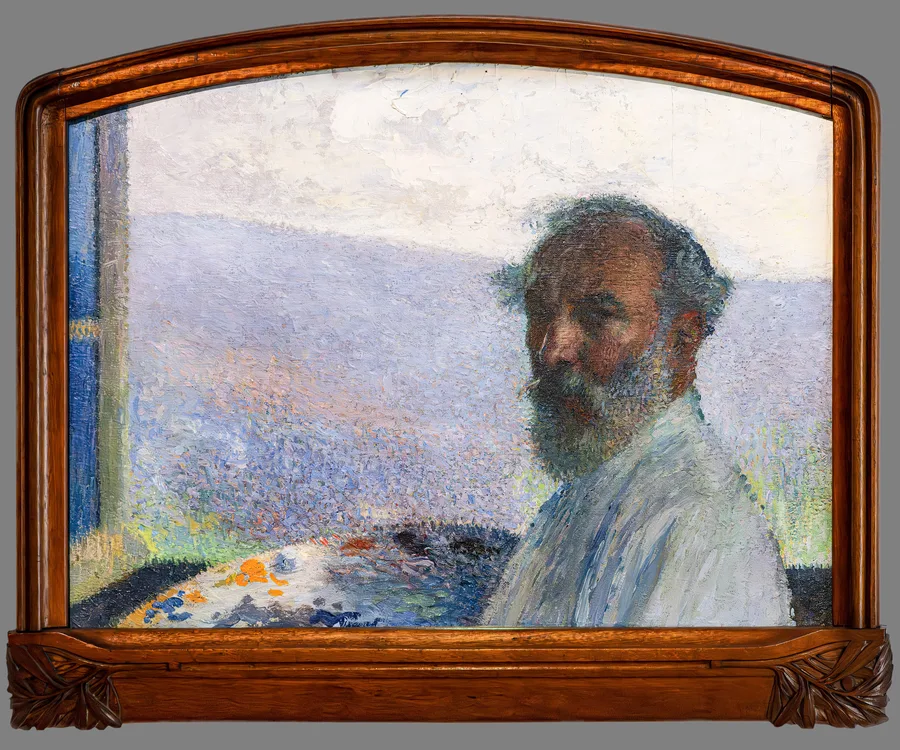
However feverish Martin may be in following these metamorphoses, his painting never retains the dishevelment of a pochade (a quick sketch). Haste is not visible in it; it produces no incoherence. The brush does not panic. It is held firm by a nervous hand, guided by the mind of that somewhat pale, ardent, and wise head, with its steel-like gaze—that head which, slightly inclined, meditates, discerns, prepares. This is how Bellery-Desfontaines depicted Henri Martin in a memorable portrait. Like his impressions, his language varies. At times it is a rich paste that solidifies as it accumulates; at others, it becomes lighter, more aerated, and volatilizes until it barely covers the canvas.
Here, pure tones are divided and opposed to represent the serene impassibility of nature; there, an abrupt swerve of the brush, a deep furrow marked in the paint, betrays an emotion. Depending on the effects, the touch expands or contracts; the molecules tighten like the squares of a mosaic or scatter like an untied bouquet. The brushwork not only models itself on the appearance of the materials to be represented but also adapts to their quality: a heavy sky, calm water, or deeply black hair absorbs the shimmer into its opacity.
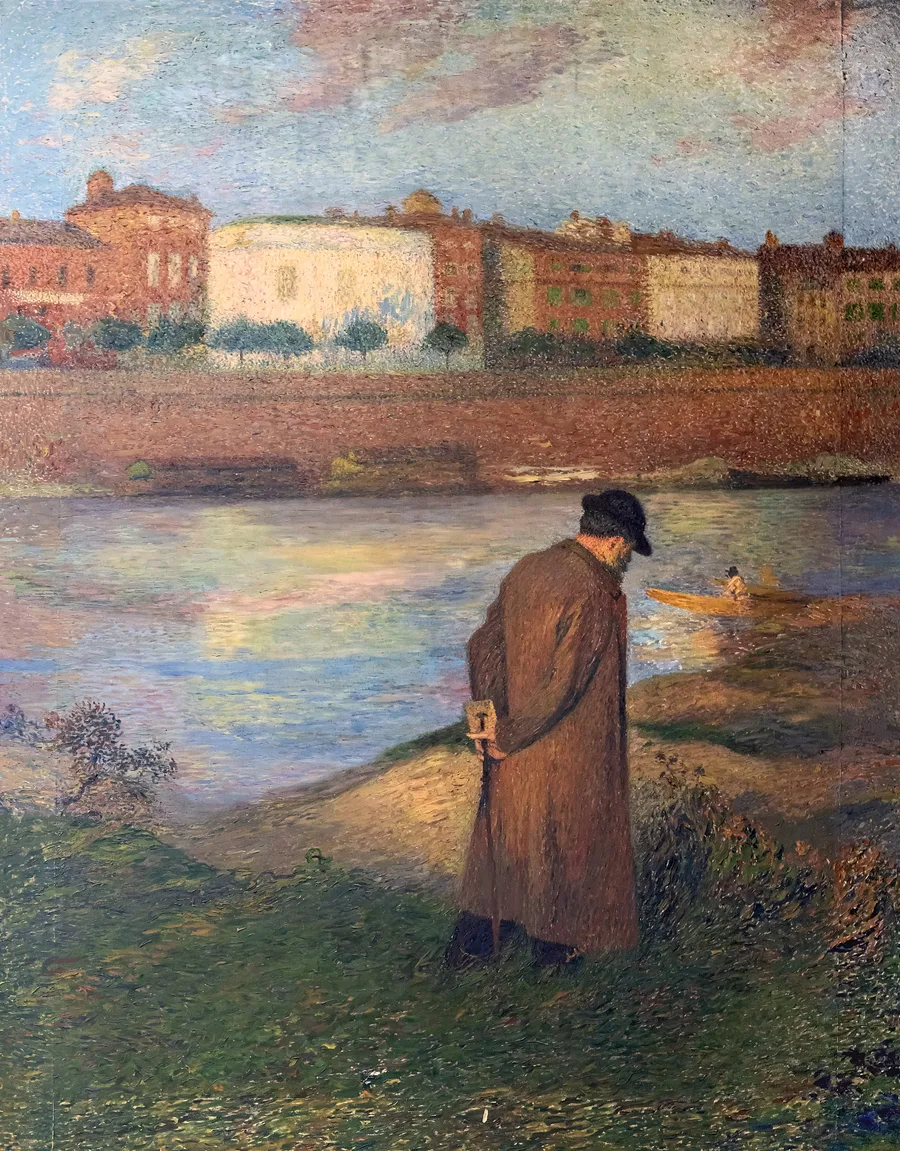
The fields—that amalgam of earth, air, season, and weather, reconstituted rather than described; the old farmhouses with their sun-soaked walls, their well-curbs, and their flowers; the gentle sylvan solitudes; the dappled hills; the meadows planted with slender poplars and crossed by the steely glint of a stream; the village, the church, and the small bridge of Labastide du Vent, with their own particular nuance, lovingly studied hour by hour in warm intimacy, and which haunt the memory like an irreplaceable recollection: such are the familiar motifs of Henri Martin. And if I do not speak of the beautiful studies he recently brought back from Venice, it is to better frame this French figure in his native setting.
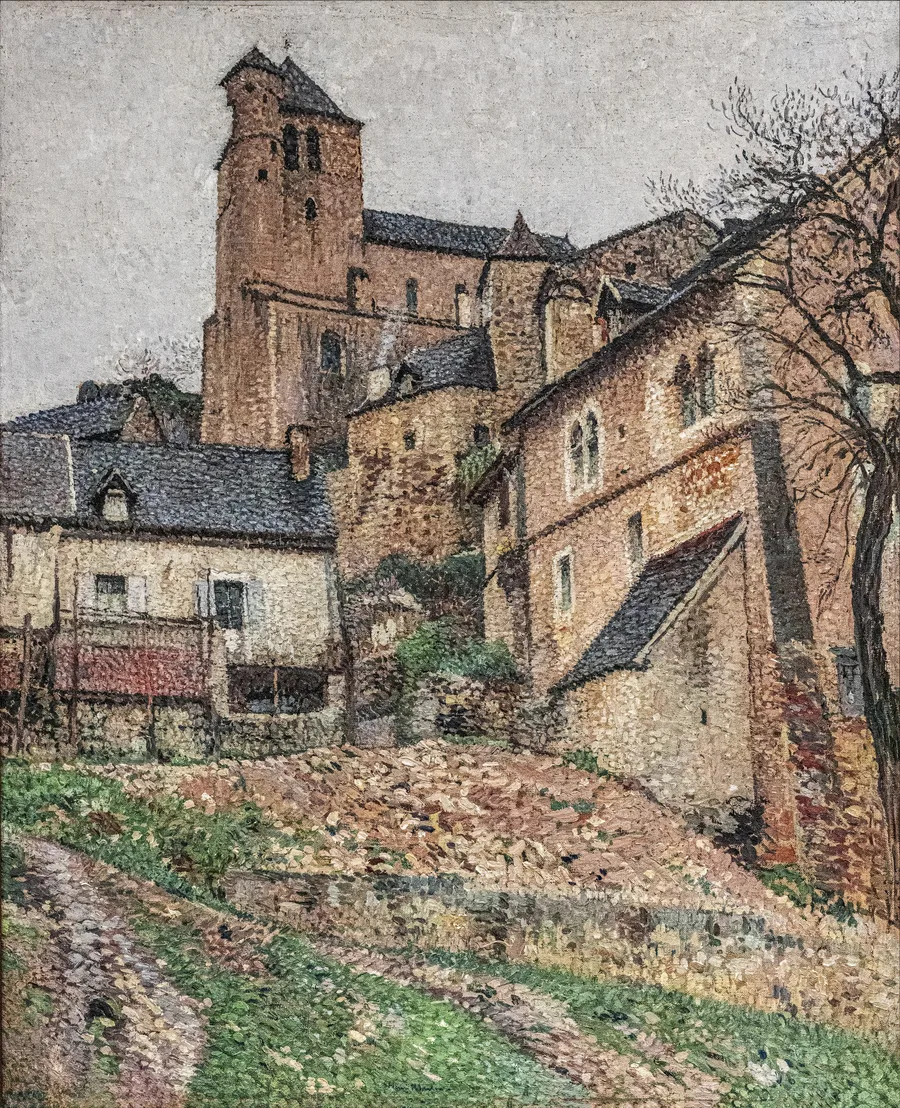
He has translated all its familiar grandeur. He has expressed its slow labors and its serious joys. He has brought down to it the ethereal muses who, henceforth, inhabit it as a homeland.
It would remain to show how Henri Martin's latest landscapes have benefited from his decorative research and achievements. It would remain to designate the perceptible link that runs from one end to the other of his enormous production, between his Virgilian eclogues and his great rustic epics. But we have deliberately confined ourselves, after others have passed a synthetic judgment on the work of Henri Martin, to observing him in his creation.
Jacques Coprau