
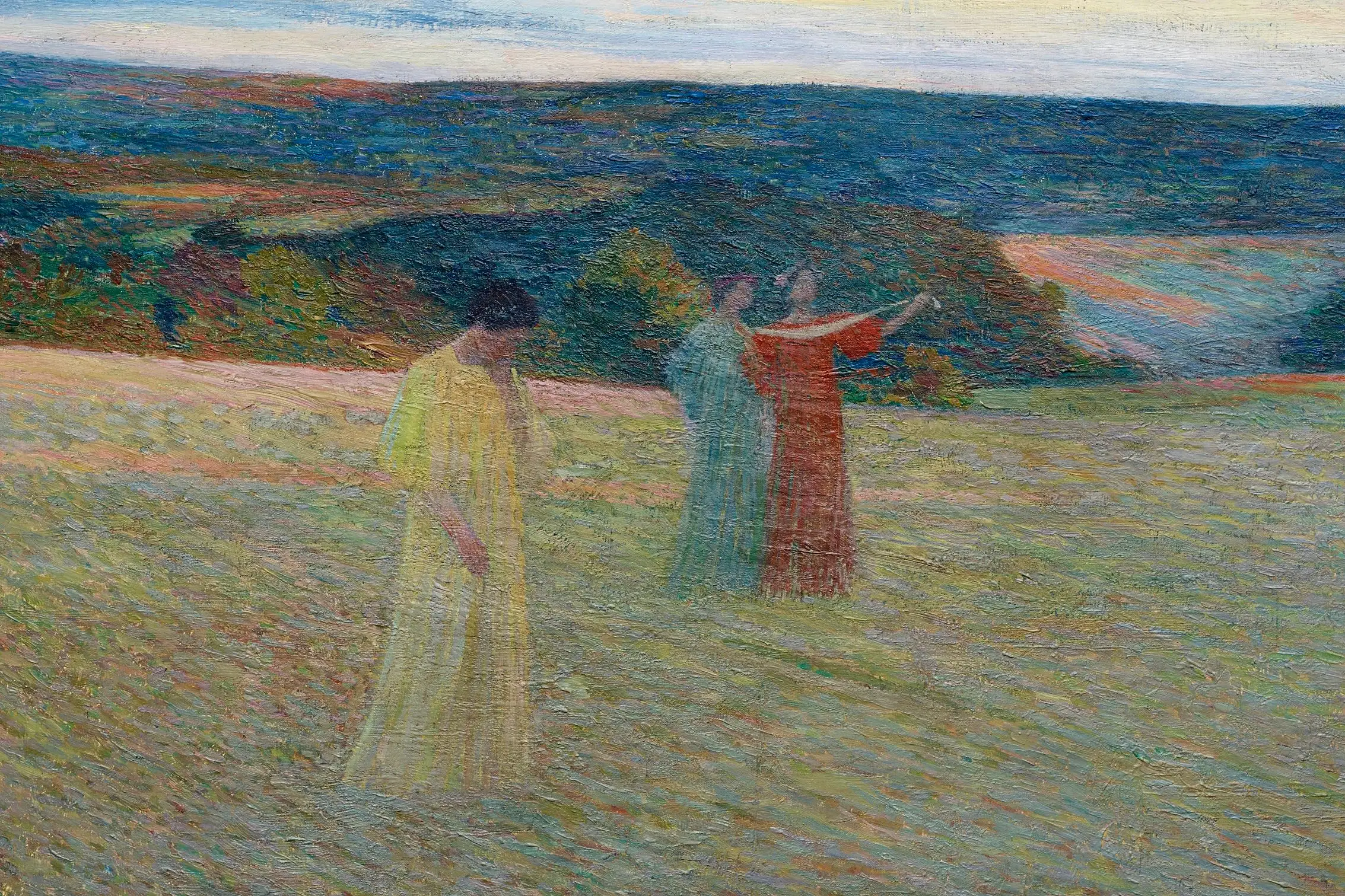

They are seated half-length, pensive and solitary, almost always at the same twilight hour. Sometimes they pause, melancholic and wild, beneath tall pine forests that rustle like the sea, their rough, moss-greened trunks and bristling needles ignited with bronze glints in the last rays of the sun. At other times, the dark bands of their heavy hair falling over their eyes, they meditate, their silent instruments beside them. They breathe in the faint scent of a small woodland flower, while the evening breeze stirs soft waves of air, perfumed by the nocturnal exhalation of the oleanders. Against this backdrop, the sky forms a distant mosaic of gold for their still and solemn silhouettes, already cloaked in shadow.
Here, fully illuminated by a rosy, supernatural light, a green laurel woven into their black hair, they touch the divine strings with a light, distracted finger. They unite their youth and beauty with the purity of a sky that trembles with all the shivers of evening, set against the pale, vibrant azure of the peaks where they rise as if to gather all the light of dusk.
There, serious and taciturn, their brows crowned with thorny holly, they move through the green light of lofty, shadowy forests. They appear in damp clearings where poplars scatter their pale gold sequins, mingling with the silent, ardent life of the world. Elsewhere, they emerge as the gentle, sad soul of the woods and waters—exquisite flowers of mystery and solitude. Further on, with a brow bleeding from a bramble's scratch, we see one of them gliding over lawns and dead leaves. She moves down deep allées that rise like the naves of cathedrals, disheveled and mystical, her fixed gaze following an inner vision, while a thistle pushes its tall, jagged stem up beside her.
And there is another still, walking at a rapid pace, veiled in crepe through the religious night of the forest, raising a bleeding, radiant heart like an offering. Both are symbols of the harsh joys of sorrow and sacrifice, or of the silence that alone befits them.
These chaste and singular figures are the favored creations of Henri Martin's mind. As daughters of his imagination, they follow him through life like companions, sisters, and sure, faithful inspirers, appearing at every turn of his path. We have just seen them in isolation; we will find them again, mingled with every manifestation of his thought, their long black hair streaming in the wind, holding high the golden Lyre.
The Rebirth of a Symbol
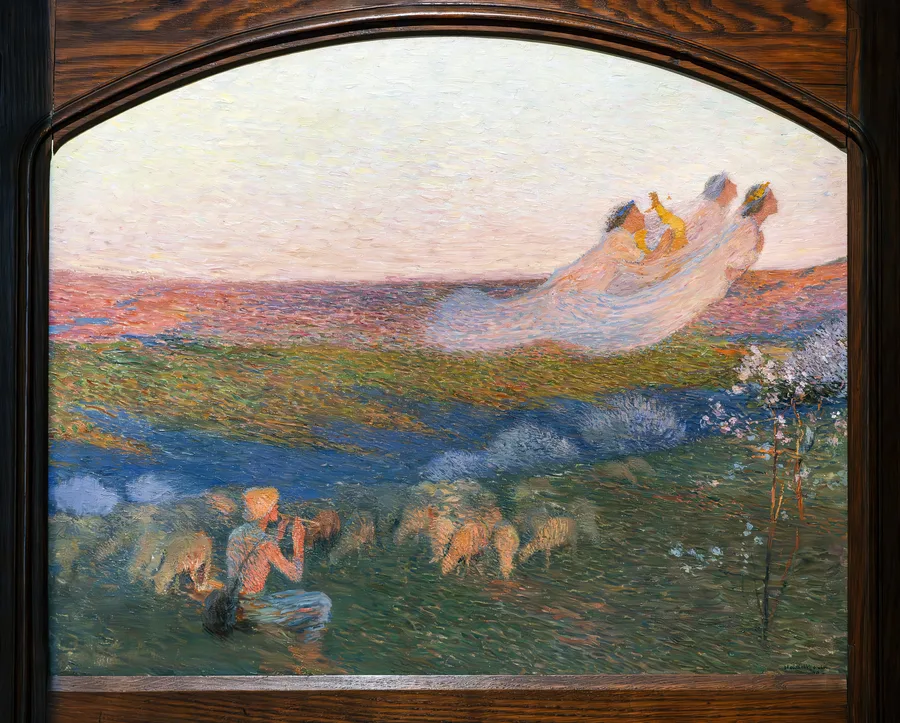
The Lyre! It is an antiquated emblem that has traversed the ages, worn down by the common banality of human life, yet to which poets have given a new meaning that has rejuvenated and vivified it. The Lyre was the sacred instrument with which the ancients honored their gods: Hermes, Dionysus, and Apollo, who carried it in one hand while the other raised the light of the worlds, thus illuminating and guiding creation. The Lyre has seven strings, just as the prism has seven colors. It is a radiant hieroglyph, an expressive emblem of harmony, measure, order, and beauty.