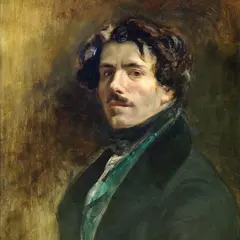
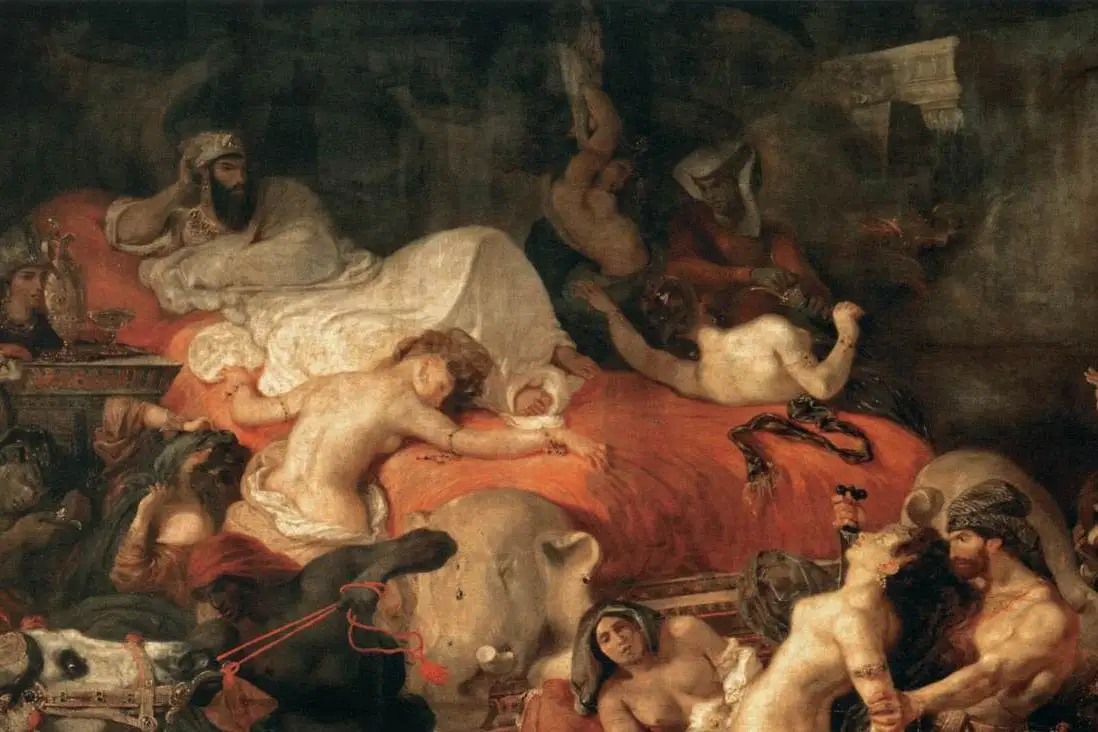
When the Salons were held at the Louvre, the space was so limited that sometimes, during the course of an exhibition, new works would arrive to take the place of some that had already been seen. This was the case in 1827, when Eugène Delacroix sent ten paintings to the Salon, followed by a second submission of three canvases at the beginning of 1828.
His first submission, which the jury had reduced to nine paintings by rejecting the beautiful full-length portrait of Baron de Schwiter set against a landscape in the style of Sir Thomas Lawrence,¹ included several very important works. Among them were Christ in the Garden of Olives, commissioned by the Prefect of the Seine and now housed in the church of Saint-Paul-Saint-Louis in Paris; the Justinian, commissioned for the decoration of the Conseil d'État and destroyed by fire in 1871; and The Execution of the Doge Marino Faliero, currently in the Wallace Collection in London.²
Also included were the powerful Still Life from the Moreau collection, donated by M. Étienne Moreau-Nélaton to the Musée du Louvre and kept in the Pavillon de Marsan; the Portrait of Count Palatiano in Suliot Costume, so admired at the first Chéramy sale; the Wounded Shepherd Quenching His Thirst at a Stream in the Roman Countryside; and the Episode of the War between Greeks and Turks, showing a Greek horseman pursuing his enemies, which has recently been seen in Parisian galleries.
A "Satanic" Genius
This group of paintings was received quite favorably, although some critics feigned to see them as mere sketches. The judgment of the critic Auguste Jal is worth noting:³
M. E. Delacroix is regarded as the leader of the new school; it is he whom they imitate, it is by him that they swear; his name is burdened with all the glory of the Gothic school. In 1824,⁴ he produced a work that was off the beaten path, and some studio Aristotle has since created rules based on the work of this daring master, just as rules were once made based on Sophocles, Euripides, Shakespeare, and Molière. M. Delacroix has originality, verve, an excellent education, a passion for his art, and an imagination whose excesses one may disapprove of, but whose power one must recognize. There is something satanic in his creations, something fascinating in his almost savage execution; the poet Hugo is perhaps the only man who can be privy to the secret of this painter's genius, which Dante would have understood so well. A warm and energetic colorist, he has not been granted the gift of being perfectly true; one could almost say he possesses the hyperbole of color. His palette is rich and terrible; the graceful tones it sometimes bears have a singular harmony that cannot be defined—one must be seized by it to love it. He cannot be judged by the eyes alone. A cold soul does not sympathize with M. Delacroix's talent; imagine Laharpe before a painting by this young artist, and try to get anything from him other than a "For shame!" The author of the Massacre of Scio could be a pure draftsman, but he has chosen not to be. Why? Let another guess. His style is his own: it is bizarre and creates fanatics. One can no more demand that M. Delacroix have the elegance and charm of Raphael than one can find fault with David for not having the vigor of Tintoretto or the finesse of Van Dyck...
Jal's analysis of Delacroix's talent continues in this vein for six or eight pages, with great finesse of judgment. He offers a benevolent critique, with some reservations, of the Wounded Shepherd Quenching His Thirst at a Stream and Marino Faliero, while showing none of his severity, by contrast, for Christ in the Garden of Olives.⁵