The strong resemblance between the genius and work of Albrecht Dürer and that of Leonardo da Vinci has often been noted. Dürer and Leonardo were the two great philosophers of painting. They were philosophers in the way that it is fitting for painters to be—that is, simply concerned with the theoretical side of their art, and striving to found the beauty of their works on reasoned principles.
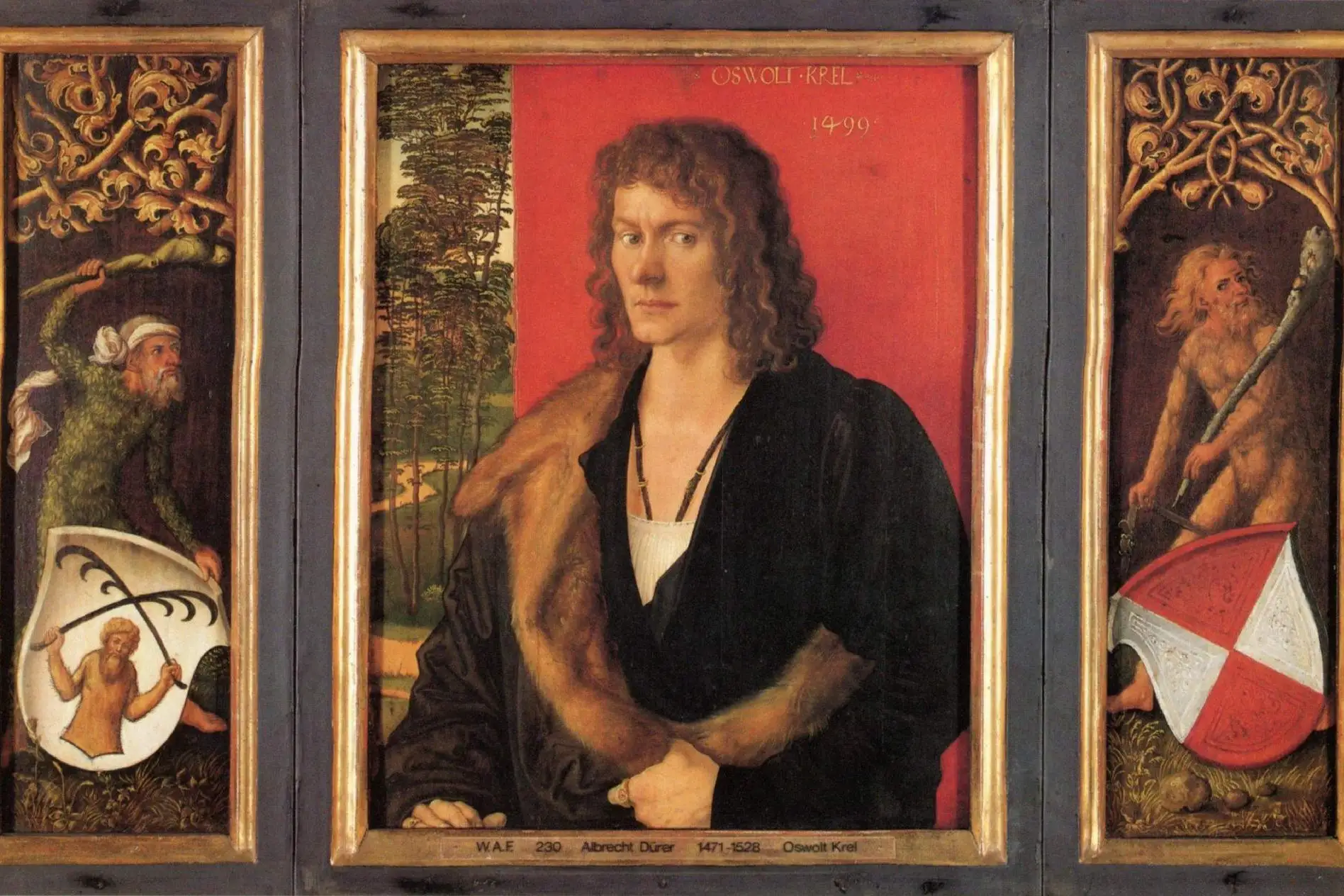
The Portrait of Oswald Krell
It seems to us, however, that the comparison can be taken further. Leonardo and Dürer, with the same temperament and the same aims, also underwent analogous evolutions over the course of their lives. Both initially showed a passionate taste for the strange and the mysterious. In both artists, this youthful taste diminished with age, giving way to a singular concern for strong, natural truth.
At the end of his career, Leonardo would return to his older paintings, attempting to introduce a simpler science and a more scrupulous reality. M. Springer has been able to argue, not implausibly, that the Burlington House Cartoon of Saint Anne and our Virgin of the Rocks were thus reworkings of earlier paintings, undertaken from the perspective of an artistic truth more detached from all mannerism.
Similarly, Dürer moved increasingly toward a complete and impartial restitution of nature. His last portraits have no other goal than to render the life of his models, pushing the intensity of their inner expression as deeply as possible. In his early portraits, by contrast, the preoccupation is manifestly quite different. The models are mere pretexts, and the expressions Dürer lends them have a striking strangeness—but it is a deliberate, external, one might say fanciful, strangeness.
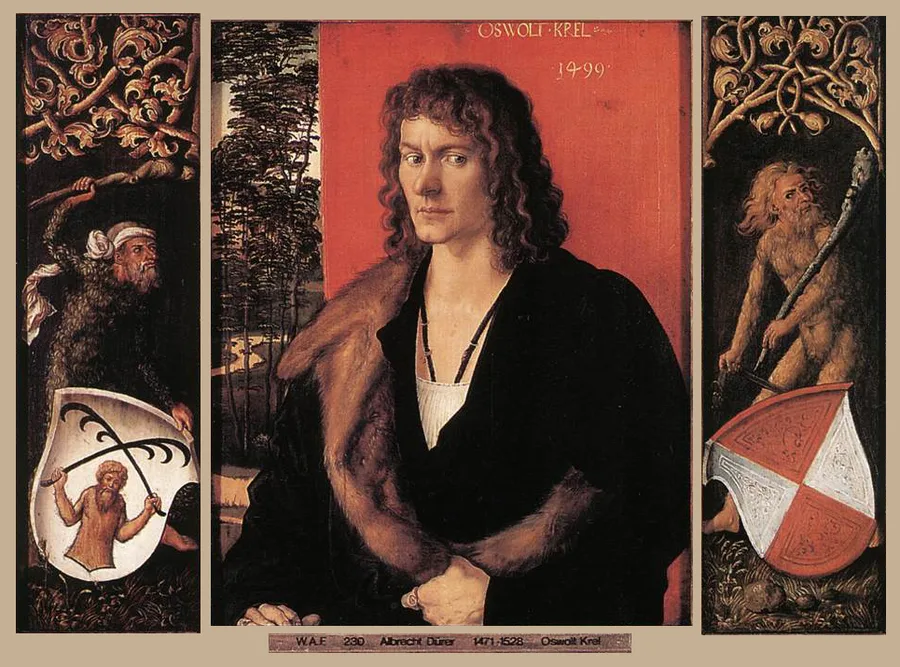
The portrait of Oswald Krell belongs to this first manner; in our view, it marks the most typical development of this style. Everything in this singular image is clearly calculated apart from the model's personality: the somewhat unsettling expression on the face, the contrast between the black costume and the red curtain, and that extraordinary glimpse of landscape opening up on the left, with its slender little trees revealing the winding course of a stream. What we have here is a composition, a study in effect, not a portrait in the truest sense.
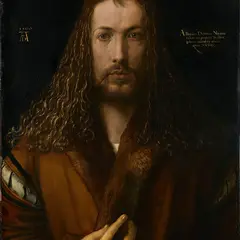
Indeed, the date of this painting marks a moment in Dürer's life when the master seems to have been particularly haunted by a preoccupation with strangeness. It was in 1498 that he finished his Apocalypse and painted himself in the astonishing self-portrait now in the Prado Museum in Madrid. From 1497 date the portrait of a woman (unfortunately so deteriorated) in the Städel Museum in Frankfurt and the Young Woman in Prayer in the Augsburg Museum. These are two paintings of which it is impossible to say whether they are portraits or compositions, so manifest is the search for an expressive effect that transcends the model's personality.
And it is from 1500 that the master's most disturbing work dates: his Hercules and the Stymphalian Birds from the Nuremberg Museum, in which the most scrupulous science is combined with such an evident anxiety for expressive effect. Alas, we know what time has left of this marvelous painting; we could scarcely form an idea of it without the sketch in the Grand Ducal collection of Darmstadt.
The Origins of a Peculiar Style
That Leonardo, at the beginning of his career, had a marked taste for the strange and the mysterious is not at all surprising. This taste was endemic in Florence, and Leonardo's singularity might readily appear as a return to healthy nature when compared with that of his predecessors Verrocchio and Cosimo Rosselli, or his contemporaries Botticelli and Filippino.
But Dürer's case is more obscure. From where could this preoccupation with the strange and the mysterious have come to this young burgher of Nuremberg, a student of the placid Wolgemuth? At most, we can offer a few hypotheses: we can recall, for example, the master's Magyar origins, the current of ideas into which the illustration of the Apocalypse must have pushed him, and the intensity of feeling that always simmered at the bottom of his poet's soul.
But the true source of Dürer's taste for strangeness, in our opinion, was his first stay in Venice in 1493 or 1494. What he encountered of Venetian art then was not the cold and concentrated manner of the Vivarini, nor the style full of life and health of the Bellini and Carpaccio. Instead, it was the deliberately bizarre, morbid, and unsettling manner of those Germano-Italian masters: Giovanni d'Alemagna, Carlo Crivelli, and Jacopo de' Barbari.
"These painters," says Thausing, "feel themselves drawn to what is strange and adventurous; they incline partly toward brilliant and fine execution, partly toward penetrating observation, and partly toward the expression of sentiment." There is no doubt that their influence, combined with that of Mantegna's prints, acted powerfully on Dürer's soul.
Perhaps it is of their mannered and unhealthy works, so seductive at first glance, that he speaks when, in 1506, during his second stay in Venice, he writes in a letter: "The things that pleased me so much here eleven years ago no longer please me today."