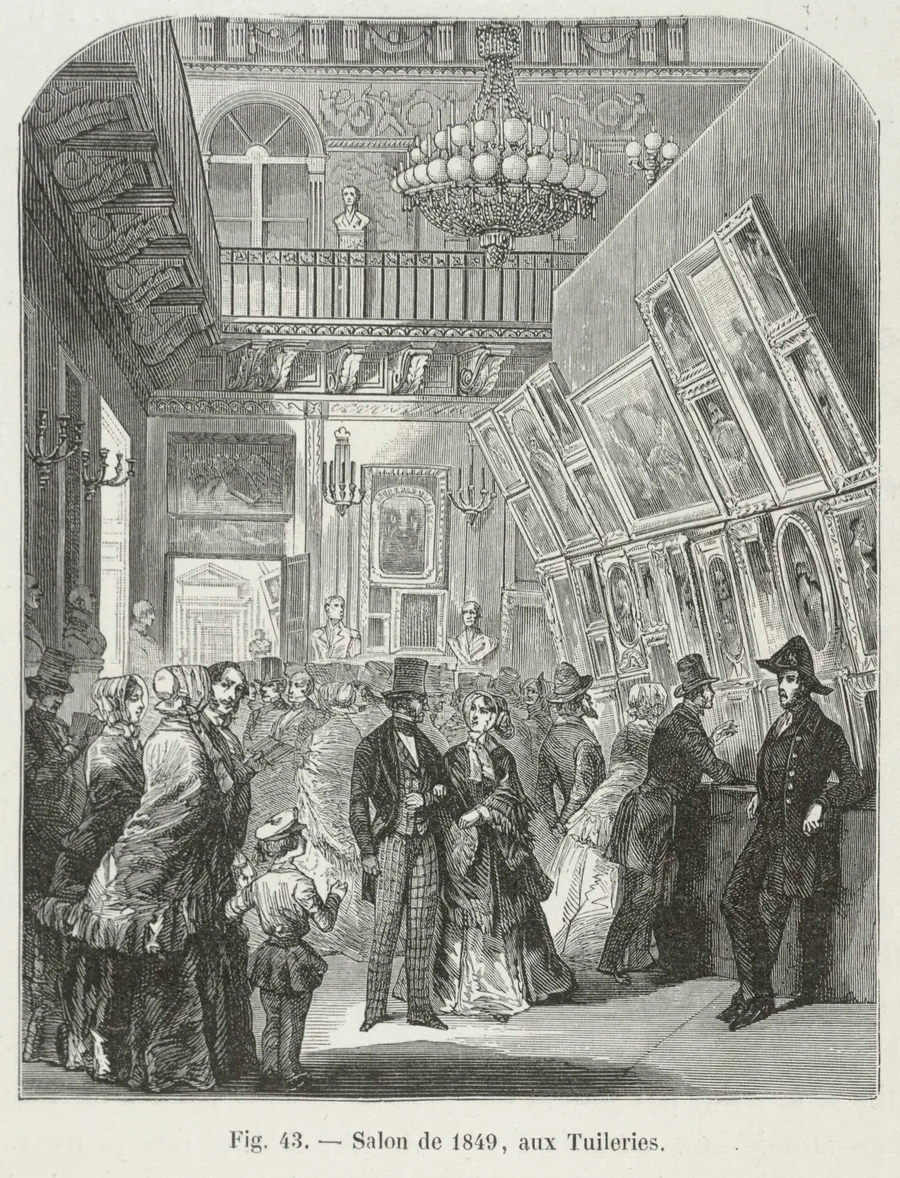
Engravers are not treated by Salon visitors with the consideration they deserve, as the crowds do not flock to their exhibition. And yet, this year's display contained some very interesting works; the collection as a whole even seems superior to that of previous years. This public indifference is hardly surprising. After traversing the interminable circuit of the painting galleries, a visitor would have to show exceptional courage indeed to subject their tired eyes to a new ordeal—an ordeal even more trying than the first, as it demands sustained attention.
Here, one must abandon all hope of encountering any of the cheerful incidents that the whimsy, and often the incompetence, of certain painters provide in the neighboring rooms, which singularly alleviate the fatigue of the journey. The engraver's art is an intimate art, serious even when it deals with subjects that are not. It never lends itself to laughter. In the view of the general public, this is a fatal flaw. For this to be overlooked, the Engraving Salon would need to be held alone, sheltered from all competition, at a different time than the painters' exhibition.
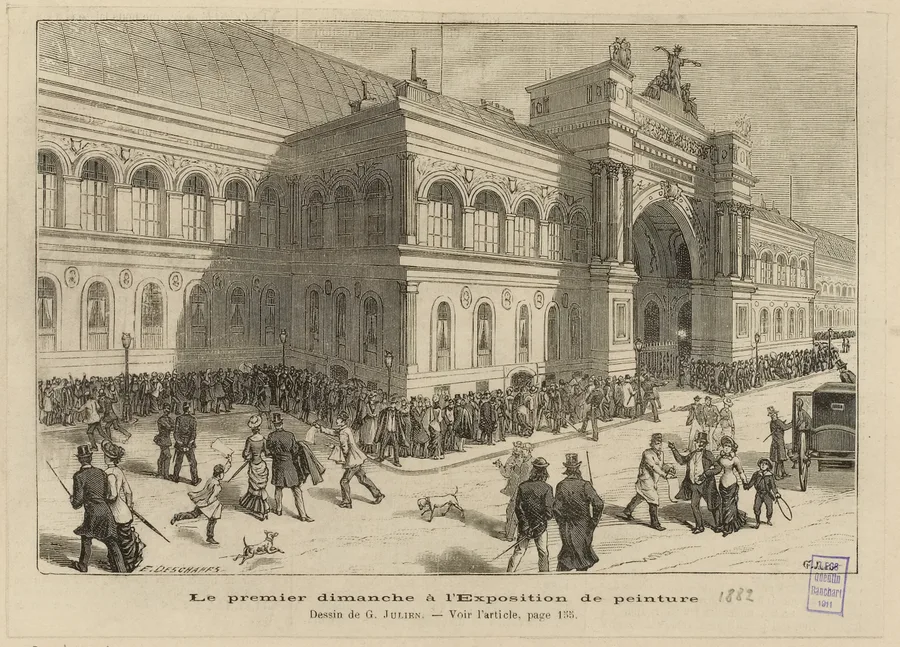
Unfortunately, the remedy might be worse than the disease, and it is likely that the engraving rooms would be even more deserted than they are today. The experiment has been tried: in France, exhibitions of black and white art do not draw crowds. Engravers must simply resign themselves to this fact. If the misfortune of others can be a comfort for one's own suffering, the example of their neighbors, the architects, is well-suited to console them. Nothing equals the melancholy of the spaces reserved for architectural works. It is a perfect solitude, barely disturbed from time to time by a lost visitor or one pursuing goals other than examining the displayed projects for school buildings or reconstructions of Hadrian's Arch.
It seems the fashion is to arrange marriage interviews there, as the antiquities rooms at the Louvre are now too frequented for such discreet negotiations.
The Medal of Honor: Charles Waltner and Large-Format Etching
The Medal of Honor was awarded this year to M. Waltner, and a better choice could not have been made; this decision by the jury will be ratified by all artists. For several years now, M. Waltner has been the preferred artist of print collectors. The French and English compete for the first-state proofs (épreuves de premier état) of his engravings, driving prices to the highest levels. As a former winner of the Prix de Rome who has passed through all the stages of success in exhibitions, the only reward he now lacks is that little ribbon that has been so prodigally bestowed upon those less worthy than him.
But the distinction with which he has just been honored by his peers sufficiently designates him for the consideration of the Administration of Fine Arts, so he should not have to wait much longer.
M. Waltner exhibited two superb portraits after Rembrandt. These are large-format plates that can be viewed from a distance like paintings, or as painted copies would be. This style of reproduction, which by its size approaches the originals, is now in fashion. They are true paintings in black and white, capable of capturing everything: the subject in its smallest details and the slightest incidents of the execution—the spirit and the touch of the master. This is a genuine innovation, inspired, I believe, by the marvelous results of heliogravure applied to the direct transcription of paintings.
This approach requires the participation of superior talents, for it takes more than mere skill to bring such a work to a successful conclusion. Here, there are no more evasions, no more subtleties; the drawing must speak loudly and firmly. One no longer has the resource of masking the hand's failings under the deceptive charm of borrowed colors. To large plates, one might say, large means are required. Not just anyone can employ these means, and the proof is that poorly equipped engravers prudently remain on the sidelines. The few imprudent ones who so far forgot themselves as to display their weakness in large formats will not do so again; the lesson will not be lost.
M. Waltner possesses both scientific knowledge and an exquisite feeling for his art. A born engraver, he began by training his hand in the severe discipline of the burin; it was then child's play for him to appropriate all the secrets of etching. His Rembrandt and the Portrait of the Rabbi reveal an incomparable skill; they speak highly of the artist, and the process he used gains in importance through them. After admiring these magnificent plates, so powerful and well-executed, it is difficult to understand the disdain in which etching was held for so long by the classicists, a disdain from which it has not yet recovered among the members of official teaching.
It is now demonstrated that etching is capable of translating all subjects and all genres: the serious and the gentle, the pleasant and the severe. This nobility of origin attributed to the burin can be won for it by the effort of a great artist. Etching then joins to its natural grace, to the charm of its rich and varied colorations, the qualities of its new condition: elegance of bearing and distinction of manner. This is equivalent to saying that there is no recipe in engraving for creating works of style; all means are good for one to whom nature and education have given the power to express this transcendent quality of art.
The State of Burin Engraving
Burin engraving proper—that is, treated in the classical manner—sees the ranks of its adherents thinning every day. But if they are few in number, they do not lack talent. M. Huot, in particular, is on par with the most illustrious masters of the past. In his hands, the burin acquires a grace, a facility of movement that leaves no hint of the difficulties overcome; a skilled draftsman does not handle a pencil with more ease. When one knows the slowness of the work, the energy and constancy required to overcome the resistance of the metal, one is left amazed. Why must so much talent and effort be expended in the service of a work of little interest, such as The Love Letter by M.
Toulmouche? We sincerely pity M. Huot if, as I suppose, he followed the will of a publisher in this instance rather than his own particular taste.
This remark can, moreover, be made in a general way: burin engravers are very poorly served this year in terms of subjects. It took a rare talent for M. Jules Jacquet to make the most of Esmeralda by M. J. Lefebvre, as he has done; he well deserves the first-class medal the jury awarded him. His brother, M. Achille Jacquet, was hardly more favored: M. Cabanel's Flora and Psyche will owe more to him than he received from that painting. For M. Leenhoff, it is even worse; he had to engrave Young Girl Struggling with Love, after M. Bouguereau. The poverty of this canvas, which was in last year's Salon, is well known.
M. Leenhoff has transfigured it through the sheer power of his talent as an engraver; here is another well-earned medal.
To be fair, M. Leenhoff is not a very classical burinist; he professes a complete independence of means, and his art brings him much closer to M. Gaillard than to M. François, to cite an example. We will neither blame nor praise him for this; the essential thing is that, through tight and correct drawing, he has managed to faithfully copy his model. And, as we have said, M. Bouguereau owes him a real debt of gratitude.
Other names also seem highly commendable. M. Ch.-A. Deblois, very orthodox in his methods, engraves with wit and finesse. M. G. Lévy and M. Morse possess the suppleness that comes from great skill. MM. Massard, Salmon, and Burney exhibit excellent portraits. The misfortune is that one senses the photographic document too much beneath the engraving. These are very skillful copies, no doubt, but we prefer the interpretations of yesteryear, which revealed a more personal mark; each engraver imbued his work with a particular, individual sentiment, which was like a signature.
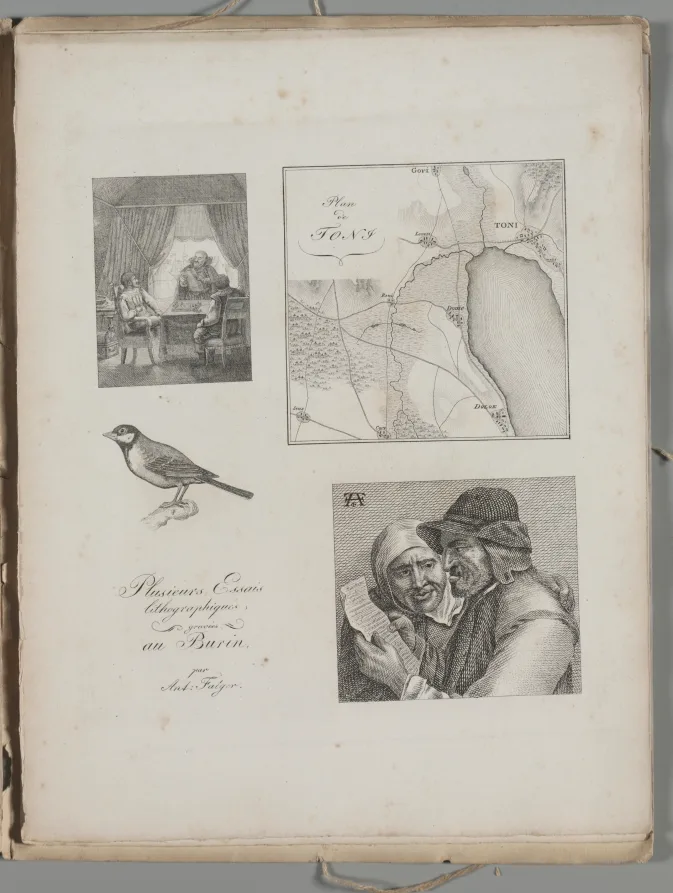
Innovations in Wood Engraving and Lithography
Wood engraving holds its own at the Salon. Certain artists, mostly foreigners, have found a way to rejuvenate old processes. MM. Closson and Nash engrave with the point of a needle, which may not be the ideal to strive for, since it results in an almost complete effacement of the work—that is, the disappearance of an element of interest—but it must be admitted that the result is very seductive. The proofs of these engravings have the freshness, finesse, and brilliance of certain etchings. It remains to be seen how they behave during printing; we believe their delicate constitution must require special care and that they would not easily lend themselves to multiple, hasty impressions.
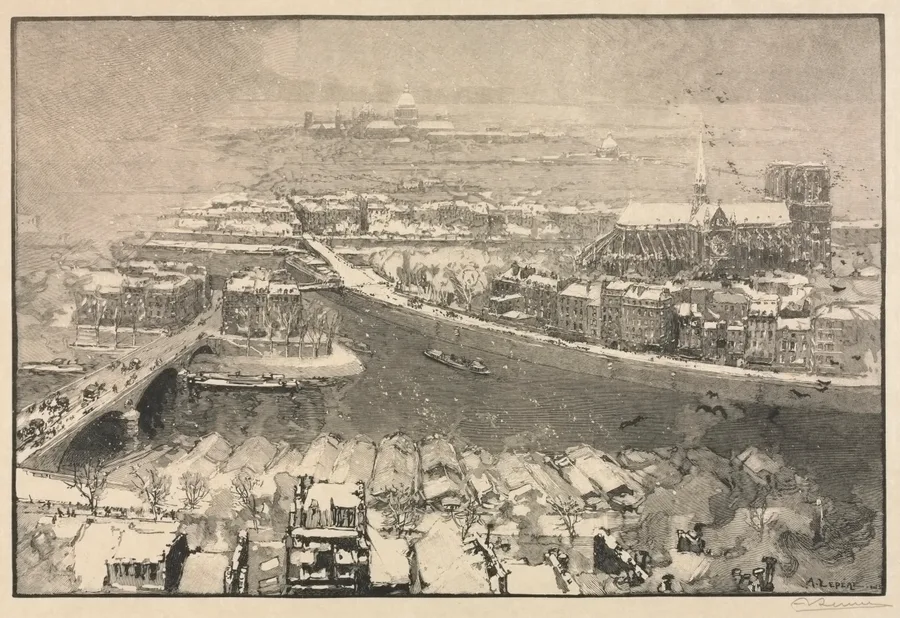
I have noted some names, still little known, that deserve to be remembered: MM. Mathé, Prunaire, Villemsens, Wuillier, Fleuret, Thomas, Paillard, and Mme Delorme. The old guard is still in the breach, holding their rank; the jury has rewarded the most valiant, MM. Rousseau, Maurand, Dutheil, C.-E. Bellenger. The same honor could have been given to MM. Ansseau, Baude, and many others I could name, for talented men abound in wood engraving.
Lithography, which has hardly any more of a clientele, is not completely abandoned by artists. M. Fantin-Latour, whose paintings do not make a great stir but attest to a first-rate talent, continues the series of poetic transcriptions of modern musicians he began some years ago. Wagner and Schumann provided him with the theme for two beautiful drawings on stone; they will join the analogous works of the same artist in the portfolios of connoisseurs. Some of these are now almost impossible to find. The jury rewarded two lithographers: MM. Georges Bellenger and Maurou. The former exhibited a reproduction of M.
Feyen-Perrin's painting, Velpeau and His Students, whose composition recalls, without imitating, Rembrandt's Anatomy Lesson. M. Maurou translated M. G. Bertrand's Patrie with a firm and bold crayon.
The Dominance of Etching
The etchers (aquafortistes) show us what is most interesting to see in the Engraving Salon. At their head marches M. Waltner, whom we have already discussed. Alongside him, one rightly admired superb landscapes by M. Chauvel and M. Maxime Lalanne; a plate freely yet entirely accurately treated by M. A. Gilbert, after Rosa Bonheur's The Wild Boars—the engraving is unquestionably superior to the painting. This is not, as we have said, the only surprise of this kind offered by the Salon of 1882. M. Haig had two remarkable views of the Cathedral of Chartres; the jury noticed and awarded him a medal.
One is not accustomed to seeing architecture treated with such breadth; the warm accents of M. Haig's drawing did not prevent him from respecting the truth in the details. M. Champollion engraved M. Orchardson's Le Décavé with talent, though with a somewhat soft point. It is true that the concern for accuracy led him to follow the defects of his model; it is known that the English painter's picture leaves much to be desired in terms of firmness.
All the plates we have just mentioned are of large dimensions; they demanded from the engravers a sum of talent and effort that must be counted to their credit, in the chapter of difficulties overcome. M. La Guillermie is also one of those who do not shrink from the obstacle of size; he was well-schooled. His portrait of President Grévy, after M. Bonnat, is a solid work, like the painting; the expressive and well-managed drawing reveals an educated artist, an excellent interpreter of the works of others, and capable of creating on his own account, as he has proven on several occasions.
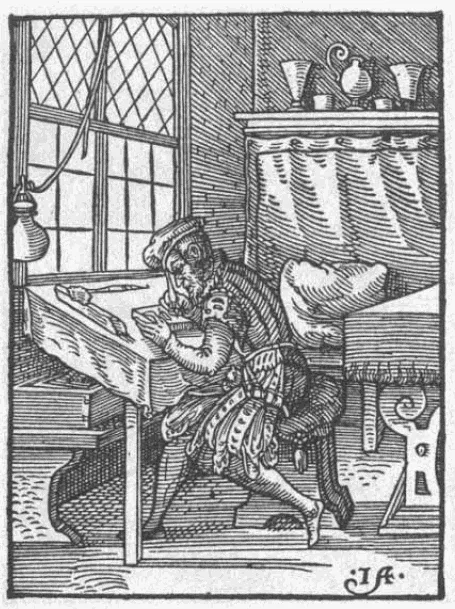
Original Illustration and its Masters
Apart from painters who occasionally etch, one finds very few engravers confident enough to venture into original creations. MM. L. Flameng, Lalauze, and Hédouin have proven themselves; the exhibition of the latter two shows them to be as valiant and alert as on the first day. M. Flameng abstained this year, but he is always in the fray; lovers of fine illustrated books constantly see his name, consecrated by success, reappear.
The series of illustrations that M. Boilvin composed and executed in etching for the poems of M. F. Coppée will count for much in this engraver's body of work. We see in him the last descendant of an exquisite race of artists whose names are celebrated by bibliophiles the world over. By the suppleness, grace, and elegance of his talent, M. Boilvin is the worthy heir of our French illustrators of the 18th century. He resembles them to such an extent that at times one would believe him their contemporary; when his subject leads him to reproduce the manners and costumes of the time in which they lived, the illusion is complete—one looks at the bottom of the print for the name of a Moreau or a Saint-Aubin.
The skill of M. Eug. Burnand is not comparable, considering only the engraver; but his illustrations for Mireille attest to a real talent for invention and very commendable qualities as a draftsman. We are not surprised to find his name in the painting section and to see him figure there with honor.
Individual Voices: Whistler, Buhot, and Renouard
M. Whistler's etchings on motifs taken from Venice are exquisite works. Connoisseurs know this and vie for them; as for the public, it passes by them without seeing them. The contrary would surprise us. An original artist, enamored with the quintessence of things, M. Whistler most often confines himself to summarizing the dominant note of his visual impressions in a few strokes. At other times, he delights in extracting fantastic silhouettes from the shadows. Always and everywhere the poet is present, but one must have good eyes to distinguish him. It is understandable that these mysterious scripts can only be deciphered by a small number of initiates.
M. F. Buhot, whose interpretive merit our readers have often appreciated, also has the ambition to drink from his own glass, so to speak. The Norman Cottages he exhibited have that marked flavor that only true artists manage to release in an original print. One of them brings to mind the admirable etchings of Claude Lorrain; I know of no better recommendation for connoisseurs.
The robust and sincere talent of M. Paul Renouard is well known in this review; the drawings of his that we have published have been much appreciated. His etchings at the Salon, in which he studies the backstage and dancing staff of the Opéra with the same spirit of observation, seemed to us less successful than the drawings. The fault lies, we believe, in the process he chose: the mixture of etching and aquatint weighs down a subject that, on the contrary, needed to be treated lightly. M. Renouard did, however, achieve beautiful effects of light.
Artists of the Gazette and Concluding Thoughts
The illustration of Victor Hugo's Les Orientales does not do great honor to MM. Gérôme and Benjamin Constant, who composed the drawings, but the merit of the engraver will not be disputed. M. F. de los Rios interprets the drawings of others with the same consummate skill he employs when engraving his personal compositions, for example, the original illustrations for the Tales of Pinot-Duclos that he also exhibited.
Many of the excellent artists whose works we have just appreciated are very close to us; they have all, to some extent, collaborated with the Gazette. Among those we must still mention, we find other names familiar to our readers: M. Le Rat, whose scholarly and seductive etching after Meissonier, La Vedette, was made for us; M. Lalauze, already named; MM. G. Greux, Queyroy, Milius, and J. Adeline, whose works would deserve more than a quick mention; and M. Henri Guérard.
A draftsman of serious talent, pursuing objective truth and stopping only when he has reached his goal, M. Guérard interprets all things with originality. The jury awarded a medal to the series of engraved glasses and crystals and the seascapes that formed his exhibition. One of the plates is here before the reader's eyes; he will doubtless think, like the jury, that the artist deserved a distinction.
Finally, I find in my notes several names of exhibitors accompanied by flattering comments; they must not fall victim to the necessity I am under to cut short the thankless task I have undertaken. M. Lenain, an excellent portraitist; M. Jequier, whose seascapes were much noticed; M. Storm de Gravesande, a master of drypoint; M. Lecouteux; M. Foulquier... and all the talented men I am forgetting will kindly excuse me if I do not render them the justice they are due. The Engraving Salon is like the others: talent and especially knowledge of the craft are now so widespread that it is almost impossible for criticism to make a completely equitable choice.
To tell the truth, good artists do not lose much by it, for the public knows well how to recognize them in the fray and to lavish upon each favors far more precious than the praise of the press.
ALFRED DE LOSTALOT.