One must always marvel at the ease with which people in Paris forget the things of yesterday. This is a great blessing, but it is also a great embarrassment when one has neglected to record in an authentic manner what was seen and said only the day before.
The Forgotten Spire
It is a constant source of wonder how easily Parisians forget the events of yesterday. This is a great blessing, but it is also a great source of trouble when one has failed to officially record what was seen and said only the day before. A Parisian recently insisted to me that the Tour Saint-Jacques has been surrounded by a public square since the revolution of 1792. Another, recounting an event that took place in 1848, told me: "I am certain of what I recall here, and the proof is that the event occurred (it seems to me I am there now) on the Boulevard de Sébastopol, at the corner of the Boulevard Saint-Denis."
Everyone knows the famous remark by Fouché, the Minister of Police under the Empire. He was recounting a conversation he had with Robespierre, and how, in a particular circumstance, he felt he had to stand up to him: "Duke of Otranto!... Robespierre answered me, you are playing a high-stakes game!..."
From the day that authorization was granted to restore the spire on the crossing of Notre-Dame de Paris, when His Excellency the Minister of Public Instruction and Worship approved the project in March 1858, I was assailed from all sides with the same question: "Was there a spire on the cathedral?" To which I would reply, "Certainly! Did you not know?" At first, I did not think it necessary to provide proof, because I believed that a good number of living Parisians had seen this steeple standing.
However, the questions became more pressing. Some did me the honor of believing that this complement to the mother church had never existed except in my own mind. This became embarrassing, for what I had thought was a joke threatened to become an accusation of misleading the public, or at least of an excess of imagination. Things reached a point where I was decidedly forced to furnish authentic evidence. The respectable architect who demolished the spire of Notre-Dame, much to his regret, because it was threatening to collapse and he was not given the means to preserve it, Mr. Godde, is doing perfectly well.
It is claimed, at least, that he was the one who presided over this execution.
Historical and Pictorial Evidence
Let us gather our evidence from earlier times. J. Du Breul, in his Théâtre des Antiquitez de Paris, 1612 edition, states on page 11 of Book I:
In the small bell-tower, over the crossing of the church (Notre-Dame), are six small bells, not including the wooden bell... The timberwork that supports the lead roof of this cathedral-church rests only on the four great walls, as does that of the small bell-tower, which is above the middle of the crossing, built on a large wooden trunk, supported only by four large beams that rest on the four main pillars of said crossing.
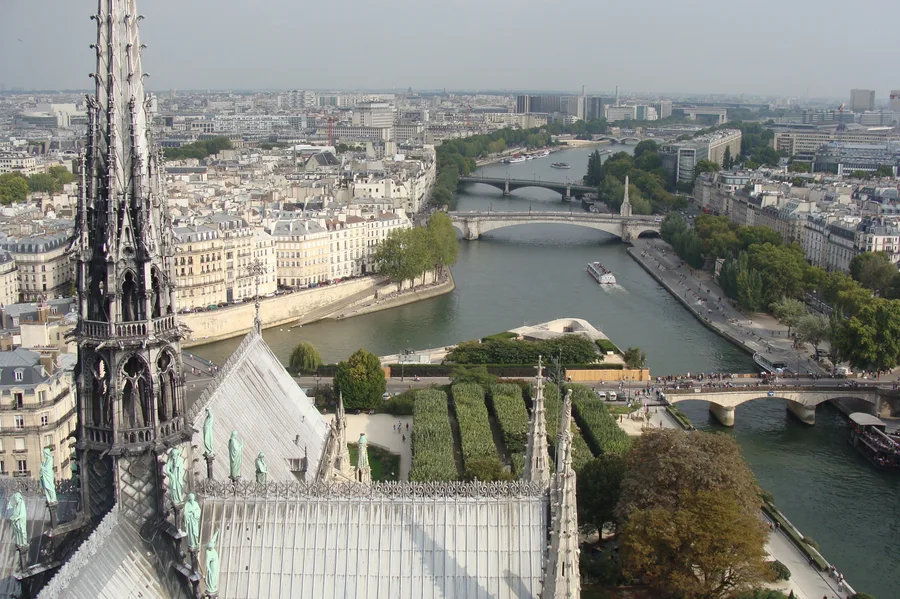
In the Recueil d'un grand nombre de Vues dessinées et gravées par Israel Sylvestre, collected by Laurent Cars in 1750, Volume I, one finds a first view of the Cité taken from the Hôtel de Nevers (the Mint), where the cathedral appears with its spire. A second view, taken from the Quai des Tournelles, shows the spire of Notre-Dame with its two tiers of bays. A third view, taken from approximately the Halle aux Vins, also features the spire.
A fourth view taken from the Quai des Augustins shows the spire; a view taken from opposite the Archbishop's Palace, again the spire; a view taken from the level of the Jardin des Plantes; a view from the Hôtel de Bretonvilliers; three views from the Place de Grève; a general view of Paris from Chaillot; a view from the Île Louviers, and so on: always the spire.
In the collection of Mérian, in the plan of Gomboust, in the beautiful bird's-eye view plan by Mathieu Mérian, which provides such precious information, and in the well-known plan of Turgot, the spire of Notre-Dame is drawn in the clearest fashion, albeit on a very small scale.
Perhaps I will be told that all this information is quite old, and that Notre-Dame, having been deprived of its spire for a long time, must have grown accustomed to being without it. Let us therefore move closer to our own time. Besides the already cited plan of Turgot, which dates from the last century, there is Félibien. In his Histoire de la ville de Paris, he gives us a view of Notre-Dame with the spire. Then there is Béguillet who, in his Description historique de Paris (1789), shows the spire standing on the cathedral. We find it again in some poor-quality engravings from 1792 and 1797.
From that moment on, that is to say in prints made during the Empire and the Restoration, there is no longer any mention of the spire. But the base of this timberwork structure existed intact under the cathedral's roof until two years ago; however, this base was in very poor condition. The king post of the spire still bore a carved wooden capital from the beginning of the 13th century, a capital that has been preserved in the site's storage. Du Breul also tells us that this spire was one hundred and five feet high from the ridge of the roof to the rooster. From all this, it seems we can conclude: first, that there was a timber spire covered in lead on the crossing of the cathedral; and second, that this timberwork dated from the beginning of the 13th century, like all the upper parts of the structure.
The New Spire's Construction
Structural Foundations
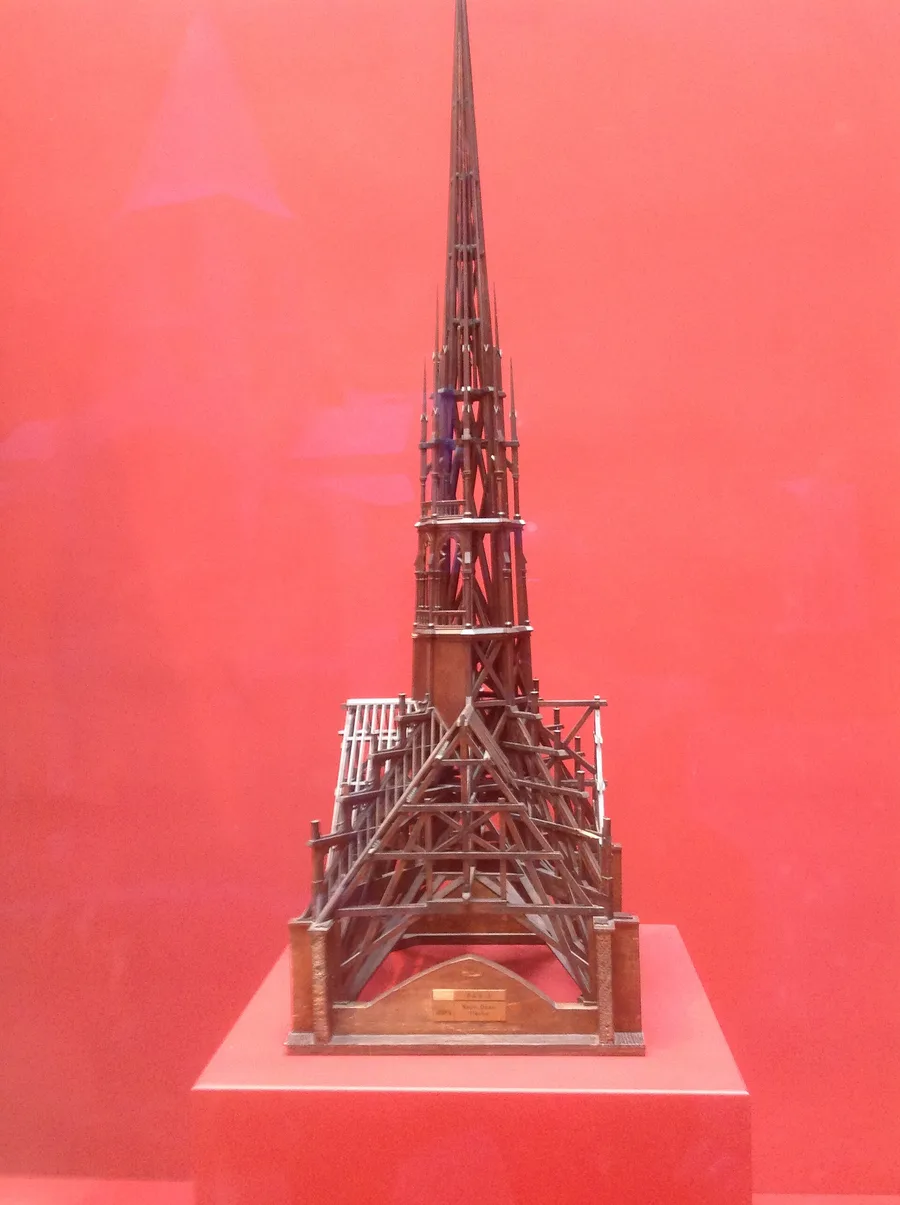
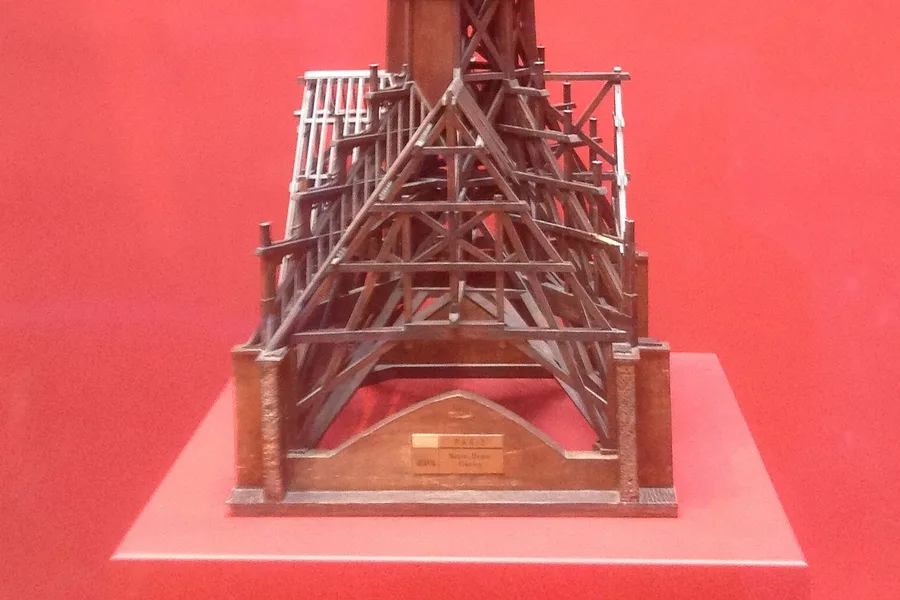
During the dismantling of the old spire's base in the autumn of 1858, we had the opportunity to rediscover a very beautiful and original primitive arrangement. This was the design of the four large decorated braces that filled the valleys at the intersection of the crossing's roof sections. These four braces gave great stability to the timber frame and served as a transition between the solid parts of the roof base and the base of the spire itself.
It should be noted that typically, timber spires rising from the crossing of cathedrals, like the one at Amiens for example, appear slender above the junction of the roofs. Their base is not clearly defined; they seem like a spindle planted on the transept. At Notre-Dame de Paris, this flaw was skillfully avoided. For a long time, the entire decorative part of the four large braces had been removed or partially hidden under a rather unattractive lead coping, a coping that can be seen in the engraved or photographed views made before the end of 1858. It was under this lead sheathing that several fragments of the old ornate arrangement were found.
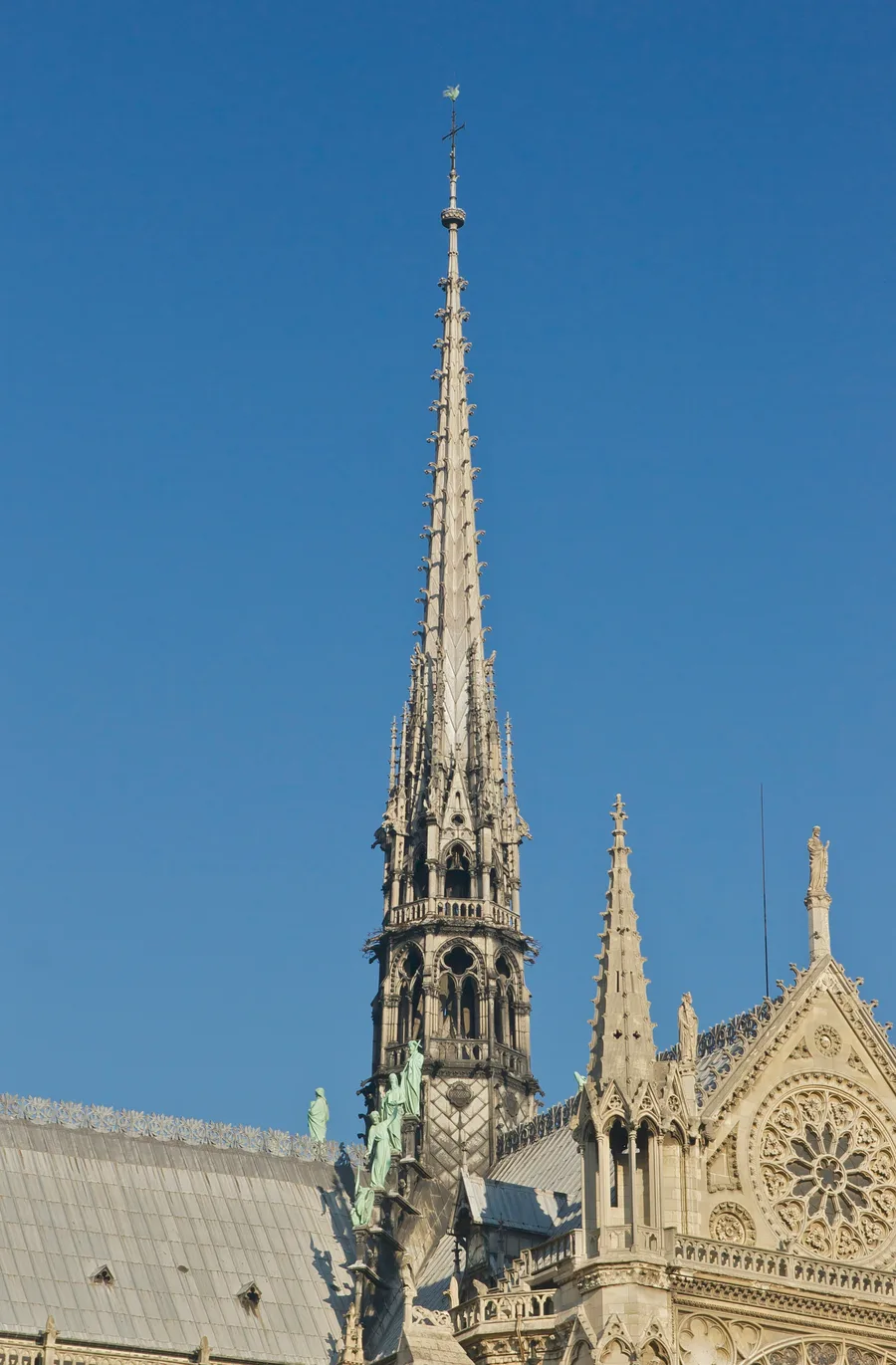
The new spire of Notre-Dame de Paris rests entirely on the four pillars of the transept, by means of a system of four inclined trusses and two large diagonal trusses. Its height, beneath the roof, is fourteen meters, including the struts that descend to the level of the haunches of the great vault. From the top of the roof ridge to just below the rooster, the height is forty-four meters and fifty centimeters.
It is constructed entirely of oak wood from Champagne, some pieces of which are no less than fifteen meters long. All parts of this wood that could be damaged by humidity before the lead cladding was applied were painted with red lead. This red color has led many people to believe that the spire of Notre-Dame is made of iron, due to the common practice of painting large ironwork in this manner. But (and this is for my colleagues) red lead preserves wood from rot just as well as it protects iron from oxidation, and, particularly in the joints, for the tenons and mortises, red lead is an excellent means of preventing the wood from overheating.
Decorative Elements
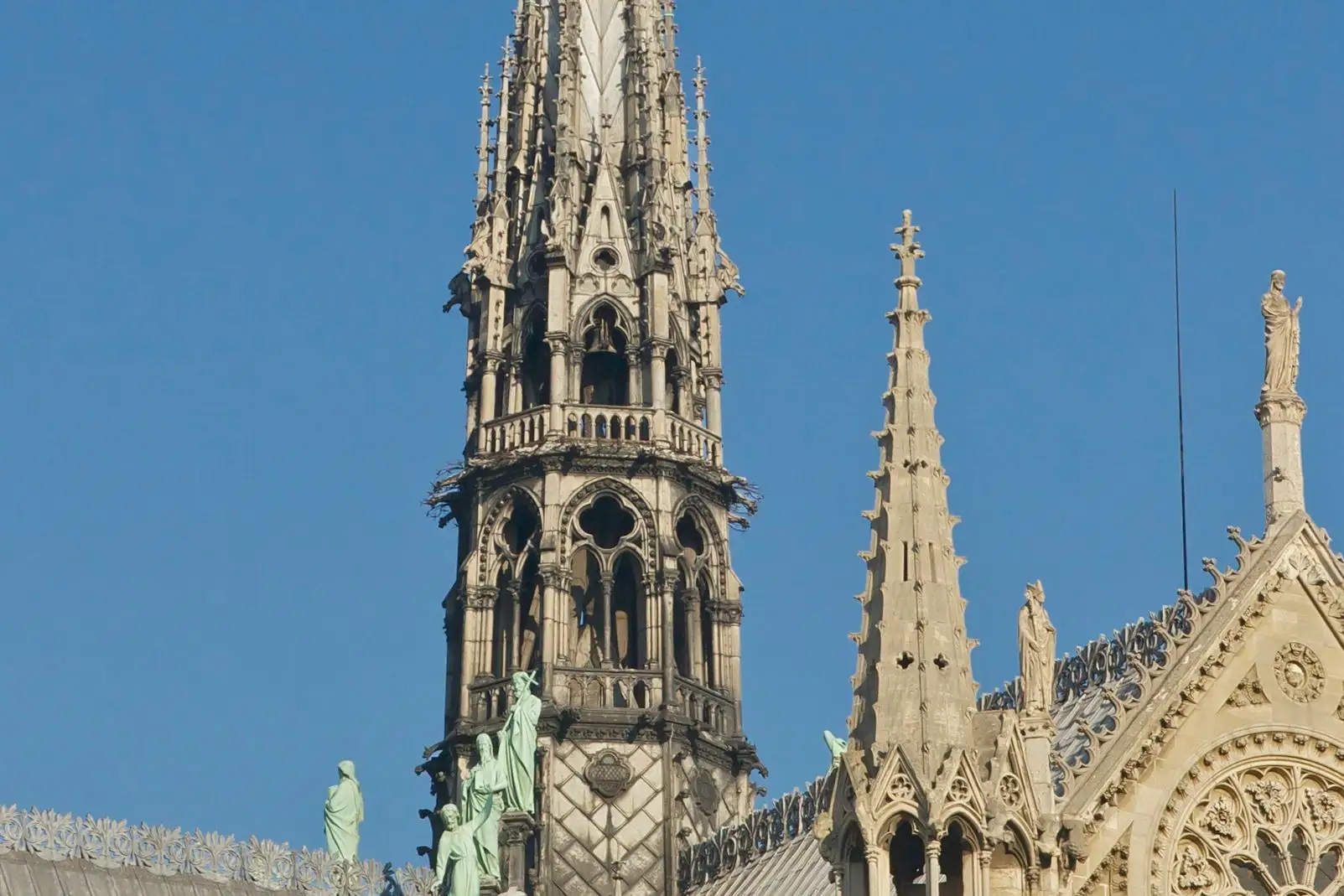
The four large lower braces in the roof valleys, as our engraving indicates, are decorated with openwork, the four symbols of the Evangelists, and the twelve apostles, each three meters high. These figures are made of beaten and embossed copper, supported by an iron frame. This openwork decoration, which is very light, allows the wind to pass through, thus reducing its force on the spire's base. The twelve apostles are arranged in four groups of three on stair-steps that rise along the four hips of the spire. They are all turned towards Paris, as if to contemplate the great city, except for one: Saint Thomas, who turns towards the spire, seeming to admire it.
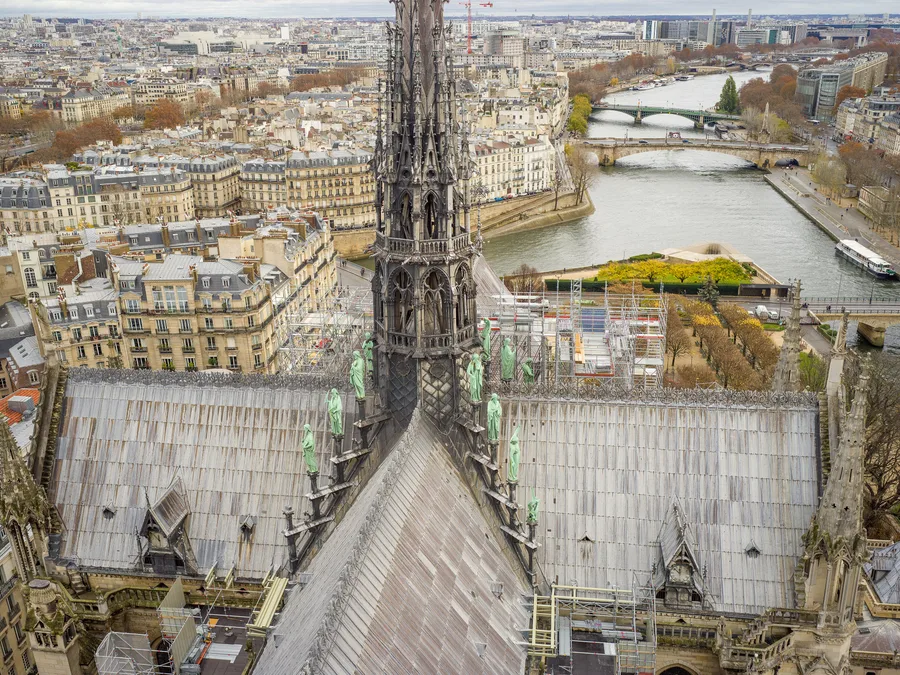
This Saint Thomas has the features of the architect who designed and built the spire. This is a small personal fancy, a signature, if you will, that has been permitted. The symbols of the Evangelists are placed at the four cardinal points, at the foot of the upper part of the spire, which is decorated with crockets. These symbols are: the eagle for Saint John, the ox for Saint Luke, the lion for Saint Mark, and the angel for Saint Matthew.
The entire spire is covered with lead sheets weighing seven millimeters, which represents a total weight of two hundred and fifty thousand kilograms. The leadwork is executed according to the methods used in the 13th century, that is, with counter-curved folds that allow for the expansion and contraction of the metal without tearing. The ornaments, crockets, and finials are made of embossed lead, following the finest models left to us by the Middle Ages.
The rooster that surmounts the spire is also made of embossed copper. It is designed to serve as a lightning rod. Inside this rooster, three relics have been placed. The first is a small piece of the Holy Crown of Thorns, which is preserved in the treasury of Notre-Dame. The second is a relic of Saint Denis, and the third is a relic of Saint Genevieve, the patroness of Paris. It is believed that the lightning, by striking the rooster, will be conducted into the earth by the spire's metalwork, and that these holy relics, placed at the very point where the electric fluid will first strike, will serve as a paratonnerre for the entire cathedral, protecting the faithful who gather within its walls.
This new spire, though appearing very light, is solidly anchored to the four massive pillars of the transept. It is built to withstand the most violent storms. The calculations of its resistance were made with the greatest care, and its construction was supervised daily by the architect himself. It is hoped that it will stand for centuries, a testament to the skill of the 19th-century craftsmen who, inspired by the masters of the Middle Ages, have sought to restore to the mother church of Paris one of its most glorious and, for too long, forgotten ornaments.