
For a long time now, art historians have recognized the important role Syria played in the artistic development of medieval Europe. In both Byzantium and the West, the influence of Antioch appears to have been decisive. Unfortunately, until systematic excavations are undertaken on the site of a city that was once one of the world's metropolises, it will be impossible to specify the character of this influence. However, in the absence of evidence from architecture and sculpture, treasures of silverware and goldsmithing provide us with information of great importance. Perhaps the time has come to explore what they can teach us about Syrian art.
Major Discoveries of Syrian Silverware
Over the last twenty-five years, famous discoveries of goldsmithing and silverware treasures have been made in Syria, around Antioch, Aleppo, and in the neighboring regions of Cilicia and the island of Cyprus.
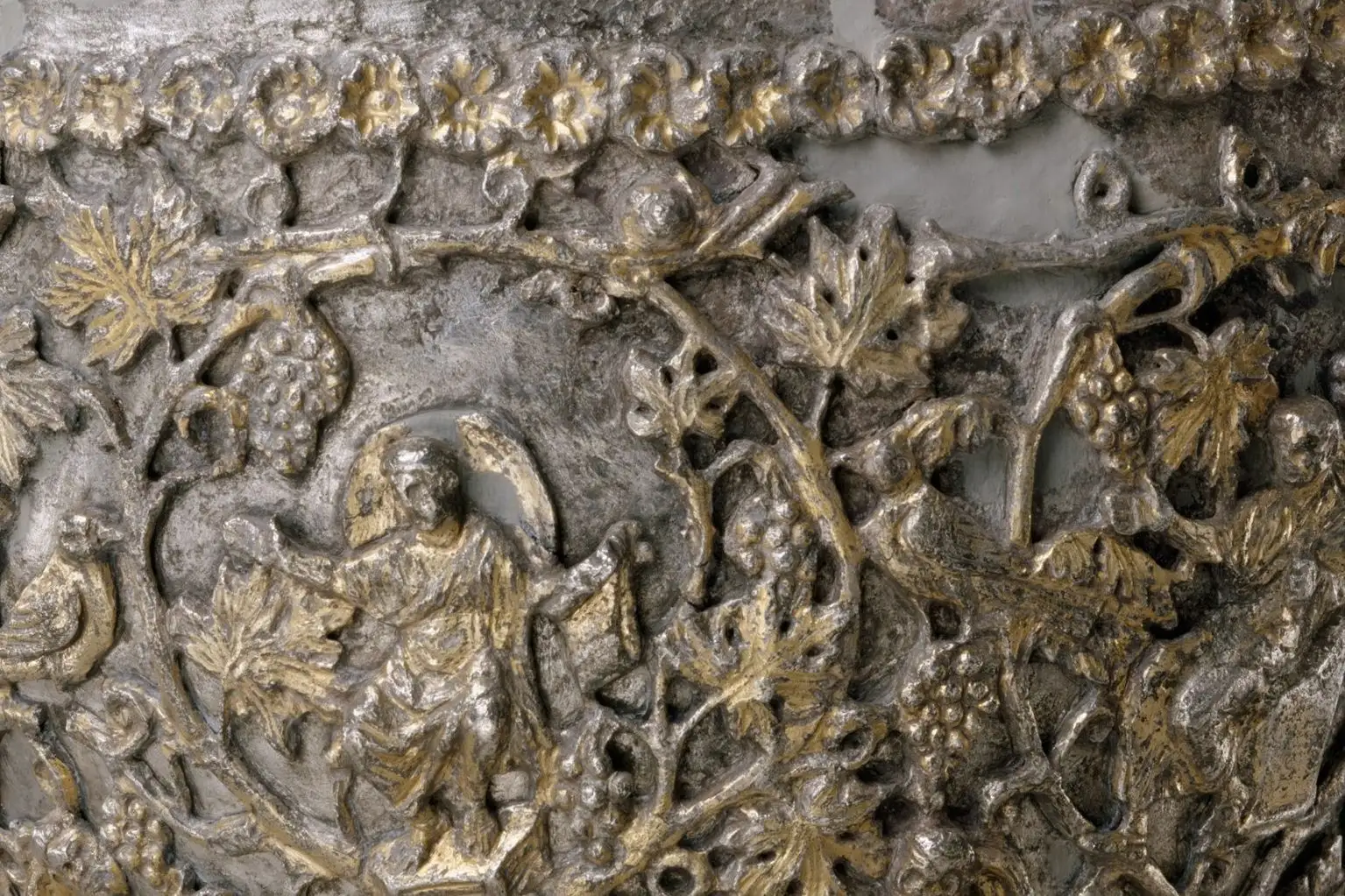
In 1892, the Louvre Museum acquired a magnificent silver vase discovered in the ruins of a church near Homs (Emesa). The body of the vase is adorned with repoussé relief figures showing the Virgin between two angels and Christ surrounded by four saints.1
A few years later, in 1899 and then in 1902, the finds at Kerynia on the island of Cyprus, now divided among the British Museum, the Pierpont Morgan collection, and the Cyprus Museum, brought to light a collection of marvelous pieces. These included silver plates, or missoria, decorated with reliefs—some stamped with a cross, others bearing the effigy of a saint, and the most beautiful forming a unique series of episodes from the story of David. The treasure also contained a hexagonal censer adorned with Christian figures; silver spoons whose handles feature an animal in relief on one side and finely engraved foliage on the other; and admirable gold jewelry.
Among the jewelry was a bracelet covered with vine scrolls within a filigree frame, a gold necklace made of openwork leaves from which hang a cross and six disc-shaped pendants, and another object—either a necklace or a belt—composed of sixteen gold medallions. The four largest of these medallions depict a basileus (emperor) in a quadriga and are inscribed with the names of the emperors Tiberius (578-582) and Maurice (582-602). This famous discovery has revealed an entire facet of the decorative arts at the beginning of the Middle Ages.2
To this sumptuous collection, we can add a gold bracelet found in Syria and acquired by the British Museum in 1897. It is similar to the one from Kerynia but is ornamented with a bust of the Virgin Orans and birds—swans or pheasants—encircled by the coils of a double stem emerging from a magnificent vase.3 Similarly, the jewelry from Mersina in Cilicia, which entered the Hermitage Museum, recalls the Kerynia necklace with its pear-shaped pendants and filigree ornaments.4 Finally, in 1908, a treasure discovered at Stûma in the district of Aleppo entered the Museum of Constantinople.
It consisted of a gilded silver liturgical fan with incised ornaments, two silver patens decorated with an engraved cross, and a third paten bearing in relief the well-known Byzantine iconographic subject of Christ depicted twice behind an altar table, distributing bread and wine to his Apostles.5 Certain awkwardnesses in composition, the dryness of the draperies, and the stereotyped smiles of the figures allow this curious work to be dated to the 7th century, during the era of Heraclius, whereas the majority of the objects from Kerynia and other Syrian treasures belong to the late 5th or the first half of the 6th century.