We need not inform our readers of the art treasures accumulated by Mr. Spitzer; we have studied them at length in these very pages. While not claiming to have covered everything, our eminent collaborators have certainly overlooked none of the collection's major pieces. However, a detailed analysis of this admirable collection would have required a scope that the Gazette does not permit. A considerable task remained: to create an exact inventory of these riches, complete with meticulous descriptions and the critical insights they provoke. This work is now underway, and as the first of its six volumes has just been published, we can now offer our opinion on it.
Each section of the catalogue is preceded by an introduction written by a specialist, illustrated with a few drawings in the text, and accompanied by Dujardin heliogravures printed in color and chromolithographs. Here is a quick overview of the contents of the first volume, with a brief assessment of the importance of each section.
The Catalogue's Prefatory Sections
I. Antiques
Notice by M. Froehner; 12 engravings in the text, VII plates, 32 objects catalogued.
For many years, Mr. Spitzer devoted himself exclusively to acquiring art from the Middle Ages and the Renaissance. Once his collection was formed—or rather, his museum, for it is a museum that can rival the most famous public galleries in Europe—it required a kind of explanatory preface. To satisfy our thoroughly modern need for precise information and conceptual continuity, which governs the plastic arts as well as other intellectual domains, this preface needed to define the origins of the works, showing, in a sense, the genealogical tree of the pieces described and illustrated.
This is why Mr. Spitzer chose to place a few antique objects at the threshold of his collection. He selected pieces suitable for a shelf or display case, as they are better suited than large monuments for establishing the transition between Pagan and Christian art. Thus, he was led to assemble admirable terracotta figures from Tanagra and a few bronzes.
II. Ivories
Preface by M. Alfred Darcel; 43 engravings in the text, XXIV plates, 171 objects catalogued.
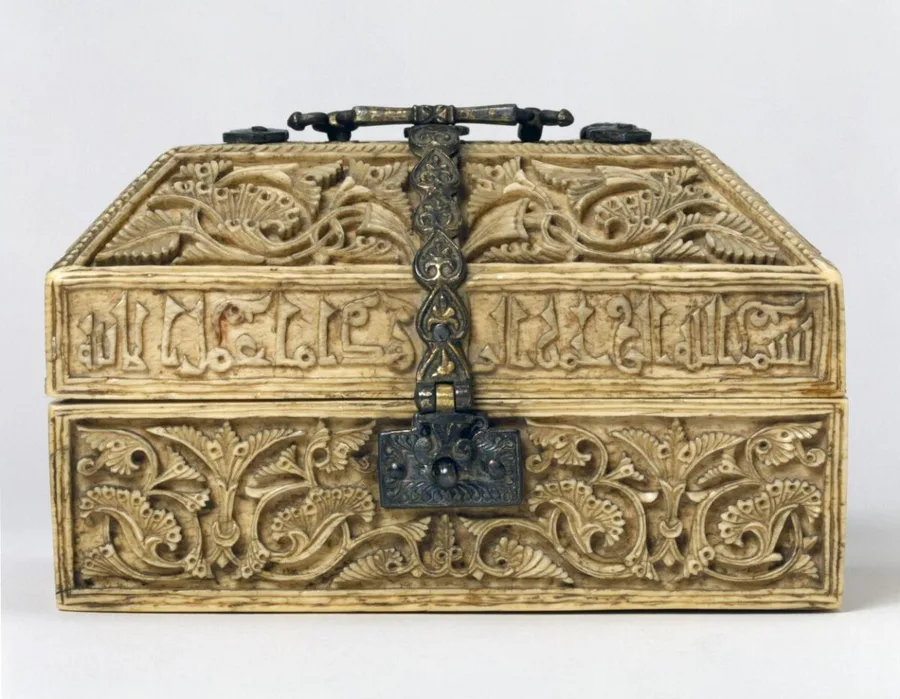
Ivories, saved from destruction because their material has no intrinsic value, are the best surviving witnesses to the irremediable decadence of ancient art in the fourth century of our era, the barbarism of the Middle Ages, and the process of the Renaissance. Ivory is the quintessential traveling art object: it is often found far from its country of origin, and sometimes returns bearing the stamp of the lands it has traversed. This creates an uncertainty of provenance that is the despair of archaeologists. It required nothing less than the rare competence of M. Alfred Darcel to bring order to this chaos.
The series of ivory objects in Mr. Spitzer's collection is truly magnificent, though this comment will seem superfluous; let us state once and for all that the same is true for every series in his museum. We will later appreciate the role of M. E. Molinier, who deserves a considerable share of the credit for the general task and the honor of having accomplished it so well.
III. Religious Goldsmithing
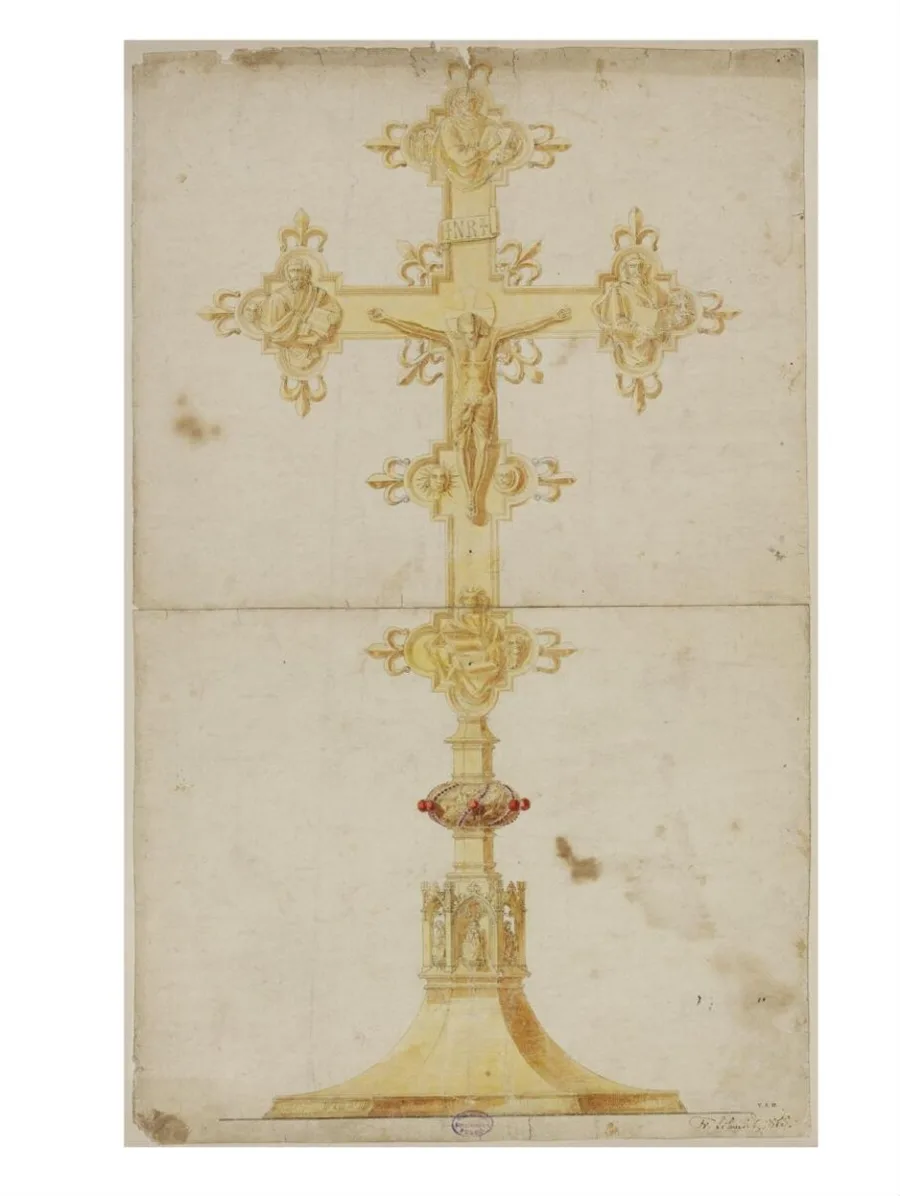
Notice by M. Léon Palustre; 61 engravings in the text, XXV plates, 185 objects catalogued.
The scholarly notice by M. L. Palustre has taken on the proportions of a true monograph. He had before him, moreover, pieces of incomparable richness and beauty. It is a reproduction of one of these that we wished to show to the readers of the Gazette—and Mr. Spitzer agreed with a kindness for which we thank him warmly. Our aim is to give an idea of the rare perfection with which the challenge of illustration has been met in this marvelous catalogue, and at the same time to revive the memory of a piece that excited the admiration of all visitors, archaeologists and non-archaeologists alike, at the Retrospective Exhibition at the Trocadéro in 1889.
The Christ in Majesty is described as follows by M. E. Molinier:
Book cover plaque. Cloisonné and champlevé enamel on copper. French work. Limoges (late 12th century).
In an aureole in the shape of a vesica piscis (an almond-shaped halo) chased on the plaque, Christ is seated, his feet placed on a footstool. With his raised right hand he blesses; with his left he rests on a closed book. Bearded, with long hair, his head is surrounded by a cruciform nimbus, and on each side are figured an A and an Ω. The four corners of the plaque, bordered by a chased beaded pattern, are occupied by the symbols of the Evangelists: at the top, the angel of Saint Matthew and the eagle of Saint John; at the bottom, the lion of Saint Mark and the ox of Saint Luke.
The heads of Christ and the symbols of the Evangelists are in relief and applied. The hands and feet of Christ are chased. The figures stand out against a plain background of gilded copper, and the entire design of the animals and Christ's garments is expressed by thin partitions spared from the background. The dots that adorn the nimbus and the orphreys of the garments are cloisonné. Throughout this piece, the intention to imitate a true cloisonné enamel is evident, and nowhere is the nuance and transition between the two processes better captured.
Enamels are lapis blue, lilac blue, turquoise blue, light green, dark green, dark red, and white. This plaque is marked on the reverse with an engraved A. Height: 0.236 m. — Width: 0.136 m.
To this very precise and detailed description, there is nothing to add. But what M. Molinier could not say, since he was not tasked with appraising the objects submitted to his analysis, is the extraordinary impression of grandeur that emanates from the object. One can judge this by the reproduction that accompanies our article; its resemblance is striking.
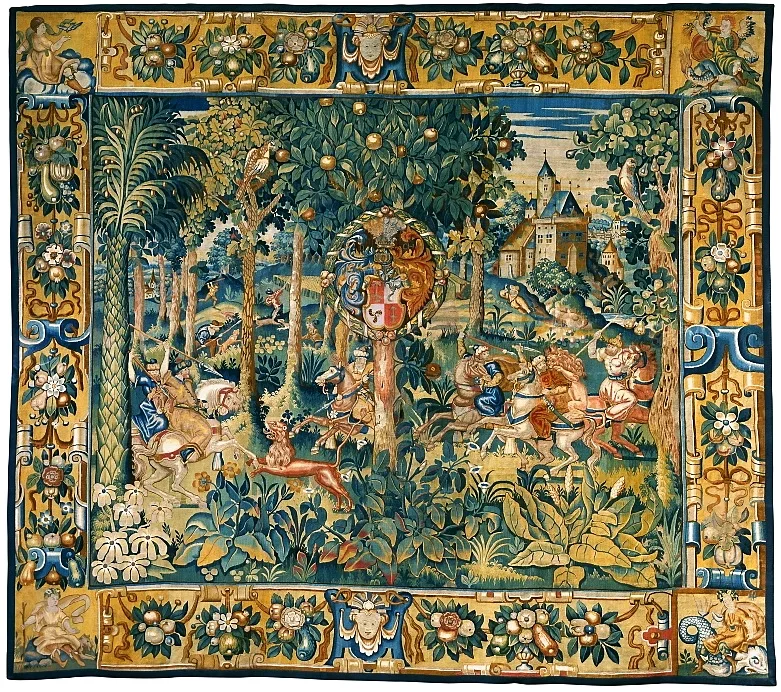
IV. Tapestry
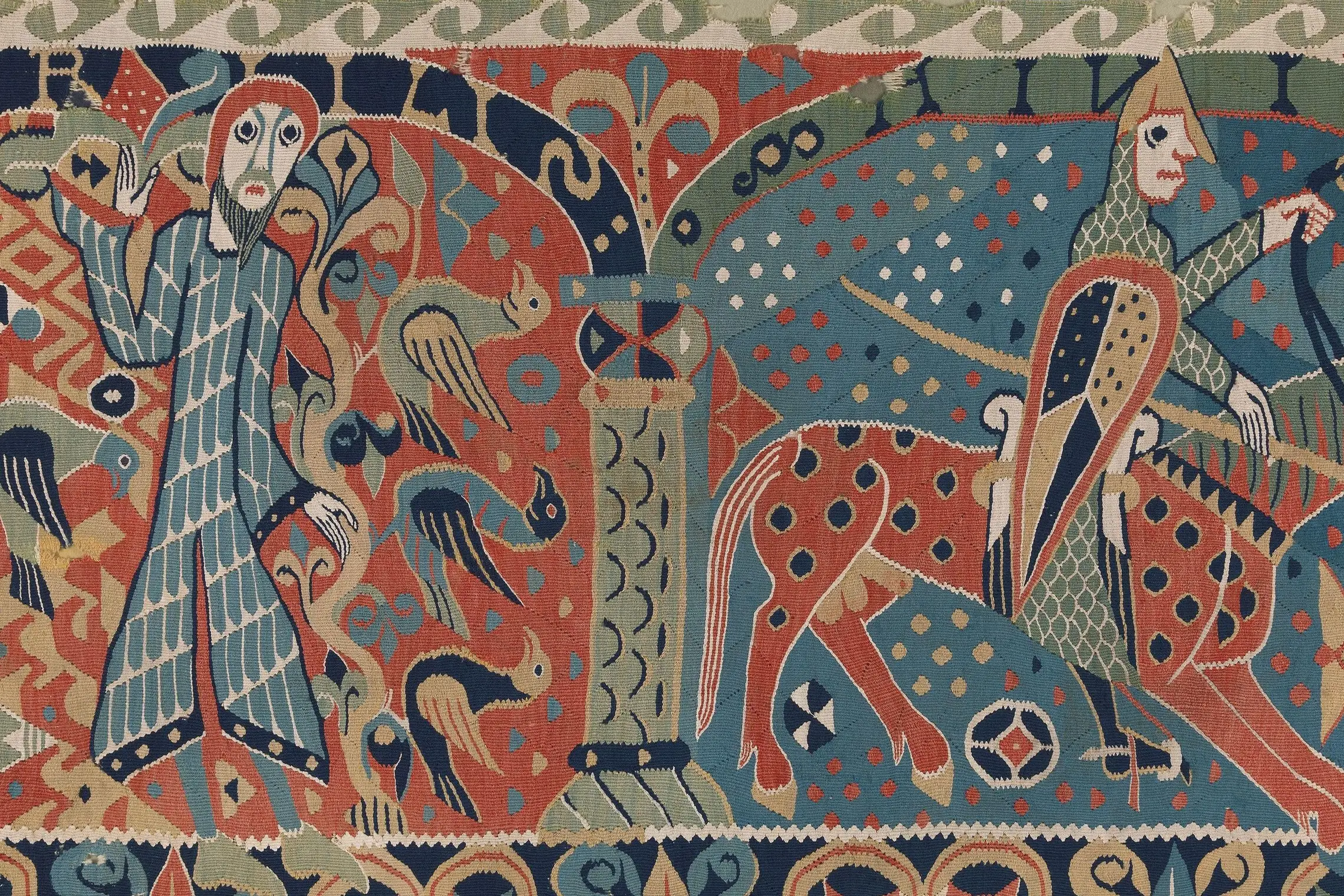
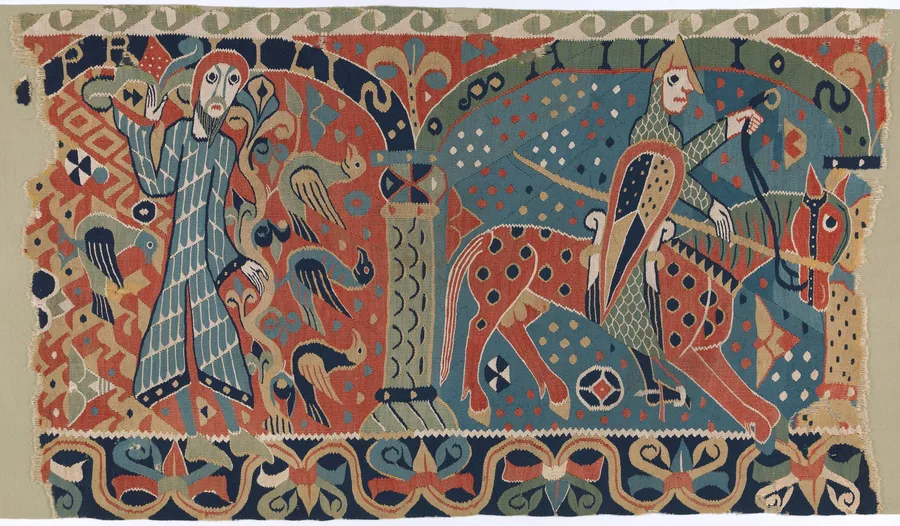
Notice by M. Eugène Müntz; 2 engravings in the text, VII plates, 23 pieces catalogued.
The importance of this series is well known; nor do we need to elaborate on the merit of the commentator. Our readers have long been aware of the authority attached to his slightest works.
The Monumental Task of Cataloguing
For a very long time, Mr. Spitzer had been considering commissioning a catalogue of his collection, and the articles published in the Gazette des Beaux-Arts were, in a way, merely the prelude to this major work, which presented many difficulties in its execution. Although he had found distinguished archaeologists and learned amateurs to introduce the public to all the wonders he had assembled, it was more difficult to find someone to describe, classify, and date each piece one by one. This was a long, meticulous task that could not be asked of established figures, nor could it be entrusted to just anyone or to several people.
After some searching, Mr. Spitzer's choice fell upon a young archaeologist undaunted by long-term projects. For four years, M. E. Molinier has been working on this inventory, the first volume of which is published today. It is a long time, no doubt, but considering that the work will comprise six volumes and that the manuscript is now finished, it is not excessive. It is only fair to define M. E. Molinier's role in this work, for in sum, all the heavy lifting is his. It is, in a way, an impersonal work for which he will never reap the honor that less arduous and less considerable works might have brought him.
His name will, however, appear at the bottom of several of the prefaces for series in the upcoming volumes; he is to give us the Palissy faïences, the Italian faïences, the dinanderie (decorative brassware), the plaquettes and medals, and more. These synthetic studies will compensate for the aridity of his primary task. Thus he will find himself truly admitted into the company of the eminent archaeologists who have attached their names to the most beautiful catalogue of a private collection ever published.
Moreover, M. Molinier's fate does not seem to us the least enviable. Has he not handled and studied for several years the riches of a collection unique in the world? This is one of those rare opportunities for which every archaeologist must yearn, but which are seldom encountered. If Mr. Spitzer's choice fell upon our collaborator, it is because his name was already known to him through important works, some of which have appeared in the Gazette and need no recalling here. The task was nothing less than cataloguing approximately 4,000 pieces; but among the young, the passion for knowledge is in its full vigor, and they expend their efforts without counting the cost.
Scholarly Contributions and Reattributions
We owe to M. Molinier a classification of the ivories that is as rigorous as the state of this branch of archaeology—still very poorly understood, even though for part of the Middle Ages they are the only monuments of sculpture we possess—will permit. He has successfully resolved certain questions of dates and iconography. For example, he establishes that the famous saddlebow (troussequin de selle) must have belonged to Frederick of Aragon, and would therefore have been made at the beginning of the 14th century in Spain or Sicily.
Certain English ivories owe their determination of origin to him; we reproduce one from the Spitzer collection that can be usefully compared with a whole series of ivories of which the Louvre possesses specimens. The English attribute them to 12th-century France, whereas they are works of an English type from the 15th century.
In the classification of goldsmithing, M. Molinier has given a larger share to the Limousin School. He includes in it the admirable plaque reproduced in chromolithography in the Gazette, which many people still attribute to Germany. These attributions are the result of studies made in recent years by the young archaeologist, prompted by exhibitions such as those in Limoges and Tulle. Now, for a somewhat trained eye, there can no longer be any possible doubt about the provenance of these pieces, which have been debated for many years.
For the 15th century, the difficulty of classifying objects by provenance—France, Spain, Italy, Germany—is well known. It is often very arduous to justify an attribution and especially to present it in a way that is acceptable to someone who has not specifically studied the question, since in a catalogue it must be presented bluntly, in just two or three words.
The Art of Illustration and Production
We have sought to give an idea of the considerable effort and sagacity that the arrangement and writing of the Spitzer Collection catalogue required; it remains for us to say a few words about the illustration. It is worthy of the subject—that is the highest praise one can give it.
The perfected process of M. Dujardin triumphs in the monochrome plates and in those that need only a few discreet colors to provide an excellent reproduction of the original. The printing of these heliogravures, using the à la poupée method (a technique for inking a single plate with multiple colors), has yielded the best results, thanks to the skill of M. Eudes. The reproduction of the ivories, bronzes, and terracottas is perfect in every respect.
For the tapestries and especially for the goldsmithing pieces enriched with enamels, M. Émile Lévy, who was in charge of managing this difficult illustrative work, resorted to color printing using new processes from the Maison Lemercier. This approach gained an element of accuracy, pushed to the point of trompe-l'oeil (an optical illusion), that intaglio printing does not yet possess: the ability to varnish the proofs. The images, varnished after printing either entirely or in specific spots, give the objects a striking relief. Never has the art of the facsimile been brought to this degree of perfection.
In concluding this review of a truly exceptional publishing work, it would be unjust not to mention its general layout and execution. The printing of this large in-folio volume does the greatest honor to the Maison Quantin. Furthermore, it was Mr. Spitzer who conceived the plan for his catalogue; this credit, which is quite important, must be given to him, even after that of having formed his admirable collection. Is it necessary to add that a publication of this importance is destined to render the greatest services to all who are concerned with art? It will be expensive,¹ that goes without saying, but those who cannot buy it will always have the resource of consulting it in public libraries, museums, and art schools, where it has its designated place.
ALFRED DE LOSTALOT.