
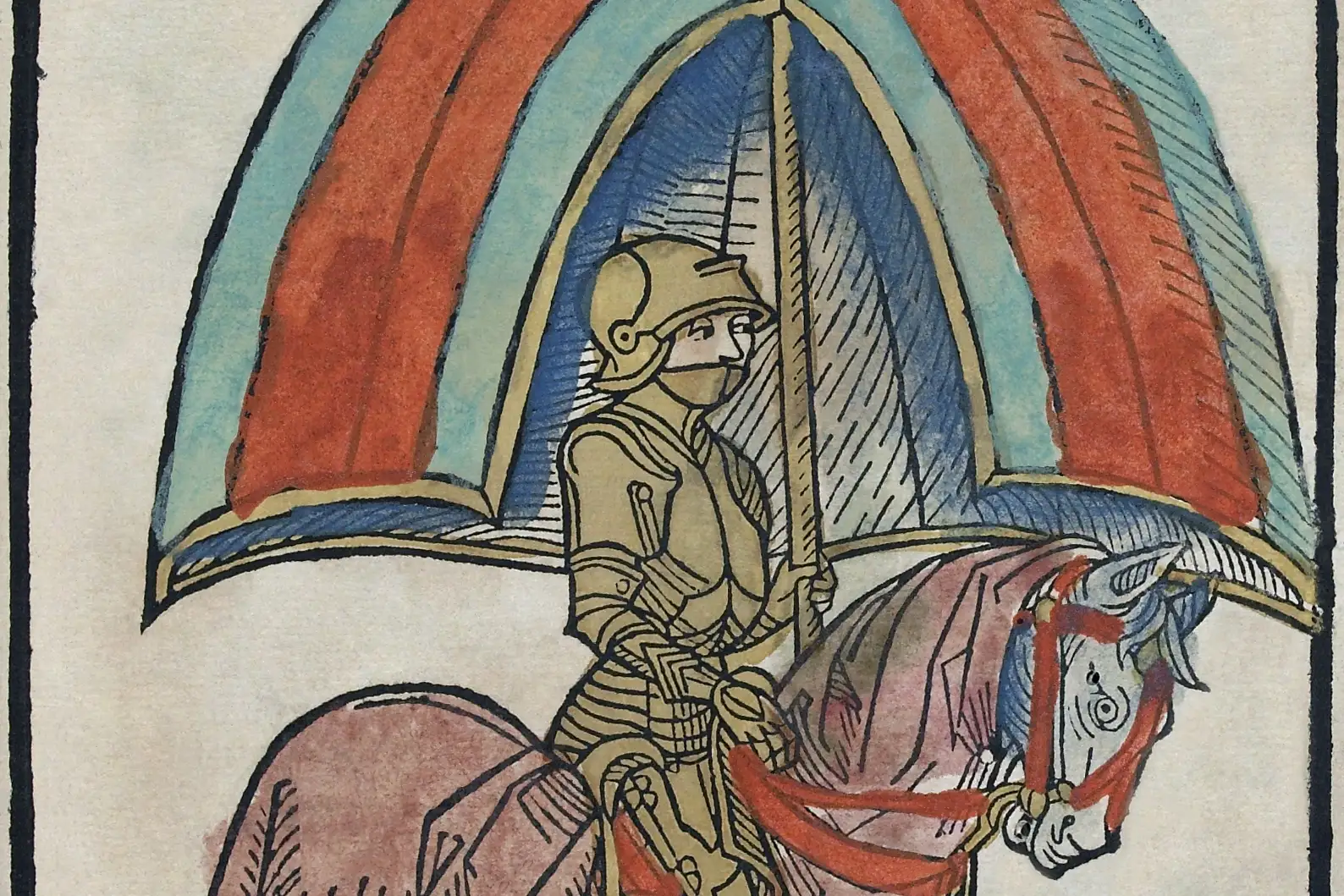
From the 11th to the 16th century, seals consistently repeated the image of a fully equipped knight, brandishing a sword or holding a lance, mounted on a galloping horse. This image, though seemingly always the same at first glance, offers to the careful observer a history of all the changes that occurred in military attire. This visual record spans from the day the Normans conquered England to the moment when the study of armor could be continued in specialized museums.
It is not the purpose here to chronicle every transformation in wartime clothing during this long interval. Instead, describing a few examples taken from characteristic eras will suffice to show what can be gleaned from the rich collection of the National Archives. Since the subject is the knightly type, it is best to first clarify what was understood by a "knight" in the Middle Ages: a privileged individual whose birth assigned him to the profession of arms and granted him the right to fight on horseback, clad in complete armor.
The Early Knight: 1050 to 1200
The first equestrian seals appear in the second half of the 11th century. On these, the man-at-arms wears a tunic made of leather or several layers of fabric, reinforced with metal plates sewn very close together, or latticed with iron bands; this was called the broigne, or byrnie. It was fitted with a coif that served to protect the neck, sides, and lower part of the face.
The skirt of the byrnie, split in the front and back, descended below the knee and was usually cinched at the waist with a belt. The sleeves stopped at the wrist; they were sometimes narrow, flaring at the end to ensure freedom of movement, and sometimes very wide from the armhole down. In 1095, Guy de Laval is depicted wearing a byrnie without a belt, covered with round iron plates, and with sleeves that flare at the wrist.
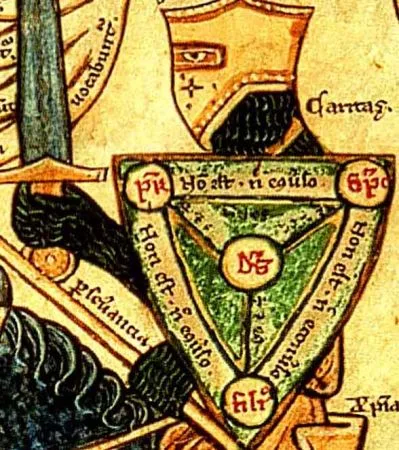
Another, more protective tunic was in use at the same time as the byrnie, though it was less common due to the difficulty of its construction. Its exterior defense consisted of a fabric of interlaced mail rings, and it was known as the haubert, or hauberk. Both the byrnie and the hauberk were worn over a second, lighter, and more flexible fabric tunic called the bliaut.
Initially completely hidden by the outer tunic, the bliaut began to extend beyond it around the middle of the 12th century, revealing the edge of its pleated skirt. This skirt was destined to take on the most exaggerated dimensions a few years later. This refers to the time when knights sought to imitate the costume of ladies, attaching long, flowing sleeves to their wrists—a fashion that was, however, soon abandoned.