
Spend an hour at the Musée des Arts Décoratifs, and you will leave convinced that the works which have stood the test of time without losing their appeal or charm—those that endure with the immutability of, for example, a piece of period furniture—are all the works of artisans. This point should be emphasized for those who still overestimate the utility of imagination and theories in the revival of our decorative arts. To achieve such a lofty goal, the conscientious study of technique and a return to its effective practice are indispensable. This is why nothing definitive will be accomplished without a complete reform of apprenticeship.
Industry may seem poor in ideas, true enough. It will have them in abundance and will know how to use them better once it has rediscovered the profound character of the crafts from which it emerged, and of which it currently only multiplies a weakened, trivialized expression.
While we wait for a little idealism, born from the love and dignity of labor, to inhabit the modern factory, let us be grateful to the people of goodwill who maintain or revive the beautiful artistic crafts of the past in new forms. The humility of their means only highlights the significance of their achievements and the amount of initiative and willpower they represent. Ceramics, furniture, and textile decoration have provided many examples over the past twenty years. The metal arts have not lagged behind. A fortunate evolution has rejuvenated ironwork (ferronnerie), bronze, brassware (dinanderie), goldsmithing (orfèvrerie), and jewelry.
We see them increasingly triumphing over commercial banalities and ugliness, drawing inspiration from and moving closer to life, entering the home, and fulfilling their role of utility or adornment. To these traditional categories, one might be tempted to say that Jean Dunand has added another with his decorative vases, whose varied and personal technique is almost as intriguing as it is interesting. But in reality, however new the result may appear, the artist did not aspire to create a new branch of the metal arts. He simply dedicated himself to obtaining new forms and decorative effects by combining different, more or less known techniques that could be harmoniously associated.
It is precisely this research that we find interesting to summarize here.
From Sculpture to Metalwork
The first works Jean Dunand exhibited, about fifteen years ago, had few ornaments in the strict sense. They were vases and platters, most often of hammered and patinated copper, which were captivating primarily for the simple and well-balanced harmony of their form. If this quality still dominates his production today, it is because the artist began his career as a sculptor and, for a long time, wielded the hammer and the modeling tool concurrently. Between the firm and sensitive modeling of the few busts one enjoys seeing again in his studio and the elegant curve of a vase from his recent work, an obvious kinship is discernible.
The sheet of copper, like clay, obeys a robust and frank personality who prefers to express himself through the most direct means. Thus, even when the work seems to owe more to craft than to art, it is pure and spirited, possessing that particular seduction of simple things illuminated by a ray of the ideal.
Dunand's early studies at the School of Industrial Arts in Geneva had already guided his preferences toward repoussé metal, chasing (ciselure), and engraving. From that time, he had the intuition that he would find in this path everything that could excite an artist's imagination: the revelation of an infinity of new forms and aspects, the discovery of a field of investigation that was, if not virgin, at least relatively unexplored in the preceding period. His time in the studio of Jean Dampt, as noble an artisan as he was a proud sculptor, certainly could not have steered him away from what his adolescent mind had discerned through still-vague and insufficiently considered notions.
Yet, from 1896 to 1902, he devoted himself exclusively to statuary, and the catalog of the Salon de la Nationale in 1904 still mentions his participation in the sculpture section. But that same year, he also exhibited his first metalworks in the decorative arts section. The novelty and originality within them could not go unnoticed in that period of hesitation and timid experimentation. Fortunately, the works of artisans have multiplied over the past fifteen years and are appearing more and more frequently in exhibitions. But in 1904, artists who worked the material themselves were rare. People stopped before Dunand's vases, as they did before the ceramics of Lenoble or the leathers and ivories of Clément Mère, for the directness of their creation and for the personality that was manifest in the execution as well as in the conception.
The public looks for the artist behind the work; an original work is one in which the creator's hand can be felt, where one senses that an idea, a feeling, or a will has guided the hand, just as the hand guides the tool.
Philosophy of Form and Decoration
As his production developed and became richer, Dunand had to create from scratch a technical organization suited to his work. Nothing is more interesting than this gathering of old trades that the artist revives by training apprentices and workers, after having reconstructed the necessary tools. We found there, as we previously did at the master ironworker Robert's workshop, about twenty young people between the ages of fourteen and twenty, taught their trade by the artist himself according to an apprenticeship method that appeals to their taste and initiative as much as to their skill. The results are very satisfactory.
An adolescent progresses quickly in a job that captivates and holds his intelligence; if he is gifted (a frequent case among young Parisians), he passes the preliminary stages in a few months and is soon able to tackle more advanced techniques.
Jean Dunand, though he owes his best inspirations to nature, never incorporates any direct copy of it into the general lines of his works or the ornaments he adapts to them. Some of his vases may evoke, if you will, beautiful unknown fruits, on whose surface repoussé and chasing create crevices or asperities that seem to express the bubbling of life. But all of this is created, not copied. Guided above all by the nature of the materials he employs, the artist understood from his first hammer blow that the adornments of fields and orchards cannot be transferred to metal objects without being arbitrary and insipid.
By pushing his research a little further, he found forms that unite freshness with grace and a decorative richness that never falls into the trap of over-ornamentation.
Recently, he has added enamels to his repertoire. The complexity of these mostly ancient techniques, often combined in the execution of a single decorative vase, brings to these works effects that are all the more delightful because the decoration and form are free from any school's influence. Before moving on to a brief description of the material execution, it seems essential to first consider the ideas and concepts that inspire it. They play a much more important role here than one might initially suppose, given the sober effects and discreet sumptuousness to which the artist voluntarily limits himself.
The Workshop and Its Techniques
Apprenticeship, at least during the initial period, follows the normal progression of operations that transform a sheet of metal into a specific shape. First comes the hollowing (emboutissage), which consists of beating the copper sheet with a mallet on an oak block that serves as both a support and a template. This initial operation forms the base. The raising (rétreinte) and planishing (planage), which follow, are shaping processes done with a hammer; they complete the essential profile. As this hammering continues, the metal sheet thins, its molecules become increasingly compressed, and its malleability decreases; it is therefore necessary to intervene between each phase with an annealing, or heating, to facilitate the completion of the work.
Once the form is raised, it is filled with cement or a plastic material, depending on the decoration process that is to follow.
The decorative techniques are more varied and complex than the preceding ones. Here, the students begin to specialize according to their tastes and aptitudes. Some stick to repoussé work with a hammer or a recingle (a tool that allows a design to be pushed out even at the base of the deepest vases), while others are familiarized with different types of chasing or the even more delicate work of inlay. Each of these trades is independent of the others, but their combination in Dunand's works contributes greatly to achieving original effects. It seems unnecessary to go into detailed descriptions here.
Repoussé is self-explanatory: it is what creates the ornaments in more or less pronounced relief, with each detail being traced, drawn, or marked by a guide on the surface to be decorated. Chasing is used either to complete and accentuate the repoussé or to hollow out the areas intended to receive inlays or enamels.
Finally, the inlays themselves are obtained by pouring softer metals—gold, silver, nickel, etc.—into the hollows thus created. Polishing then completes the series of operations.
The Art of Enameling
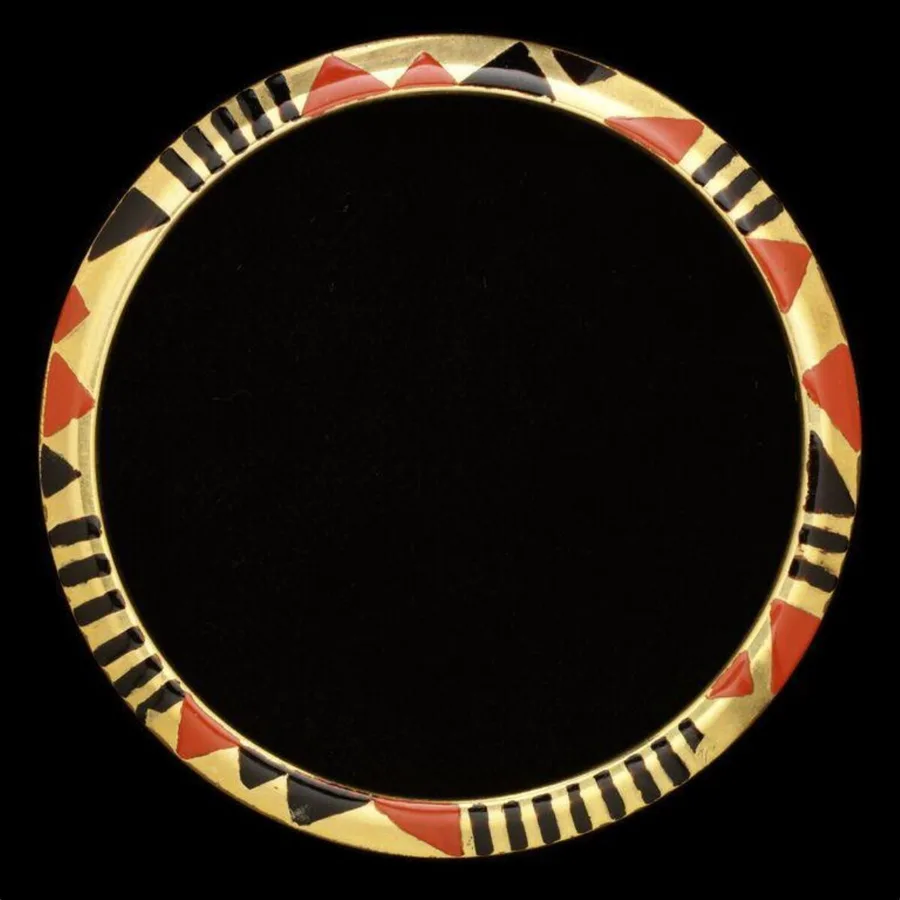
For champlevé enamels, also known as "in taille d'épargne" (in reserved cutting), the hollow parts are carved out with a tool, following the contours of the design transferred onto the metal. For repoussé enamels, as one might guess, instead of leaving a design in relief on a hollowed-out surface, this relief (or cloison) is produced by working the metal from the reverse side. Finally, in cloisonné enamels, the relief design is first formed from thin metal strips shaped with pliers, then applied and soldered onto the object to be decorated. In all three types, the enamel paste is then poured into the hollows, after which the pieces are placed in a kiln where the firing makes the enamel and metal a homogeneous whole.
Polishing the surface brings out the final brilliance of the colors and reveals the metal outlines.
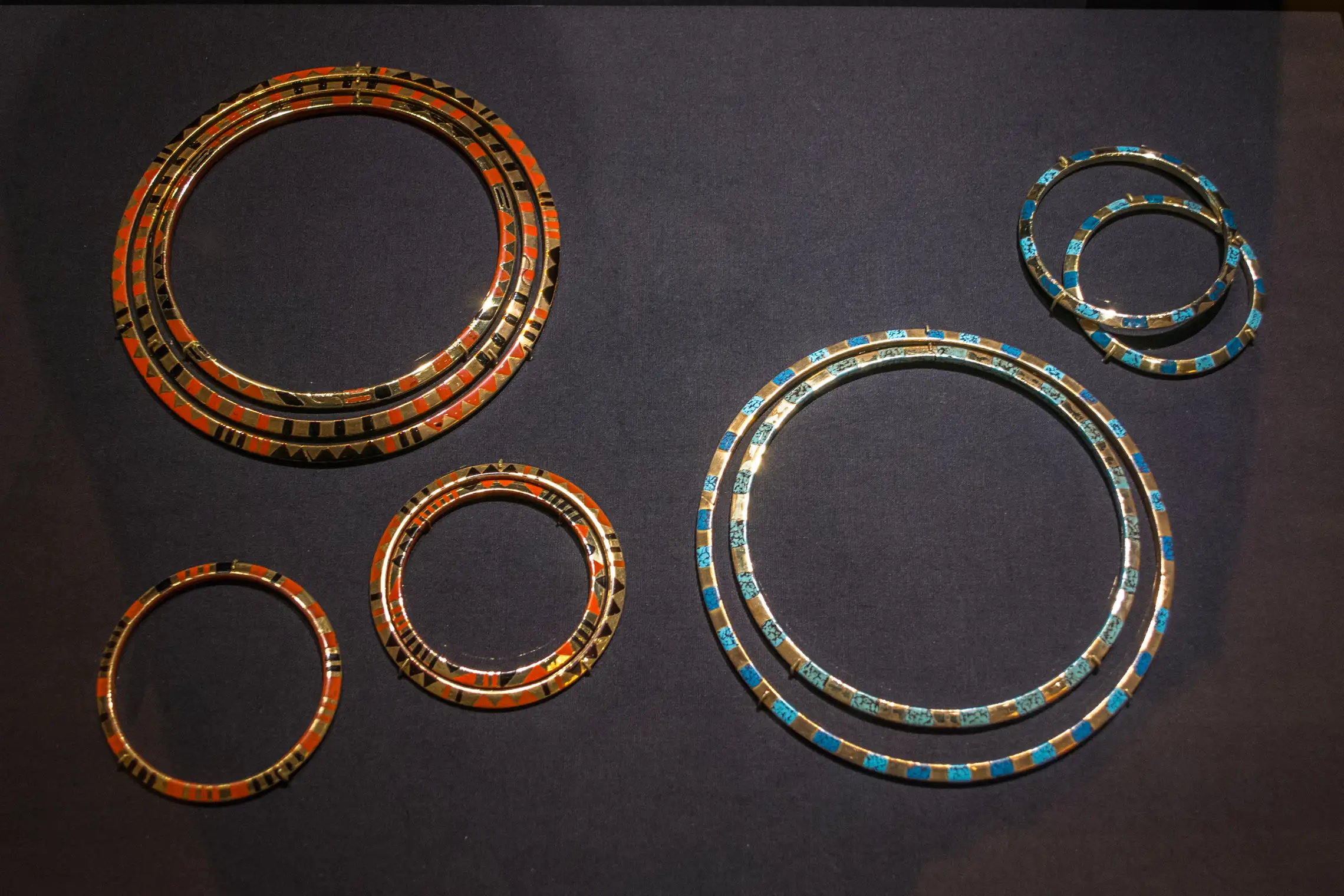
We have provided these brief indications only to facilitate the examination and understanding of Jean Dunand's works. One can imagine that in practice, many details left unmentioned here make a useful contribution to the desired effect. Regarding enamels, for example, Dunand pursues his experiments in a very personal way. He understood that adapting them to decorative objects of sometimes large dimensions, made of hard and resistant materials, called for different effects than those suitable for small and fragile trinkets. He gives the metal a more prominent role, not hesitating to subordinate the color to its support, sometimes asking it to embellish a vigorous repoussé, other times to adorn the neck of a vase much like a necklace adorns the neck of a beautiful young woman.
This research has led the artist to other applications of enamel. He is currently working on binding plates for books made of copper decorated with champlevé or repoussé enamels. However limited its applications may be, this contribution to the decoration of books deserved to be noted.
Innovations in Materials and Form
Jean Dunand has also found other effects in the use of lead, steel, and nickel—less varied, certainly, than those he obtains with copper, but whose artistic and technical interest is no less. Nickel, in particular, produces blacks of a remarkable quality through oxidation. But here, we must confine ourselves to mentioning the very broad contribution of chemistry to this art, which is constantly preoccupied with new effects. The search for patinas and their fixation on various metals is not the least exciting part of Dunand's work. It gives rise daily to unforeseen problems, which in turn direct his attention toward new discoveries.
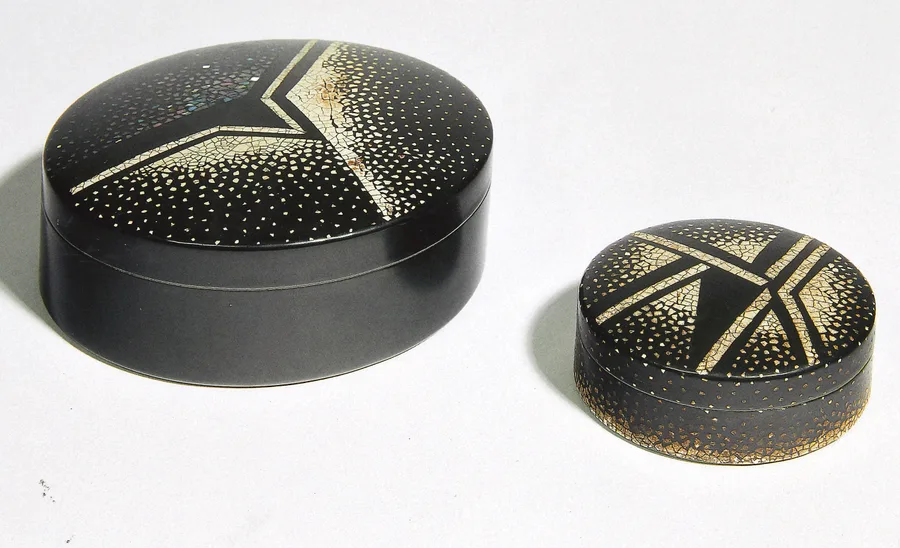
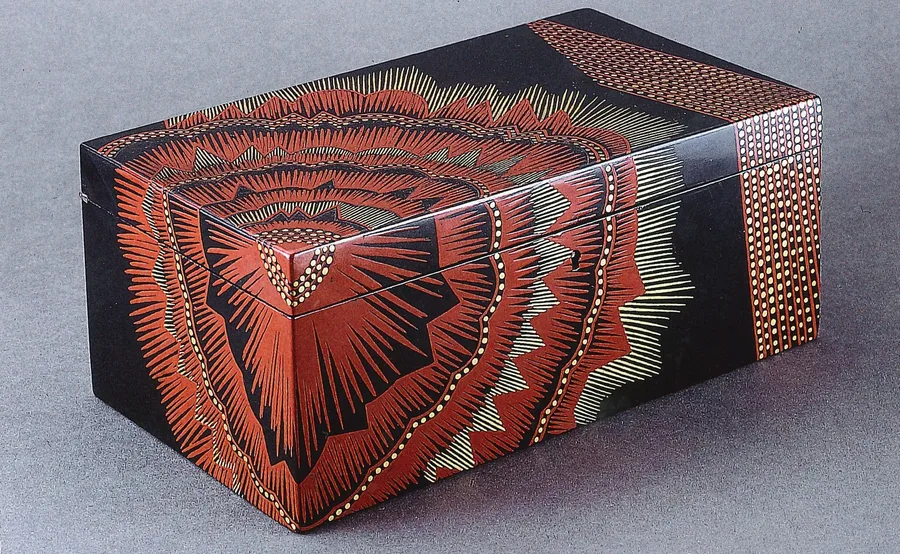
It was thus that the study of fixatives led him, many years ago, to the use of lacquers, from which he subsequently derived many interesting and original effects.
Jean Dunand, whose name was first revealed to the public through works that were essentially decorative objects (bibelots), today shows a laudable tendency to extend the applications of this art—at once robust and precious—that his efforts have resurrected, or more accurately, recreated. The large copper vase with silver inlays, which was seen at the Salon des Artistes Décorateurs, is a testament to this. Other, more direct applications of metal to the interior decoration of the home are currently under study.
Finally, one should not forget that during the war, Dunand invented a visor adaptable to the trench helmet, designed to protect the soldier's eyes from shrapnel and jets of flaming liquid. All the arbiters—and God knows there were many—agreed on the advantages and effectiveness of this innovation. It is not for us to judge the practical objections and perhaps the administrative delays that prevented the widespread implementation of this improvement in time, despite the inventor's generous zeal. But it should also be noted that Dunand was led to consider the transformation of the helmet itself. The standard-issue helmet, not to mention its other claims to our gratitude, has an undeniable plastic value.
It must be acknowledged, however, that with its attached brims and crest of painted iron, it has a certain air of a bazaar armor. The headgear created by Dunand, after numerous trials, was, by contrast, made of manganese steel, stamped from a single piece. The integrity of this solution was, as is fitting, reflected in its form: sober, robust, and masculine under its dark patina, Dunand's helmet is a true work of art. Only a few thousand examples had been manufactured and put into trial when the signing of the armistice returned the inventor to more peaceful pursuits.
Regarding the pieces reproduced here, we will dispense with a descriptive commentary that would add nothing to the inevitable imperfection of the photographs. While the art of Jean Dunand and the theories from which it proceeds can be expressed in words, the same cannot be said for what I would gladly call the poetry of his works—a serene poetry, rich in accent and character, which its imperishable form will fortunately transmit intact to the future.
For those who will later wonder who this chaser of sensations, this hammerer of harmonies was, let us be content to have shown Jean Dunand, vigorous and meditative, in his small house in Montrouge, where the family organization, the simple tools, and the tranquil activity reminded us of the past and its fine examples.
ÉMILE SEDEYN.