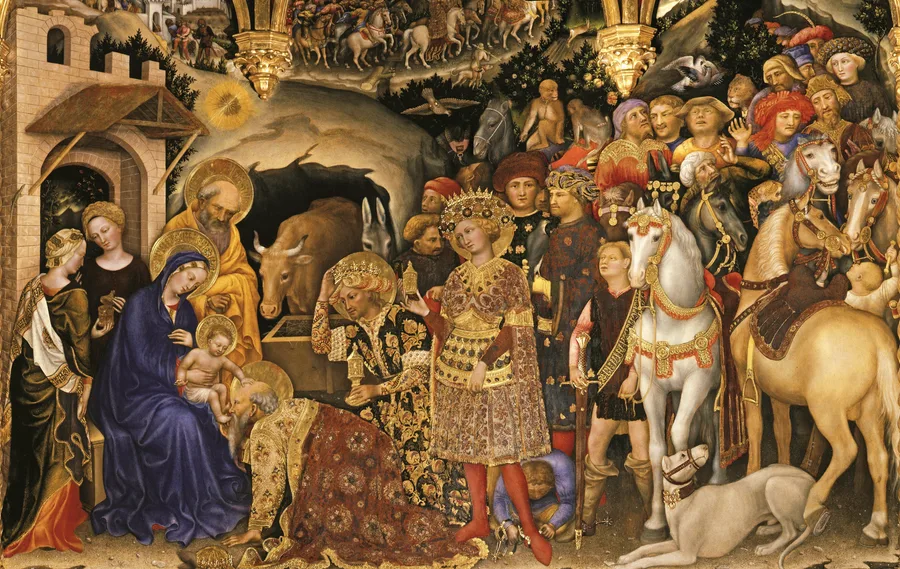
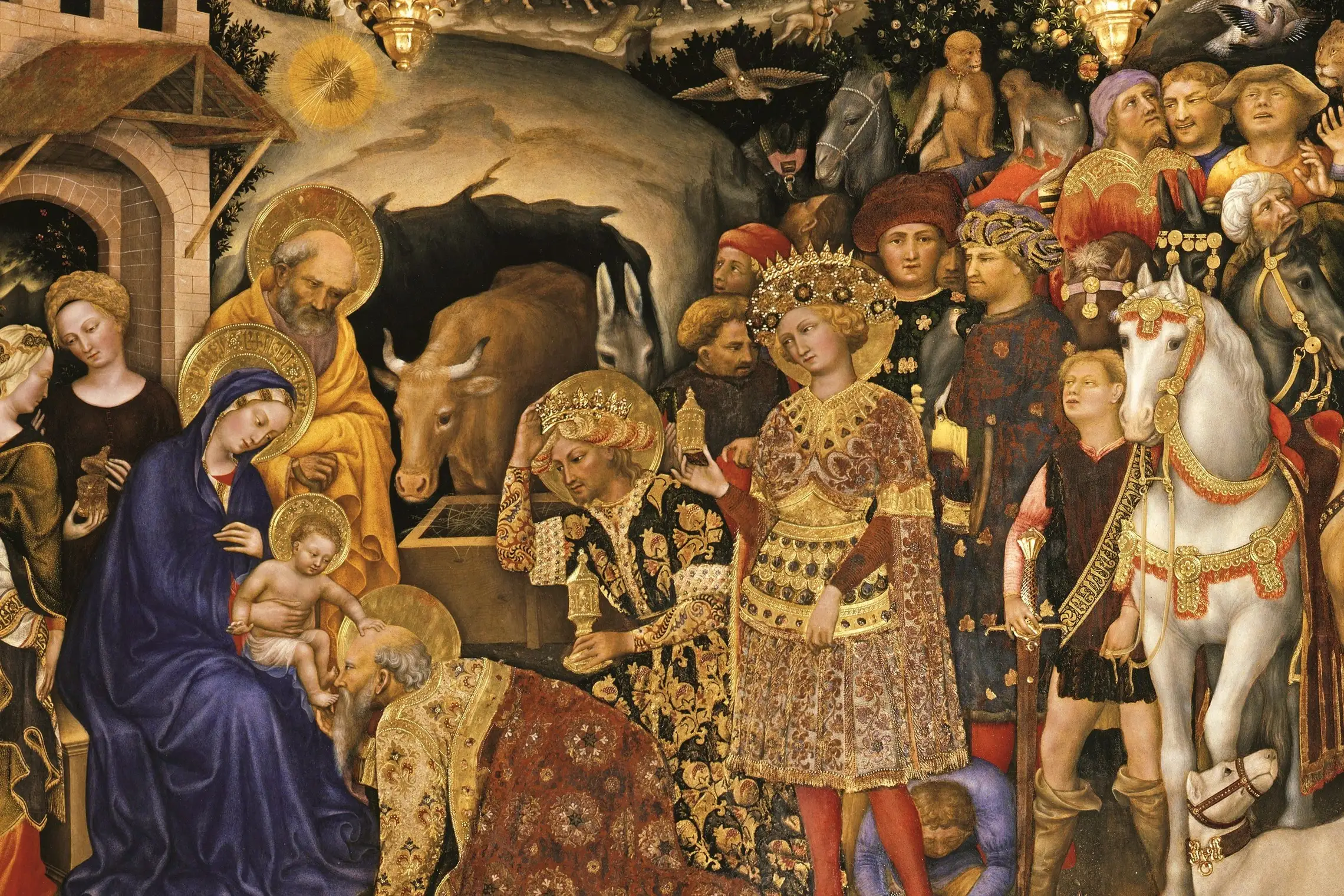

The Academy of Fine Arts in Florence possesses an excellent painting by Gentile da Fabriano, which the master painted in 1423 for the Vallombrosan monks of the Holy Trinity: it is an Adoration of the Magi. At once simple and grand, full of naivety and charm, this work excited the greatest enthusiasm upon its appearance and earned its author the title of magister magistrorum (master of masters). And a master he was indeed, this Gentile, who counted the two Bellini brothers among his pupils. The stern Michelangelo admired the composition and color of his works, and Raphael would go to a small village church to study their sentiment and grace. Venice rewarded him magnificently for the works he executed for the Republic and honored him with the patrician's robe.
My purpose here, however, is not to recount the merits of the Fabrianese painter or the qualities that assign his masterpiece one of the foremost ranks in Italian painting at the beginning of the 15th century. To speak of slightly lesser things, I must disregard the intrinsic value of this master painting and focus on just one of its parts, the least important one. I will examine only a few secondary points of its ornamentation. This search for the infinitely small in the great works of art will doubtless seem petty, but small things also have their interest, and observations of detail sometimes lead to curious results.
An Inscription in the Halo
From the depths of the East, the Magi have followed the star that guides them. Prostrate before the Christ Child, they lay their treasures at his feet and, so to speak, pay homage to their entire kingdoms, so numerous are their gifts and so great is the crowd that accompanies them. A long caravan of men and horses unfolds in the distance across the mountains of Judea. In such a multiple and animated scene, the accessory parts of the ornamentation are necessarily lavished with profusion. The garments of the traveling kings and their retinue, brilliant with gold and silk, recall in even the smallest details of costume the luxury of 15th-century Florentine lords.
Amidst this wealth of detail, one point still strikes the eye and particularly draws attention: the golden disc that surrounds the Virgin's head. This halo is composed of embossed letters, arranged in a circle. Their relief is very pronounced, their design strange. A similar design is also reproduced in the nimbus of Saint Joseph and is found again, though in reduced proportions, on the border of a king's mantle and on the baldric of the squire holding one of the Magi's horses. These characters, angular at their top and elongated at their base, are surprising in their unusual appearance.
Upon closer examination, however, one soon recognizes in their altered form an imitation, rather than an exact reproduction, of the beautiful Kufic-style letters that Orientals employed with such great skill in their epigraphic monuments of the Middle Ages. The presence of these Arabic letters in a religious painting, and particularly in the place they occupy, may seem singular. Yet this fact, strange at first glance, finds its explanation in a very natural cause. Doubtless, faced with the model before him, the painter saw only the elegant design he wished to reproduce. Less concerned with the meaning of the words than with the form of the characters, Gentile da Fabriano encircled the head of his Madonna with a Muslim legend.