
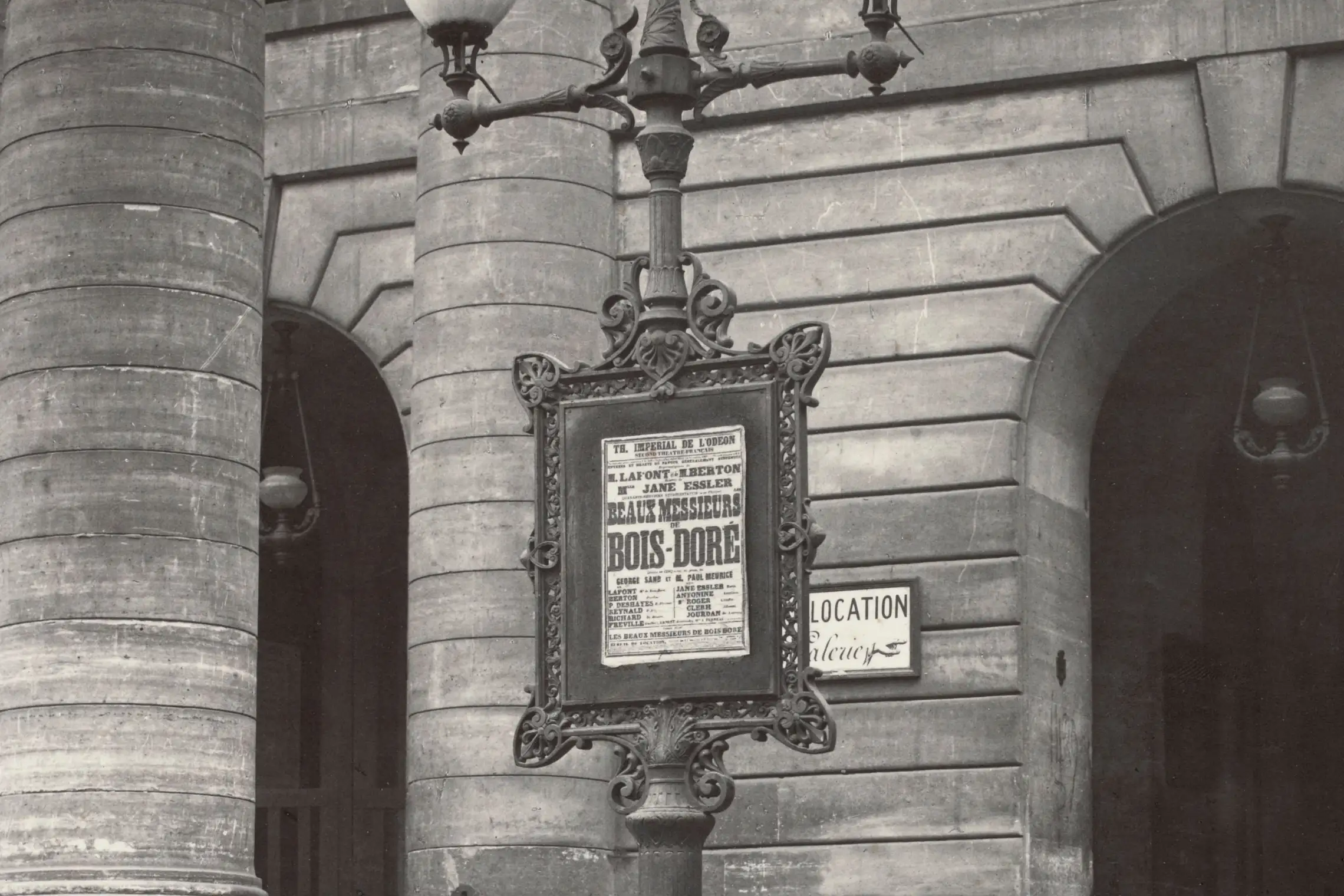
Are you not like me? Do you not feel offended by these large industrial placards that sprawl across the middle of our streets, impose themselves on our gaze, and spoil so many beautiful views of our city? Perhaps you will be astonished by this question; if so, too bad, for you have already been contaminated by the environment in which you live, and your sense of taste has become dulled. As for me, these enormous painted posters always leave me with a most disagreeable, even painful, impression. I often feel myself seized by a violent resentment against the administrators who so negligently allow, or have allowed, our city to compromise its beauty with such signs.
An Assault on the Senses
How is it that, while walking through certain districts of Paris, I cannot admire the buildings at my leisure, without my admiration being obstructed by enormous advertisements that both attract and wound my sight? How is it that I cannot try to study a monument without being distracted from my study by the monstrous placards of La Belle Jardinière, the Maison du Pont-Neuf, or "Teeth for 5 Francs"? This is a genuine abuse, almost a dishonest act!
I pay my taxes to have a cheerful, pleasant, clean, and well-kept city. I pay my duties, surtaxes, centimes, and décimes so that you—the mayor of Paris, the prefect of the Seine, or the chief of police—might give me a little well-being here, a little art there. And if you allow these insolent signs to be spread all along the walls of the houses, do I not have the right to find that my money is, in part, poorly spent? It is not enough to sweep my streets so that my feet do not get muddy; you must also sweep away these invasive advertisements that plaster themselves in my path and splash my eyes.
For I care about my eyes just as much as you seem to care about your ears, which you appear to protect by forbidding the playing of horns in the street or the shouting of newspaper headlines. Therefore, protect my gaze as well, and prevent it from being irritated by unpleasant and enormous advertisements!
And that is not all. Not only do letters of a ridiculous size spread across isolated walls, but ignoble and barbarous paintings also cling to the stonework, offending my artistic sense. We would be lucky if these daubings had only that drawback! But do you believe that this "Good Devil" sowing green clothes, that this "Bristly One" surrounded by a halo of caps, that this hideous great Cyclops eye staring impudently—do you believe that this inane composition of the History of France is designed to inspire in the people a love of the good and a feeling for the beautiful?
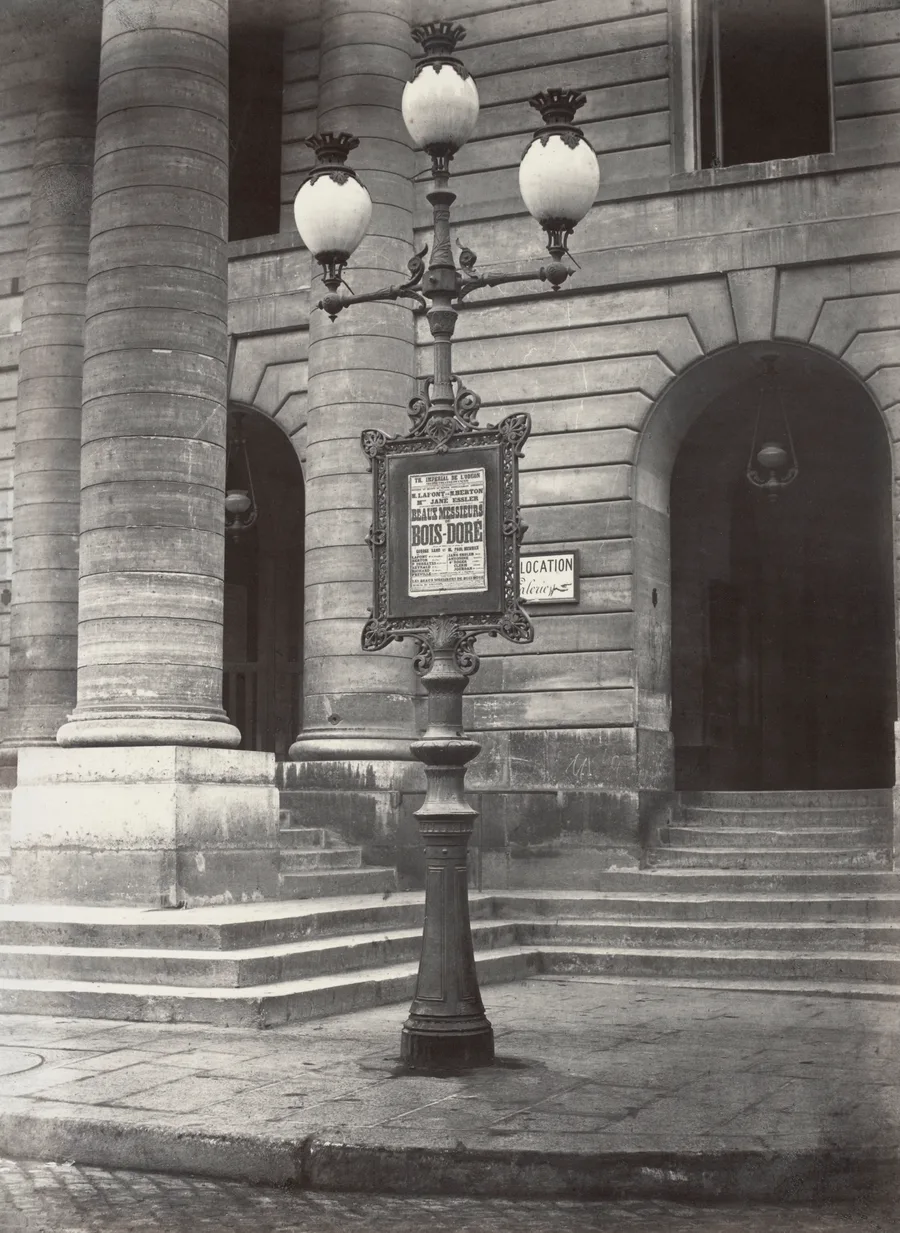
The Corruption of Public Taste
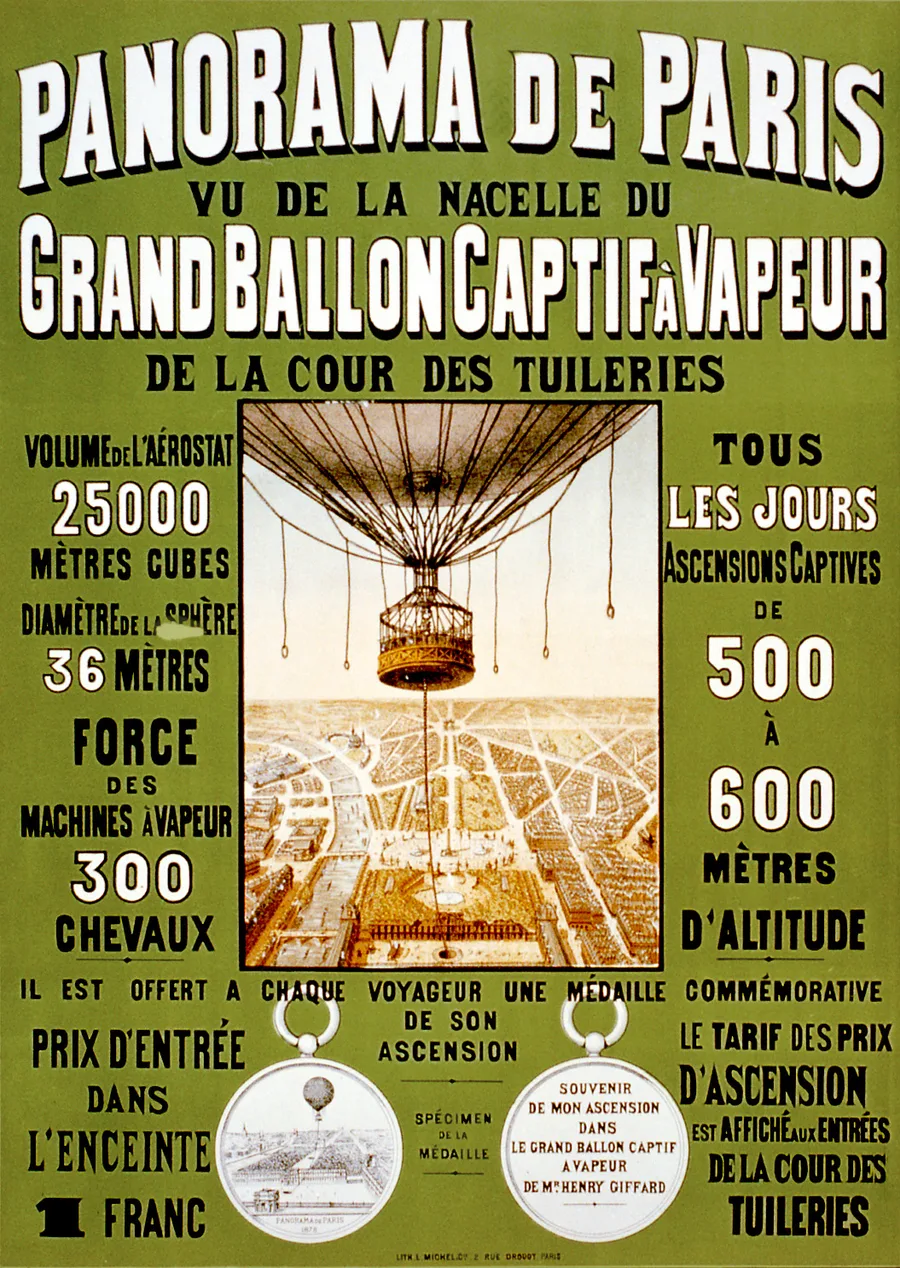
Is it not possible that the general public, which forsakes museums and is a complete stranger to aesthetics, might be taken in by these coarse images forced upon their sight every day? What about all these children, who still know nothing of art? Oh, they will not be able to escape the persistent influence of their surroundings. If the baroque, the bizarre, poor taste, and impudence dominate these mercantile placards, they will become familiar with impudence and poor taste. From this unhealthy promiscuity with ugliness and barbarism will be born an indifference to the beautiful, and habit will soon consecrate it.
The streets, the squares, in short, the cities, must serve as teachers. Our primary and persistent education comes from what surrounds us, and we must not neglect these public lessons. For the instruction we receive from them, whether good or bad, leaves deep seeds that will take a very long time to disappear, if they ever disappear at all.
If you feel powerless to develop this form of teaching, at least be strong enough not to pervert it. A nation that is ignorant is better than a nation that is corrupt. And, even if only partially, you are unquestionably aiding in the corruption of taste by not severely proscribing such signs.
Oh, I know very well that you will hide behind the grand principle of individual liberty, and that you will tell me that every property owner has the right to dispose of his wall as he sees fit. But if you leave him free to abandon that wall to the creation of huge advertisements, you no longer leave all the other inhabitants free to walk about without being annoyed by them.
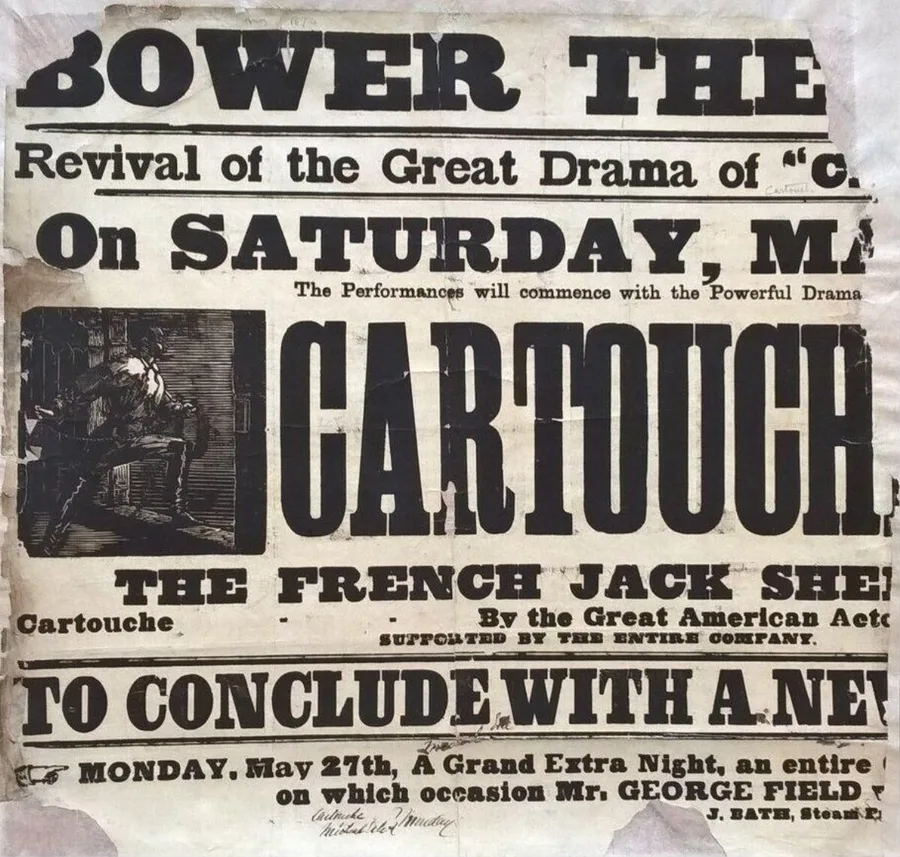 Cartouche the French Jack Sheppard, Bower Theatre 27 May 1872" loading="lazy" width="900" height="600" />
The Hypocrisy of Urban Planning
Besides, you create plenty of laws and ordinances for city planning. You prevent construction that extends even a few centimeters beyond your alignments; you impose heights for buildings; you parsimoniously measure projections. In short, you entrap architects in an administrative net whose mesh they cannot break. You do all this in the so-called general interest. And when you have forced numerous property owners to build identical façades because that seems to you the height of art, when you have laid out your great, monotonous thoroughfares with a ruler, you then allow your work to be dishonored by these barbaric eye-catchers that immediately destroy the very uniformity of proportions you had so rigorously imposed.
What is to become of those poor monuments placed next to these huge placards? When a wall twenty meters high contains two or three lines of six-foot-tall letters, or when a great devil selling matches stretches from the first floor to the top of the building—if it is not a grey frock coat that could clothe the Colossus of Rhodes—everything instantly diminishes. The windows look like mouse holes, and the houses like dog kennels. Not to mention that all of this is illuminated with garish tones that scream, clash, and recall the shop fronts of paint merchants.
And you think that gentle and discreet art can hold its own against such an inconvenient neighbor! And you think that sensitive people will suffer without complaining, and that artists will not protest against such an abuse, whose only advantage is to inform us that the house is not on the corner of the quay?
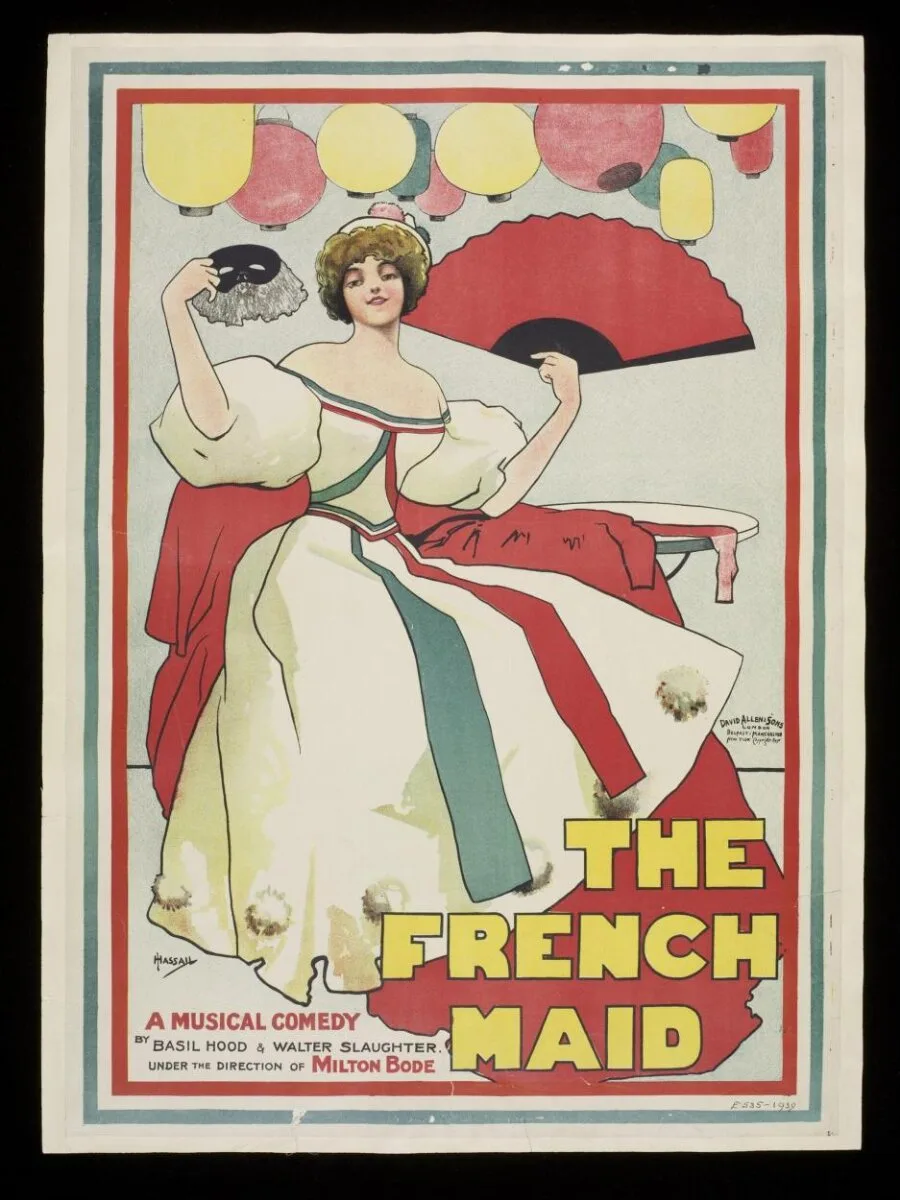
A Spreading Decadence
Well, no! Even if I am to be scorned by every ready-to-wear clothing merchant, I want to protest, and I do protest, against this deplorable custom, which is, in sum, nothing but a mark of decadence that is, alas, tending to become widespread. The provinces imitate Paris in this ugliness; foreign countries are following the same path. Italy, harmonious Italy, is little by little allowing itself to be invaded by these unpleasant signs. Imperceptibly, we are going to accept the ways of the Barnums (American-style showmen) by letting our dear cities follow the example of London, that anti-artistic city.
Come on, let's follow bad taste as it marches on! To hell with beauty! A little more expansion, and let us make our city a receptacle for gigantic alphabets and deformed daubs! Let the moving advertisements, carried on men's backs, clutter our streets. Let thousands of juxtaposed posters show us regiments of "Themisk," or let that execrable gentleman with the lorgnette, who counted on his fingers, be pasted on every wall, right side up or upside down. "Old England, Old England," a repetition of irksome names or things. Let the kiosks shriek with their colored panes; let the striped yellow and red carriages, the omnibuses illuminated like those on Regent Street, shake their masquerade of tones along our boulevards.
Let the seamless boots, the phosphoric matches, the insecticide powder, or Galopeau's pomade circulate their Mardi Gras floats.
Poor great art, how far away you will be! And you too, dear Athenians of the time of Pericles, and you, seductive Italians of the Renaissance, disciples of form, lovers of color! Turcaret (a symbol of vulgar new money) will make us forget Maecenas (a patron of the arts), just as Pilotell (a contemporary caricaturist) will make us forget Phidias and Michelangelo.

Art is Everywhere
Really, you think I exaggerate? You think these daubings are not worth so much anger and sadness. Alas, alas! There are many who think as you do and who make light of these small artistic profanations. What does it matter to them if the letters of the placard next to Saint-Séverin are larger than the pinnacles of that charming church? And what did they care for so long about that Dorigny advertisement, whose gold glittered brutally above the picturesque cluster of the Palais de Justice and the Sainte-Chapelle?
Have they never stopped on the Pont des Arts to admire that splendid view of Paris, that they have not cursed both the dentist who implanted himself in the center of this unique motif, and the property owner complicit in this act of vandalism? And to cap it all, every photograph taken of this ensemble, which spread abroad, showed all the artists of the world that, little concerned with the distinct and typical character of this view, Parisians allowed some random individual, for the lure of a few francs, the right to destroy both the lines and the colors of the tip of the Pont-Neuf.
Ah! If someone took it into their head to stick a scrap of paper on the nose of the Madonna of the Chair, if someone dared to hang a rag on the tail of Coustou's horses, what an outcry there would be! And rightly so, the entire press would be unanimous in condemning this assault on beauty. But art is not only found in Raphaels. The silhouettes of cities make as much of an impression as the silhouettes of statues, and you are as guilty in mutilating the former as you are in mutilating the latter. Art is everywhere, it is in everything—in the street as in the museum. And I deny the right that four or five industrialists arrogate to themselves to deface with their presumptuous signs the city that shelters a million inhabitants!
A Call for Administrative Action
My insistence is therefore just, my passion is therefore logical, and my grievances are therefore serious. If I have taken issue with Parisian posters, it is because they belong to that vast series of objects that daily offend the eye. If I have been able to direct thought for a moment toward one of these productions that so outrage artists, perhaps this thought can be awakened in some of our administrators, and give them the idea of opposing the popular demoralization of art.
If, just a few years ago, those who decided to place white letters and numbers on blue plaques at the corner of our streets and on all our doors had reflected a little before making this decision, they would doubtless have rejected these enameled signs. False in tone, without any harmony with their surroundings, badly placed, badly framed, they are all the more regrettable because, thanks to their nature, they are destined to resist the air for a long time and thus increase the color antagonism that exists between them and the walls on which they are placed. Come now, gentlemen, for goodness' sake, since you have a commission for fine arts, consult it a little!
Do not give a bureau chief the power to annoy us for twenty years by imposing white and blue where those colors alone should have been banished, and the power to annoy many generations by decreeing stupidly uniform houses and boulevards as morose and inflexible as an engineer's formulas.
But I do not wish to insist too much on the errors and negligences of past administrations; they had arduous tasks. They have, on the whole, done great things, and if one often regrets many failings, one must even more often recognize the benefits of a single, persistent will. I therefore limit these reflections to what forms the title of this article. As the remedy can be applied without the past harm reflecting on the current prefects, mayors, or councilors, it may be that the little bell I am ringing will jingle loudly enough in the ears of our city officials for them to suppose that the noise they hear is not made by me alone, but also by a number of people who share my impressions regarding these annoying posters.
CHARLES GARNIER.