
A Career in a Lost Valise
It begins, as so many modernist legends do, with a train and a disappearance. In December 1922, Hadley Richardson, the first wife of a young and still unknown Ernest Hemingway, packed a small valise at their Paris apartment. Inside, she placed nearly everything her husband had written: the manuscripts of his early stories, sketches, and the draft of a novel set in the war he had just survived. She was taking the train from the Gare de Lyon to meet him in Lausanne, Switzerland, and thought the work might cheer him up. During a brief stop to buy a bottle of Evian, the suitcase vanished. With it, a year of relentless work, the entire foundation of a literary future, was seemingly erased.
The loss was absolute, a blow that might have permanently silenced a less resilient writer. Hemingway would later describe the feeling as a hollow sickness. Yet this act of accidental destruction, this void at the heart of his beginnings, became the crucible for his actual debut. From the ashes of that lost portfolio, a new, leaner, and more concentrated beginning was salvaged. The book that emerged the following year was not the sprawling collection he had intended, but a slim, almost fragile volume of 58 pages titled Three Stories and Ten Poems. Published in a private run of just 300 copies, it was a work forged in absence. And in its spareness, its survival, and its immediate controversy, it contained the complete genetic code of the author Ernest Hemingway was about to become.
The Salvage Operation
Only two stories survived the Gare de Lyon disaster, having been sent out to magazines before the trip: “My Old Man,” a poignant tale of a boy’s disillusionment with his jockey father, and “Out of Season,” a bleak story of an expatriate couple’s argument in the Italian countryside. They were not enough for a book. To these, Hemingway added a story he had written earlier, one he had set aside precisely because of its volatile content: “Up in Michigan.” This story, a stark and unsettling account of a young woman’s sexual encounter that reads to modern eyes as a clear depiction of date rape, would become the collection’s center of gravity.
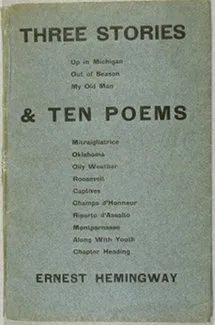
He also gathered ten of his poems. Though poetry would not be his legacy, these short, imagistic pieces were far from filler. They were distillations of his most visceral experiences, particularly the trauma of the Great War. Titles like “Mitraigliatrice” (Machine Gun) and “Riparto d’Assalto” (Assault Unit) are not literary allusions but direct reports from the Italian front where he had served as an ambulance driver and been grievously wounded. They are sharp, brutalist fragments, the linguistic shrapnel of an experience that would fuel his greatest novels. The inclusion of these poems alongside the prose created a curious hybrid, a book that felt less like a curated collection and more like an intimate, almost accidental, portfolio of everything that remained—the salvaged evidence of a young writer’s obsessions with violence, love, and betrayal.
This piecemeal assembly, born of necessity, inadvertently served his emerging aesthetic. Hemingway was already developing what critics would later call his “iceberg theory”—the principle that the true meaning of a story floats beneath the surface of the explicit text. What better embodiment of that theory than a book whose very existence gestured toward a vast, unseen body of lost work? The ghostly presence of the stolen manuscripts haunts the final text, lending its minimalist prose an even greater sense of weight and omission.
A Parisian Midwife
The book found its physical form in the fertile artistic soil of 1920s Paris, the undisputed capital of the avant-garde. The publisher was Robert McAlmon, an American writer and bon vivant who ran Contact Publishing Company, a small press dedicated to printing the experimental work the mainstream houses in London and New York wouldn’t touch. McAlmon’s press was a crucial engine for modernism, publishing works by Gertrude Stein, William Carlos Williams, and Djuna Barnes. In this context, Hemingway was not an outlier but part of a movement defined by small, defiantly non-commercial publications.
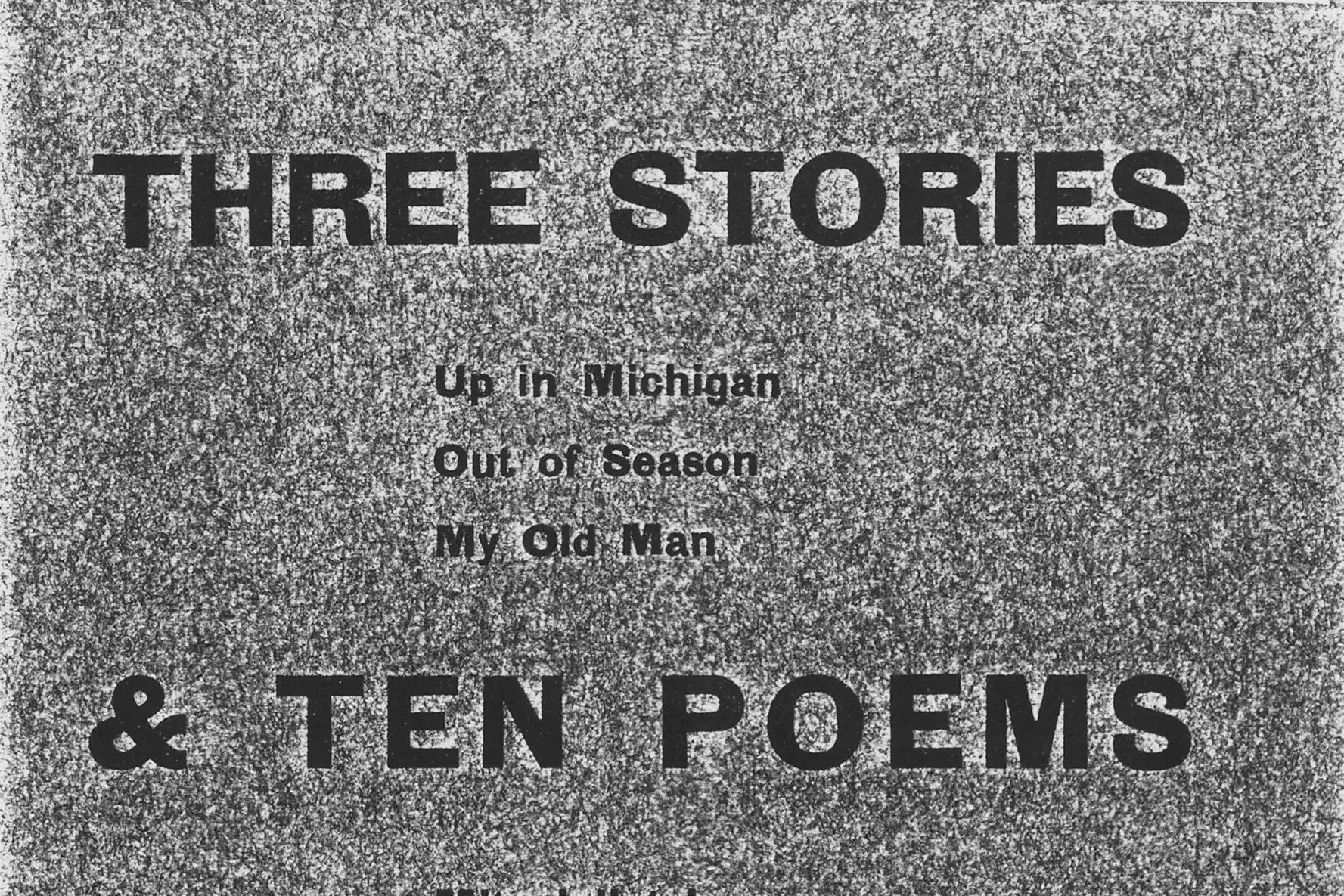
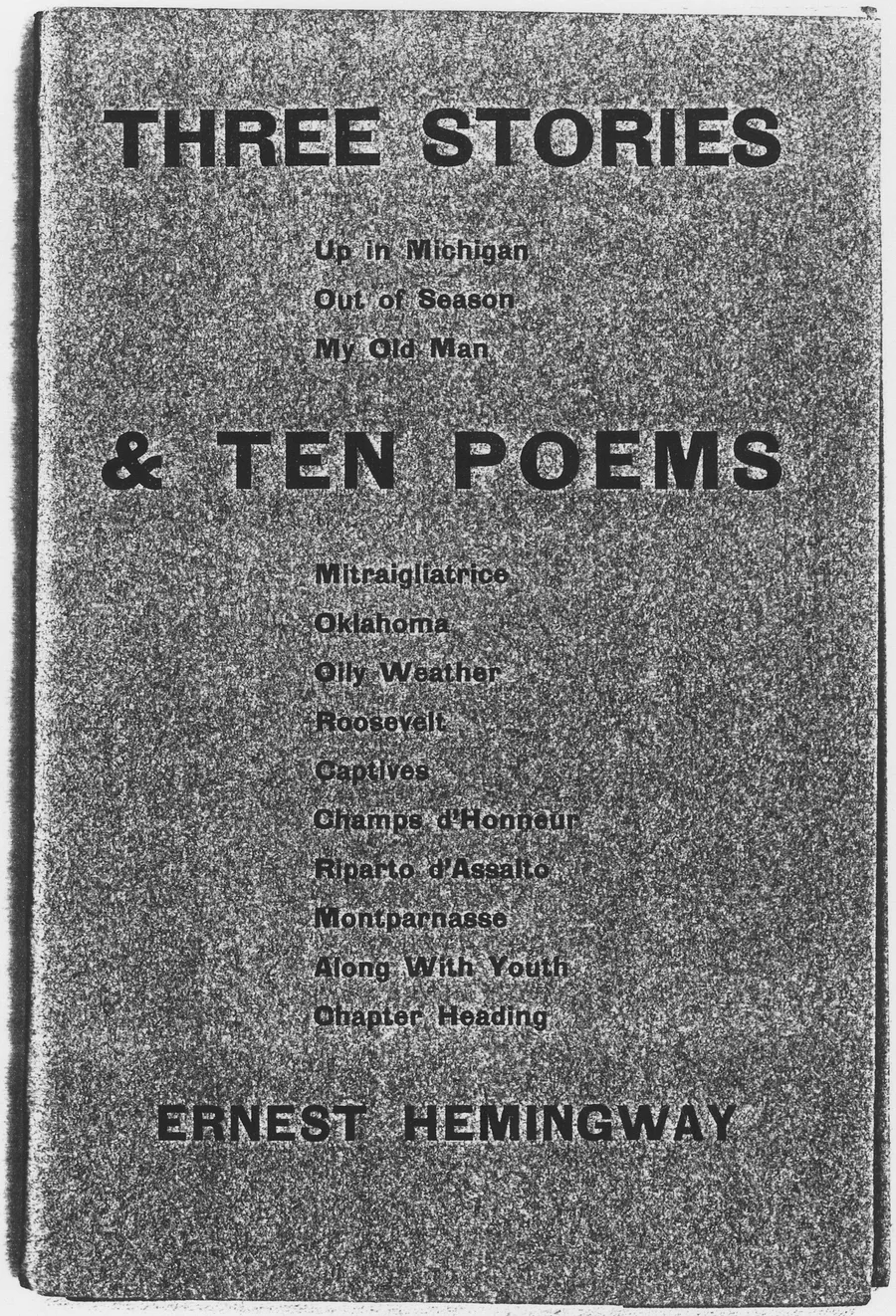
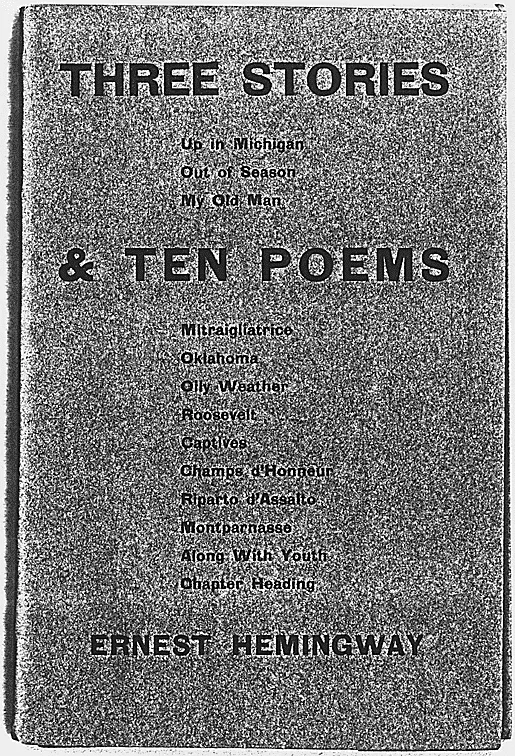
McAlmon agreed to publish Hemingway’s surviving work as a favor, producing a simple volume bound in blue-grey paper wrappers with a plain printed label. The design itself was a statement. Influenced by the typographic starkness favored by modernists like Stein, the cover dispensed with ornamentation, announcing its author and contents with a declarative simplicity that mirrored the prose within. It was a book that made no attempt to sell itself; its value was self-evident to the small circle of expatriate writers and artists who were its intended audience. It was an artifact of a specific time and place, a physical object that embodied the spirit of a generation breaking from the past. Its very construction, however, was poor, and the cheaply glued wrappers meant that few of the 300 copies would survive the century intact, adding a material fragility to its legendary scarcity.
The ‘Inaccrochable’ Story
Even within the permissive world of Parisian modernism, Three Stories and Ten Poems caused a shock. The source was “Up in Michigan.” When Hemingway showed the story to Gertrude Stein, the self-appointed godmother of the Lost Generation, she pronounced it “inaccrochable”—unhangable, like a painting unfit for public display. She found its sexual frankness repellent. Ezra Pound, another key mentor, was more encouraging, but the story’s unvarnished depiction of the blacksmith Jim Gilmore forcing himself on the waitress Liz Coates was deemed unpublishable by commercial standards.
Stein’s judgment was a telling moment. The story is a masterclass in Hemingway’s early style: short, declarative sentences building an atmosphere of dread and inevitability. The narrative stays tightly focused on Liz’s perspective, her romantic idealization crumbling into a painful and confusing reality. The final lines—“She was cold and miserable and everything felt gone. She had been asleep and now she was awake”—are devastating in their emotional precision. It is a portrait of the aftermath of assault, written with a psychological acuity that unsettled his contemporaries and continues to provoke debate.
For decades, “Up in Michigan” was the flashpoint for arguments about Hemingway’s alleged misogyny. Yet, in recent years, critical opinion has shifted. The story is now often read not as an example of chauvinism, but as a remarkably empathetic exploration of female violation, one that gives voice to the victim’s internal experience. The Irish novelist Edna O’Brien famously challenged his detractors to “read that story, and could you in all honor say this was a writer who didn’t understand women’s emotions and hated women?” The debate is far from over, as evidenced by ongoing discussions in forums like the Hemingway Society and on podcasts such as One True Podcast. What is certain is that this short, censored story, tucked away in his very first book, laid down a thematic marker that would shadow his entire career: the complex, often brutal, intersection of sex, power, and disillusionment.
The Genesis of a Style
Beyond its controversial subject matter, the collection announced the arrival of a revolutionary prose style. The clean, hard sentences, the reliance on dialogue and action over interior monologue, the deliberate stripping away of authorial comment—it was all there, in nascent form. One could see the direct line from the terse exchanges in “Out of Season” to the celebrated dialogues of The Sun Also Rises or A Farewell to Arms. He was learning to write, as he famously put it, “one true sentence.”
This was not just an aesthetic choice but a moral one. For Hemingway and his generation, the florid, patriotic language of the nineteenth century had been exposed as a lie by the mechanized slaughter of World War I. The old words—honor, glory, sacrifice—were obscene. A new reality demanded a new language, one that was precise, concrete, and unadorned. His prose was a tool for scraping away sentimentality to get at the truth of a thing, whether it was the feeling of a fish on a line, the taste of wine, or the cold reality of a sexual encounter. The New York Times would later capture it perfectly, noting that he “records with precision and economy, and an almost terrifying immediacy, exactly what he sees.”
This radical simplicity would become one of the most influential and widely imitated styles of the twentieth century. From Raymond Carver and Cormac McCarthy to countless writers of contemporary flash fiction, the echoes of the prose found in these three slim stories are unmistakable. The book may have had little commercial impact upon its release—Scribner’s editor Maxwell Perkins, who would become his champion, repeatedly refused to reprint the stories—but its literary impact was a quiet, slow-burning fuse.
A Legacy in Rarity
Today, a first edition of Three Stories and Ten Poems is one of the holy grails of modern book collecting. Its scarcity, a result of the tiny print run and the fragility of its binding, has turned it into a near-mythical object. Its journey from a small-press favor to a six-figure auction item mirrors the trajectory of its author from obscure expatriate to literary icon. The book’s value lies not just in its rarity, but in what it represents: the starting point, the concentrated seed from which an entire literary universe grew.
Facsimiles have been produced, and in 2021, Warbler Press issued a new paperback edition, bringing these foundational texts back to a general audience. This renewed interest, amplified by the monumental work of the Hemingway Letters Project and other scholarly endeavors, confirms that the book is more than a collector’s curio. It is a vital document for understanding the origins of one of America’s most important writers.
All that remained from a stolen suitcase became the cornerstone of a legacy. Three Stories and Ten Poems is a testament to survival—of art over accident, of a new voice emerging from the ruins of the old world. It is a book about loss, in both its content and its creation. In its pages, we see not Hemingway the Nobel laureate, the titan of American letters, but a young, hungry, and wounded writer gathering the fragments of his life and work, and forging them into something hard, true, and permanent.
Seen at auction: Sotheby's