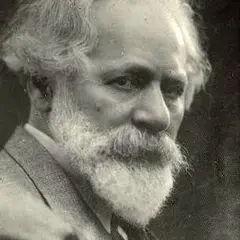
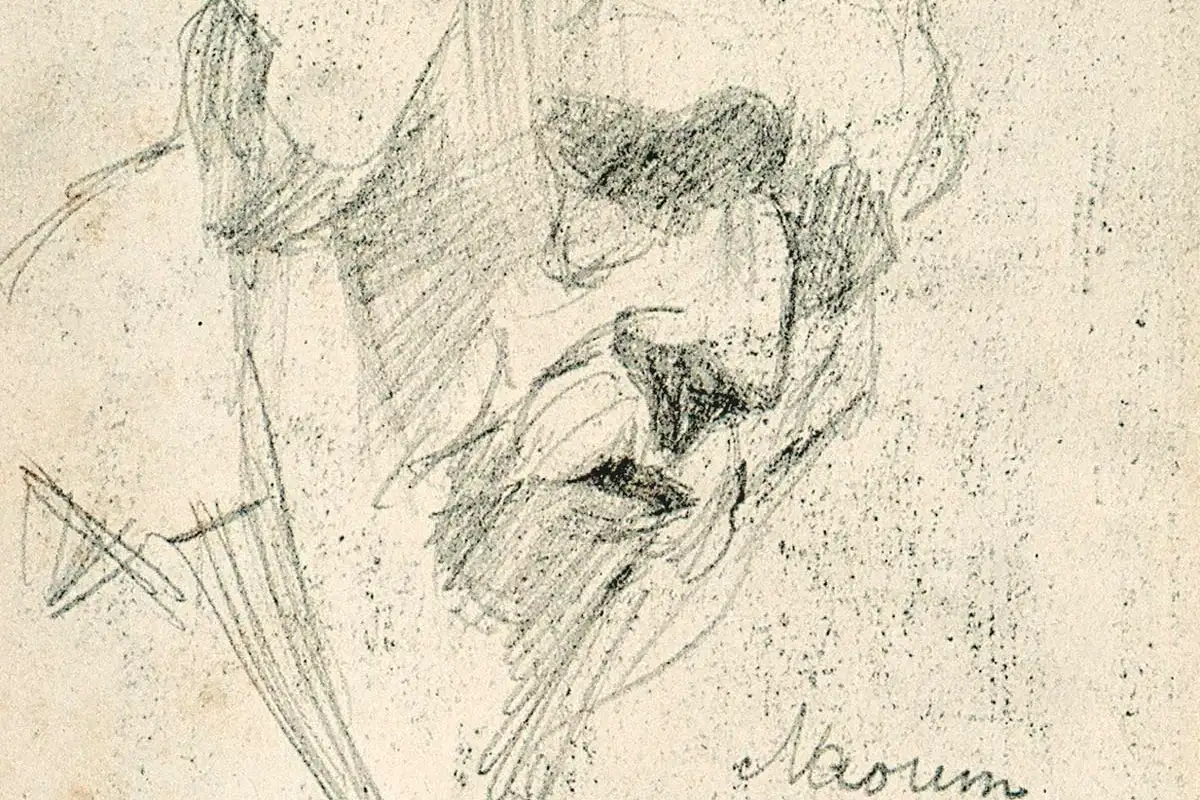
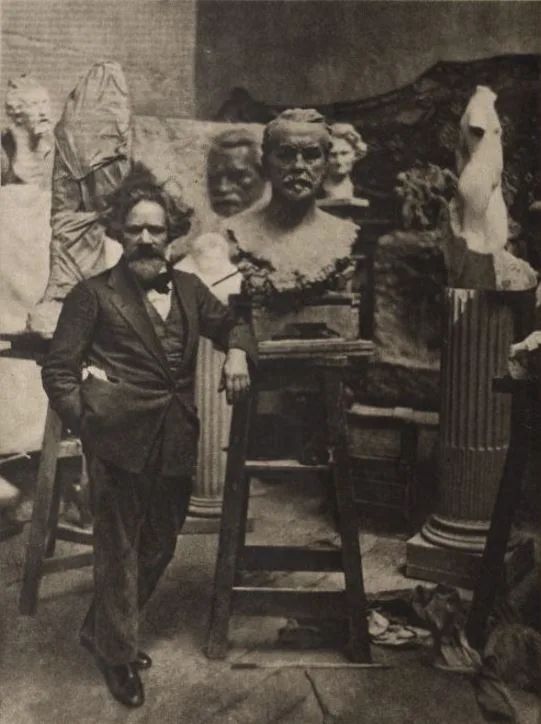
Nearly twenty years ago, a short, eighteen-year-old man arrived in Paris from the borderlands of Poland and Russia. He had candid eyes and a fierce energy, and although he had only known for two years that human fingers could draw something other than pots from soft clay, he imperiously wanted to be a sculptor. This young man was Naoum Aronson, whose journey would see him become one of the most original and seductive sculptors of his time.
An Unconventional Apprenticeship in Paris
Rejected by the École des Beaux-Arts, notably due to the need to advance money for studio fees, he knocked on the door of the École des Arts Décoratifs, which welcomed him. He had left Vitebsk, where his parents were small merchants who had initially wanted him to sell cloth, with only one hundred and thirty francs in his pocket as his entire fortune.
Within a few months, his teachers Corbel and then Hector Lemaire were astonished by his precocious skill and strange temperament. Full of ardor and illusions, speaking a fantastical broken language, and incapable of submitting to school discipline, he nevertheless received some encouragement from the kind Louvrier de Lajolais and some professional lessons from Hector Lemaire.
Perhaps perplexed by this "wild duck" that had landed among his brood, Lemaire did not try to keep him there. Instead, he benevolently offered Aronson the opportunity to work in his own studio. This was a godsend for the young man, who was living in a hovel and working in a stable. Under the influence of the classical Lemaire, he tempered his natural impetuosity and perfected what he had begun to learn in his homeland at the Vilna Academy.
It was in Vilna, in fact, that he had undertaken his initial studies. In light of some early successes, there had been a desire to send him to St. Petersburg. However, driven by an instinctive repulsion for the northern mists and its rigors of all kinds, and seduced by an almost mystical attraction to the Paris he imagined as a luminous garden, he had set off with his meager savings in pursuit of his dream.
The Struggles of a Parisian Life
The realities of life were harsh, but they did not deter him. He had to return to Russia for his military service; in 1894, he came back more determined than ever to the chosen land to which he has obstinately attached himself ever since, apart from a few brief migrations. Despite the difficulties and unequal struggles of Parisian existence, despite the disappointments, and despite the seductive offers that may have come to him from across the Rhine, he had fallen in love with our sky, our customs, and our art. He has remained faithful to us.
He has retained his ethnic temperament, his intellectual and sentimental friendships with all those who live by the spirit in his native country. However, the few experiences he had with the official world there disgusted him forever. Similarly, despite the welcome he received in Germany or England and the material success he could have found there, it is in France that he has wanted and still wants to live.
With a mind both very flexible and very personal, while retaining his nuance of character and his soft, singing accent, he has managed, through active sympathy, to assimilate a certain number of the dominant qualities of our art. He has come under the influence of a few masters who have left their strong mark on the present generation, and he is following, with the best of that generation, an evolution whose essential direction should not be obscured by what is particular and a little strange in his temperament.
Early Works and the Shadow of Rodin
As early as 1897, he presented a few works that were accepted by the Société Nationale, and he managed to win the approval of the master sculptors who had gathered there. Rodin loved and encouraged his promise and his natural, impetuous talent. At that time, it was more a matter of abundant facility, a picturesque verve that poured out into somewhat adventurous compositions, where the ardent and slightly mystical spirit of the young Russian reappeared in the choice of subjects as well as in the way they were treated.
His Au-delà (The Beyond) from the Salon of 1897 and his Berceau d'amour (Cradle of Love) of 1898 are clear evidence of this. In the latter, notably, he had sung a melancholy and passionate legend of unhappy love and union in death, already infusing it with a soft and poignant accent. The group of the two desperate lovers' bodies, brought together by the lulling waves, was not without points of contact with certain groups from Rodin's Gates of Hell. Likewise, later on, a certain mask with a caressed modeling, barely emerging from the unformed block, was clearly reminiscent of the master's very methods and artistic choices.
La Jeune aveugle (The Young Blind Girl), at the Salon of 1899, was imbued with a certain sad and delicate sweetness, while La Soif (Thirst) of 1901 pushed in a dramatic and violent direction, expressing a completely different aspect of the simultaneously tender and fierce soul of the race to which the young sculptor belongs. A series of works from this period testifies to this instinctive ardor of temperament, this sense of picturesque invention, and this easy promptness that had been demonstrated in the artist's very first works—those that had secured his initial success, but with which he would soon cease to be satisfied himself.
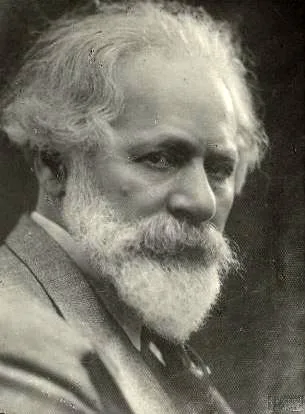
This series includes a Martyr, a Douleur (Sorrow), Les Abandonnés (The Abandoned), and later a group titled Épaves (Wrecks). An unrealized sketch for a lamentable procession of Exilés (Exiles) shows the haunting influence of Rodin, with a memory of the Burghers of Calais. A little more recently, a large maquette, which has not yet seen the light of day and which we reproduce here, symbolizes a pensive and sorrowful Russia in the form of a mature man with emaciated features, deep eyes, and a large, bare forehead—the weary face of a fighter whose only hope lies in the distant future. It is worth noting, however, that this last piece is much more recent and displays a more rigorous art, which we will define shortly.
The Development of Portraiture
From his first years of personal work and his first submissions to the Salon, alongside the compositions whose spirit and character we have just described, a number of busts were grouped. These were vigorously individual portraits or study heads, like the Silésienne (Silesian Woman) which he exhibited several times. In the beginning, the facility Aronson brought to constructing a figure or a group was equally evident in his translation of a human face.
Whatever the technique employed—drawing, pastel, or painting, as well as sculpture in the round or bas-relief—our artist, with his ingenious and multifaceted talent, has always been able to dash off a sketch with incomparable speed and give it a striking character. It was against his own facility that he had to struggle and regain control.
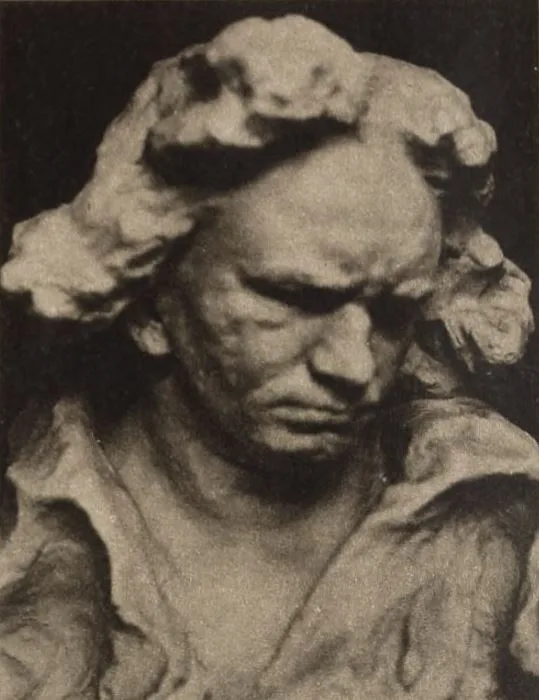
The way he created his colossal bust of Beethoven in 1904, which now stands in the garden of the house in Bonn, is a striking proof of this. Aronson had been living for some time with the obsession of Beethoven; one could say he was living within him. The music, the multiplied authentic images, the very atmosphere of the place where he had settled, all overexcited him to the point that one day, from memory, without documents or models, having received permission to set up his modeling stand in the courtyard of the museum-house, he erected in a few hours the tragic and profound bust that Beethoven's admirers, touched by this evocation, wished to keep in the very place where it had been modeled.
The same was true for his Turgenev. Aided by racial sympathy, this other great colossal figure emerged from his sculpting tool, bursting with life, striking in its moral resemblance and character. In front of these "resurrections," one is reminded of the magnificent verve and retrospective evocative power of a J.-J. Caffieri, modeling, a hundred years after their deaths, the effigies of a Rotrou or a Corneille.
The Art of the Portrait: Beethoven, Turgenev, and Tolstoy
There is one figure, however, for which Aronson's work has an even higher value—that of a truthful and scrupulous witness, as well as a comprehensive one: his Tolstoy. It was in 1902 that Aronson, unknown to Tolstoy, presented himself at Yasnaya Polyana and asked to make a portrait of the master. Initially turned away, he was about to leave when, after some conversation, Tolstoy told him that he did not want to pose, but that if it interested Aronson to watch him live, he could stay there as long as he wished.
Aronson took advantage of this permission for many weeks, executing some sixty sketches captured on the fly or completed from memory. Some were more detailed, others simple impressions of a facial movement, of an almost instantaneous aspect of that mobile mask framed by a snowy beard, where the penetrating gleam of grey eyes shone under willful eyebrows. He was given a corner to model in, and, half out of kindness, half out of curiosity, the patriarch came to visit him there and agreed to give him a few quarter-hour sittings after all.
The opportunity was admirable, almost unique, and Aronson seized it with all his soul, full of ardent and sympathetic veneration for his model. In a way, he too, as Romain Rolland wrote at the beginning of his penetrating and masterful Life of Tolstoy, was bringing a "tribute of gratitude and love" to the master. He had the good fortune to find him still standing in the glorious and serene halo of his active old age, before the final disappointments, bitterness, and anxieties of his very last years.
"His face," in the very words of Romain Rolland, "had taken on the definitive features by which it will remain in the memory of men: the broad forehead crossed by the arc of a double wrinkle, the white thickets of the eyebrows, the patriarchal beard reminiscent of the Moses of Dijon; the old face had softened, grown tender; it bore the mark of illness, of sorrow, of affectionate goodness. How it had changed since the almost animal brutality of his twenties and the starched stiffness of the soldier of Sevastopol! But the clear eyes still have their deep fixity, that loyalty of gaze that hides nothing of itself and from which nothing is hidden."
It was under these conditions that Aronson modeled the great, Michelangelesque bust he exhibited at the Salon of 1903 and executed those sketches of a completely rare variety and expressive quality, one of which we reproduce here. In them, we find all the suppleness of his free and spontaneous talent that we have already noted. But the bust, with the powerful construction of the forehead and the accent of reflective truth that emanates from it, testifies to a new orientation and a new will.
It was around this time, in fact, that Aronson began to distrust his natural gifts and sought, through more scrupulous observation and a more rigorous execution, to give his creations a solidity and a composure that strike us today just as much as his preserved qualities of dreamy charm and supple grace.
A New Maturity: The Study of Form and Material
One of the first works to betray this new will was the lovely figure of an ephebe intended for a fountain commissioned from Aronson by the small German town of Godesberg. It is not without kinship in its general arrangement with the famous Narcissus of the sculptor Dubois-Reymond, who was also of Russian origin. But where the somewhat heavy and rough modeling of the French master is apparent, the Russian brought to his conception, as in his modeling, a fluid grace, a delicate and poetic charm, and an unexpectedness of movement that did not, however, exclude solidity and study—quite the contrary.
From that moment on, he devoted himself fiercely to the study of the nude, with the same concern for precision, correctness of construction, and proportion that our great realist sculptors of the mid-18th century, like Pigalle or Bouchardon, brought to it. No academicism, no recollection of school formulas taints this sincere and almost naive study of nature. One finds neither learned movements in the pose nor banal workmanship in the execution.
It is to Bartholomé that our artist, successively sensitive to all the great forms of our modern art, seems to want to draw closer from this point. He shuns improvisation, hasty indications, and incomplete realizations. He no longer knows how to work quickly.
The Nude and Decorative Forms
Another fountain, intended for a private garden in Berlin, gave him the opportunity to take up a model of a young boy in a completely different attitude. Standing, leaning against a rock, advancing his foot cautiously as if to test the water or jump from stone to stone, he is a boy frolicking naked on some shore, like Rude's little Neapolitan fisherman. The study, however, is even more rigorous than in the Narcissus, to the point of even presenting some dryness.
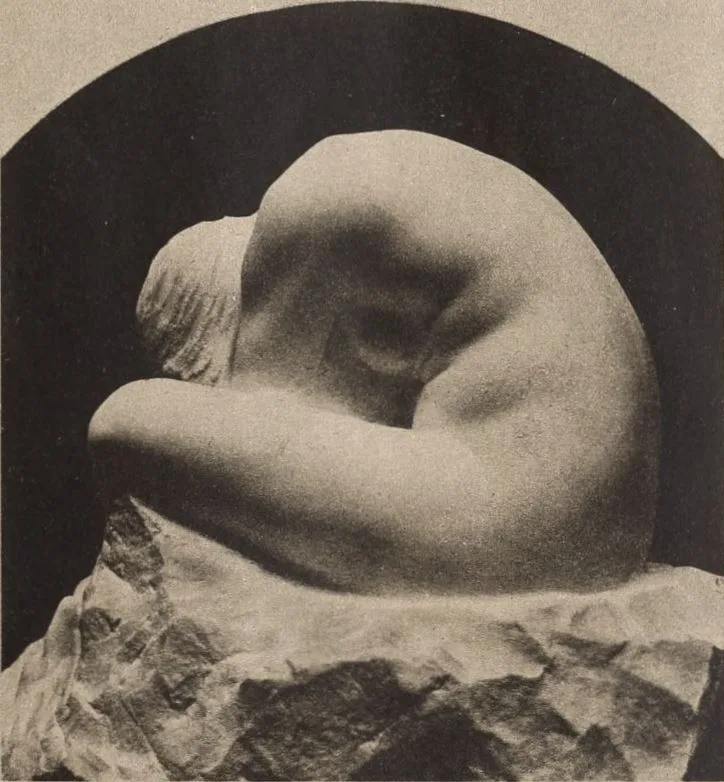
The female nude also inspires him and protects him from this pitfall. Two charming statuettes of standing women, one young and slender, the other more mature, more robust, and more womanly, which he christened Eve or the Source of Life, emerged from his studio around this time. So did another seated figure, her torso leaning slightly forward in a very supple attitude of a young bather or a woman at her toilet. It is this figure of which we provide a view from the back, based on a stone execution of a very beautiful quality of simplicity and precise finesse.
We must not fail to emphasize the interest, in these pieces created by Aronson, of the execution in the final material, chosen and treated by himself with love. Whether stone or marble, he knows their qualities, which he strives to bring out through personal work that has nothing in common with the banal virtuosity of the practitioner. Sometimes, as here, he summarizes and simplifies his modeling; at other times, on the contrary, he refines it to the point of making it seem enveloped and soft. Sometimes he uses white marble of virginal purity, and sometimes materials with subtle nuances, where the full range of grays and pinks plays, as in the lovely statuette of Ida Rubinstein exhibited this year.
Here we find the most important of the pieces he has yet been given to create: the group of Adolescents, which appeared at the 1909 Salon, somewhat lost in the Garden of the Nationale, and which is of such lovely harmony of lines and at the same time of such a tender and sweet sentiment. It is, with a kind of refined ingenuity, a renewal of the eternal Daphnis and Chloé, without the conventional fictions, affectations, or brutalities that others have brought to it.
No doubt the marble, which is still in the artist's studio, will one day take its place in some decorative ensemble, like the one Aronson dreams of: a Fountain of Love decorated with several figures or groups, in the round or in bas-relief. It is on the day this project is realized that we will be able to truly judge the decorative quality of an artist like this one, whose acquired or natural qualities seem to predispose him to this role, and whom the all-too-general conditions of all our modern sculpture have alone been able to confine until now—even in the fountains we have described—to the isolated piece, without architectural support, or to the independent decorative object.
Among these pieces, there are still some exquisite ones in Aronson's production. These are the studies of heads of young women or children that have brought him success at recent Salons, several of which we have already reproduced in this journal in previous years. He now brings to these fanciful or individual effigies a concern for strong construction and precise modeling, which does not, however, exclude the search for character and the delicate, sometimes intentionally a little strange, charm of the type and expression. One certainly remembers the delightful child in a turban, christened Kim, a little Breton girl from 1910, or that lovely and precise figure of a little girl with slicked-down hair and a turned-up nose who is, it seems, just a little newspaper seller from the rue de Vaugirard.
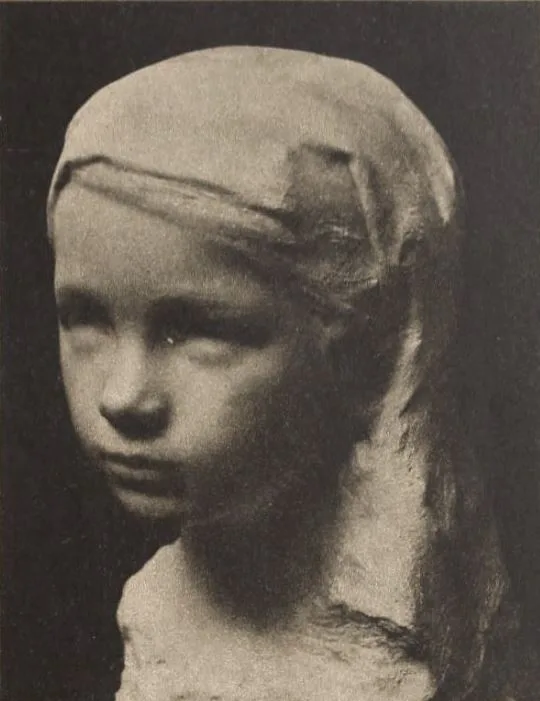
Finally, curious portraits have emerged from his chisel in recent years, as far removed as possible from the somewhat facile and superficial pieces of his beginnings. There is, for example, the portrait of Ida Rubinstein, whose fine profile we reproduce here, or that of the young woman whose face is shown in our photograph. The model's character is sought and emphasized with a rare penetration, both in the general construction, in the silhouette that stands out sharp and true, and in the modeling itself and the distribution of light.
There are no more excessive accents, no more hollows, no more oppositions of light and shadow, but a kind of delicate and enveloping caress that plays on the surface of the material without pressing, without digging. If the artist succeeds in developing this new manner, it will definitively classify him among the most original and seductive of our contemporary sculptors.
Pauz Virry.