
Partly by temperament, and partly from a disdain for public incomprehension, Degas was always a "distant" artist. With absolute disinterest, he lived exclusively for his art, selling only a few of his works sparingly, according to his needs, and piling all the others up in his studio. His canvases and pastels (at least those he did not destroy) did not suffer too much from this jealous and lengthy accumulation "facing the wall," and we have since had the joy of being able to admire them in perfect condition.
Unfortunately, the same cannot be said for his sculptures. The heat, the cold, and the dust of those years of neglect—when it was not Degas's own bad mood—seem to have been less kind to them. Nothing, however, is more interesting than these experiments. Nothing could better prove, if proof were needed, the marvelous science of form and the balance of the human body upon which his painting itself was built.
An Artist's Private Pursuit
After first being a kind of diversion for a man always eager for new means of expression, and sometimes also a working tool, as we shall see with his horses, sculpture later became one of the few distractions permitted to the artist's mind and fingers as his eyesight weakened. In their current state, the rare specimens of Degas's work as a sculptor are not easily linked to the very diverse dates and circumstances of their creation.
Degas seems to have modeled almost from his earliest days. His lifelong friend, the sculptor Albert Bartholomé, remembered seeing him make, very early on, before 1870, a large and utterly charming clay bas-relief. It depicted, at half-life-size, young girls picking apples. But the author did nothing to preserve his work, which later literally crumbled to dust.
Among the sculptures that remain to us, the oldest are undoubtedly the studies of horses, for he made many of them around 1870. Degas had been very close with the sculptor Joseph Cuvelier, who specialized in this genre. Between 1865 and 1870, Cuvelier had exhibited equestrian portraits at the Salons, and even a wax group representing two horsemen leaving the pesage (weighing enclosure). These were precise and fine waxes which, despite reservations about their subject matter and the artist's somewhat dry manner, were quite noticed for their novelty and evidently had an influence on Degas's own attempts.
The Equestrian Studies
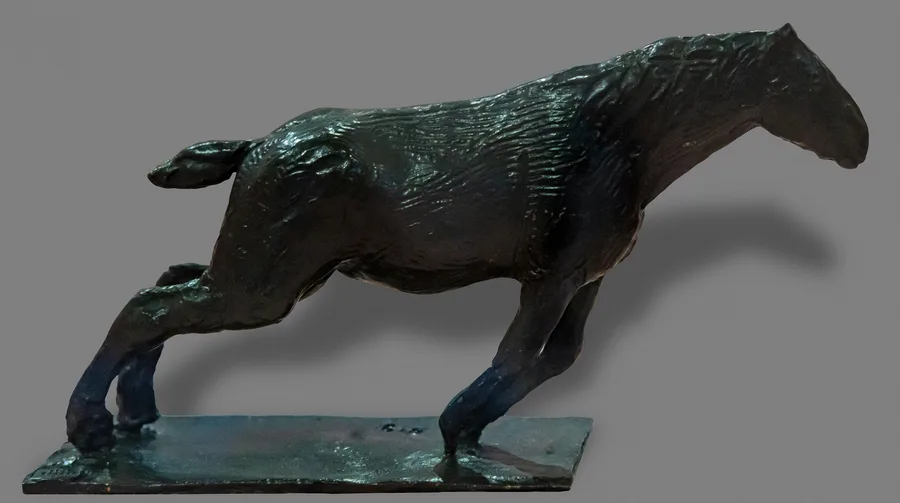
Degas's equestrian statuettes, also very fine but full of life, generally present a curious mixture of conscientious, almost naive observation of nature with a somewhat stylized elegance in the limbs and head, where one sometimes senses a reminiscence of antiquity. Such is the horse with the long neck and open nostrils, which, though thinner and more "unfinished," recalls those of the quadriga of St. Mark's in Venice.
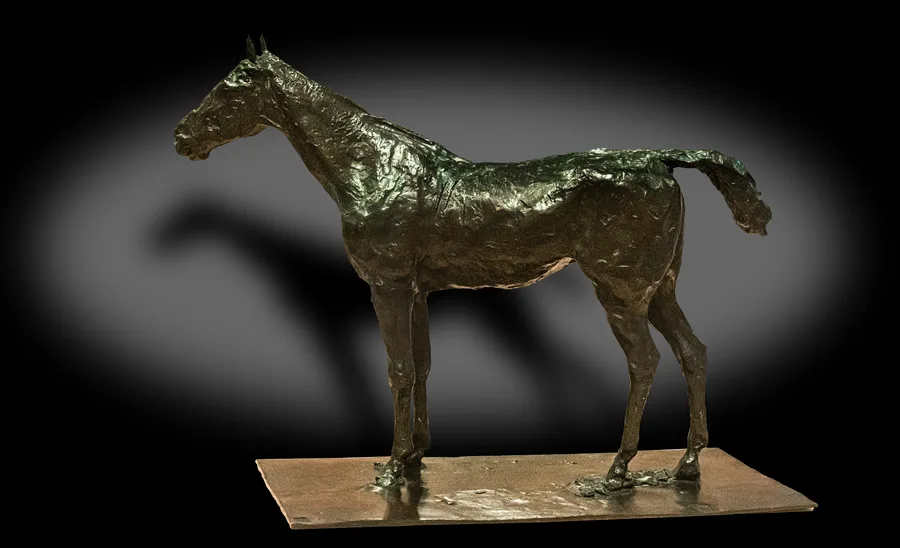
Another horse, also reproduced here, is striking, though only a sketch, for the acute observation it reveals. It is a rearing horse, in which one might find a memory of the many bullfights Degas attended. It evokes, with the patient sorrow of its whinnying head and the tragic helplessness of its dangling, disjointed legs, the picador's horse being lifted by the bull's horn.
Shortly after the death of his friend Cuvelier, who was killed during a sortie during the Siege of Paris, it seems that Degas gave up modeling horses. Those he had executed or begun then served him, reworked and modified several times, as models for his racecourse paintings. This might explain, on the one hand, the unexpected and bizarre nature of some of his equine anatomies, and on the other, the analogy between these statuettes and many of the attitudes and movements studied in his canvases.
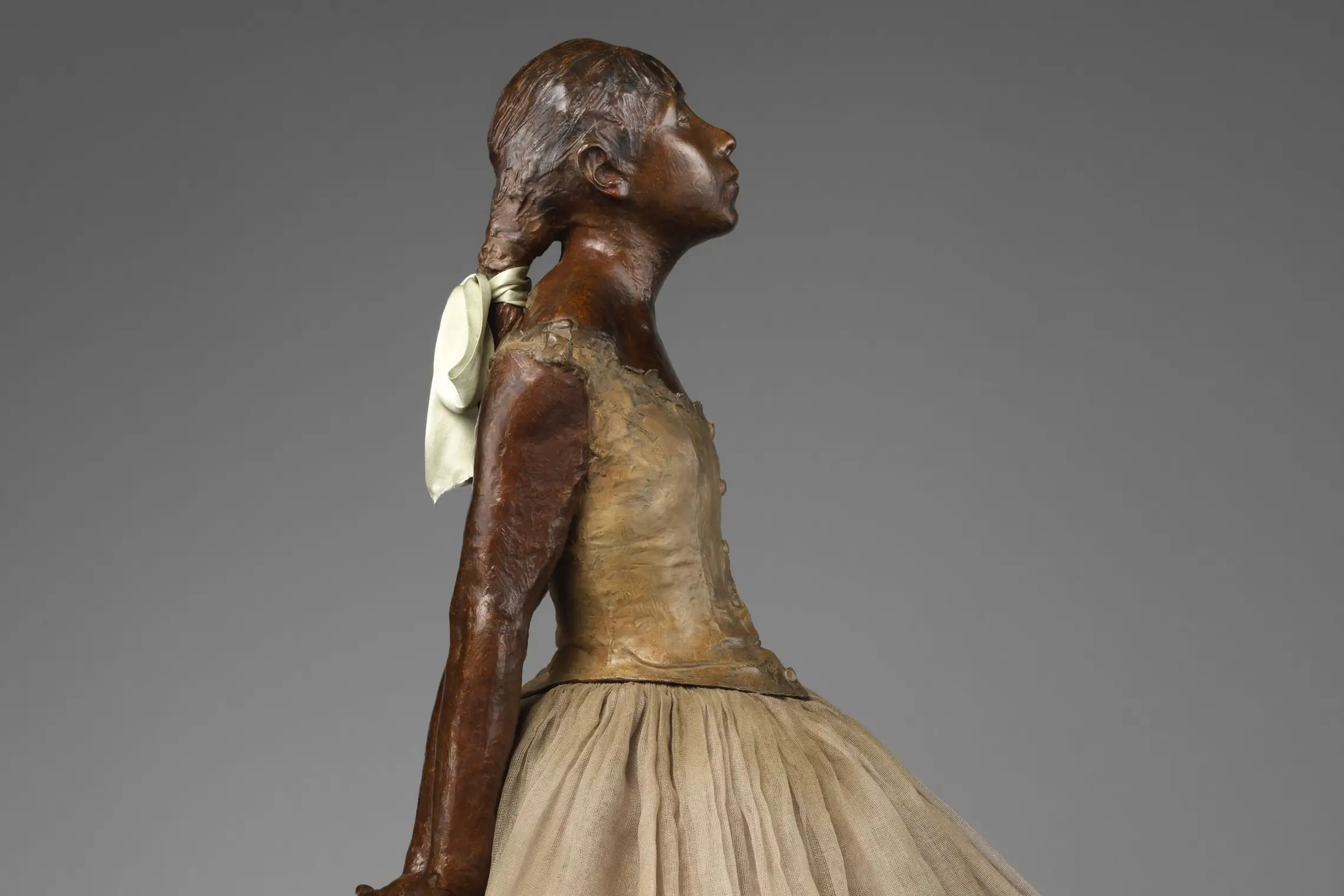
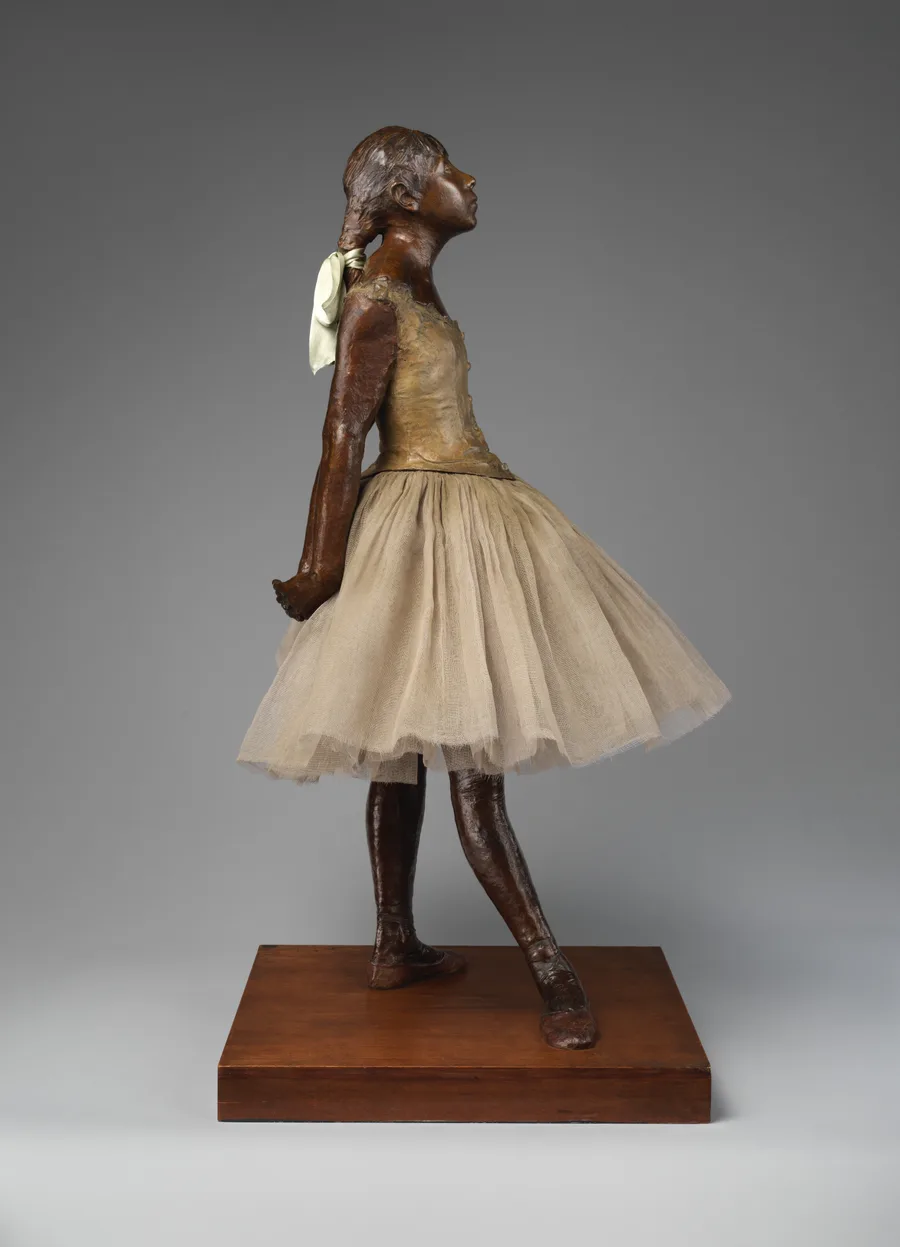
Unfortunately, this is all that has remained of Degas's oldest sculptures, which were either reworked by the artist or destroyed by time. The first work that can give us a more complete idea of his "manner" as a sculptor is the Little Fourteen-Year-Old Dancer, exhibited at the sixth Impressionist exhibition in April 1881.
The Scandal of the Little Dancer
This statue, which the Master Bartholomé recalled having to operate on the day before the vernissage (the private viewing) to fix some recalcitrant iron wires, had been announced in the catalogue of the previous exhibition but could not be finished in time. At that time, approaching his fifties, Degas was in full possession of all his faculties. The modernism of his works—dancers, portraits, laundresses, café-concert interiors, and so on—had brought him celebrity, if not general admiration, and he had already produced a long series of his best canvases as well as some of his most beautiful pastels.
At that point, he undoubtedly saw sculpture as just another means of studying movement, of seeking out attitudes and breaking them down, so to speak, in a more tangible way than through drawing. It was a way to "turn," with a master's hand, around the interplay of muscles that had always fascinated him.
Given the stormy discussions already provoked by his painting, it is evident that this little dancer—made of painted wax, and painted with a "fiery" realism (since critic Paul Mantz claimed that Degas had truthfully rendered even the grime on the model), dressed in canvas, coated with wax, gauze, and tulle, with a mask of a slightly simian vitality—was bound to stir up both a storm of indignation and boundless enthusiasm. Did not Jacques Blanche recount in his memoirs that he once surprised Whistler stamping his feet with enthusiasm in front of this little dancer?
As we find her again after thirty-eight years, in good condition despite all the vicissitudes she has suffered (for only the tulle of the tutu has been damaged), we can understand the surprise that such an unexpected work must have caused at the time. In addition to the naturalism of the figure, its unusual polychromy, and its real clothing, the very truth of the attitude must have been startling. It is, in fact, difficult to imagine a body more perfectly poised—we deliberately return to this word, for Degas himself told us what importance he attached to a body that was well-drawn, well "d'aplomb" (perfectly balanced)—or more full of latent life than in these nervous legs, in this slender body, thrown back in a movement of weariness and rest, yet seemingly ready to leap again. It seems that in the abandon and equilibrium of the pose, the muscles can still be felt trembling from the effort just expended, quite ready to take on another.
These striking qualities are even apparent in the preparatory study for this little dancer, which Degas made in the nude so as not to evade any difficulty. This is because here, as in his paintings, Degas believed that movement and attitude take precedence over the expression of the face.
A Frustrated and Maniacal Process
Before glancing at the more numerous works from the latter part of his life, let us say a word about Degas's technique as a sculptor—or rather, his lack of technique. The unpleasant surprises and fits of anger provoked by the fabrication of his sculptures were, for that matter, epic. As wonderfully skilled as he was as a painter, Degas was, in fact, a deplorable craftsman. He often lost the result of long hours of work due to his inability to build his models solidly.
Technical Deficiencies
After being put off by clay, its messy preparation, and its damp cloths, he attempted to use plasticine but abandoned it rather quickly, declaring that it "disgusted" him. Having decided to use wax, he then stubbornly insisted, out of the whim of a curious artist and also partly for economy, on making his own waxes. However, they were always too brittle, which, aided by his rage for reworking them, doomed them irremediably to destruction.
He also made the armatures himself, and did so with a motley collection of ill-suited materials, poorly attached, which often led to catastrophes: wire that was too thin and bent under the weight of the wax, or a paintbrush handle that was badly tied and would suddenly detach an arm or a leg. Flying into a rage, he would sometimes take out his bad mood on the statuette itself. Taken down from its modeling stand, it was relegated to a long table already covered with other victims—when it was not kicked away to crash into pieces in a corner of the studio.
A Demanding Perfectionist
For his sculptures, as for his painting, Degas was extremely conscientious, one might even say maniacal, tirelessly seeking the interesting but difficult-to-render movement, and even more difficult to pose. He was, moreover, insensitive to the fatigue of his models, who eventually came to dread his grueling sessions; some even ended up refusing to pose for him.
Rarely satisfied, if he did not destroy his statuettes, he would put them in "penitence," returning to them at long intervals, recarving them, gluing them back together, and changing the movements of the arms and legs. This often caused bits of wood or iron from the framework to protrude, which he then did not know how to fix. He would then sometimes accept (while "grumbling") the help of his friends Bartholomé or the printmaker Henri Rivière, but most often, he would just abandon the whole thing.
Preserving a Fragile Legacy
The few statuettes that survived these fits of impatience are enough to sharpen our regrets. Among them is the Woman in a Tub, reproduced earlier. Obviously, the public, had they known of it, would not have failed to cry out against its prosaism and vulgarity: a woman flat on her back in her tub! Her legs crossed in the air, washing one of her feet! And yet, what elegant suppleness in those shoulders and that head supported by the rim of the tub, what rightness of attitude, what beautiful lines of the body, what blossoming grace, worthy of Carpeaux's Flora.
But it is one of the rare pieces that is not in a state of sketch or ruin. His friend, the delicate artist Henri Rivière, distressed to see all these interesting pieces crumbling away, had several times extracted from him a promise to have some of them cast. But always at the last moment, Degas would back down, using the betrayals of the casting process as an excuse. More fortunate, Bartholomé finally managed to get his permission to bring over his moulder, and it is thanks to this insistence that a few of these statuettes have been preserved for us.
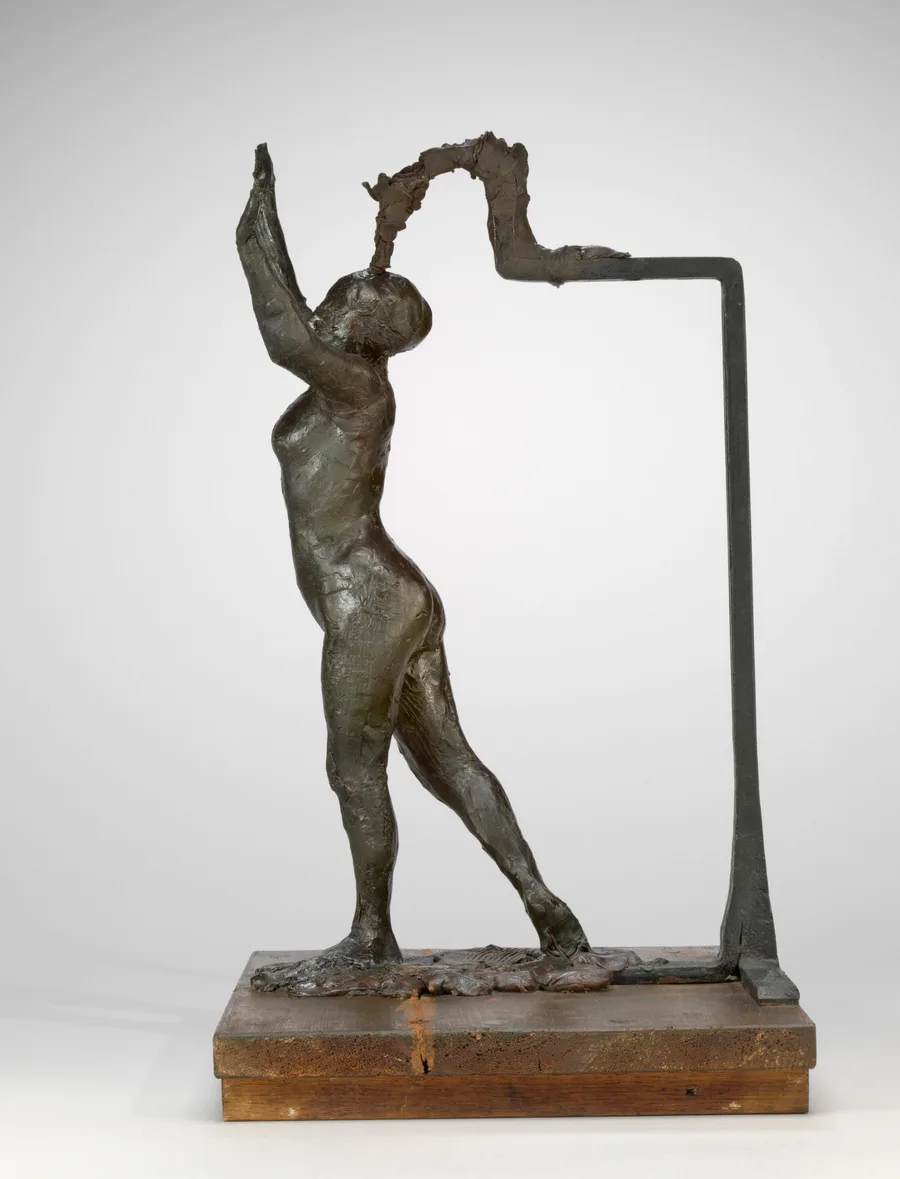
Among those that were molded around 1900 are, fortunately, two very beautiful pieces. The first is the Torso of a Woman, with her arm bent back pressing a sponge against her back; it is of a very sure execution, with such supple and powerful modeling, despite the roughness of the facture. The second is the Dancer with an Injured Foot. This one seems to have been the first example of a subject he frequently returned to later in clay, then in plasticine and wax, as the previous versions collapsed. It is extremely curious for its audacity in the arrangement and balance of this supple and full body, where no effort is felt and which seems like a living arabesque.
Sculpture in Twilight: The Final Works
The Dancer with an Injured Foot dates from the time when the aging artist (he was then nearly 70 years old) was suffering from frequent vision problems, caused by a partial detachment of the retina. He had been forced to give up painting almost completely, producing only those pastels with broad strokes and a hatched texture that characterize his late style. His visual field was very narrow, but here, one sense compensated for the other: Degas would often go and touch the model to get a better sense of the form.
Only the facture, a bit massive and rough, seems to denote that the artist could no longer give the same attention to details. One of his great sorrows, moreover, must have been his inability to render the extremities of the body with accuracy and precision—he who had always given such scrupulous importance and meticulous attention to feet and hands.
Apart from the statuettes we have just mentioned, all those that still remain are from Degas's last years, or at least were reworked and redone during that period; that is, from 1905 to 1911, when, nearly blind, or exaggerating the weakness of his sight, he was doing nothing but sculpture. In his old apartment on the rue Victor-Massé, Degas modeled ceaselessly. (Once he had moved to the boulevard de Clichy in 1912, he never returned to work and never again touched all the works piled up in the new apartment, nor his beloved collection).
Revisiting Familiar Themes
The subjects he treated then, in his long mornings of forced inaction, were those his brushes had so often described in the shimmering of colors and the brilliance of light. They partake of the masterful qualities of Degas the painter: a passionate search for and study of movement, and an audacity in this search that might seem like an affectation, if one did not know that the artist worked solely for himself.
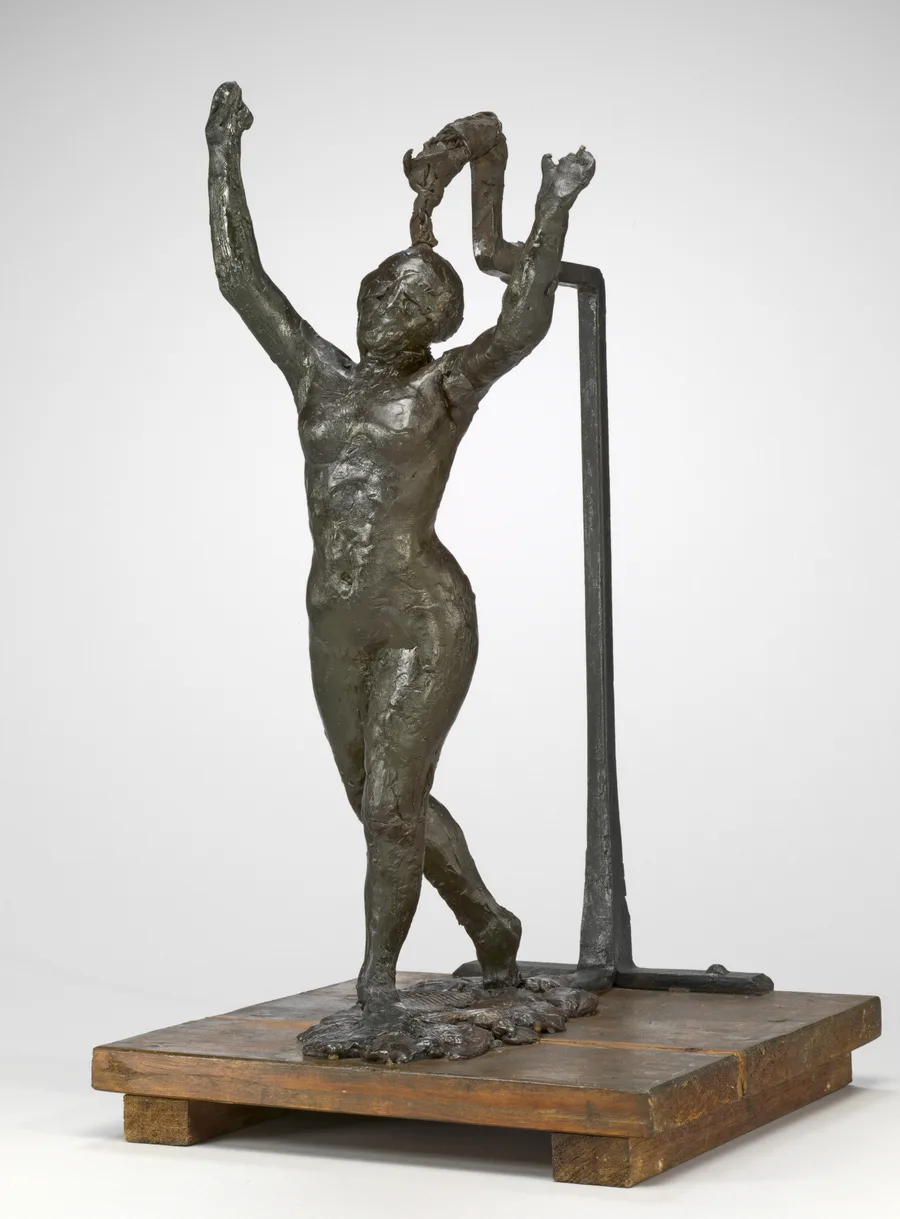
The women at their toilet, for example, inspired a whole series of studies that are quite curious for their truthfulness and their observation of forms and movements, rendered, one might say, with the scruple of an animalier (an artist specializing in animals). As for the dancers, they too found a fleeting life under his modeler's fingers. Here is a curious one in its exploration of raised arms, of a leg extended on its point, arching the back in the movement of the dance.
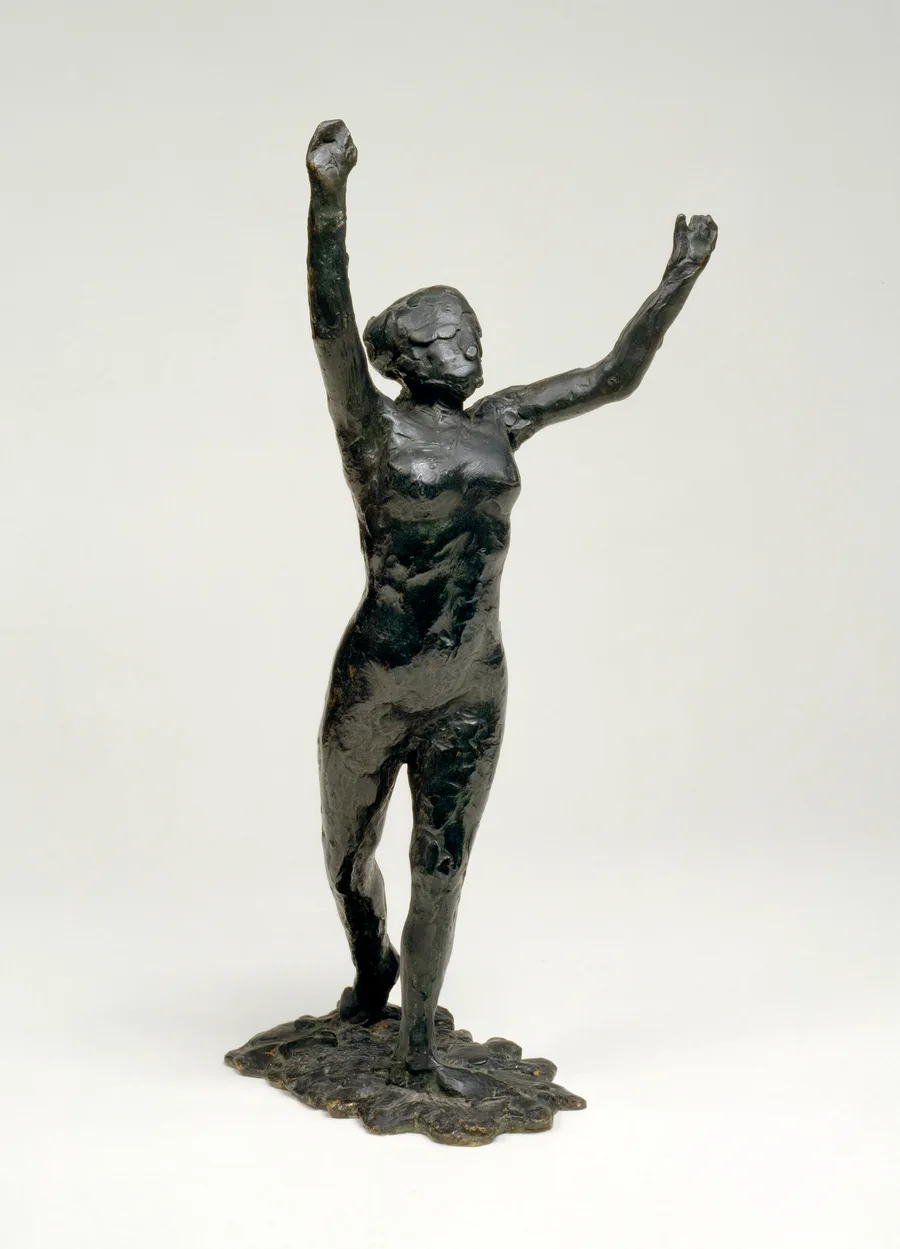
Here again is a pose he often treated in the past, captured in each phase of the movement: the dancer with her torso bent forward, standing on one muscular and trembling leg; then, in the supple balance of the whole body, extended almost horizontally; and finally, the balance accentuated, almost touching the ground with her fingertips, in the well-disguised acrobatics of the graceful movement.
All of this is unfinished, as if dashed off and modeled in a few thumb-presses. One must not, however, be deceived by this appearance of a facile sketch, which is heightened by the look of the material, where all the little balls of wax, barely smoothed by the modeling tool, are still visible. These apparent improvisations are the result of long and meticulous research, of conscientious measurements, of countless reworkings. And it is evidently to all this work that they owe their power to exude such an impression of mastery and authority, despite heads that are barely indicated by a ball of wax, broken feet, and formless hands.
Such are these statuettes, which will be doubly dear to all who have loved and admired Degas. They reveal a little-known aspect of his talent and, at least as much as his paintings and drawings, testify to his masterful audacities, though always tempered by a true artist's temperament. Finally, for all those who, in reading these lines, will evoke his last solitary years—the period of contemplation that so nobly concluded the old artist's life—some of these statuettes are veritable relics.
PAUL-ANDRÉ LEMOISNE