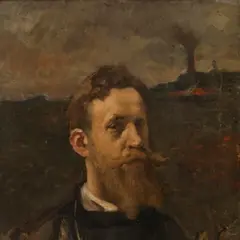
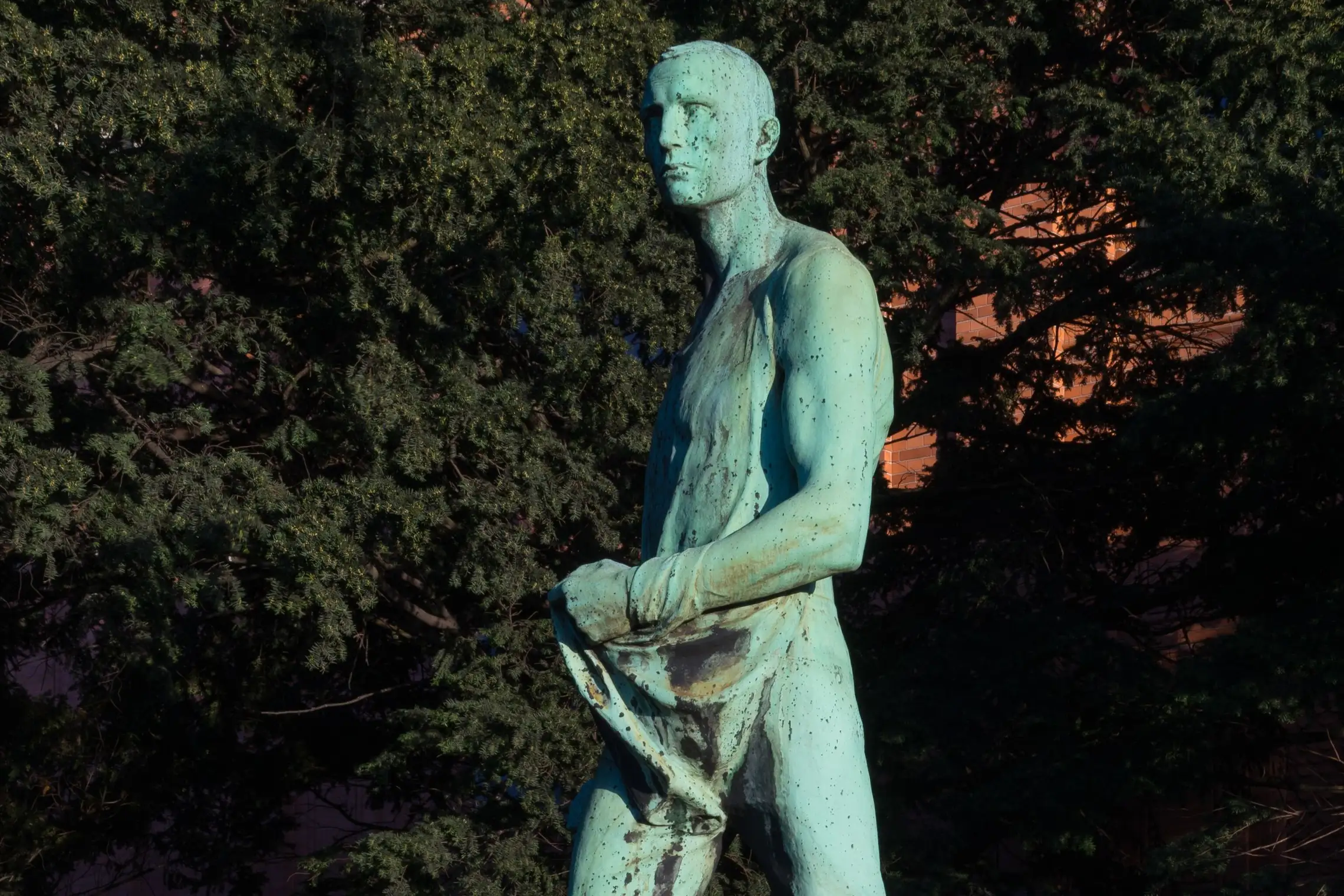
Constantin Meunier, the most classical of the great contemporary sculptors, was born in the Brabant country of Belgium. This region, at once Flemish and Walloon, alternates between plain and hill. It thus offers, in moderation, the dual aspect of the Belgian landscape, to which the Scheldt and Meuse rivers give such a contrasting physiognomy. It seems that, like his homeland, Constantin Meunier partakes of the two races that inhabit it. Through his ample and colorist emphasis, he appears Flemish. His rich and vigorous art is well-suited to humid, dense atmospheres. The magic of the great 17th-century Flemish painters resided in this very harmony of lines and aerial ambiance.
For his part, Meunier spent a significant portion of his life practicing painting almost exclusively. Yet he remains more specifically Walloon in the clear and precise rhythm of his structures, and in his natural instinct for simple beauty and harmonious balance. The unalloyed Flemish genius of a Jef Lambeaux—in whom the pompous, pantheistic sensualism of Rubens and Jordaens is revived—overflows into a luxuriant excess, tirelessly accumulating the external signs of physical force. By comparison, Lambeaux’s style serves to establish the predominance in Constantin Meunier of a more sober and concentrated race, endowed with a tranquil heroism.
A Universal Vision
Such observations, however, are only generalizations. Ethnic influences better explain the collective manifestations of a group than the isolated genesis of a single creative mind. While Meunier, by certain particularities, may claim one homeland over another, he seems to escape them all through a supreme, dominant quality that places him in the realm of masters without borders: he possesses a universal sense of Beauty.
His miners and his puddlers belong no more to the fiery territories of Mons and Charleroi than to the convulsed latitudes of Le Creusot or the coal districts of Pas-de-Calais. Their significance lifts them beyond limits and categories. They reveal to us a general humanity through a common destiny of labor and physical activity.
The manual toll of their work barely particularizes them. The deformation caused by daily effort is felt only in the swelling of a muscle, the thickening of the frame, or in certain pathetic details of form that evoke the use of hammers, picks, and stoking irons. The artist excels at indicating these marks without insistence, with a slight bulge of the line that does not break the plastic form but merely sensitizes it, as if with a more intimate warmth of life.
The Classical Heroism of Form
Meunier’s art defends itself from excess. Its submission to a constantly even rhythm of force brings it back to the beauty of postures, to the tranquil and harmonic play of bodies in motion. Effortlessly, through a marvelous gift for balance, he achieves power. He manifests the heroism of the human form. The arrangement of lines, with an inflexible logic, runs parallel to the directions of movement, following a continuous action and the transmission of conductive energy. It is the supple and rigorous mechanics of an organism paired with the reactions of a machine’s connecting rods and pistons. A figure thus conceived leaves nothing to be desired in its structure and its footing. It is planted on the ground with the same attachments that ensure the solidity of a piece of architecture.