William T. Dannat
The development of a uniquely American school of painting proved a complex and eclectic affair, with many of its most promising talents seeking their artistic fortunes in the studios of Europe. Among them, William T. Dannat stands out, not only for his early successes but for his profound and restless dissatisfaction with the very art that brought him fame. This artistic anxiety would lead him on a remarkable quest to rediscover the lost secrets of the Old Masters.
The Search for an American Style
When the efforts of the young American school of painting are displayed, whether in the grand setting of a World's Fair, as in 1889 and 1900, or in the more modest confines of a Parisian gallery, we can take a keen interest in the varied spectacle of individual virtuosity and surprising technical skill. Yet, we still search in vain to extract from our examination an impression of a national art born from the originality of its diverse expressions.
Less fortunate than the English, the Americans have not yet managed to crystallize the characteristics of their people into artistic masterpieces. They still await their Hogarth, their Reynolds, their Gainsborough—those great "primitives" of the recent past, whose radiant canvases are like great and faithful mirrors. In these works, the essential features of the Anglo-Saxon character are reflected with such noble precision and in a style of form and spirit so distinct.
It is fair to say that this almost sudden emergence of native geniuses in England occurred only after long centuries of national fermentation. Perhaps Reynolds and Gainsborough would never have captured the luminous faces of Nelly O'Brien and Mary Robinson—those radiant prototypes of the English woman—with their brilliant brushes had it not been for the providential crossing of the Channel by Peter Lely, Van Dyck, and Largillière. Furthermore, it must be acknowledged that the moral unity of the great American republic is still far from complete in the depths of its social strata. There, so many diverse and, at first glance, incompatible elements tumultuously churn before they can merge. This is a mysterious world, a feverish and unsettlingly complex crowd, whose picturesque quality the painter has not yet managed to conceive and express in the required style. American painting is still waiting for its Edgar Allan Poe.
Forced until now to come to Europe to study their art, young American artists gravitate, perhaps instinctively pushed by hereditary influences, toward the most dissimilar centers of teaching. This explains the extraordinary and disconcerting variety of genres, visions, and techniques that characterizes a collective exhibition of their works. Such a show is at once an assembly of samples of a clever and very expeditious know-how in the modern interpretation of a often superficial nature, and an overly generalized manifestation of a second-hand eclecticism. This holds true even when the excellent students of French, German, or English masters—students who, for the most part, could now teach their teachers a thing or two with the bravura of their execution—are named Knight, Pearce, Walter Gay, Harrison, Swain Gifford, Melchers, Vail, Rolshoven, Hitchcock, and so on.
If the distinguished names of Whistler, Sargent, and Dannat do not appear in this short list, it is for specific reasons. It would be truly difficult to determine the influences that presided over the emergence of the Whistlerian mode. John Sargent, an influential member of the Royal Academy, seems to have permanently taken up his great letters of English naturalization. And William Dannat appears to have definitively given up exhibiting in public, a decision that must be sincerely regretted.
The Two Manners of a Rising Star
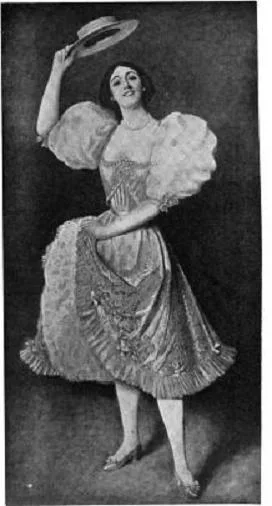
If my memory serves me correctly, it was in 1896 that Dannat's name last appeared in the catalog of the Salon du Champ-de-Mars. In that exhibition, he signed a smiling portrait of a famous Spanish dancer, treated in a very light palette.
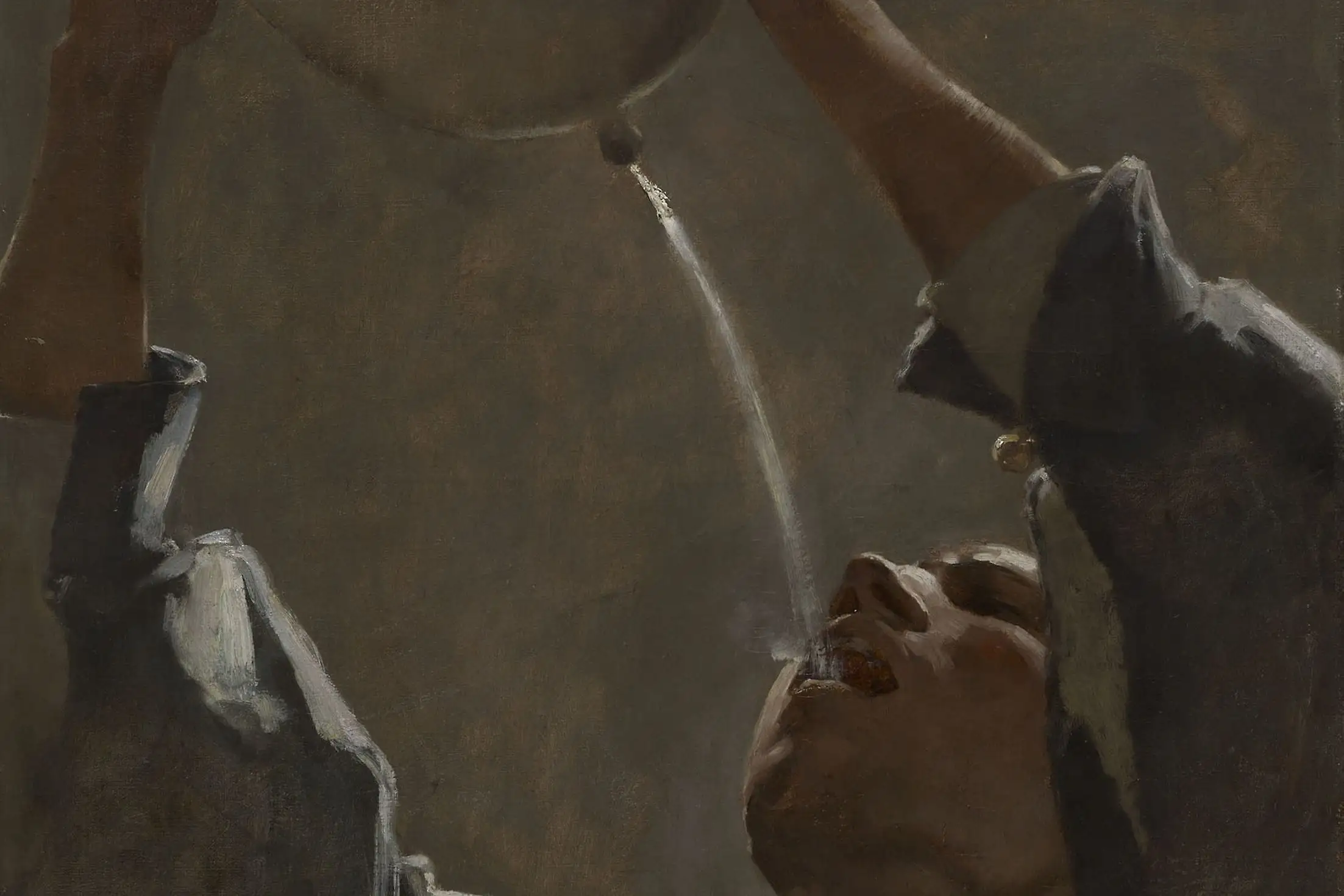
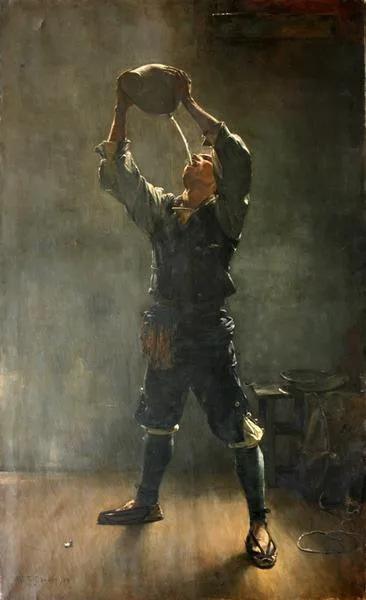
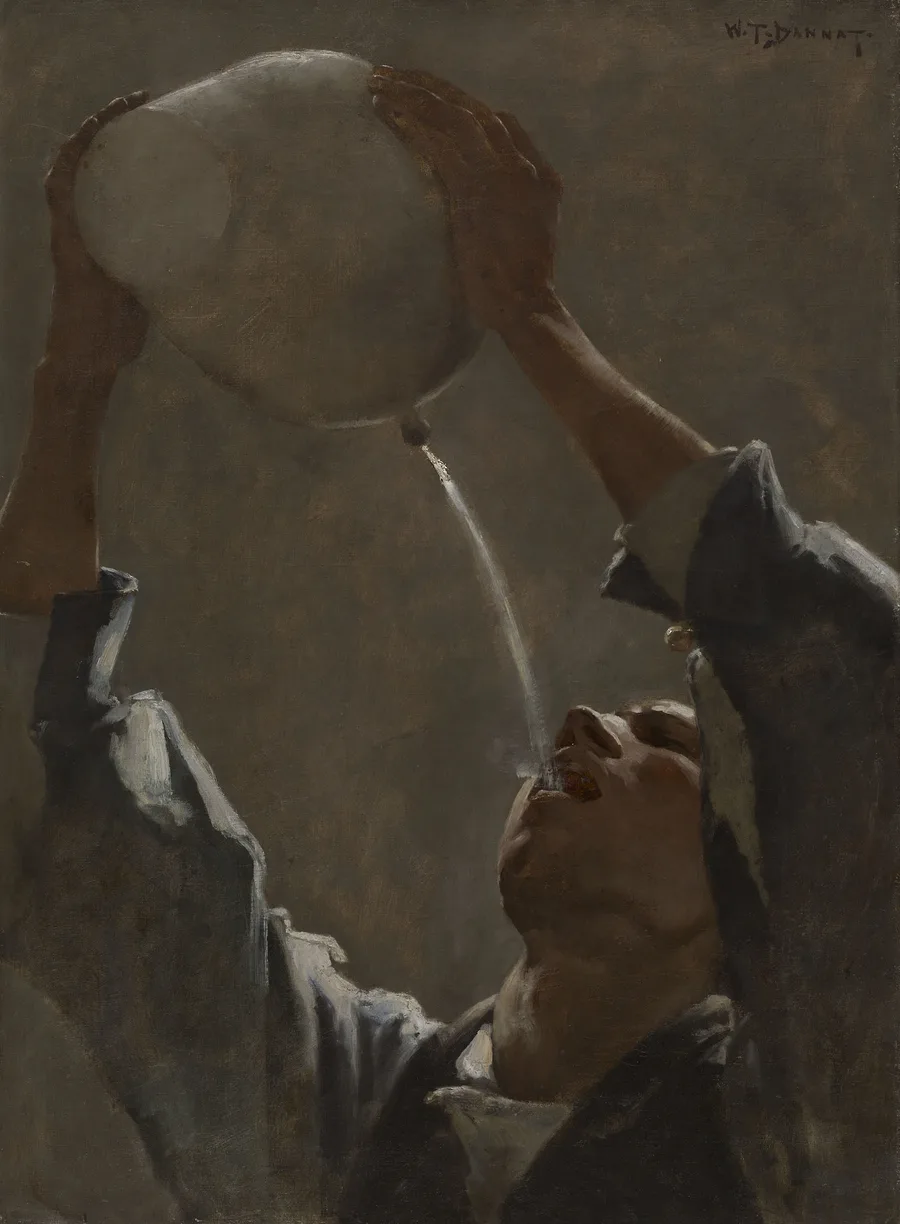
Fortunately, the Musée du Luxembourg has managed to acquire two of his best canvases: The Aragonese Smuggler (from the Salon of 1883) and The Woman in Red, which was highly acclaimed at the 1889 Exposition, where it was shown near The Woman in White and the portrait of Mrs. Eva Haviland by the same artist. The State's choice of these two remarkable works is all the more judicious because they are highly characteristic specimens of the artist's two distinct styles, or manières. In his early days, he painted under the beneficial influence of Mihály Munkácsy (I say this very seriously), creating works whose picturesque singularities were very finely observed and rendered with a strength and technical skill surprising in a debutant.1
Then, before the crisis we will soon discuss, came a change. As an excusable effect of the tyrannical fashion of the day, he imprudently abandoned the strong technique that had earned him such brilliant and legitimate success with his Aragonese, his Quartet, his Spanish women, and his smugglers. He turned instead to the pursuit of thin and light expressions of an elegant and somewhat superficial naturalism, all enveloped in an ultra-modern violet hue.
At this point, an introduction to the artist whose laborious efforts and crises of conscience we have presumptuously undertaken to describe in a few lines seems necessary.
A Portrait of Artistic Discontent
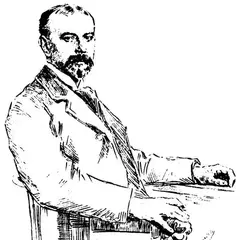
As Jean-François Raffaëlli defined him in the portrait that appears at the end of this brief study, Dannat is tall, thin, blond, and very distinguished in his bearing. I would add, however, that this living image is no longer a very accurate representation of the Dannat of 1904.
The Melancholy of Success
His forehead has widened as his hair has receded. A melancholy, sometimes crossed by a fleeting expression of almost cruel irony, now envelops the face that for so long was almost consciously illuminated by the inner radiance of a perpetual joy, born, no doubt, from perfect satisfaction.
And yet, W. Dannat possesses enough elements of happiness to have, at first glance, nothing to envy in the most fortunate of men. Does he not have health, wealth, and talent? Does he not have faithful friends, charming models, master paintings, and more? A fervent and formidable fencer, has he not, despite his Anglo-Saxon heritage (may M. Demolins forgive me), acquired a triumphant strength with the épée? And as an intrepid pioneer of automobilism, was he not one of the first to achieve the most dizzying speeds with his choice cars?
Nevertheless, Mr. Dannat is not happy. But the sole cause of his constant anxieties and absorbing preoccupations acquires a singular nobility when one realizes that it stems entirely from his passion for art, his will to do better, and his overly marked and insufficiently justified disdain for his past works—especially those he executed under the influence of a formula borrowed from the fashion of a day. If he dismisses his own past work, he is not free from a certain severity toward that of his contemporaries. On this point, there is nothing to criticize. The intransigence of his critical deductions is, moreover, of a picturesque harshness that is often persuasive and always interesting.
From Munkácsy's Shadow to Modernist Light
Like most of his artistic compatriots, William Dannat came to Europe at a young age. He was barely twelve when he arrived from New York in Germany, and from then on, he made only very short appearances in his native country. He began by studying architecture in Hanover and Stuttgart, then abruptly abandoned that career for painting.
His first lessons were given in the Academies of Munich and Florence. He came to Paris in 1879, at the age of 26. He listened to the advice of various masters, including Carolus-Duran and Munkácsy. He very visibly fell under the influence of the latter, as can be seen by examining The Aragonese Smuggler (Musée du Luxembourg) and The Spanish Quartet, one of his best canvases, which is now in a New York museum. It should be added that at that time, Munkácsy—whose early art was so rich in beautiful material qualities, with its opulent gray and black tonalities and its simple, lofty conception—was still the great painter of The Last Day of a Condemned Man, The Hunting Story, The Pawn-Shop, and Milton Dictating Paradise Lost. His native originality had not yet been forever annihilated in the fabrication of large, dioramic religious machines in which the artist's undeniable gifts disappeared. Dannat took from his master only his most precious qualities of color, which he managed to express with a breadth of technique and a very personal spirit of invention.
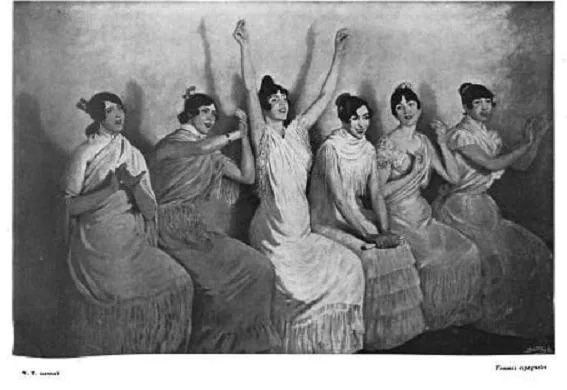
But soon, abruptly escaping the influence of Munkácsy and, at the same time, the menacing lessons of the old masters of Düsseldorf, Dannat partook in the general intoxication that seemed to have seized the world of painters. Setting aside all technical tradition, he threw himself headlong into the tender blue, the pearly gray, and the soft violet of the day. Very confident in the excellence of the "new ideas," he used the light caress of a very modernized brush on grounds free of any laborious preparation to bring forth long silhouettes of women with Botticellian slenderness. The fluttering of their hands, the twirling of their arms, and the rotations of their hips were repeated in very blue, very violet, or very mauve shadows on very white walls.
This was all very skillful, witty, unexpected, with a cheerful aspect, a frank harmony, and an indisputable artistry. It was called "distinguished," although a bit superficial, and everyone stopped with visible satisfaction before these fresh and joyous canvases.
Only Dannat himself would pass disdainfully before his own works, as well as those of his colleagues. The furrowing of his brow and the sarcastic curl of his lips said very eloquently: "Decidedly, all of this disgusts me."
The Heroic Retreat
Starting in 1896, Dannat ceased to exhibit at the Salon. Soon, a rumor spread that the brilliant artist was devoting himself with unbridled ardor to the sports of fencing and driving at 120 kilometers per hour, and had said goodbye to his palette and brushes forever.
Fortunately, this was not the case at all.
Weary of successes he deemed too easy, justly annoyed by the irritating fuss made over ephemeral triumphs by the ignorant imbecility of snobs, and also troubled in the profound honesty of his artistic conscience by the disquieting retrospective review of the countless failures that had already cluttered the history of the modern school of painting for some twenty years, Dannat made a heroic decision. Wisely sensing that the time was near when talented painters, anxious to prolong their dreams in their works, would abandon false methods and make the question of craft the object of their most feverish preoccupations, he resolved to stop exhibiting his paintings for eight years, though he did not stop painting.
He dedicated this period, with the fervor of a Benedictine monk, to researching the techniques of the great masters of the past, from Piero della Francesca to Watteau. He remembered in time, seeing the rapid and gloomy deterioration of most modern paintings, that his experiences obliged him to learn everything anew, as the teaching of the painter's craft was almost totally neglected in his day.
Indeed, doesn't everyone now paint in their own way? "Look at nature and work. You must learn the painter's craft on your own." Such is the watchword of the contemporary master. And so the young artist strives alone, without advice, without examples, in the deepest ignorance of definitive techniques, to daub his canvas, too often forgetting that a painter who learns his craft alone has, as Reynolds said, a fool for a professor: "a self-taught painter has a fool for a master."
Truly, Mr. William Dannat is one of the most anxious, most nobly anxious, artists of his time. And his anxiety would doubtless worsen if he knew that François Lemoyne once declared with a kind of discouragement that it took thirty years of studying the painter's craft to know how to create a work that could be preserved with dignity.
But such a long series of years will not be necessary, we hope, for Mr. Dannat to fruitfully penetrate the most complicated mystery of the ancient crafts and to draw serious benefits from the eloquent lessons of the great masters. To accelerate his research and confirm his opinions, did he not have the astonishing courage to dissect, so to speak, some of the masterpieces that adorn his private collection? With the help of scrapers and dissolving essences, did he not ask Titian, Rubens, Reynolds, and Goya, among others, for the secret of their prestigious and eternal fabrication, of the magnificent chemistry of their art?
Assuredly, from these long meditations and these cruel experiments—interspersed with fencing matches and restful automobile raids—some works of a precious and definitive execution will soon be born. In them, the artist's graceful and picturesque visions will be fixed forever in the most brilliant and solid of materials.
And then, Mr. William Dannat, made a Commander of the Legion of Honor in 1900, will no longer have the right to claim (an opinion that is, moreover, entirely his own) that this high distinction was prematurely awarded to him.
Armand Dayot