Today, when an illustrious painter finishes a painting, the public is invited to see it. An obliging intermediary conveniently appears to bring canvases and art lovers together. This precaution is not without purpose; who knows if they will ever cross paths again amidst the hazards of life? The masterpiece might depart for lands beyond the sea, or it may be locked away in the depths of an impenetrable gallery.
Thanks to Monsieur Sedelmeyer, we have seen the paintings of M. Munckaczy. Last year, M. Petit opened his gallery to M. Baudry’s Cupid and Psyche, and just yesterday to a series of pastel landscapes by M. Duez, the loveliest impressions of Villerville. Finally, in the first days of December, one could find M. Baudry once again at the Sedelmeyer gallery, where he depicted a new episode in the story of Psyche, a subject to which he remains faithful.
The Abduction of Psyche
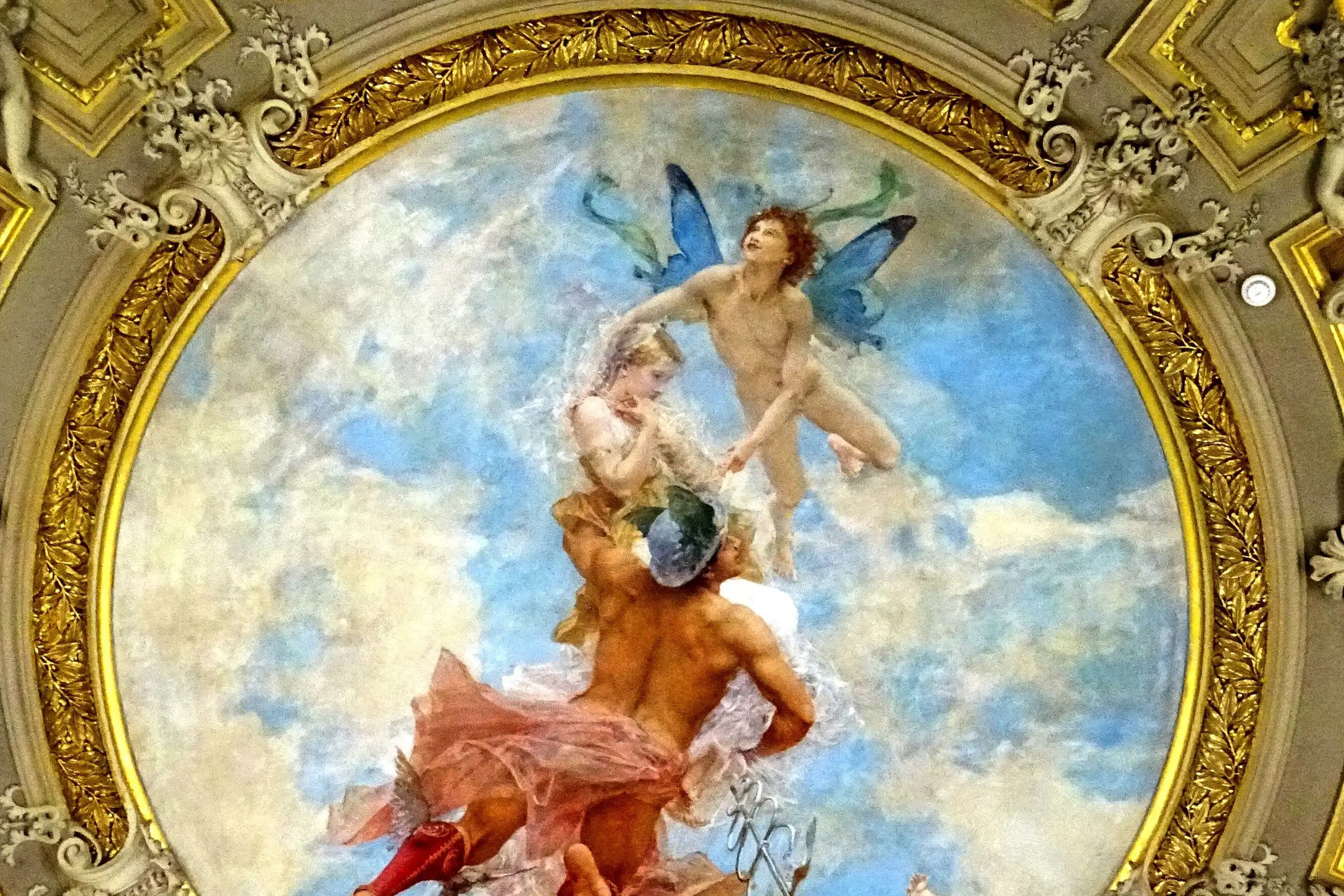
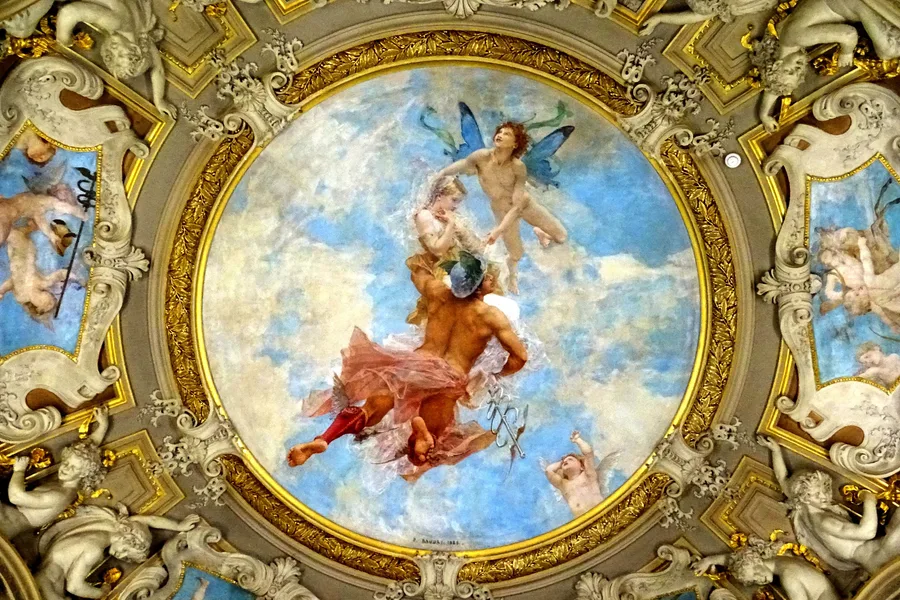
The subject of the ceiling, painted for the Château de Chantilly, is The Abduction of Psyche by Mercury. He is leading her to Olympus, where she will enjoy eternal happiness and forever inspire poets, painters, and musicians. What a shame it is that the paintings inspired by the loves of Psyche and Eros, which M. Baudry has created, are so widely dispersed from one another: The Wedding is in America with Mr. Vanderbilt, The Abduction is at Chantilly, various other scenes are at the Hôtel de la Païva, and I know not where to find the delightful couple of which M. Guillaume Guizot has spoken so well to our readers.
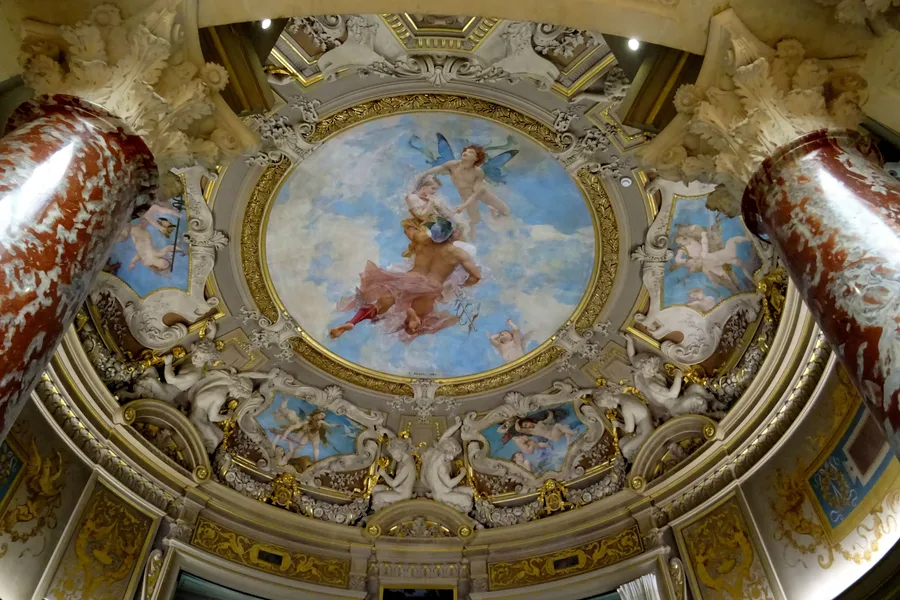
It would be easy to find certain parallels between Raphael and M. Baudry, but not concerning Psyche. M. Baudry did not find a Chigi to be his patron, nor was a Farnesina palace built for him. Let us lament this from the perspective of the future, but let us also rejoice, we poor contemporary admirers, to have our share of the feast. We leave our muddy streets and our gray sky, and when we have climbed a few steps and lifted a fold of drapery, what a theatrical spectacle awaits! We are faced with a corner of blue sky marbled with rosy clouds, before gods taking flight.
Everything is perfectly arranged for the viewer: armchairs to sit in, a carpet to kneel upon, depending on whether our admiration is blissful or respectful. Nothing is present to disturb the experience. The artist is far away. One need not worry about formulating a compliment for him, and he, happily absent, is not searching for phrases of thanks. What we are not compelled to say, nothing prevents us from writing; and yet, how can one hope to convey with ink and paper an idea of that which has so enraptured us?
The accompanying engraving will perform the task better, but can it render in the slightest the impression of that golden atmosphere, touched by a small reflection of dawn, which envelops the figures, the azure sky, and the clouds? The color, as harmonious and discreet as it is, leaps out at the eyes. It seizes them, charms them, and thanks to that first glance, one is transported to another world.
An Assembly of Gods
Indeed, here is a terrestrial genius, a small winged child, of whom we see only the upper body. With his gaze lifted and his arms outstretched, he bids farewell to Psyche. We shall not see her again. How could she possibly escape her sturdy guide? It is Mercury himself who flies with his back turned to us. One can sense from the effort of his muscles that he is holding his precious burden high and firm. It is impossible to draw the back, arms, and legs more broadly than M. Baudry has done. The soles of the feet, which are the part closest to the spectator, are true masterpieces.
These feet will perhaps provoke the same enthusiasm as those Albrecht Dürer painted in his Heller Altarpiece. Our friend and collaborator, M. Charles Ephrussi, recounts in the beautiful book he dedicated to the Master of Nuremberg that an Italian, as enthusiastic as he was barbaric, offered a hundred crowns for the right to cut the feet of an apostle out of the painting. Mercury's feet are safe, and I am certain of the response that His Highness the Duc d'Aumale and M. Baudry would give to such an offer.
Mercury wears a few articles of clothing: first, greaves of a purplish velvet with gold embroidery and gray wings. A pink drapery, which veils the lower part of his torso, wraps around to serve as a backdrop for the feet and the greaves, the right one of which seems a bit too dark to me. Why this somber point amidst all this light? Is it necessary to convey the foreshortening of the leg and to make one of those marvelous feet stand out? Mercury's face, seen in lost profile, has an expression more joyful than divine. The messenger knows what he is about, and his countenance will be just as mocking when he goes, as Molière tells us, to ask Night to favor the loves of Jupiter and Alcmene.
This vigorous young man, youthful and smiling, forms the most lovely contrast with his delightful burden. How ravishing she is, this timid young woman, with her downcast eyes and her half-open mouth! How chastely she crosses a veil of diaphanous gauze over her breast! It floats around her, winds through her hair, and falls to her feet, which are shod in cothurnes (a type of classical high boot), whose light golden latticework, held by a turquoise button, can just be discerned. Her robe is lilac, her tunic a pale straw color. One could not dream of a softer or more delicate harmony.
The final figure is Zephyr, who faces the spectator and guides the charming group we have tried to describe. He rests his right arm on Psyche's shoulder. One must remember that he is a god to believe he could hold back the young bride in the unlikely event that Mercury should let her slip from his arms. The figure as a whole is a model of grace and lightness. Was it necessary, for her to possess such elegance, that her ribs be so developed and placed so low? This is a simple question that I will not permit myself to resolve. Perhaps one could also add to these minor critiques a few observations on Mercury’s headdress, whose lilac felt hat and green wings are a bit heavy.
A Magnificent Addition to Chantilly
It is for the sake of conscientiousness that I raise these timid objections, to be quite certain that I have kept my composure before such a work. It is not a bad thing, when one admires something so strongly, to ensure one remains independent. M. Baudry may have given his Mercury a poor headdress or over-developed the ribs of his Zephyr, but it matters little; he has created a magnificent ceiling, a work to be added to an already beautiful list.
One quickly becomes impassioned with such a Psyche and cannot without regret watch her depart in the arms of Mercury. What will become of them? Will we never see them again? Well, the sadness into which this separation throws us is only felt by half. We know where M. Baudry's ceiling is going. The Château de Chantilly, to which it brings one more ornament, is accessible to the public. One can obtain the favor of a visit, and more than one petitioner will go to see Psyche again in the rotunda, which is decorated with drawings by Prud'hon, and on whose ceiling M. Baudry had already worked and which he now so magnificently crowns.
The fortunate visitors to the château of His Highness the Duc d'Aumale will be able to return to M. Baudry after they have admired the marvelous series of stained-glass windows depicting the story of Psyche. They will be able to see that, separated by several centuries, the same subjects hold the same interest, and that Psyche and Mercury can still appear alive. Modernity, as they say today, is created by talent. One may search for the grocer across the street and the deliveryman on the corner as models, but if one does not know one's craft, one represents nature no better than by evoking the eternal figures of Eros and Psyche.
What is necessary is to know how to paint and draw. I borrow this truth from Monsieur de la Palisse. He will surely lend me this one as well: M. Baudry is a very great painter.
ARTHUR BAIGNÈRES.