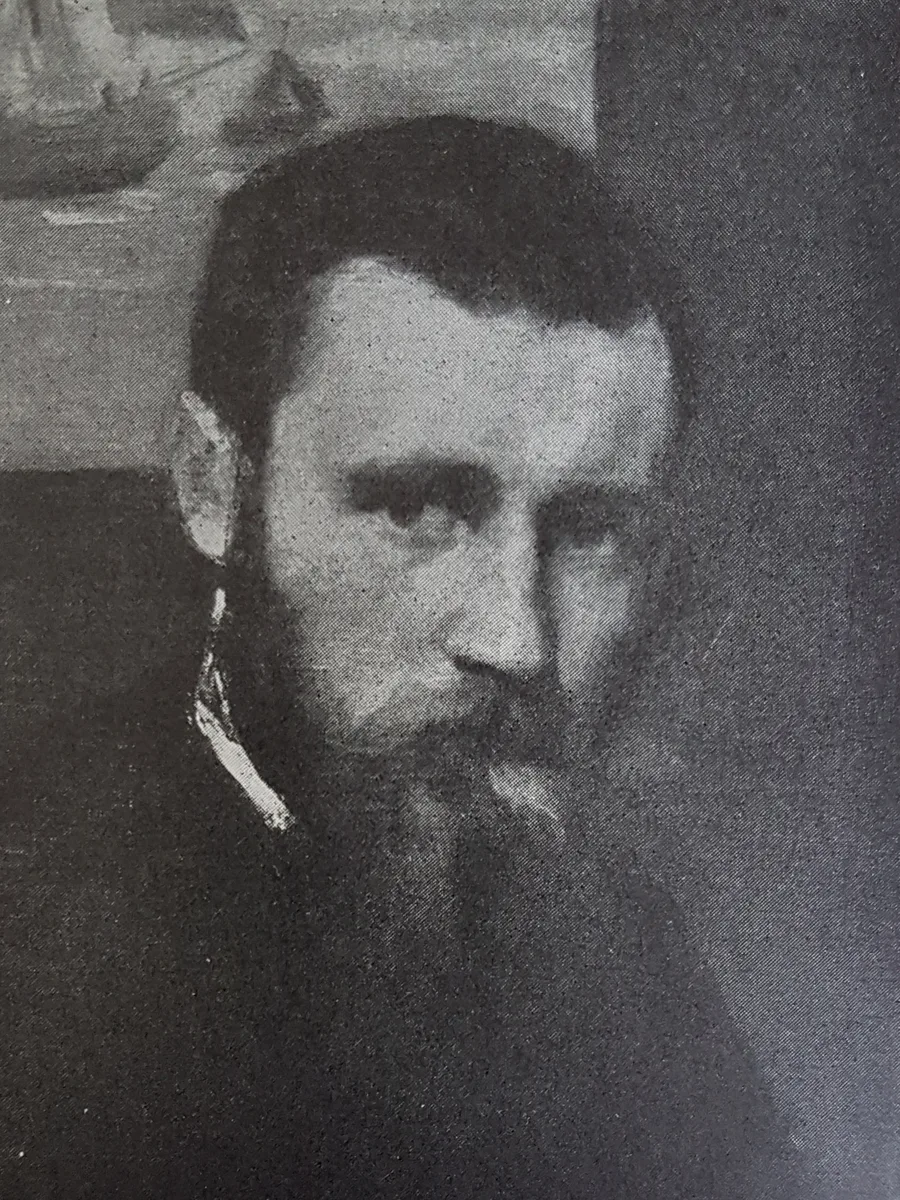
In France, we are hardly familiar with the work, or even the name, of the Swedish painter Nils Kreuger. Yet his body of work is considerable, and his name belongs to a powerful, honest, and industrious artist of a completely personal style. Alongside others such as Richard Bergh, Karl Nordström, Jansson, Liljefors, Zorn, Carl Larsson, and Fjaestad, he makes contemporary Swedish painting shine with a very bright brilliance.
An Independent Spirit Forged in Rebellion
What Nils Kreuger's talent has in common with that of the great artists of our time can, I believe, be summed up by the word that, in such cases, is the most laudatory: nothing. Kreuger seems to me to fulfill in the most complete way a condition that today appears essential to our conception of the artist. In the entirety of his work, and more expressly as his work rises and expands, he displays that rare characteristic of being connected only to himself, of feeling, expressing, and composing outside of all influence and all contingency, with no other inspiration and no other law than those of his free, inner genius.
He is an artist in the finest sense and in the greatest strength of the term. By this, I mean that he possesses not only the temperament and nature of the true artist, but also the qualities of will, tenacity, and sincerity that are the indispensable foundations for the accomplishment of a solid and homogeneous body of work.
It must be said, to the credit of Swedish art of the last twenty or thirty years and to the honor of Kreuger's generation, that he was not the only one to set an example of this harmonious and fertile alliance of the rarest artistic and moral faculties. The striking and proud unity in the work of a Bergh or a Nordström stems from the same happy equilibrium in natures differently gifted, but animated by the same passion to express themselves strongly, and voluntarily subjected to the same moral discipline of artistic conscience.
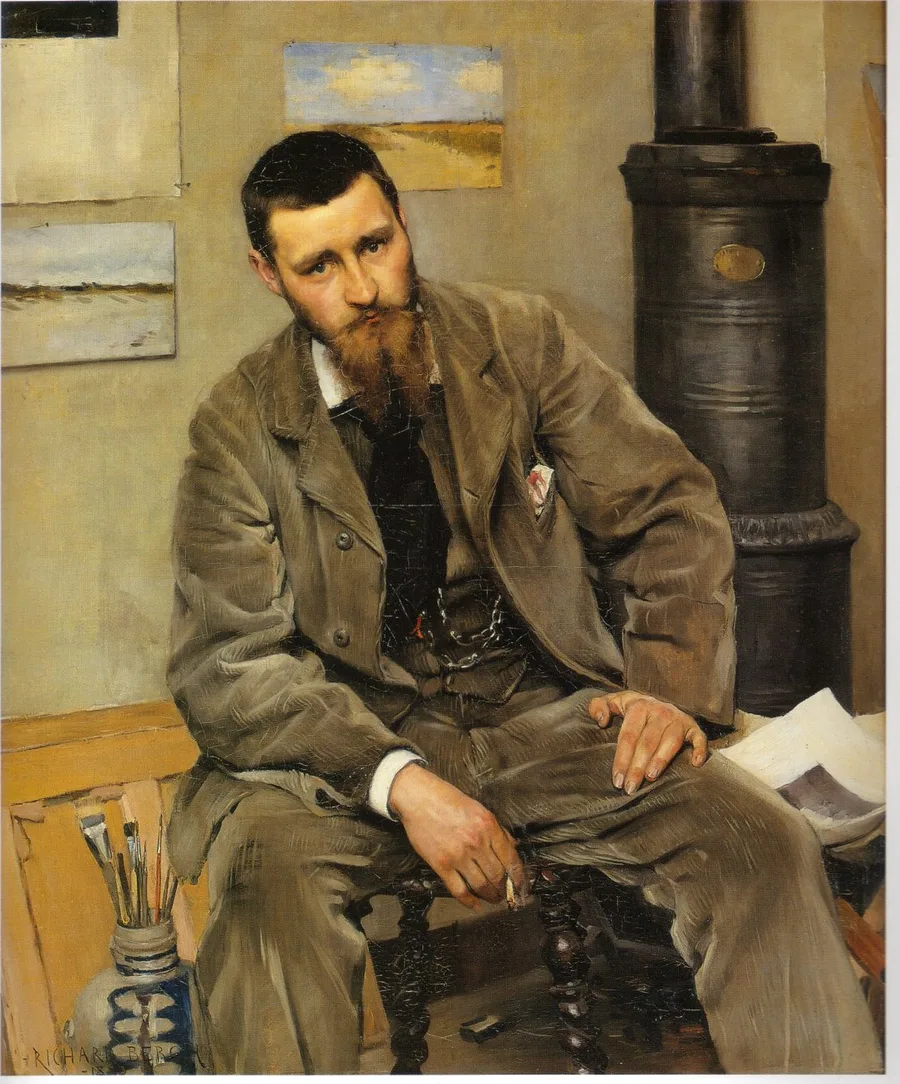
A very interesting fact to note is that this aspiration for independence developed and strengthened as a reaction against the narrow authoritarianism of academic art. The same spirit of revolt that blew through France against the routine and poisonous teaching of the École des Beaux-Arts was one day unleashed against the institution that represents the Swedish École des Beaux-Arts, the "Academy of Liberal Arts" in Stockholm. On that day—it was in 1885—Nils Kreuger, then very young, was among the insurgents.
The following year, he joined the "Artists' League" (Konstnärsförbund) and, since then, has always shown himself to be one of its most radical members. That is to say, he is one of those who defend the integrity of its principles with the most intransigence, who pursue the emancipation of art through the emancipation of the artist with quiet courage, and who, with complete constancy, refuse to pay for the benefits of a compromise with the price of a concession.
Formative Years and Artistic Journeys
Outside of this artistic struggle, which took on a particular importance and acuteness because it assumed the character of a moral and social event in Sweden, Nils Kreuger's life is marked only by a few travels and the continuous series of his works. Born in 1858 in Kalmar, Kreuger was about fifteen years old when he came to Stockholm. He was accepted into the School of Fine Arts, but he worked there for only three months. He was destined to be formed primarily outside of professors and studios.
Parisian Sojourns and Early Influences
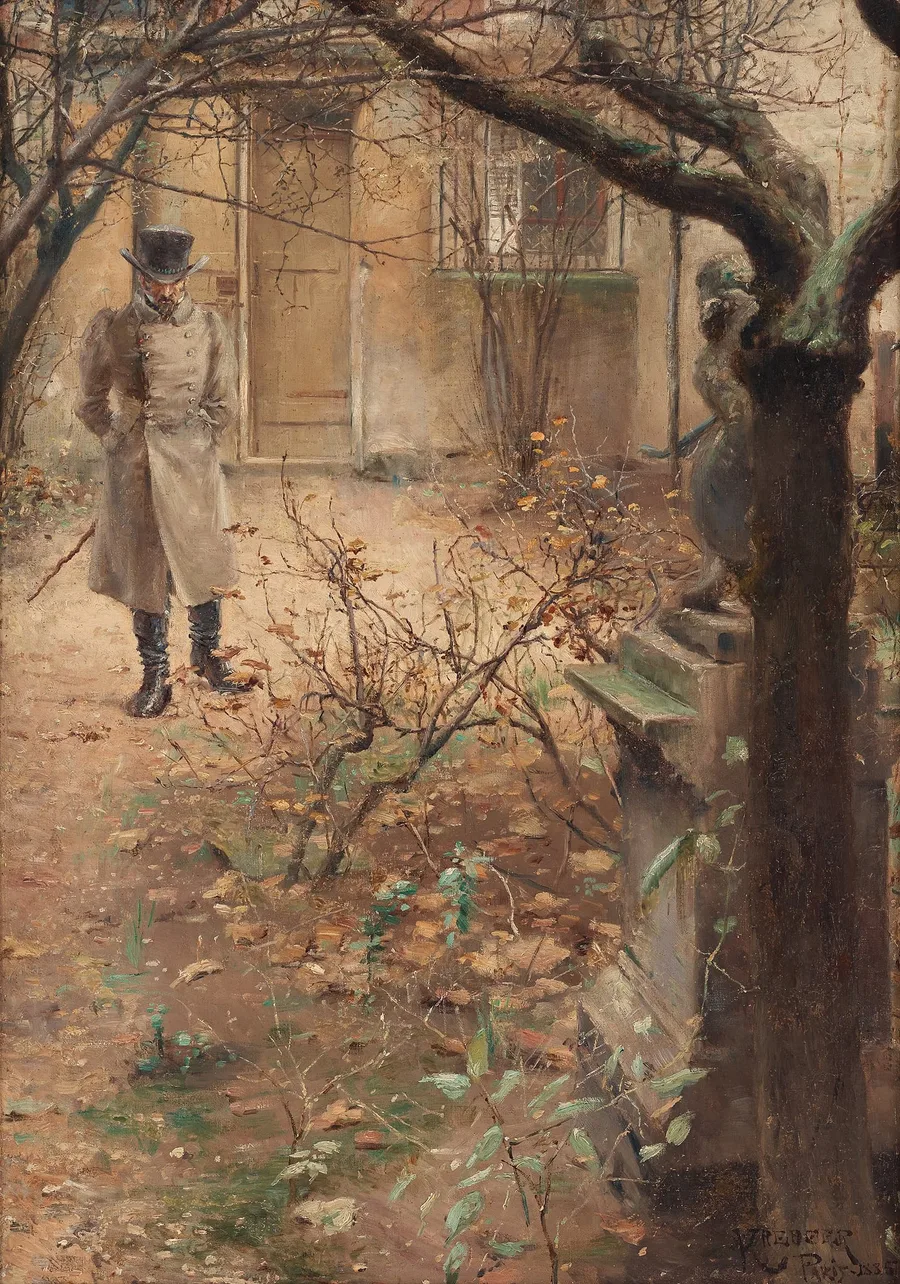
Thus, when he came to Paris in 1881, the teaching at the Colarossi studio was, so to speak, without effect, and in any case, without benefit for him. The serious and useful work was studying in the open air, with no other guide than his own feeling, no other master than his own conscience. From this period, he has some very interesting sketches in his portfolios. Kreuger roamed the streets of Paris and the roads of its suburbs. He gathered impressions that reveal a refined sense of the Parisian atmosphere and an astonishingly diverse curiosity for the forms of life.
What pleased him above all, what he sought to penetrate to its intimate soul and render its delicate and somewhat sad charm, was the landscape of the inner Parisian suburbs. He loved the arid slopes of the fortifications, the least frequented postern gates of Paris from which a narrow, bumpy path leads tortuously to some old, sleepy little town or into a deserted and silent countryside. He spent days exploring Ivry, Vitry, Bicêtre, and Gentilly. When he married in 1886, he came to live for a year in the quiet little corner of Bourg-la-Reine.
In the meantime, he made rather long stays in Brittany, at Concarneau (summer 1882), in Holland (1883), and at Grez-sur-Loing (1884), which was then the center of a very interesting colony of his compatriots. But from 1887 onwards, he became Swedish once more.
The Varberg School and Return to Sweden
Apart from a new stay in Paris in 1888-1889, he no longer left Sweden. From 1887 to 1896, he lived in Varberg, a small port in the province of Halland, on the western Swedish coast. Richard Bergh and Karl Nordström lived there for a few years at the same time as him, and they thus formed what is called the "Varberg School." Kreuger acknowledges that these years were among the most important of his life from the point of view of his artistic evolution and the self-awareness he gained.
Since 1897, Kreuger has lived in Stockholm during the winter, and during the summer, he settles for several months in the countryside, in some remote corner of a province. Thus, from 1899 to 1905, he stayed on the island of Öland, a narrow and flat strip of land that stretches into the Baltic Sea along the eastern Swedish coast. Since 1906, he has spent the summer in Båstad, in the province of Scania.
A Technique of Line and Color
To form a precise idea of Nils Kreuger's talent, it would naturally be desirable to have at least one of his works before one's eyes; and it is regrettable that none have been given hospitality in one of our museums. Kreuger, however, is not as inaccessible to us as many others. If one examines, for example, with attention the reproductions that serve to illustrate this article, they seem to be drawings rather than clichés of paintings. But for that very reason, they render the character of the works with fidelity, one might say, and they do not suggest raising, as imperiously as in many cases, the ever-legitimate question of the errors that can occur in the transposition of colors or the rendering of values through photography and printing.
The Primacy of Drawing
Most of Kreuger's paintings are, strictly speaking, colored drawings, and this is how the artist himself titles them. He begins by establishing a more or less precise drawing on the canvas or wood, after which he paints with oil and lets it dry. He then goes back over his drawing with ink or paint, sometimes with a brush, but more often with a quill pen. Not only does he accentuate the contours in this way, but he also speckles his work with dots or small strokes.
I need something to complete the values, and since color does not give me that something, I have sought it through dots.
This final touch applied to the work gives it its essential character. In art, one must obviously not attach excessive importance to questions of technique, since in the final analysis, it is the result alone that is to be considered. But in Kreuger's case, it is not insignificant that the technique itself indicates that it is the drawing that has the last word over the color.
Another point that is not at all unimportant to discuss, and which, despite appearances, is something other than a matter of words, is whether Nils Kreuger should be considered a landscape painter or an animal painter. If it were only a question of form and label, it would be childish to dwell on it; but it is in reality a matter of the judgment one makes on the fundamental character of the work and the artist's talent.
Landscapes with Animals
Kreuger himself considers himself a landscape painter, and he is right. In all his works, the landscape is, through its lines, its planes, and its masses, the essential and constructive part of the painting. The animals are presented only as one of the elements of the landscape. But it must be said at once: there is almost no painting by Kreuger where an animal, or a group of animals, does not come to occupy the scene and enhance the landscape. One must therefore conclude that the artist, to realize his vision of nature on canvas, feels the constant need to associate the mobile and living form of the animal with the immobile form of things.
From the beginning of his career, Nils Kreuger had understood that the true path for him was to study this relationship between the animate being and the surrounding landscape. It was not for nothing that he had witnessed and applauded the glorious rise of the French naturalist school of open-air painting. It was not for nothing, above all, that he had been moved by a profound sympathy as a man and an artist for Millet. But if he notes the Varberg period as a capital date in his artistic life, it is because it was truly from that moment that all confusion was dispelled and all timidity vanquished for him.
Since that time, he has moved more and more resolutely away from short-sighted realism; he has accustomed himself to conceiving on a grand scale, and, by the very grandeur of the landscapes he loved, he was led gently but surely to the style of his finest works.
Others besides him have moved from naturalism to a decorative manner; but what is quite remarkable in Kreuger is how natural this evolution has been. There is so little that is artificial in this transformation that one is always obliged to admit as the starting point of each of his works an astonishingly precise study of reality. The great decorator who captures the vast horizons of Halland, Öland, or Scania in a few simple and striking lines remains at the same time the attentive draftsman, the patient observer who has never ceased to study animals very closely. One can be convinced of this right here.
One will be convinced at the same time that Kreuger's horses and cows belong properly to Kreuger through the solidity of a completely individual drawing.
These cows and horses, Kreuger studied them as they live, in complete freedom. He did not have them pose before his easel, but he observed them in the open air and in motion. He followed them grazing or wandering on the moor of a rocky soil, breathing the salty air on the seashore and even in the sea. He painted them in the landscape, as an intimate part of the landscape. This is how and to what extent he was a landscape painter—a painter, moreover, of a severe or grandiose nature in most of its aspects; a landscape painter who needs not the intimacy of a solitary corner, but the immensity of the fields or the heath, the infinity of the sea and the sky.
The Power of Decorative Murals
It seemed quite clear that Kreuger, by the very nature of his talent, should nowhere be more at ease than in the composition of large decorative panels. He had the good fortune to be able to execute several. We have already had the occasion to mention in this review the two large panels that were commissioned from him for a municipal school in Stockholm (1). Since that time, and for another municipal school, a new large mural painting, a reproduction of which can be found here, was commissioned from him by the Swedish society "Art in the School."
The subject of this painting represents "St. John's Eve" on one of the quays of Stockholm. The light that bathes the picture is something like "the remnant of day by which the last hour of work is illuminated." Life appears joyful, work light; the carts and the horses that pull them are adorned with branches; the steamers anchored in the port are brilliantly decked with flags. In an enchanting setting, familiar to all his compatriots, the artist has presented us with a scene that is popular above all others, free from any artificial and easy emphasis; but this procession of trucks rolling along a quay has a simple grandeur that is impressive.
The reason for this must be sought not only in the art, but also in the soul of Kreuger. One cannot really repeat enough that this painter of landscapes and animals, who has today so naturally become a powerful decorator, remains everywhere and in all circumstances an impenitent realist. There is a kind of fluid that circulates from one end of his work to the other, in his most modest studies as in his greatest compositions: it is an inexhaustible, ever-attentive, often moved interest in the life of things as well as of beings, but for the life that no convention has come to distort and debase—the life of the open air or the life of labor, for example.
In this, his feelings as a deeply sensitive and thoughtful man have been admirably reconciled with his artist's instinct, for he found precisely that he could make very beautiful studies of form and color by dedicating himself to the beings and things towards which he felt drawn by a natural sympathy. It is thus that he has treated with the same force of expression the weary forms of cab horses whose captivity he pitied and the supple forms of Öland horses whose independence he glorifies. And in Kreuger, feeling adds to art because it does not seek to supplant it.
The Soul of a Realist
No art, moreover, seems more suited to be deeply felt by all and to have a powerful educational scope. It is healthy and invigorating like the fresh air of the coasts. It teaches one to despise all that is affected and artificial. It is serious, but in no way harsh or austere, for it simply has the gravity of nature and of life, from which it breathes and of which it inspires a profound love. It is the expression of a soul at once sensitive and strong, masculine and tender. And it must be added to the honor of the great artist that is Nils Kreuger, that the sincerity which led him to mastery has given his entire work a very rare quality of homogeneity and consistency.
It would be desirable that not only the name but the works of Kreuger were known in France. He is one of those who have something to say, and who, to say it, have forged their own robust language. The Salon d'Automne organized, without him, a Swedish section a few years ago that was not lacking in other enormous gaps, since no member of the "Artists' League" took part in it. This was a loss for the Salon d'Automne and for the French public, and we should welcome with joy any opportunity that might arise for a brilliant reparation.
ETIENNE AVENARD.