
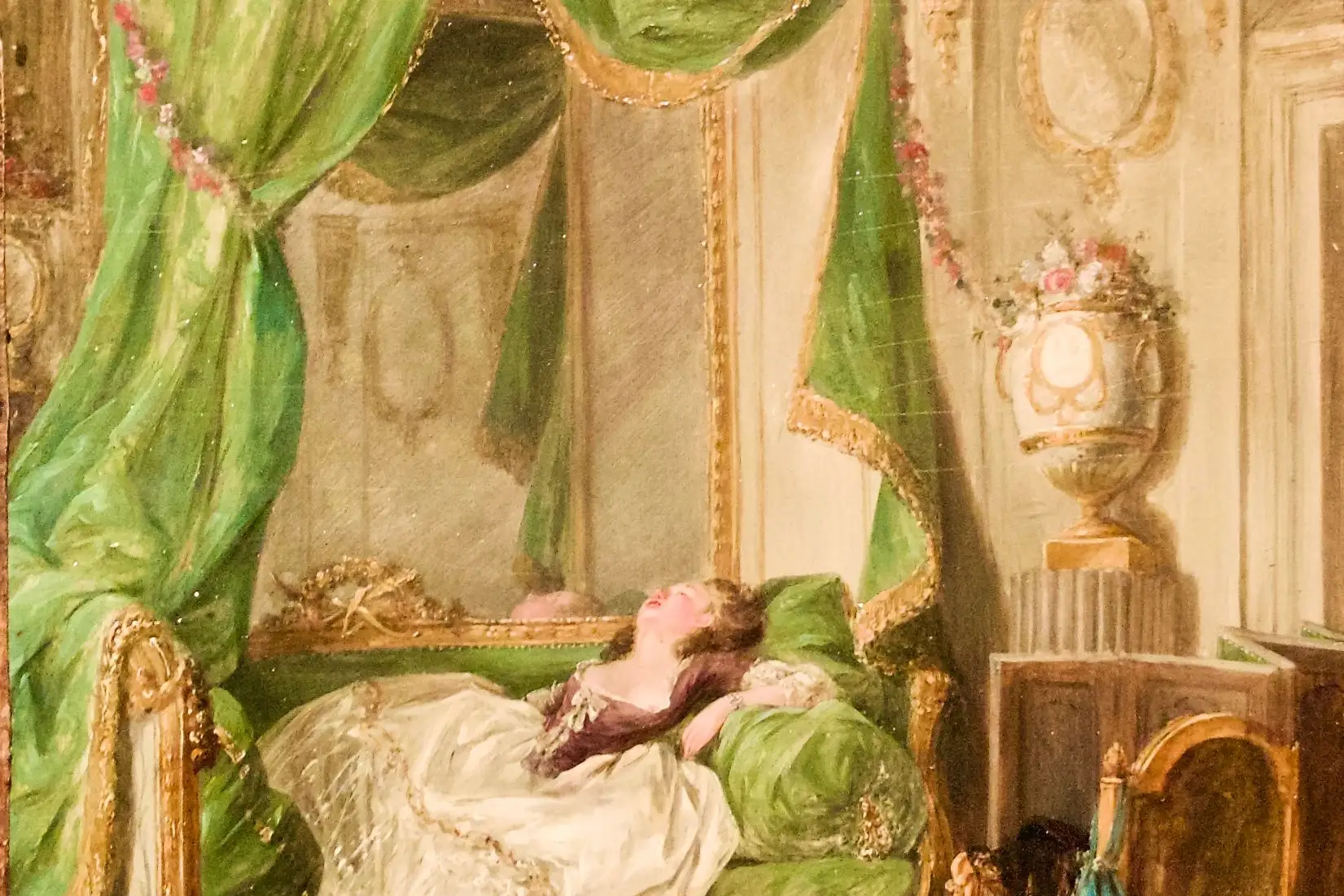
Among connoisseurs of prints with a pronounced taste for the charming French school of the 18th century—so witty, so piquant, so truly French—there is not one who does not know the lovely compositions of Nicolas Lafrensen. A great number of his gouaches and colored drawings were honored with engravings in France under Louis XVI. The shimmering burins of Nicolas Delaunay and the color facsimiles of Janinet gave a second, long life to these intimate or lighthearted scenes of the era. In their original form, these works were sometimes colder, often straying in pursuit of a finished quality—that down-to-earth pitfall that thwarts lively, swiftly captured fantasy in favor of a dryness of execution.
A rather bizarre peculiarity has arisen concerning Lafrensen and his work, which is a very curious resource for the history of the era's customs, costume, and furnishings. The interpretation has completely overwhelmed the source; the engravers have almost entirely caused the gouache painter to be forgotten. In France, where he nonetheless lived for nearly twenty years, there is no information available about him. Even his name, difficult to omit from the prints made after his compositions, has been continually disfigured. I have noted more than twenty variations of this unfortunate name, which had nothing baroque about its spelling; only on a single piece, the portrait of Gustav III engraved by Gaucher, is it transcribed correctly.
He is best known in the world of art lovers under the Gallicized name Lavreince, and some of his gouaches are signed in this manner. Although a stranger to our customs and our country, which he only came to around his thirtieth year, Lafrensen is completely acclimated in his work. His conversation pieces, his galanterie stücken (gallant pieces), as collectors across the Rhine call them, faithfully reflect the image of that gallant and frivolous world. This society, with little concern for the future and enjoying the present, would, after a drink, parade its disheveled elegance to the petites maisons—private houses used for trysts—of the Pont-aux-Choux, the Roule, and the Barrière Blanche.
One would never guess that the latitude of Stockholm saw the birth of the artist behind La Consolation de l'absence (The Consolation of Absence), L'Innocence en danger (Innocence in Danger), Le Roman dangereux (The Dangerous Novel), and so many other intimate compositions. These works not only sketch the gallant profiles of the day but also place them with perfect accuracy in their setting, in their milieu. They are set in those Louis XVI interiors, a little more spacious than the boudoirs of the preceding reign, where draperies and pier glasses have become disproportionately large, serving as backdrops for the contrived comedy of easy love affairs.
Such scenes demand discreet light, broken lines, no sharp angles, and many curves—for operatic loves, a tempera Olympus.
This result, this complete assimilation, seems to have been achieved from his very first years of expatriation. As early as 1777, Delaunay had engraved L'Heureux moment (The Happy Moment), a composition that perfectly sets the tone for the genre. This theme is repeated in subjects published later with varying degrees of success, but never with greater accuracy. If we in France knew nothing of what Lafrensen was, apart from his engraved work, the opposite can be said of his native country, Sweden. There, they hardly suspected that they had endowed us in the last century with one of our most sought-after gallant petits-maîtres (minor masters).
The titles of a few of his compositions were barely known there, only mentioned in Nagler's voluminous dictionary.1