
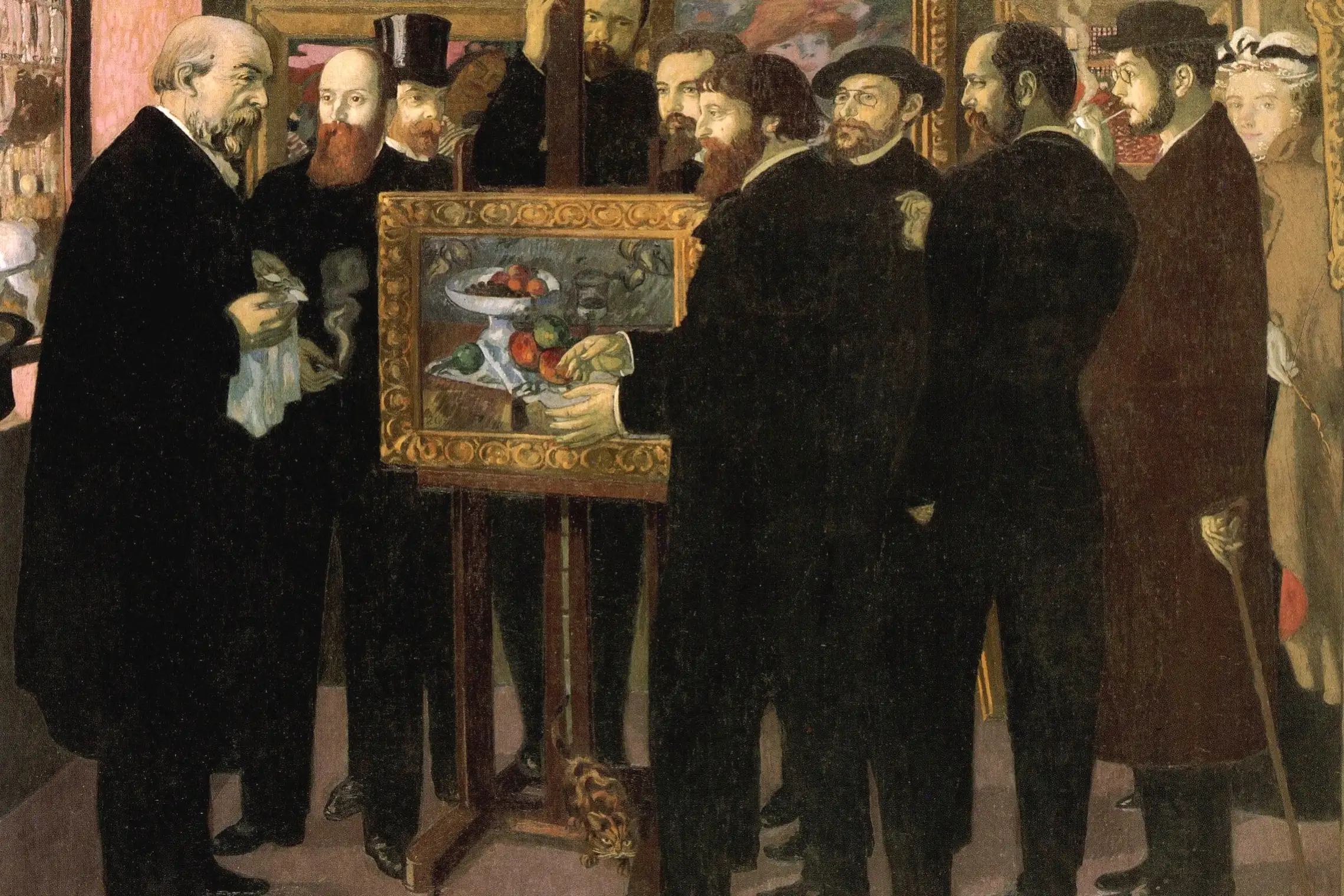
The artistic career of Maurice Denis began around 1890. At that time, with a certain awkwardness that was part of his charm and with delightful imperfections that already revealed his uncompromising will, he was exclusively an imagier—a creator of images. He was a youthful artist who was perhaps the most disdainful of the conventional craft of painting, determined to express himself in a language different from the one spoken all around him.
The young men of the small circle to which Maurice Denis belonged—Paul Sérusier, Édouard Vuillard, Pierre Bonnard, Ker-Xavier Roussel, and Paul Ranson—formed the somewhat esoteric group of the "Nabis," a name derived from the Hebrew word for "prophets." Within this group, Sérusier seemed to hold a preponderant authority. Under the influence of their immediate elders, such as Émile Bernard, Louis Anquetin, Charles Laval, and Émile Schuffenecker, who had exhibited in a café at the 1889 Exposition Universelle, they were in fact propagating Paul Gauguin's Synthetism under the banner of "Neo-Traditionism." This was the era of celebratory banquets for the poets Paul Verlaine and Jean Moréas; Denis himself painted sets for the writer Édouard Dujardin and for the Théâtre d'Art. What painters could glean from this milieu was a taste for the rare, the subtle, and the immaterial, along with a certain disdain for nature and a penchant for idealistic distortions of form. In the critic Albert Aurier, they found a remarkable theorist for their ideas.
The Revelation at Pont-Aven
A pivotal moment occurred in 1888, when Sérusier went to spend his holidays in Pont-Aven. He did not know Gauguin personally but was staying at the same inn, run by Marie-Jeanne Gloanec, where art students from the official academies mingled with the innovators. On the eve of his scheduled return to Paris, Sérusier decided to approach Gauguin for a conversation. Gauguin immediately suggested they work together. The next morning, the two men went to the Bois-d'Amour, a nearby wood. That evening, Sérusier left for Paris, carrying a small panel he had painted under Gauguin's direction. It was covered in pure blues, yellows, and bold reds, which formed a rich and solid composition where the literal representation of the landscape was subordinated to a kind of organic sympathy between the colors themselves.
When Sérusier returned to the Académie Julian, where Maurice Denis was studying, he showed his fellow students the panel and declared: "This is what painting is." The young painters, of course, did not fail to joyfully turn the panel every which way, jokingly asking whether it should be viewed this way or that. All the same, a few of them felt liberated from a sense of uncertainty. They began to realize what it was they were meant to attempt beyond the scope of Impressionism.
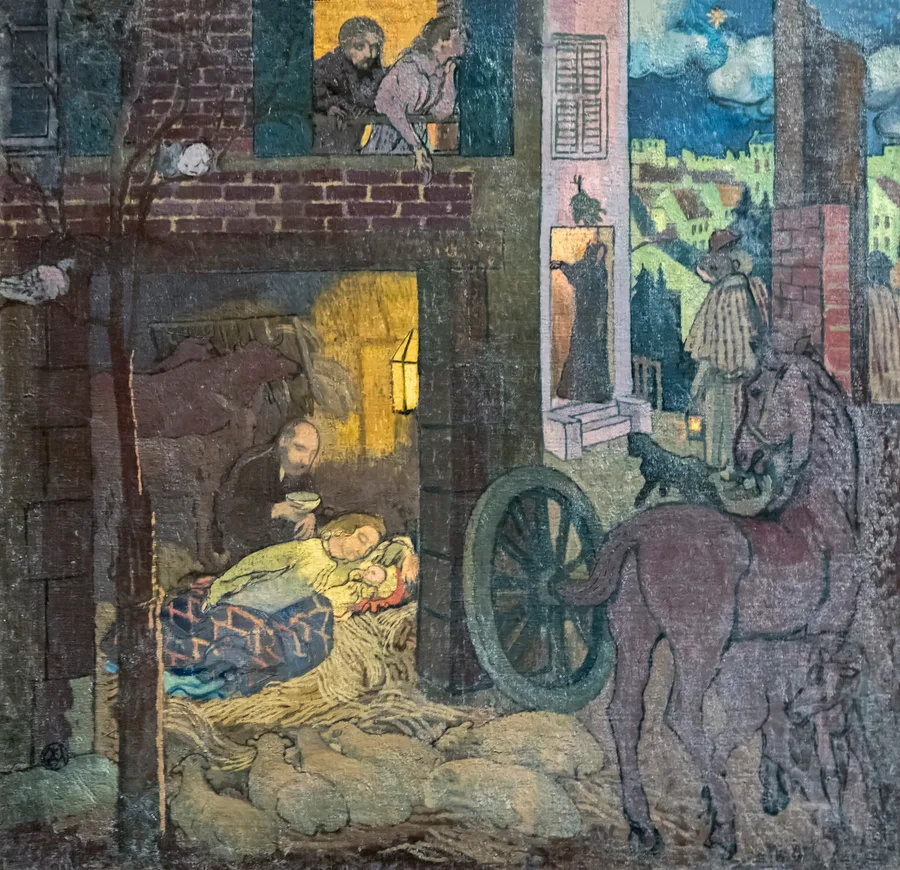
Such were the circumstances of Maurice Denis's beginnings. Impressionism had already moved beyond realism by making room for the painter's temperament and legitimizing the accents of personal vision. Denis was fortified in this conviction by the example of Gauguin, who famously advised: "You saw some green, so put down your most beautiful green." Therein lay the subjective seed of a new art, and it was by following these masters that he could become so intensely idealistic.
This approach certainly showed little regard for a literal interpretation of nature. In the young journals of the time, where he defined "Neo-Traditionism," Maurice Denis formulated aphorisms such as this one: