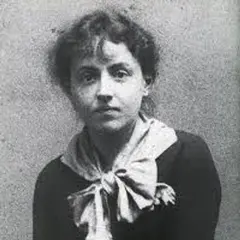
In the two volumes of her Journal, the poor Marie Bashkirtseff appears to us as both very touching and very vain. She certainly could have been featured as an eloquent example in a recent magazine inquiry into child prodigies and the ultimate outcome of their gifts. She was one of them, possessing their charms and their flaws. Her sad end diminishes the latter in favor of the former. Peace to her iridescent and troubled ashes!
The childhood of the serious, great artist to whom I wish to dedicate this essay must have been very different. And yet, from an early age, fame had already brushed against, and secured, the name of Breslau—a name in which the vibrant memorialist I cited above heard a powerful, sonorous, and calm chord. But it was a fame in harmony with such sure promise.
Yes, sonorous, calm, and powerful; the accuracy and justice of these expressions speak in favor of the one who formulated them in her restless fairness. Bashkirtseff, the young and brilliant socialite, was ambitious to devour an entire art career with the speed of a hare, while her prudent and patient companion, Breslau, slowly, wisely, and valiantly progressed through its successive and consecutively victorious stages.
It is these stages that we are now permitted to survey, thanks to the exhibition whose initiative once again does great honor to M. Georges Petit. The overall view is surprising even for those who, like us, have followed the painter's work with attentive interest for years. What am I saying? It is surprising, I am sure, even for the painter herself. For artists worthy of the name—I mean those who possess the necessary modesty and pride—the effect produced by the gathering of their works is a surprise. And this surprise has something triumphant and consoling about it, like the gaze that the aging philosopher affirms belongs to a man who has stored his riches elsewhere than in the chest the thief attacks.
Mademoiselle Breslau will certainly be able to cast such a look upon herself when the injuries of time, many years from now, have made her a venerable old master. For from the hands of this old master, many of these precious leaves will have fallen, upon which she will have inscribed the history of many souls. And beneath this vital and pensive harvest, the future will be able to inscribe the lovely verse:
Here are fruits, flowers, leaves, and branches...
The Rivalry with Bashkirtseff
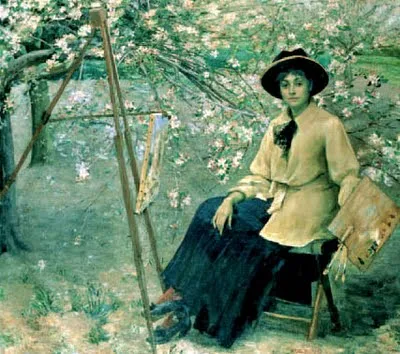
This harvest will be that of our Masterful Woman (Maître Femme). We will return to this harvest shortly. But first, I would like to insist further on the comparison sketched out earlier, which gives us some very instructive information on the virtue of emulation.
In the second volume of Bashkirtseff's journal, the name "Breslau" is printed more than thirty times; I counted them, and I must have missed some. It returns like a haunting, an obsession, the real specter that must be vanquished. Breslau is the representative being of the merit one desires for oneself—that being who exists for many of us, if not for everyone, and whom circumstances endow with the power to make us realize the best of what we contain, the blossoming of which might have been lesser without them.
I quote from Bashkirtseff's journal:
"Breslau has received many compliments. — How well that Breslau draws... It's that scoundrel Breslau who worries me. She is admirably organized, and I assure you that she will break through. — That scoundrel Breslau has made a composition; when one knows how to do something like that, one will be a great artist. — You guess, don't you? I am jealous. That's good, because it will push me. — Naturally, Breslau is a huge success; it's because she draws well. — Breslau will win crowns. — Breslau is my constant preoccupation, and I don't make a single touch without asking myself how she would do it. — I dare not ask anything for fear of hearing what Breslau is doing. — Next to Breslau, I feel like a thin, brittle cardboard box next to a richly carved solid oak chest. — The happy Breslau; yes, truly happy, and to be as happy as she is, I would give everything they call my happinesses. — That famous will of Breslau. — God was good in allowing me not to be completely crushed by Breslau, at least for today... — I am not favored like Breslau who lives in a small artistic circle, where every word, every step contributes something to her studies...
In the evening, for example, Breslau spends her time drawing, composing... — It's not that she is very interesting as Breslau would have been, for example... etc., etc."
This interminable refrain laments indefinitely, swelling or subsiding, accusing or fading, across five hundred pages, like the leitmotif of a stimulating and effective rivalry. And yet, she emerges from the shadows at my call to bring, in these lines I have quoted, a posthumous and continued tribute to the once-envied rival—a faithful admiration, now stripped of all earthly competition, and magnificently justified today by what her inspiring companion gives us to judge.
Critical Acclaim and Artistic Integrity
Before speaking of the striking collection of these works, about a hundred of which are exhibited by Mademoiselle Breslau in the Galeries Georges Petit, I want to cite a character trait of hers that aligns with what I said earlier about her disdain for vain glory. On the eve of writing these lines, I asked her for some of the innumerable newspaper clippings where, for twenty years, her fame was first heralded and then accentuated in incessant variations, in order to document my writing. She gave me this simple reply: "I had a few bundles of those clippings, but during my last move, all of that disappeared..."
I like that response infinitely. Yes, these superficial judgments, "rather without great good faith," as the poor Verlaine said, all disappear during the successive and increasingly reflective pauses of existence. All that remains is the appreciation of certain luminous minds who have honored us above all, and even more so, if they have deigned to put a little of their feeling into the judgment of their thought.
Among those who acted thus toward Mademoiselle Breslau, I would cite Messieurs André Chevrillon and Émile Hovelacque. Let us listen to them:
"The same psychological sense is found in Mademoiselle Breslau, who focuses primarily on the physiognomies of women and children. One likes to linger before this serious and wholesome talent, enamored of freshness and strength, of kindness and finesse, full of feeling and devoid of sentimentality. One admires this sincere and upright craft, applied to complete and scrupulous modeling, to the representation of the entire physical exterior that is molded by the inner life. It is an art of pure reflection and conscientiousness, which refuses to sidestep difficulties, and which the French eye, accustomed as it is to light deftness and brilliant virtuosity, does not appreciate enough at its high value.
Mademoiselle Breslau is our foremost woman painter, at least in portraiture, the only one, perhaps, who is not a replica of a masculine talent. In pastel, her tenderness, her sympathetic and spontaneous woman's intelligence find their use. Nothing is more gently restful and intimate, nothing more friendly, than her groups of young girls with their delicate and light shades of flowers, of such a peaceful and measured grace. Her studies of children are often masterpieces of arrangement, of simple and sure execution, succeeding in expressing young life with its contained radiance, its reticent strength, its almost vegetal freshness, and the calm of its unfinished blossoming."
This passage is one that anyone would be proud to have inspired. The one who had this honor did well to misplace all the rest in a move. This fragment is enough. It would be useless to quote others. It contains everything and can serve as an epigraph for this peaceful and measured body of work, just as it may one day, in the very distant future, serve as an epitaph for she who will rest gently, having realized this calm dream.
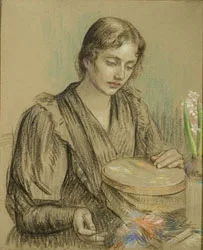
A Style of Honesty and Insight
Let us try, in our turn, a few modulations on the collection now on display and the artist to whom we are indebted for it. First of all, does it not seem that we find in the eyes of some of her models a reflection of her country of origin—pure and powerful, with its candor and its azures? Mademoiselle Breslau is a native of Zurich.
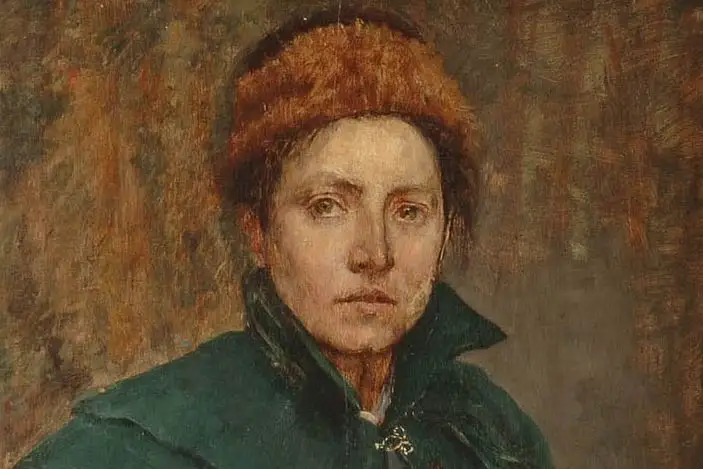
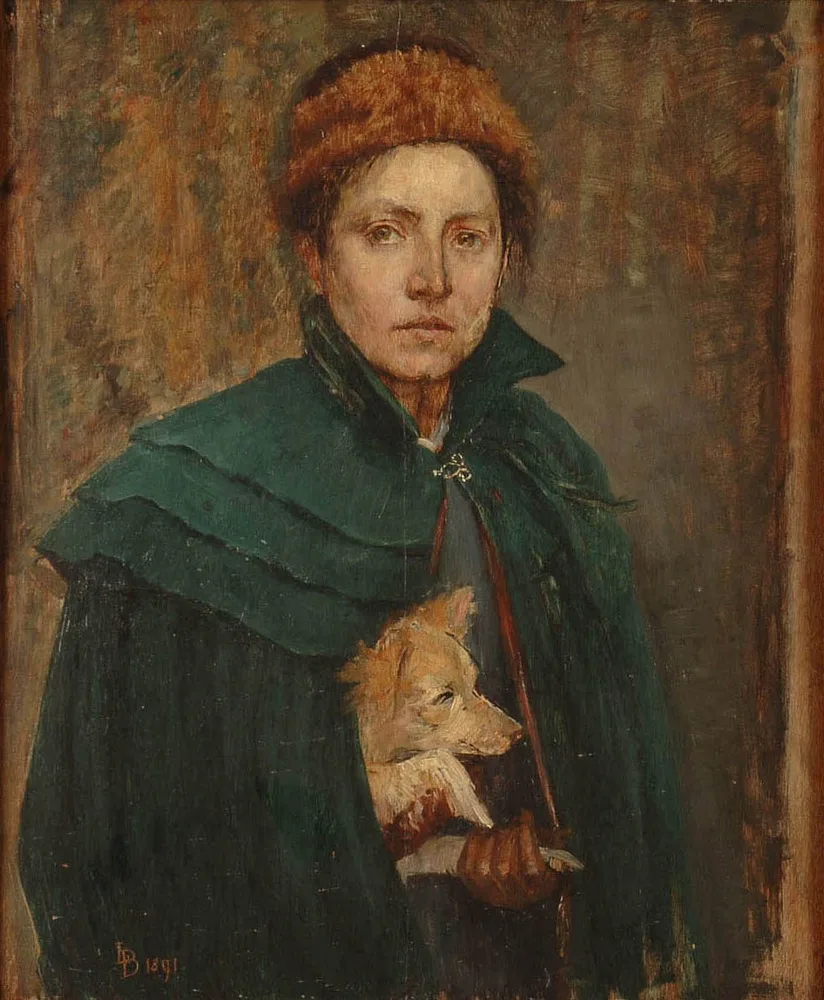
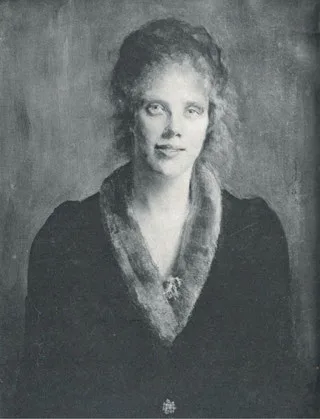
"How well she descends from her mountains!" the Master Degas once declared, with one of his familiar witticisms, in front of a curious self-portrait of the artist. Indeed! This portrait, fur-clad and forbidding, is significant, with its frown that seems to address all the mawkishness, affectation, and trinkets—everything false in what is today called art, which is most often only an insipid counterfeit. Yes, truly, something limpid and restful, as in the atmosphere of high-altitude countries, can be breathed in the honest and quiet room where a few thoughtful men, young women, older ladies, and especially those truly childlike children, live out their life of healthy aesthetics so gently, among pensive flowers and sensitive animals.
Louise-Catherine Breslau affirms herself daily as the incomparable translator of these subjects.
Such are the few themes, at once simple and infinite, around which a mastery sure enough of itself not to show off its virtuosity is exercised. There is no sleight of hand or prestidigitation; no false chic, nor even real chic; finally, no couturier's elegance or mannequin's graces. But all this is without any inverse affectation, which would be no better. No; there is only a search, more felt than seen, for the attire that reveals a self, for the accessory that completes or comments upon it. This attire, if it is to the painter's taste, will be simple and charming; but it may also take the form of a bizarre hat, if this detail tells us more about the head it covers than a whole treatise on physiognomy.
But, I repeat, when the taste of the painter and that of the model can be reconciled, what happy results! As proof, among many, I offer this engaging portrait of M. Victor Klotz, a work of such perfect bearing and satisfying harmony.
Sometimes, the artist goes even further in the choice of detail, and we follow her with joy, for a sure prescience of what Carlyle called the philosophy of clothes prevents her from misleading us. Thus, in the admirable portrait of M. de Brantes, which will remain one of Mademoiselle Breslau's most delightful works, the painter considered her model a character who wears fingerless gloves (mitaines). It was true; he himself realized it. And the amiable man, who sometimes "put on gloves" (prenait des gants) to speak of things delicately, will henceforth wear fingerless ones; it will be all to the good, since they will leave half of his charming hands visible.
It is truly without exaggeration that one can mention Perronneau in connection with this pastel. The eloquent eye, the learned nose, the shrewd air, the sly smile—all this wheedling and cozy grace is of an eminently witty psychology.
The Incomparable Translator of Children
And yet, it is in the portraits of children that this gift is exercised with a more tender finesse.
Two subtle verses say:
With every step he takes, the child, behind him,
Leaves several little phantoms of himself...
One could write a book of the reflections Mademoiselle Breslau has collected from the mouths of her young models. She excels at making them talk, or rather, at letting them talk, in order to extract the secret persona of their future individuality, which it is her task to express, in turn, upon a surface. But how expert she is at it! There is in her something of a Kate Greenaway, of vaster proportions, of course, and of a higher caliber; but what I mean is a kind of artistic transposition of maternal love, consecrating a tender celibacy to understanding well, and translating better, these first fruits of souls.
The reward for such subtle application, served by exceptional means, a perfect sincerity, and a consummate art, is that no one, it can be affirmed, will have, like Mademoiselle Breslau, fixed "mortal eyes in their entire splendor..." (according to Baudelaire's expression) along with that which, sometimes prematurely, makes them "darkened and plaintive mirrors."
What immediate beauty, what future femininity in the portrait of the child, Béatrix de Clermont-Tonnerre! The eyes, two flax flowers; the lips, a rose's smile; and two chubby arms with a plumpness that is already a form of modeling, just as the gaze is already a dream.
As for the characteristic and incessantly varied accessory I mentioned, which the painter uses to inform us about those she herself deciphers, it appears alongside these nice little boys and these true-to-life little girls. Depending on their age, it might be a globe—a serious and fixed ball—or a balloon, a globe that flies away. And then, when the accessory comes to life, there are flowers and dogs, whose grace and mystery blend sweetly or amusingly with those of their friends and masters. But as for the flowers, the panels that show them in isolation tell us how much the author loves them and knows not to betray them: delphiniums of intense azure, campanulas of dying carmine, wallflowers of velvet, zinnias of fire, roses of flesh.
I know only Fantin-Latour who can give such a pensive air to a few Chromatella roses in a vase. These bouquets, painted by Masters who are not specialists in them, have a brilliance, I was about to say a fragrance, that is all their own. Such are those of Monticelli, Manet, and Raffaelli.
Madame Lemaire, an admirable painter of flowers, paints figures like petals; Mademoiselle Breslau, an attentive portrait painter, represents flowers like women. Two very different methods, both justified by the works.
Portraits of Friends and Fellow Artists
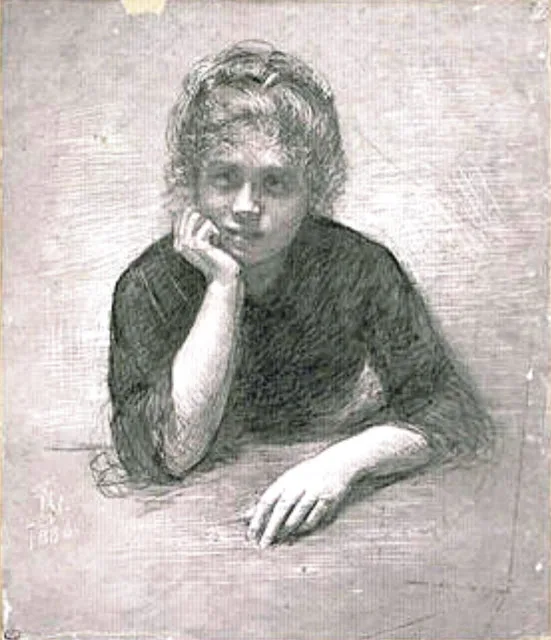
One more word about the portraits of men; less numerous, but no less notable. I will cite three of artist friends. The first is a curious and fascinating effigy of an English student, an early work (dated 1880) that marks a phase in the painter's life. It was, in fact, after the completion of this work, which already reveals a mastery, that the one who had revealed herself in it renounced all school attendance.
As for the portrait of Carriès, that sculptor of genius whose warm friendship is one of the glorious memories of the one who transmits his likeness to us, it is a page of contemporary art doubly assured of living on. It is the definitive and, I believe, unique portrait of an already illustrious Master whose name will only grow. One day, his native city, or his adopted city, will send a deputation to the studio in Neuilly, those who will have the mission to acquire and appropriate this priceless memento. Thus did the city of Glasgow for Carlyle, with regard to Whistler.
Another great artist, Maurice Lobre: Mademoiselle Breslau has put her art and her friendship into the portrait she gives us of him. It is a true likeness, meaning it bears on its face that expression both affable and rugged that gives so much character to his features and so much physiognomy to his character.
To the names of such colleagues, such friends, I want to add two others whose portraits I would also love to see in the painter's body of work. These two portraits would speak of the long-standing and maintained esteem with which their two illustrious models honor the one who, I repeat, owes us their image. I have named Messieurs Degas and Forain. The praise of such men is rare; it is worth a crown.
And it is with this that I wish to grace the threshold of this article. To it, I add the garland of this sonnet. This one, more modest, is my own.
No one has known like her, and, in her art, Breslau,
To unite the dead past and the fleeting present;
The former reborn beneath her sagacious touch,
The latter she fixes, like a sky upon the water.
Each of her portraits will live on as a painting,
Being a portrait of spirit, of nature, or of lineage;
The arrangement never displeases or irritates,
Holding something of Saint-Quentin and of Fontainebleau.
Her Masters, Perronneau, Latour, Vivien, Vigée,
Love her when they see her immersed in her work,
Knowing that to paint a soul demands a whole heart.
Near theirs, your name, Louise-Catherine,
Will remain guarded under the clear glass
Where memory inscribes what remains victorious.
Comte Robert de Montesquiou.