

It is not a particularly original thought to believe that certain past eras, in art and literature, had a greater concern for unity than our own. Was it a conscious concern? Or the result of a natural harmony? Sometimes one, sometimes the other: in the finest periods, a general sense of security prevailed; at other, more moving moments, there was an anxiety that was, one might say, disciplined.
The compass rose, which guides the work of weathervanes, has thirty-two divisions. To what number would the divisions swell on the ideal, complex rose that a patient, laborious hero might dedicate to the innumerable winds that tempt and seduce contemporary painters? All these groups, which appear so contradictory and hostile to us, may perhaps seem more connected in half a century than we can currently perceive. Yet what link could one discover, for example, between the charming and tasteful artists who descend from Whistler, and those more ferocious creators of dazzling works who sought their courageous instruction from Cézanne and Van Gogh?
One must reduce one's ambitions and, renouncing a comprehensive view without regret, be content to choose one, two, or three small diamonds from this Harlequin costume of modern art.
The Société Nouvelle and Its Circle
Today, although the artist who concerns us does not yet feature there, we will choose the Société Nouvelle. It would be quite surprising, moreover, if Mademoiselle Jeanne Simon did not exhibit at the Société Nouvelle within a few years. She possesses almost all the qualities that charm and hold one's attention in the work of most of the painters gathered there.
There, Mrs. Jeanne Simon and Mr. Lucien Simon would "make a pair" with that other painter-couple: Mr. and Mrs. Duhem, who present their consistently Flemish and always muted landscapes with conviction and modesty. Mr. Lucien Simon is undoubtedly the most "healthy" of our current painters. And we must implore the reader not to attach any unbearable moral intention to this word "health." In our mind, it concerns the manner in which Mr. Lucien Simon's works are painted far more than their inspiration or subject matter.
The craft of Mr. Lucien Simon is healthy in the way that Baudelaire's craft is healthy, and also in the way that the craft of Mr. René Bazin lacks health. Health does not mean virtue. It goes without saying that this health of craft serves and enriches the emotion that it expresses. There is no work by Mr. Simon before which one can escape the evident poetry that an artist's inclination reveals, when it is natural and acknowledged. But perhaps, in Mr. Lucien Simon's case, this poetry does not go much further. His portraits with accessories or his decorative pieces are almost always content to be luminous, cheerful, and true to life. One might wish that the heart, more often, had guided the hand.
In our time, portraitists are not ambitious enough; landscapists are not either, for that matter, and one could level at them the same reproach once directed at the Parnassian poets. It was said of the Parnassians that they cared only for form. Could one not say to painters that craft alone occupies them? This preoccupation with craft is not excessive if it advances alongside inner preoccupations. Beautiful portraits are not beautiful only because they are well-painted.
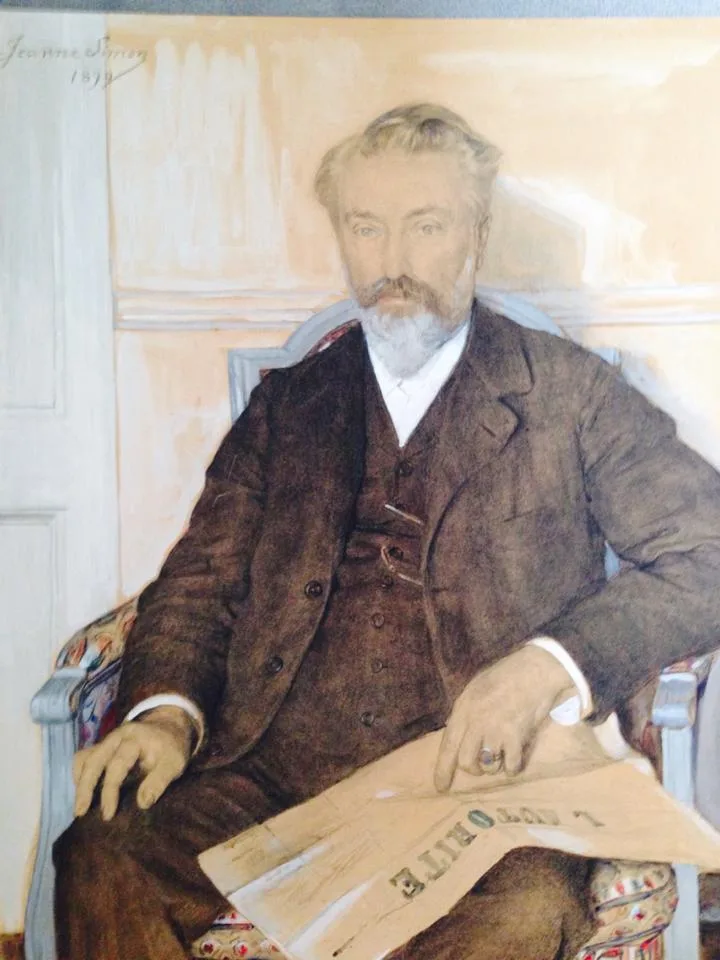
We are repeating a truism here. The portrait Holbein made of his wife and children; that of the Englishman at the Pitti Palace by Titian; that of Madame de Calonne by Ricard—these fill us with emotion and dreams for qualities in which good painting is not the cause, but the means. In speaking of Mr. Lucien Simon's art, we do not feel we are straying from our subject, which is the art of Mrs. Jeanne Simon. This charming and sensitive painter will not hold it against us to say that to speak of one is already to speak of the other, for no student ever had a more permanent master than Mrs. Simon.
The Intimate Art of Jeanne Simon
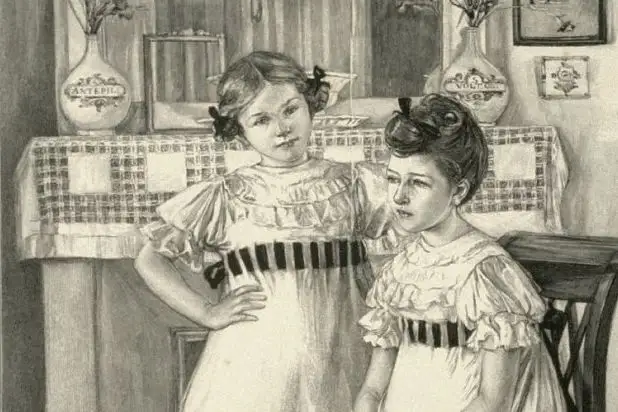
In her portraits, Mrs. Simon strives to go beyond simple observation. One of her best works is the large watercolor reproduced here, where, in front of a fireplace whose accessories are more significant than a still life, two little girls pose sweetly for a painter who, assuredly, knows them very well. These young models, full of confidence, have offered up to the artist's affectionate solicitation the small confidences of their innocent but already distinct hearts.
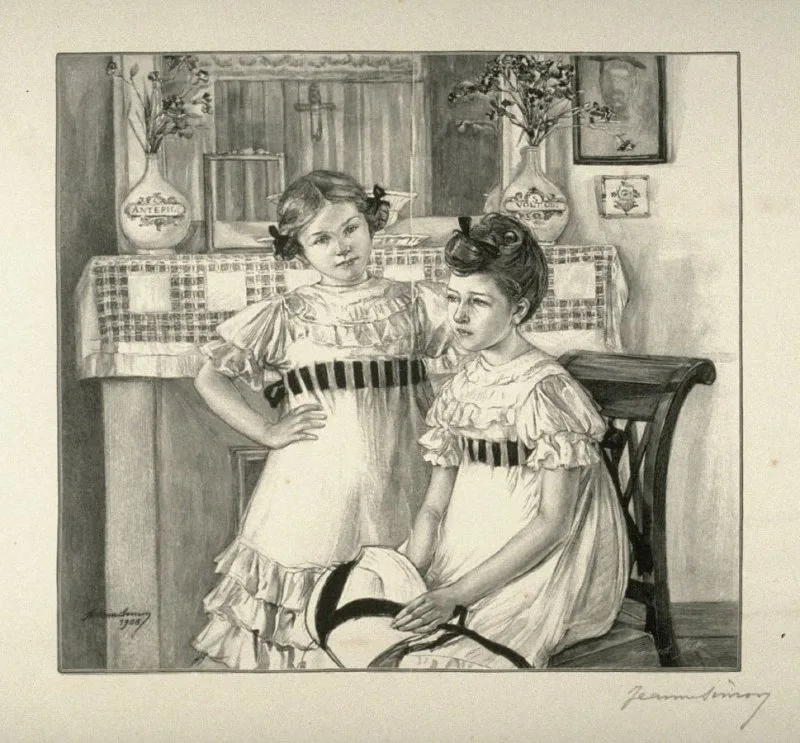
If it is true that every work by a woman is a work of love, never was this truth more evident than here. The linens of the dresses and the doily, the ceramics, and the light colors further enhance the deeply penetrating impression of freshness and candor that fills this piece. We linger on it because it seems to us the best representation of Mrs. Simon's talent—though perhaps less so than the large panel, so bathed in space, that the painter recently showed at the Exhibition of Painting in Water-based Media.
There, one saw lively adolescent girls running through a white landscape, fully illuminated by spring. The following sentence from Le Visage émerveillé (The Marvelling Face) would have suited it perfectly:
Today, everything in the air is too beautiful, and light, young, joyous, tinkling, intoxicated, as would be a silver bell, crowned with roses and glistening with dew.
In our memory, the composition of this utterly lovely work merges somewhat with that of one of the three panels Mr. Lucien Simon showed at the Salon this year. This convergence is due to the models and the setting, which are the same for both artists, but it also stems from identical inclinations.
An Essentially French Sensibility
It must be said—though the term has been overused lately—that Mrs. Lucien Simon's talent is of an essentially "French" nature. The sentiment in her work is natural and direct, and the execution has an integrity and simplicity that seeks neither to deceive nor to dazzle. Finally, this art is also very French in its almost complete absence of sensuousness. When Mrs. Simon paints a bouquet, she is more sensitive to the grace of its color than to the wholly sensual persuasion of its fragrance.
This kind of composure is very particular to us. With the exception of Lorrain and Watteau, which French painter makes us feel that confused, blissful, generous fever that one feels almost immediately before a Titian, a Vermeer, or a Velázquez? Ricard, perhaps, whom knowledgeable people scorn because he was "too influenced by the Venetians." But the portraitists of the 18th century, along with Chardin and Corot, are better representatives of our sensibility. Their discretion is constant and their confessions very measured. They express what nature offers them without violence and almost without falsehoods.
Mrs. Lucien Simon, in her small domain, applies herself to this wisdom and sincerity. One should not ask of her an elegance à la Van Dyck, where worldly convention is elevated to style; nor should one ask for the tormented fervors of an El Greco, nor the calm and powerful luxury of an Ingres. But one will easily find behind her modesty a persuasive conviction, a kind of limpid emotion that also has its nobility. We sometimes think, before certain of these works, of the Manuscrit de ma mère (My Mother's Manuscript), which Lamartine published near the end of his life, and which was the pure journal of a beautiful existence. Madame de Lamartine knew how to be touching using the barest of means. She never forced her wholly instinctive talent, and from no book is the professional writer more absent. We hope not to offend Mrs. Simon by saying that her talent as a painter seems to us equally involuntary, equally instinctive, and that we picture her in the family studio, painting without pretension or virtuosity, canvases that are, like the pages of Madame de Lamartine, the journal of her life as a wife and mother.
Devotion in Everyday Life
Looking at the pure and graceful faces of the children, grandmothers, and peasant women who illustrate these pages, one will notice the taste Mrs. Simon reveals for gazes where mystery is born of great transparency. Those eyes of such blue, almost shimmering water, where the pupil seems to arrive from the depths of the sky like a bird—these are the eyes one imagines for Nausicaa, for Mélisande. It is a delicious, endearing, and effective purity to which the feminine sensibility was bound to be more attuned than our own. These airy eyes that Mrs. Simon repeats from one work to the next are her best signature, just as certain Italian primitives repeat a cluster of grapes, a finch, or a columbine stem from painting to painting.
It is from these same primitives that Mrs. Simon borrows, perhaps less involuntarily, the sentiment of her religious paintings. To handle these subjects, Mrs. Lucien Simon does not trouble herself with rare models of singular types; nor does she seek out the dazzling costumes that enchanted Veronese; she disdains all archaeological frippery. Her angels and saints have the air of peasants, and, dressed in linen capes and poor tunics, it is by the sole contemplation in their posture and their gaze that they inform us of their pious mission.
The setting for these religious scenes is also very quotidian. There are no pompous architectures or "picturesque" nativity mangers, but rather the room of a humble farmhouse, whose open door reveals a modest garden where the flowers are not glorious. One imagines that the "Church dressed in leaves" where the poet Francis Jammes prays is dedicated to the ingeniously Christian worship that Mrs. Jeanne Simon celebrates.
These are familiar Nativities, peaceful Annunciations where the Baby Jesus and the Holy Virgin are painted as one would describe them to children. But what poetry is more certain than that which is born from a cradle a mother rocks? These large, pious images, like nursery rhymes, have their refrain: light, conventual whites that always compel an impression of purity. And it is this word, "purity," that must be repeated in concluding these few hasty appreciations; a purity related to that which is never entirely absent from the canvases of Mr. Lucien Simon. Mrs. Simon expresses it perhaps with more lightness and grace than her master, but with less assurance, just as water purifies but also softens what it reflects.
Jean-Louis Vaudoyer.