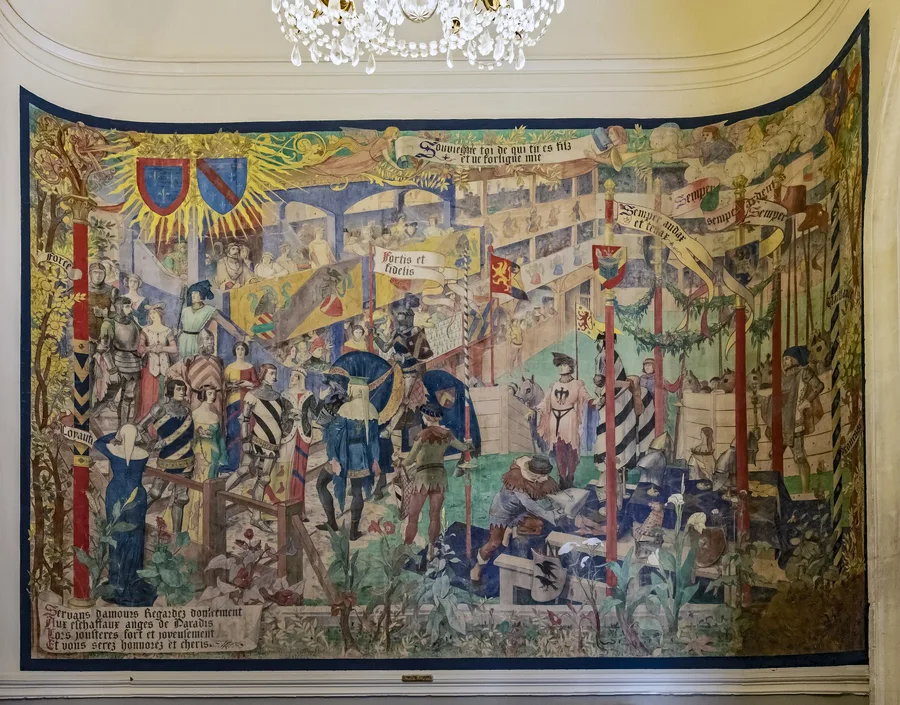
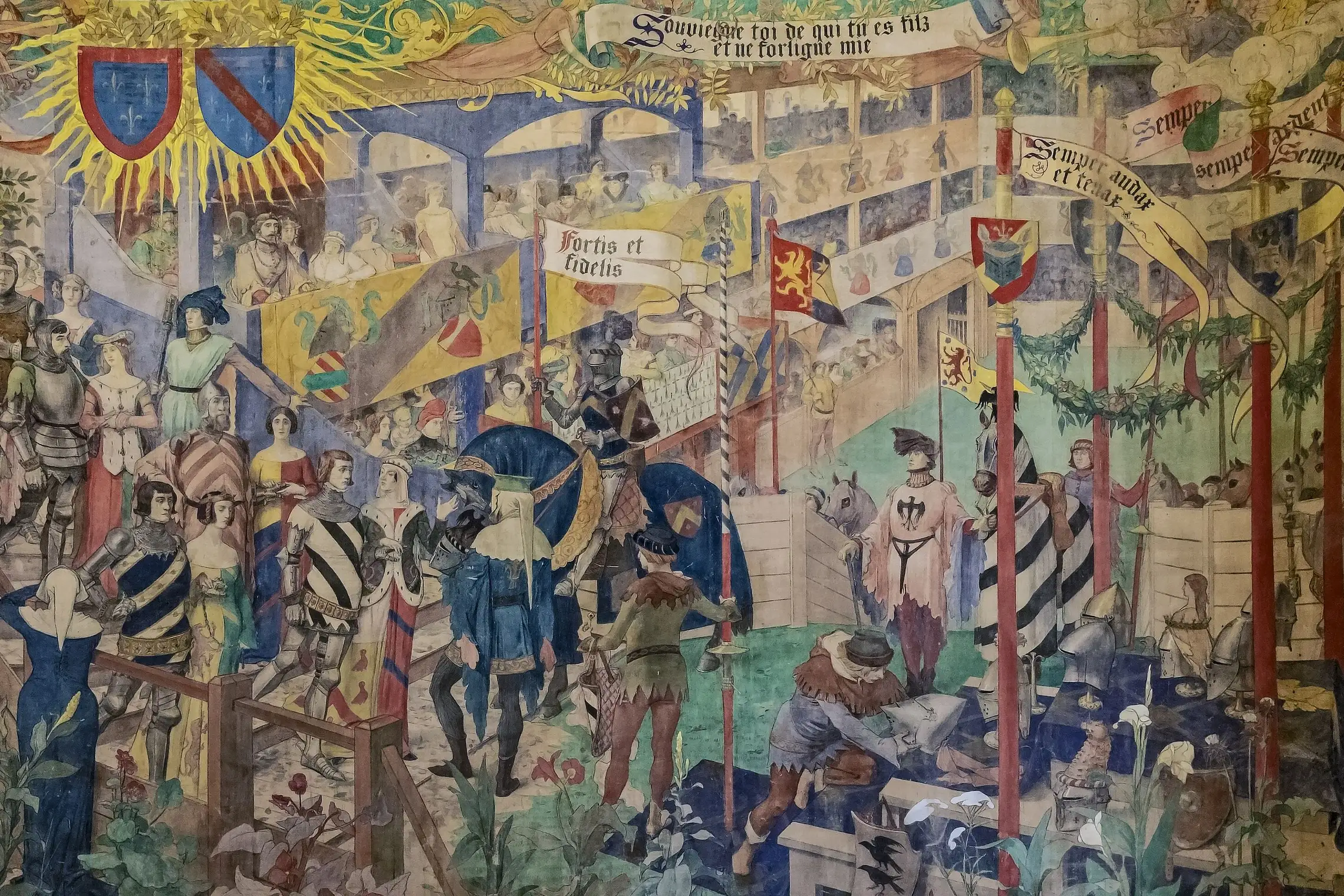
Jean-Paul Laurens creates paintings not only for museums and private collectors but also for temples and palaces. The Panthéon, the Palais de la Légion d'honneur, the Odéon, the Hôtel de Ville in Paris, and the Salle des Illustres at the Capitole de Toulouse certainly house his most significant and enduring works of mural painting.
The Monumental Works
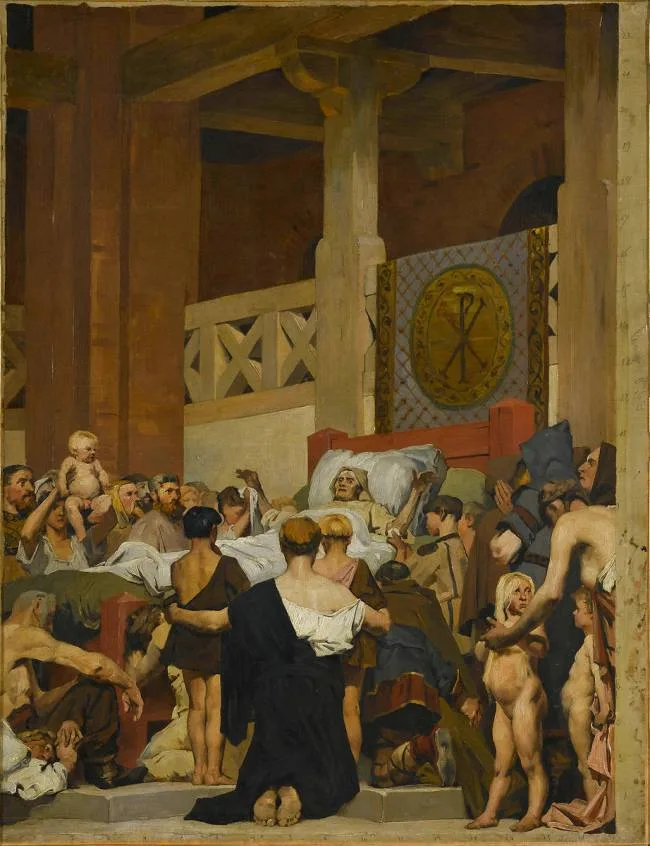
At the Panthéon, he painted The Death of Saint Genevieve. For the Hôtel de Ville, his works include The Vault of Steel, July 17, 1789; Louis VI Grants the Parisians Their First Charter; Étienne Marcel Saves the Regent of the Kingdom by Placing the Parisian Cap on His Head; Jean des Marets and the Maillotins; The Arrest of Councilor Broussel; and Anne du Bourg. The portraits of Pache and Turgot complete the paintings in the Jean-Paul Laurens room at the Hôtel de Ville.
At the Palais de la Légion d'honneur, he created a domed ceiling that "allegorizes with grandeur the institution of the order by Napoleon I." At the Odéon, a ceiling glorifies Comedy, Drama, and Tragedy. Finally, in Toulouse, he painted The Siege of Toulouse by Simon de Montfort and the beautiful composition Le Lauraguais, which was exhibited at a recent Salon. It was before this latter work, in Laurens's studio on the Île des Cygnes, that the landscape painter Busson exclaimed, "This is not a landscape, it is an entire country!"
This is a brief overview, for to re-evaluate compositions so often described would be to risk repetition. It serves to recall an important part of the artistic life of the man of whom I speak here with such joy. Yet, I must be permitted to demonstrate the profound significance of all these pages, which, like those whose titles I have just mentioned, are dedicated to magnifying the great deeds and comforting actions upon which the history of France is built.
Alongside his diverse painterly gifts—grace, delicacy, fantasy, a genius for composition, color harmony, and intensity of effect—Jean-Paul Laurens powerfully embeds an idea in all his subjects. This idea may be a philosophical or social concept, a synthesis summarizing the aspirations of an era, or the soul of a people. Instinctively, "under the irresistible impulse of his mind and heart, ever in love with humanity, justice, and virtue, he chooses historical scenes where brutal force—in all the forms it can take in events: death, war, invasion, oppression, tyranny—is always vanquished by the idea whose aims are independence, liberty, peace, and glory, and whose means are patriotism, charity, faith, and devotion."1