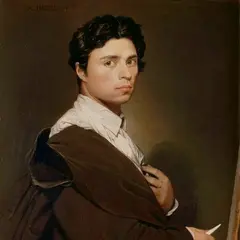
Baudelaire, who in art was a judge of marvelous clairvoyance, a critic of subtle vision and a highly comprehensive mind, wrote of Ingres, whom he admired: "Beautiful women, rich natures, calm and flourishing health, that is his triumph and his joy!" On many occasions, he insisted on the "profound voluptuousness" that emanates from his works; and one day, in a moment of bold frankness, he even dared to use the word "libertinage"—not as an accusation, nor as a reproach.
If we set aside that loaded word, should one insist on it, I see little to fault in this assessment, in this praise. More than once, standing before the female portraits signed with the great name of Ingres—before certain low and polished foreheads, devoid of all spirituality; before certain hands, deliberately refined and softened; before certain smooth throats, caressed by an attentive, amorous brush—I have had the very precise impression of sensuality that the critic perceived. I heard the cry of joy savored in the presence of healthy and tempting flesh, before the warm and soft fabrics enveloping beautiful young bodies.
Certainly, perhaps without his knowledge, and with no ulterior motive, I am willing to believe, the painter of La Source was a voluptuary, a passionate worshiper of carnal beauty. Therein, undoubtedly, lies the cause of the perfection in almost all the effigies of women he has left us.
The Ingres Woman: A Vision of Placid Beauty
Other artists have striven to idealize, to deify woman. Others have dedicated their talent to the glorification of her sovereign grace, focusing on rendering the undulating elegance of her walk and the harmony of her gestures. They have allowed themselves to be seduced by the abandon of her poses, to be moved to pity by her weakness and fragility. Some have plunged into the depths of her blue or dark eyes to discover the secret of her victorious charms. Others had the inestimable fortune of immortalizing the melancholy of her disappointed eyes, the poignant sadness of her disillusioned gaze in the autumn of life.
Ingres, however, saw her as placid and healthy, without secret turmoil, without dreams of the impossible and the unattainable, without chimeras in her head. He saw her as made for healthy and simple love, barely preoccupied with her trinkets and jewels. She was, to put it plainly, the good bourgeoise, the sweet fiancée, the worthy wife with flat-banded hair of a Bertin the Elder, a Monsieur Rivière, or a Monsieur Bochet. She was the perfect mother who, each morning, would ready her children for school and personally supervise the cooking of her jams.
Paul de Saint-Victor found in La Source "a vegetative soul." The phrase is admirable. But does it not seem to you that most of Ingres's women live a purely passive life, like a plant awaiting the rain—or, to move up a degree on the scale of sensations, an animal life? In the presence of those fixed, impassive eyes reflecting a soft light, do you not recall the epithet that old Homer attributed to the venerable companion of Zeus: "Hera with the eyes of a heifer"?
This impassiveness, moreover, was intentional on the master's part. To note that he achieved it is to please the spirit of the man who wrote: "In the images of man by art, calm is the first beauty of the body." He also wanted the eyes to be expressive. "In a head," he said, "the first thing to do is to make the eyes speak." And it is surely not the artist's fault if, most often, his models' eyes did not have much to say. That little, at least, he made them say it justly and well.
Thus, with what a tranquil tone do the eyes of the Vicomtesse de Senonnes—the beautiful portrait that is one of the glories of the Musée de Nantes—express the sweetness of living in an Italian palace, beside a husband mad with love. They speak of contemplating the limpid sky of Rome each day, from dawn to dusk, with the slightest glance at the marble balcony. They speak of being fully happy, without jolts, without troublesome worries, all ambitions satisfied. They speak. Too bad if the verses of Abbé Delille or M. Baour-Lormian, which would suffice to translate their language, resemble prose!
A Roman Masterpiece and Its History
This portrait was painted in Rome, in 1814 exactly, as confirmed by a letter in which the painter announced that the painting would be shown at the Salon of that same year, letting slip his hope that it would be noticed there.
This was the period when Ingres was producing portraits in abundance. His biographers tell us that, being of modest means, he accepted commissions—without any eagerness, but compelled by necessity—from the tourists and idlers who, then as now, flocked to the Eternal City. They were brought to him, for a commission, by some local servant acting as a cicerone and interpreter. These were mostly pencil drawings, inexpensive portraits. He charged eight écus for a bust, says Vicomte Henri Delaborde, and twelve écus for a full-length portrait. It is said he drew three hundred of them in this way to earn eight thousand francs.
It even seems he was not always paid promptly. When the portrait of Madame de Senonnes entered the Musée de Nantes and its authenticity was debated, Ingres wrote a letter—which has since disappeared from the archives—to claim paternity of the work. He declared that a sum of fifteen louis, which remained owed to him for the superb canvas when it was completed, had never been paid. Times have certainly changed for our "young masters."
This masterpiece, like so many others, has a whole history—a legend, I might say, as many points are difficult to verify today. For instance, I have not been able to learn for certain what exactly Vicomte Alexandre de Senonnes, the model's husband, was doing in Rome. It is asserted that he belonged to the administration of the Beaux-Arts. He was the younger son of a great family from Maine. His brother, Pierre de la Motte-Baracé, Marquis de Senonnes, was wealthy and well-connected, and held an enviable position in Angers, where he settled and died. The Vicomte himself, under the Restoration, served as Secretary-General of the Royal Museums.
One fine day, the Vicomte de Senonnes fell in love with a young woman who was neither of his world nor his rank. A ballerina, say some; a woman of the people, in any case. In the often-deserted room that houses the mysterious portrait in Nantes, I have often dreamed of this captivating love story: the young man, one evening, during a random stroll through Trastevere,1 encounters this opulent daughter of Italy. She is dark and delectable, with an amber chest, wide hips, and perhaps slightly heavy limbs—the only sign of her plebeian origin—and velvety eyes.
He falls madly in love, to the point of offering his name and his title, sacrificing his family ties, the hopes conceived for him, and the plans made by his relatives. He consummates a misalliance that his aristocratic family will never forgive. Then, the woman is installed in a stately home, living, I fear, as a recluse—but an adored recluse, showered with happiness, loving and grateful.
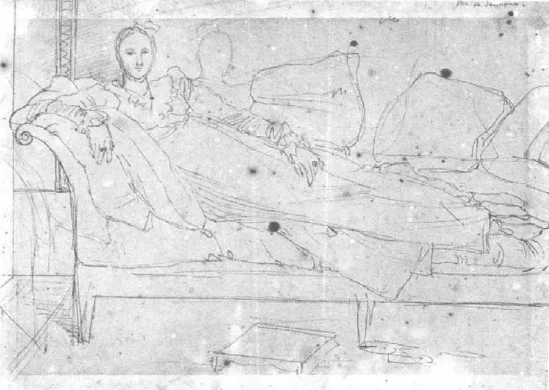
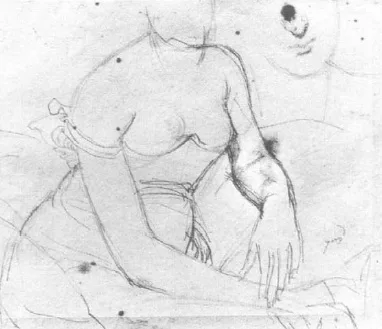
Ingres must have succumbed to the seduction of this beauty. He studied the portrait of this desirable lover with fervor. He first recalled having once seen his master, David, paint the portrait of Madame Récamier, which is now in the Louvre. He, too, dreamed of depicting Madame de Senonnes reclining on a daybed and even studied her in that pose. In the end, this attitude was abandoned, and the artist produced the canvas we admire today—one that many hope to see again in 1900 at the Retrospective Exhibition of Fine Arts, where it will be one of the jewels.
An Analysis of the Portrait
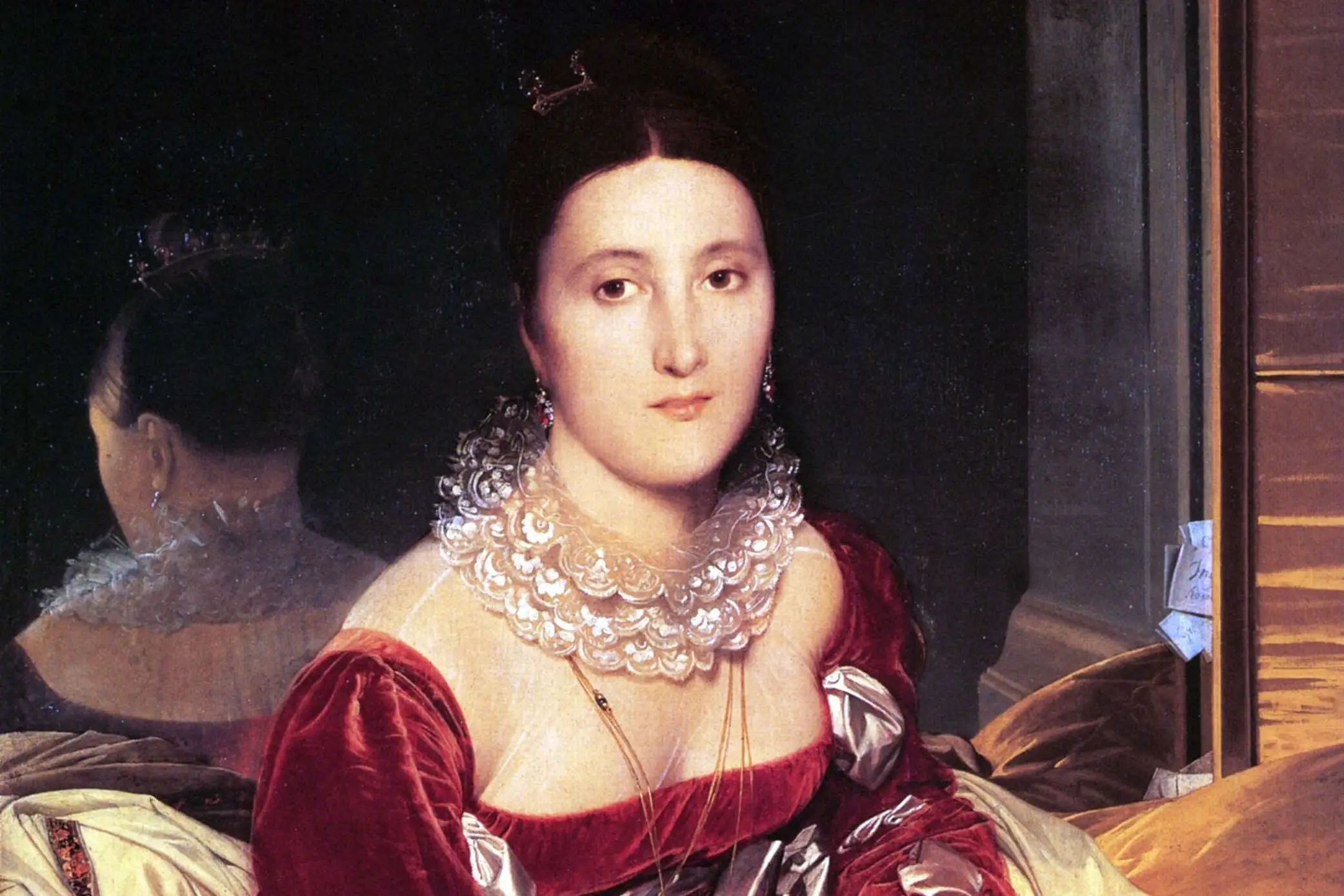
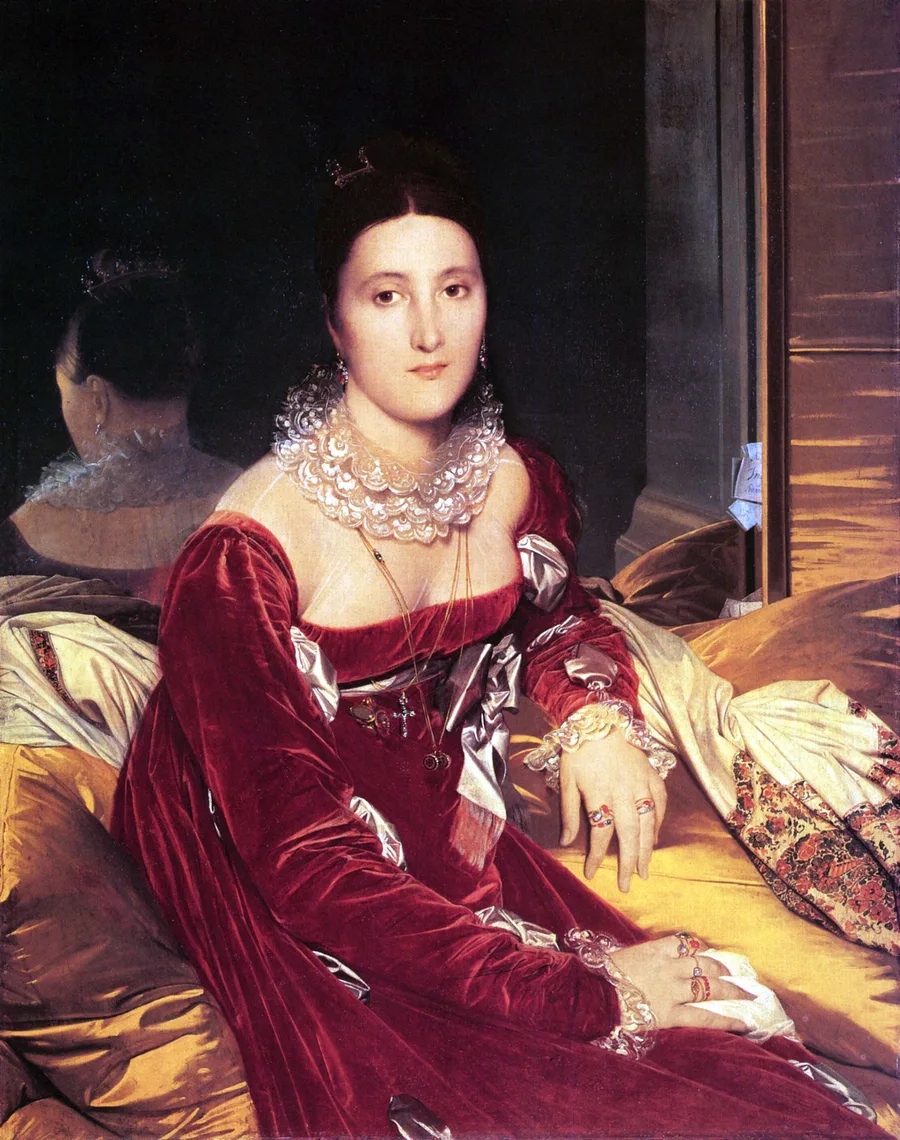
Madame de Senonnes is seated in a relaxed pose before a mirror that reflects her dark head, her full shoulders, and the top of her back. She is on a divan of yellow satin, a slightly harsh tone, slashed with gray shadows that are always cold. She is dressed in a sheath of garnet velvet with shimmering folds and sleeves slit with slashes of white satin. A wide white ribbon is tied very high, under her breasts. A lace modestie (modesty piece) veils her ideal bosom—round, transparent, and delectable as a beautiful fruit—and blossoms into a cloudy ruff at the base of her neck, which is as slender as a Greek column.
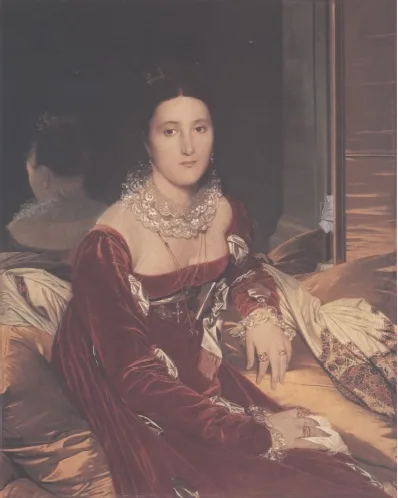
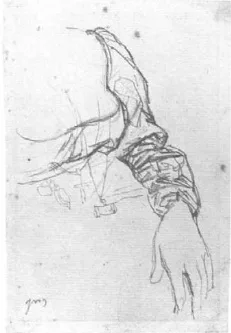
Similar lace is interposed between the heavy velvet of the sleeves and her hands. The hands are tapered but, as I have said, a little thick, and laden with rings on the index and ring fingers. A scarf, an Indian shawl similar to the one in the portrait of Madame Rivière, dotted, striated, and ocellated with patient, vibrant embroidery, undulates among the yellow cushions.
But the opulent splendor of the velvet, the diaphanous quality of the lace, the richness of the jewelry, the brilliance of the embroidery—all of it disappears before the serene radiance of her two fixed, velvety, living eyes. Her face, which is not regularly beautiful, with its rather small nose and its futile, childlike mouth, is illuminated by them from beneath her dark, center-parted hair. A languid flame slumbers in the depths of her dark pupils, commenting on the abandoned posture of her body, the morbidezza (softness) of her gesture, and the indolence of her hands, which hang limply.
It is a radiant canvas, and I can think of few pages in what I know of Ingres's work that could eclipse this one.
A Masterpiece's Journey
The portrait, as we have seen, was not fully paid for. Before arriving by chance at the Musée de Nantes, it was to suffer even sadder fortunes.
First, although it was exhibited at the Salon of 1814, whose catalog simply lists "several portraits" under a single number, it did not achieve all the success its author had hoped for. Here, at least, is how M. Boutard, Bertin's brother-in-law, judged in the Journal des Débats, without otherwise identifying it, the only portrait that had caught his eye:
This work, without being entirely free from the customary affectation, nevertheless determines us to redouble our insistence with the author to urge him to return, while there is still time, to the manner of the masters of the beginning of the 16th century and the end of the 18th century.
Was he referring to the canvas in question? But let us not judge, lest we be judged in our turn! The portrait returned to Rome, I imagine, after the Salon closed.
One day, it had to leave the Roman palace. The exquisite creature it immortalizes deserted the enchanted dwelling where she had shone for a few years for a hole in the sun-drenched earth. Her very memory, it is said, did not long survive her: Monsieur Alexandre de Senonnes remarried. The seductive effigy was banished from the paneled walls where it had once been enthroned, exiled to a cold country, to the home of the Marquis de Senonnes. I imagine that more than once, even in the "sweetness of Anjou" sung by the poet Joachim du Bellay, a mist of regret floated over the beautiful eyes of the Italian woman.
Then came another misfortune. Vicomte Alexandre had died; Marquis Pierre, in turn, passed away. The heirs refused to keep the pretty intruder in their family gallery. Madame de Senonnes had apparently left a son, but legend has it he was traveling abroad. Ingres's masterpiece was sold for one hundred and twenty francs, plus a mahogany pedestal table of the purest style then in vogue, to an antique dealer in Angers, a Monsieur Bonnin. This was in 1851.
It was not until 1853 that the splendid canvas arrived in Nantes. An enlightened art lover and member of the Musée de Nantes commission, Baron de Wismes, had discovered it in M. Bonnin's shop. He had sniffed out the marvel and spoken of it to his friends on the commission. Negotiations were initiated, in which Messieurs E. Chérot, Doré-Graslin, and Doctor Turpin took part. In the end, a deal was struck for four thousand francs. The work entered the Musée de Feltre at a bargain price, as one can see. It is in brilliant company there; yet none of its neighbors, no matter what illustrious name is signed on the golden frame, can outshine it.
Never was Ingres a more certain, more accomplished draftsman; never, perhaps, was he so equally a painter.
Have I praised sufficiently, in writing these two words, the man for whom "the pale praise of a beautiful thing was an offense"? Alas, I fear not! And yet, it is not conviction that I lack, and I am entitled, at least, to indulgence, to absolution, for I love this canvas as much as one can love a pure, irreproachable masterpiece.
The Engraving by Patricot
A masterpiece, too, is the burin of M. Patricot that accompanies these pages. In the history of French engraving at the end of the 19th century, we have no doubt that Madame de Senonnes by Patricot will be spoken of as a pure and irreproachable marvel.
The Gazette des Beaux-Arts called upon the young engraver to reproduce our portrait, after Botticelli's Madonna of the Rose Garden, because such high-style pieces required a translator in love with style. They needed an artist refined by knowledge and studies broader than those of the tool alone, one conscious of all the intimate art of the masters of great drawing—a passionate copyist rather than a technician confined to his own craft. He has visibly surpassed himself, and the work on this plate is an act of mastery. But we wish to emphasize with what intelligence and constant respect for the original painting, with what concern for color and values, and with what sacrifice of easy effect for the benefit of general serenity, he has brought his personal masterpiece to perfection.2