
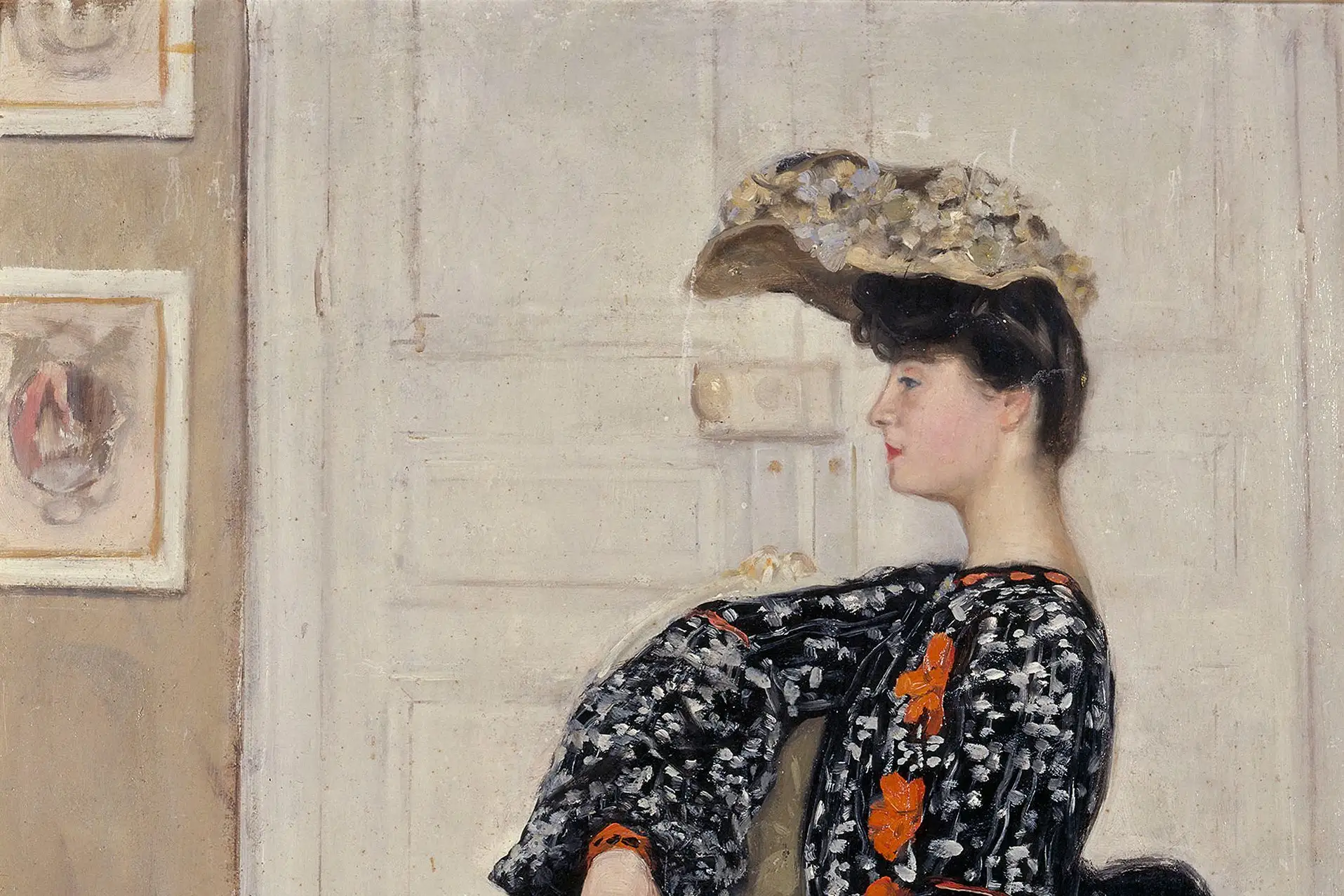
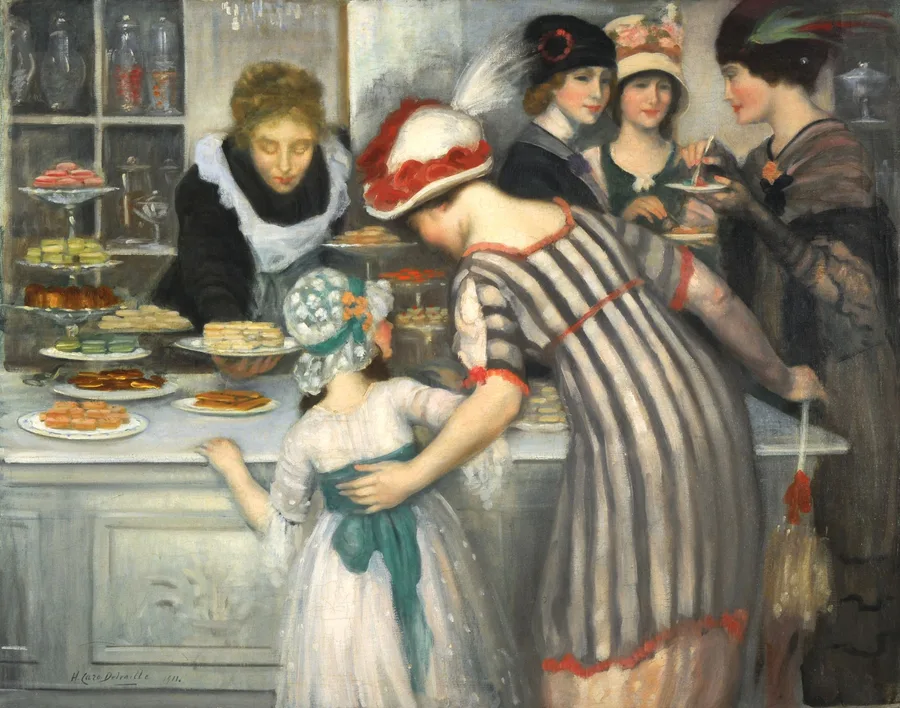
Here are adorable silhouettes that seem to revive the intelligent tenderness the ancient artists of Tanagra devoted to the female form. These are lines of power and grace, glimpsed beneath modern dresses that increasingly allow a woman to quietly confess her natural logic—that which constitutes her strength, her gentleness, and all the glory of the world.
In the depths of large, friendly armchairs, we see the sway of undulating torsos swathed in the dazzling tumult of faille silk. We see the calm, upward sweep of full necks, their hair curled by the day’s caresses, rising toward the mass of shadow or gold of an inclined head. Like black pistils bursting from white corollas, small, restless feet chatter at the hems of skirts. Long, narrow hands, on which petrified drops of fire tremble upon a golden band, emerge like moving blossoms from the shimmering water of silk and the foam of lace.
This is the world of delicate boudoirs in today's apartments and of gardens where dresses and bodices—before alighting like immense butterflies—select the tones of fruit amidst the glint of glasses and the hues of flowerbeds. It is a world of light conversations punctuated by laughter, whispered confidences, swift departures, and entrances into a whirlwind of perfumes and rustling fabrics. It is a world of silent words conveyed through studied little gestures: a kiss from carmined lips, light as a bee's flight; a visitor making her rounds, whose amusing and precise profile would have delighted a Japanese master; calculated moments of abandon; and the mockingly attentive smiles of eyes and faces.
These are the warm corners of pretty, futile lives, of sparkling luxury and fragile joy. Whenever he chooses, Mr. Caro-Delvaille will be the very opposite of a society painter; he will be the painter of the world and of the woman of today.
The Burden of Early Success
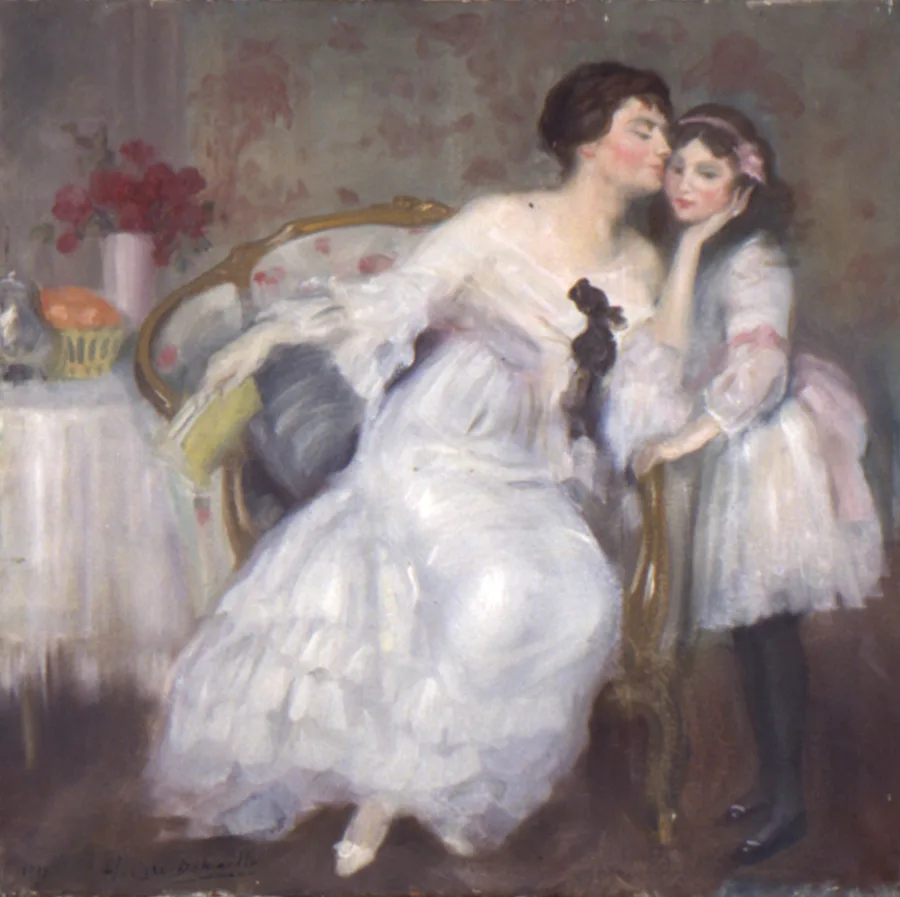
At first glance, however, the new canvases from this painter reserve a surprise for those who admire him—and perhaps even a disappointment. His young shoulders have a singularly heavy burden to bear, and he might have done better to wait a while longer before submitting the results of his efforts to the public. From his debut, he had the unfortunate fortune of encountering the most difficult obstacle one can find on one's path: success.
In his 1901 canvases—The Tea Party and The Manicure—critics saw the revelation of a superior talent. This may be what prevented them from discerning in the following year's works—The Lady with the Hydrangea and The Pretty Girl—that the fatigue in the brushwork and the awkwardness of the composition, despite the beauty of certain passages, signaled something else. In the style of an artist from whom they expected a clearer affirmation, these traits announced not the premature decline of a painter, but the anxiety of a man.
Today, this anxiety has become fully manifest. He has had the rare courage to escape the initial formula that assured him success and to follow the direction in which his instinct was leading him. Here, we can accompany him step by step, from his first canvas to his latest study. The Manicure that the State failed to purchase is here. So is The Pretty Girl. And with them are eleven more recent paintings.
A Departure from Formula
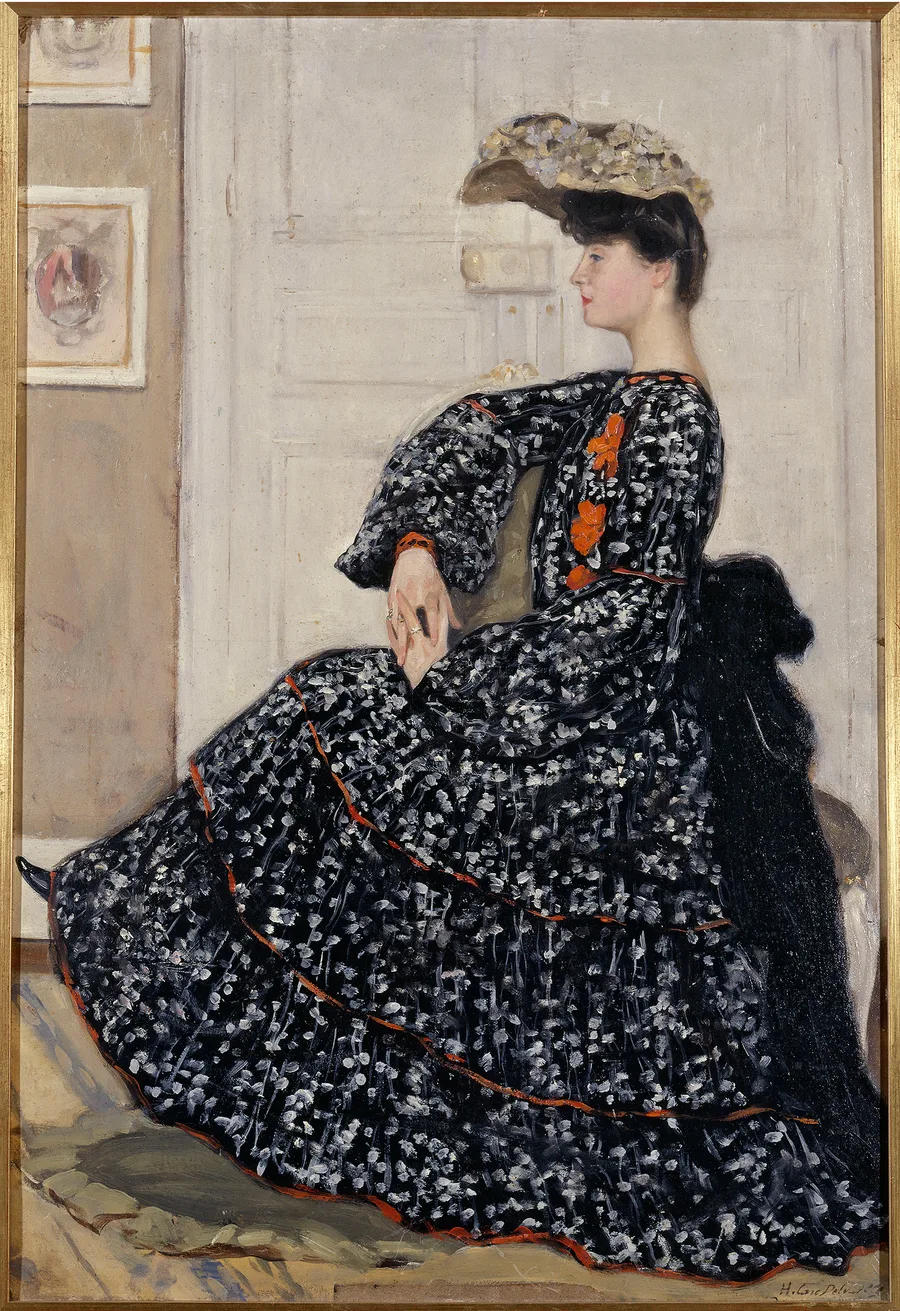
I retain my admiration of the first day for his older works. The Manicure, in particular, is a pure masterpiece of style. Precise, bold, deliberate, and wonderfully balanced, it maintains the haughty bearing that, in the Salon where it appeared, gave it the air of a museum canvas lost in the howling jumble of a fashionable paint shop. It clearly indicates Caro-Delvaille's origins: Whistlerian in its symphonic premeditation and severe arrangement, and in the style of Manet, with a memory of Ingres, in its vision of simple patches of creamy blacks and whites on light backgrounds, delineated by an impeccable line.
Furthermore, it betrays the influence of Velázquez and Goya in the general tonality of amber suffused with silver that bathes the entire work.
But the birth of the painter preceded the birth of the man. The eye had become saturated with the evident aspects of life before persuading the mind to penetrate its mysterious realities. The Manicure is a scholar's canvas; it is constructed like a theorem. Before undertaking it, the painter knew what he would do, down to the smallest details. He left no fissure in his program through which an immediately felt emotion could slip.
The new canvases do not have the same precision, but they gain in freedom. The artist is clearly attempting to escape the intransigent formulas to which the admirable certainty of his visual organization had so quickly led him. This freedom is certainly not yet that of fingers following, without deviation, the complete instructions that the senses carry to the brain; it is the hesitation of a virtuoso descending from the certainties of his craft into the uncertainty of life.
The Awakening of Emotion
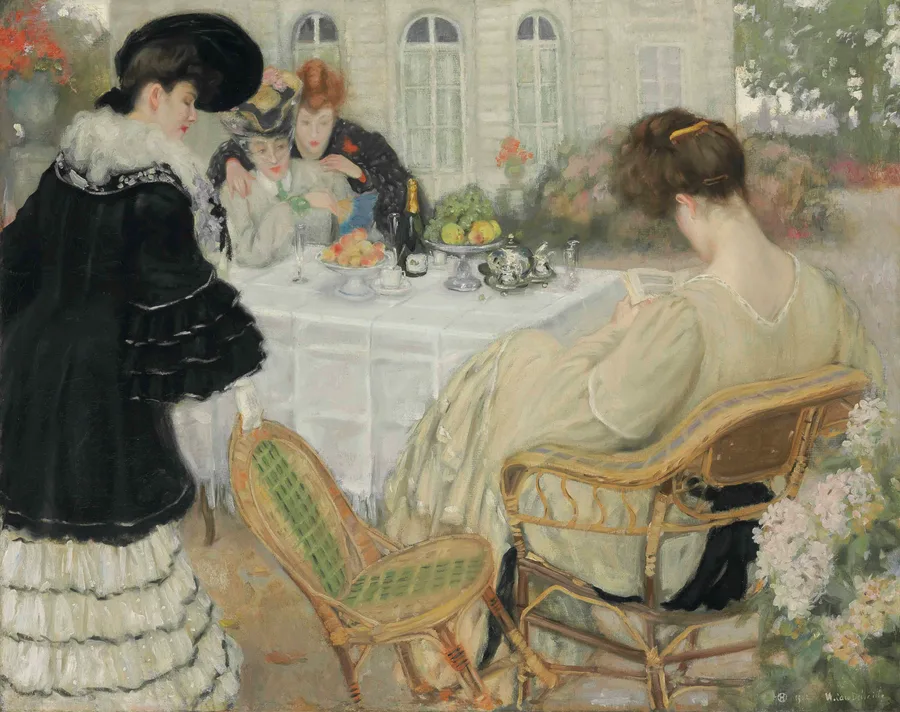
The effort is too scattered, spread over too vast an area. Initially, his dominant concern seemed to be to restore the objective quality of various materials, and he achieved this effortlessly. Today, here and there, inconsistencies appear—negligences that are surely unsuspected and can be explained by an overly strained will to express a neighboring sensation. At times, the artist even resorts to invention to finish canvases undertaken in the visible agitation of overly hasty production. This was bound to happen: once awakened, his emotion disperses on the surface before penetrating in depth. Entirely focused on discovering the life of the exterior "barks," he does not yet concern himself with the densities they cover.
He is re-educating his sensuality, step by step.
But spelling mistakes and stylistic errors no longer matter to one who witnesses the emergence of human meaning in a man's expression. I read in these new forms a kind of astonished disappointment. Slowly, the veil of prejudice is lifting, and the cloudy lenses of disciplined sensations are falling from the artist's eyes. For example, the fabrics, whose glacial sumptuousness and personal existence he once seemed solely to want to convey, are now beginning to come alive with languor, fluid falls, and muted rustles. They are animated by a shivering life, the very life of the warm flesh they serve as caskets.
It is in what he shows us of this flesh itself that the artist's new orientation is best manifested. The hands, faces, and necks no longer have the gleaming opacity of the first canvases, where the accuracy of the tones did not hide the absence of that immediate atmosphere created by the vibration of light on the surface of living bodies. Leaving the Bath, in which I believe I see the most recent stage of his current evolution, is very characteristic from this point of view. This is all the more true as it can be compared to The Chambermaid, a brutal symphony in black and white where the painter asserts the powerful technique of his primitive manner.
In The Chambermaid, the visible pieces of flesh—the neck, the hand—are treated with the same scholarly gravity as the black dress, the bonnet, the white apron, and the sonorous crystal of the glasses. On the nearby naked body in Leaving the Bath, by contrast, one cannot find at any point on the surface those varnished tones of painted porcelain. The shimmering wave of blood shows through the skin, where the light of the room, along with the dispersed steam, deposits the gentlest of touches. The brush caresses the forms like a hand. Instead of an even, cold tone, there are tender passages, cross-hatched strokes, mauve, blue, and violet touches, and enveloped contours—the life of a human structure in both surface and depth.
Toward a Unified Vision
Finally, his primary qualities are becoming noticeably more refined. Above all, he remains a symphonist, but the contours of his symphonic patches are beginning to recede into the ambiance to organize themselves into volumes. The sober contrasts his vision favors are softening their brutality. Whites, blacks, and pinks still dominate, but the whites no longer reflect, and the blacks no longer absorb, all the elements of the spectrum. They consent to darken, to lighten, to allow their surfaces to tremble with the play of shadows and light.
In The Breakfast, for example, the old rose of the wall transitions to the pale yellow of the bed, and to the matte, brilliant, and bluish whites of the sheets, the nightgown, the bonnet, and the porcelain, with the imperceptible progression of a rising dawn. These colors undulate and recede like waves of clarity. At other times, as in his Enid, with flesh made bluish by the filtered light, it seems that the artificial night of the room is illuminated only by the contrast between the black lake of patent leather shoes, the opaque blacks of the hair, cloak, and silk stockings, and the muted pinks.
These pinks alternate in changing scales, their quiet swells cresting upon the diversified whites of the sheets.
Lastly, particularly in Leaving the Bath, where the chilly dampness of the naked body so eagerly seeks the embrace of the proffered towel, I read here and there, in fleeting glimmers, the appearance of a sentiment where all masters meet: the consciousness of the original link between all scattered things, of the chains of air and light that bind together the colors and forms in the world that live by air and light. We await more contemplative pages from Mr. Caro-Delvaille. When the patch of color fully becomes volume through the gradation of values toward the background and its surroundings, when the uneven light, the circulation of air, and the murmur of silence connect the organisms that have appeared within the circle of his vision, Mr.
Caro-Delvaille will have found that which expresses the intimacy of human shelters and the continuity of dispersed life, from the dense mineral to the invisible molecule.
Nothing more is needed to be a truly great painter.
ELIE FAURE.
