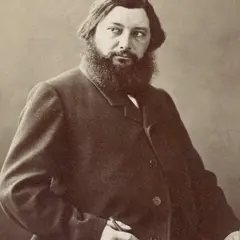
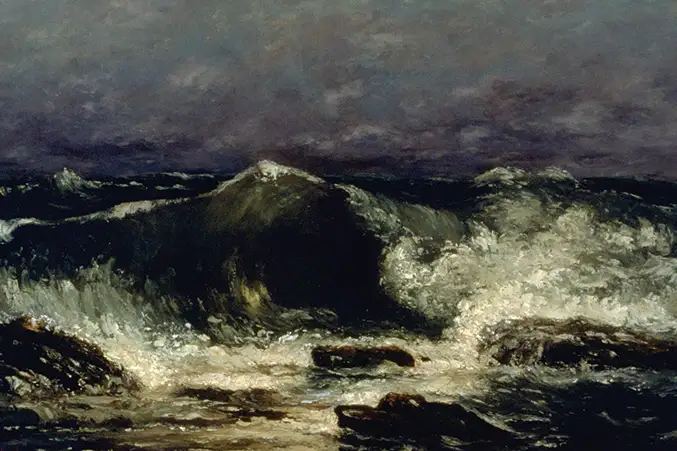

The preoccupations of the theorist and the orator did not prevent Gustave Courbet from loving his craft as a painter. He was always working. During a trip he took to the Saintonge region at the beginning of 1863, he almost constantly had a brush in his hand. In a letter dated May 26, published upon his return, he speaks of having prepared seventy or eighty sketches or paintings. He had practiced in every genre: he had painted landscapes, flowers, fruits, and animals, including one of the stallions from the stud farm in Saintes. These paintings were not immediately known, as the Salon only showed a Fox Hunt and a Portrait of a Woman. But what am I saying? We were also given the chance to see an unexpected work. Courbet, a man of endless surprises, had improvised himself as a sculptor.
He exhibited a plaster statue, A Young Fisherman in Franche-Comté, the model for a figure he intended for the decoration of one of the squares in Ornans. We do not blame Courbet for this attempt in a field that was not his own; it is good for an artist not to confine himself to too narrow a horizon, and nothing is more respectable than a diversity of aptitudes. The sculptural fantasy tormented Courbet several times. In 1864, he made a medallion in Salins that was a portrait; in the final years of his career, while living in retirement in Switzerland, he modeled a bust of the Helvetic Republic in 1875 for the decoration of a fountain in La Tour-de-Peilz.1 We are not familiar with this latter piece, but we have seen the Young Fisherman and believe we can affirm that when Courbet thought himself a sculptor, he was under some singular illusions.
A Controversial Painting and Its Philosophical Aftermath
At the Salon of 1863, the exhibition of the master of Ornans remained incomplete. A painting on which he was counting heavily was missing—the one that, in his opinion, held the most significance: the painting of the priests, The Return from the Conference. Considerations unrelated to art prevented this painting from being publicly displayed. The moment was ill-chosen to show a scene in which churchmen were losing their sense of the vertical line a little too cheerfully. Courbet invited critics to his studio to see the painting condemned to remain in the shadows.
This jest, whose timeliness and propriety seemed debatable, was not without consequence. It provoked the creation of a book that, when published later, would have a very great impact. This book is the most important of Proudhon's posthumous works, Du principe de l'art et de sa destination sociale (On the Principle of Art and Its Social Destination), published in June 1865. The philosopher begins by describing The Return from the Conference and, as the powerful artist he is, finds a way to give this somewhat vulgar painting much more value than it actually possessed.
As the painting was hardly known to the general public, and since the sale of photographs made from it was still forbidden in 1876,2 it is necessary to reproduce the boldly idealized description that Proudhon gave of Courbet's composition.
Imagine on a main road, at the foot of a blessed oak, before a holy image, under the sardonic gaze of the modern peasant, a scene of drunkards all belonging to the most respectable class of society, the priesthood. There, sacrilege is joined with drunkenness, blasphemy falls upon sacrilege; the seven deadly sins, with hypocrisy at their head, parade in ecclesiastical costume; a libidinous vapor circulates through the groups. Finally, by a last and vigorous contrast, this little orgy of clerical life takes place in the heart of a landscape both charming and grandiose, as if man, in his highest dignity, existed only to defile innocent nature with his indelible corruption. This, in a few lines, is what Courbet has taken it upon himself to represent.