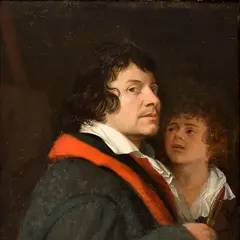
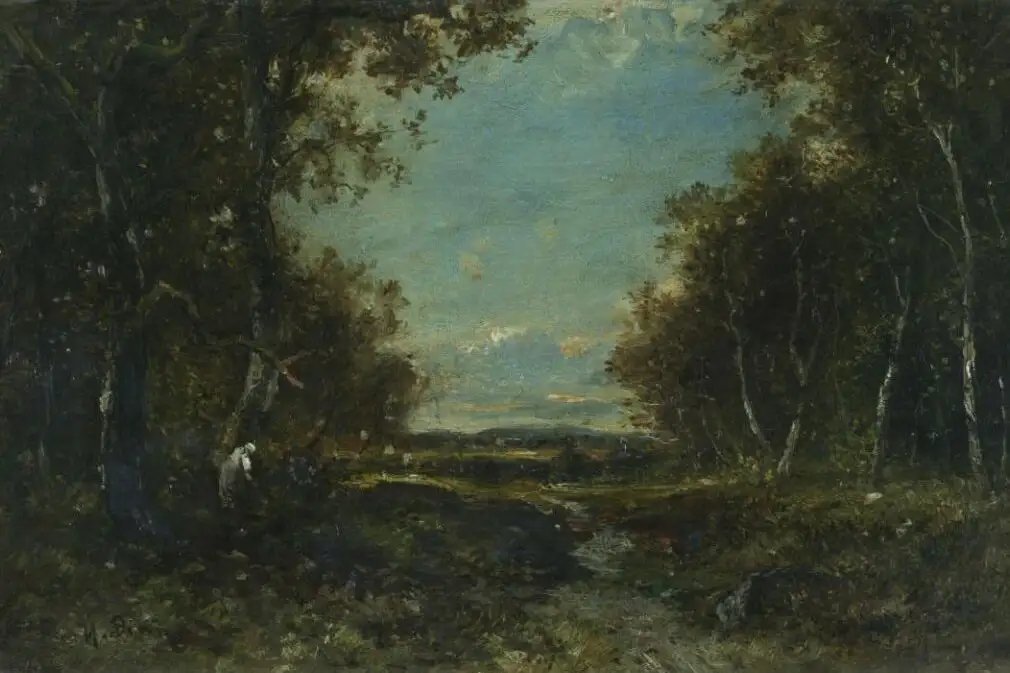
Names, like artworks, have their own destiny. While some vanish in the smoke of a fleeting glory, others are reborn from long periods of darkness. Among the forgotten, is it not surprising to encounter, one after the other, the two artists who mark the beginning and the end of Romantic landscape painting, the wellspring of modern art? Adolphe Hervier represents its strange twilight, with old hovels that evoke the realist Baudelaire of Spleen and Ideal. Georges Michel, on the other hand, embodies its tragic dawn, inhabited by a popular and Parisian Obermann. This artistic impression, however, must first be corrected by adding that the precursor was above all a good craftsman of the palette, a healthy and strong character, a true painter.
The Path to Rediscovery
When and how did those of my generation come to know Georges Michel? Who revealed his work to us, before his life story? It was the liberal donation made to the Luxembourg Museum in 1880 by its new curator, M. Étienne Arago, who accompanied it with this notice: "A Windmill at Montmartre, Entrance to a Wood: two specimens of the innumerable work of Georges Michel; a posthumous reparation made, without blind admiration, to this poor child of Paris, to this special painter of Montmartre and its surroundings." Arago described him as a talent that was misunderstood, almost unknown during his lifetime, and yet possessed a virile, strange brush, from his terrains to his skies.
Today, he is considered the first milestone firmly planted on the road followed by the English and French landscape painters of the Naturalist School.
Six years later, during the inauguration of the new rooms, the two canvases were transferred to the Louvre, designated as Near Montmartre and Interior of a Forest. Since then, deeply drawn to this raw and proud art, we have followed and rediscovered G. Michel at the Centennial Exposition of 1889, with two small frames.1 We found him again at the Rothan collection, and at the Cottier sales in London, as well as the Arago and Paul Mantz sales between 1892 and 1895.
Notably, the Étienne Arago sale on May 4, 1892, offered two characteristic examples of Michel's work, alongside a View of Meudon by the old Louis Moreau, a piece so curious for its early desire for sincerity, which was acquired by the Louvre. Michel, less fortunate, did not surpass the humble bid of 600 francs. Indeed, forgeries have done him great harm, once again eclipsing his true value. The painter, who delighted in copying the masters, was in turn too frequently imitated—an excessive punishment of talion law, expressed through distrust. His reputation, like his skies, has suffered from alternations of shadow and light.
The "first rumor" of G. Michel's existence dates back to Thoré, who, in the Constitutionnel of November 25, 1846,2 judged the painter masterfully, even as he repeated studio gossip about the man: "While Michel held court at the city gate, M. Bidault held a seat at the Institute..." This was the era when violent and confident sketches enlivened the displays of second-hand dealers, circulating a very obscure name. The young artists would stop; Charles Jacque admired them. The critic depicted the author as a Lantara of taverns and hospitals, an overly assiduous lover of the bottle.
The following year, Thoré's audacity led him to risk a tumultuous canvas by Georges Michel at the exhibition on the Boulevard Bonne-Nouvelle. On August 15, 1848, Paul Lacroix (the "Bibliophile Jacob") provided some less fanciful notes in the petition he addressed to the Journal des Débats on behalf of the finally discovered widow of the unknown master. Later, in his 1863 evocation of old Montmartre, Monselet did not forget its special painter, "a little-known, poor, bizarre artist, who had found his Roman Campagna there."