
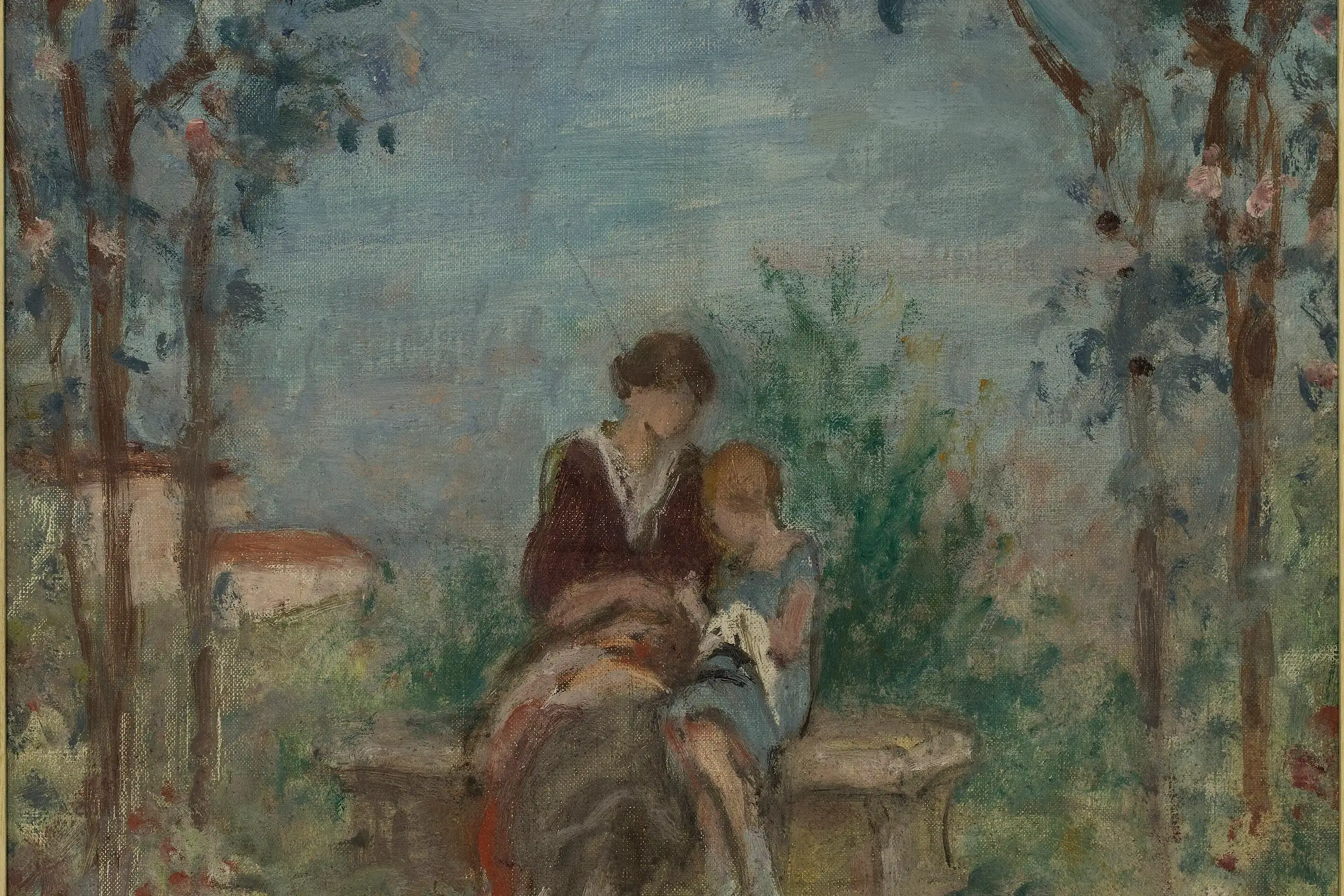
This is, I believe, the first time the name of M. Georges d'Espagnat has been mentioned in this journal. I am pleased for the opportunity to draw our readers' attention to a French artist who remains faithful to the beautiful traditions of color, and who combines sincerity in his craft with a delicate vision of nature.
An Unconventional Debut
The painter’s beginnings are recent, dating to the Exhibition of Childhood Hygiene organized in 1891 at the Palais des Arts Libéraux. This was a heterogeneous exhibition where, among baby bottles and a thousand bizarre devices, one could see canvases by Anquetin, Lautrec, Hermann Paul, Henry de Groux, and other artists who are renowned today. M. d'Espagnat was part of this group of undisciplined artists who, mingling with the Indépendants (Independents), joyfully campaigned for the liberation of art.
He reappeared in 1894 in Brussels, where he exhibited at the Salon of the Cercle Pour l'Art. In addition to a few landscape studies, his Portrait in a Red Coat and Seated Peasant revealed a colorist's temperament. The following year, at the Le Barc de Boutteville gallery, he assembled a fiery collection of canvases with a romantic air, executed with vehement brushwork. Despite their exaggeration and deliberate style, it was easy to discern exceptional gifts within them.
A few years of study, face to face with nature, have singularly refined this willful, impetuous art of exuberant health. Then, in March 1898, after two successive submissions to the Indépendants, the young artist was featured in the Durand-Ruel galleries, which were generously opened to a major selection of his works.
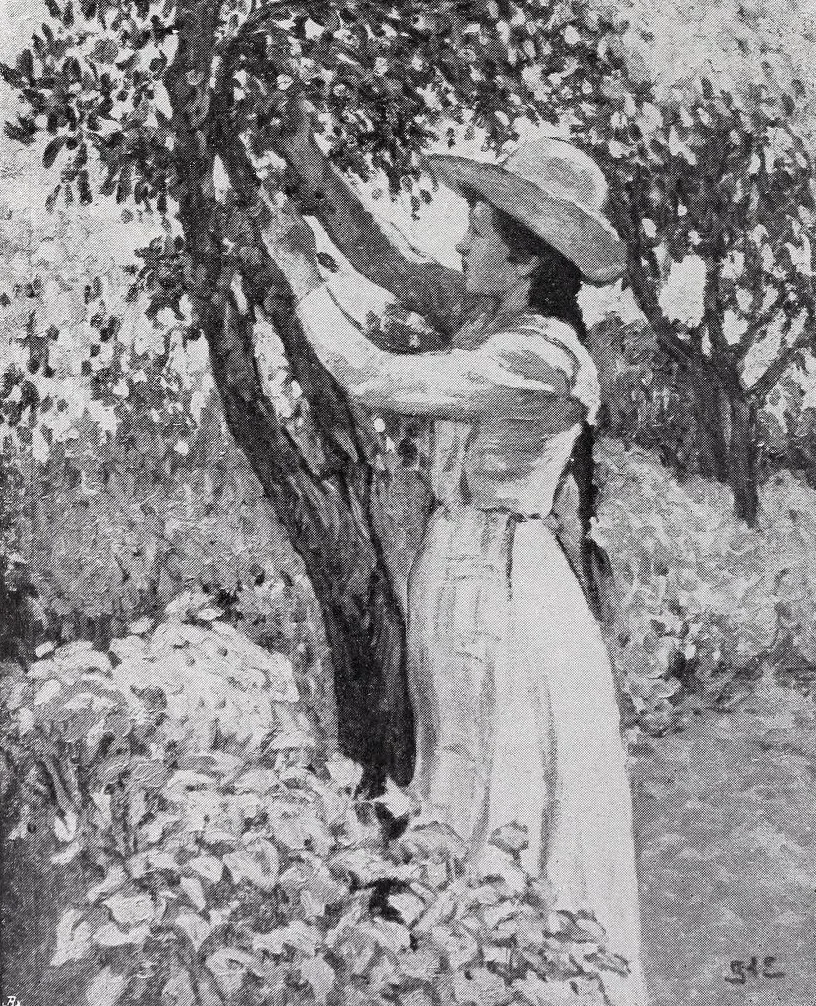
This exhibition was the starting point for M. d'Espagnat's growing reputation. In this collection of bright, harmoniously composed canvases—redolent of the open air, filled with light and joy—the figures, studied from life, and their landscape settings affirmed a scrupulous truthfulness and a probity of expression that immediately ranked their author among the most engaging "Naturists" of the new school. One sensed in him the direct heir of Renoir, Monet, and Pissarro, to whom he is linked by close affinities, although his personality in no way merged with that of these illustrious masters.
The foreign exhibitions in which he took part—in Christiania, Stockholm, Berlin, Saint Petersburg, and London; at La Libre Esthétique in Brussels; and at the Salon recently inaugurated last March at Durand-Ruel by various young art groups—all confirmed the impression made by this successful debut.
Certainly, there are inaccuracies to be noted in M. d'Espagnat's paintings and reservations to be made. His technique has not yet reached the mastery toward which his conscientious studies are leading him. But one can hope for everything from a temperament so essentially that of a painter—at once robust and supple, oriented toward the splendors of color and light, and free from all unwelcome literary pretension.
A Turn Toward Decorative Art
The special character of this spontaneous talent, of this sensitive nature from which sonorous chords and harmonious arabesques spring forth without empty rhetoric, justifies the artist's inclination toward ornamental art. It is as a decorator that I intend to assess M. d'Espagnat here, and in this regard, his work already includes several important projects.
The painter’s portfolio includes a decoration approximately 7 meters long by 3 meters high, executed for the property of M. Georges Viau in Vilenne; the ornamentation of M. Viau's dining room in Paris; a three-panel screen for a children's room, acquired by M. Goupy; a model for a theater curtain; designs for doors commissioned by M. Durand-Ruel; and several ornamental canvases, some fully completed and others in preparation.
The dining room decoration reproduced here characterizes the painter's style and shows, better than any commentary, the goal toward which he strives with continuous effort. For Georges d'Espagnat, the decoration of an apartment should inspire cheerful ideas, bring the illusion of vast horizons into the cramped quarters of Parisian homes, and use the artifice of distant perspectives to push back the immediate proximity of the walls. And to evoke pleasant thoughts, what could be better than to populate one's favorite sites with figures of children, young women, and girls?
The artist professes an equal aversion to the banality of anecdote and to the solemnity or gallantry of mythological fables, so highly prized in the past. Idyllic scenes and dramatic ones seem to him equally outside the decorative domain. A simple play of colors and values, a harmonious grouping of figures captured in their usual postures, and the rustic setting of a pleasant landscape—is there any more charming than that of the Parisian countryside?—provide him with the theme for his composition. This is generally reduced to a few essential elements: flowers, children, toys, and birds, not to mention the familiar cat and the faithful little dog.
The Viau Dining Room
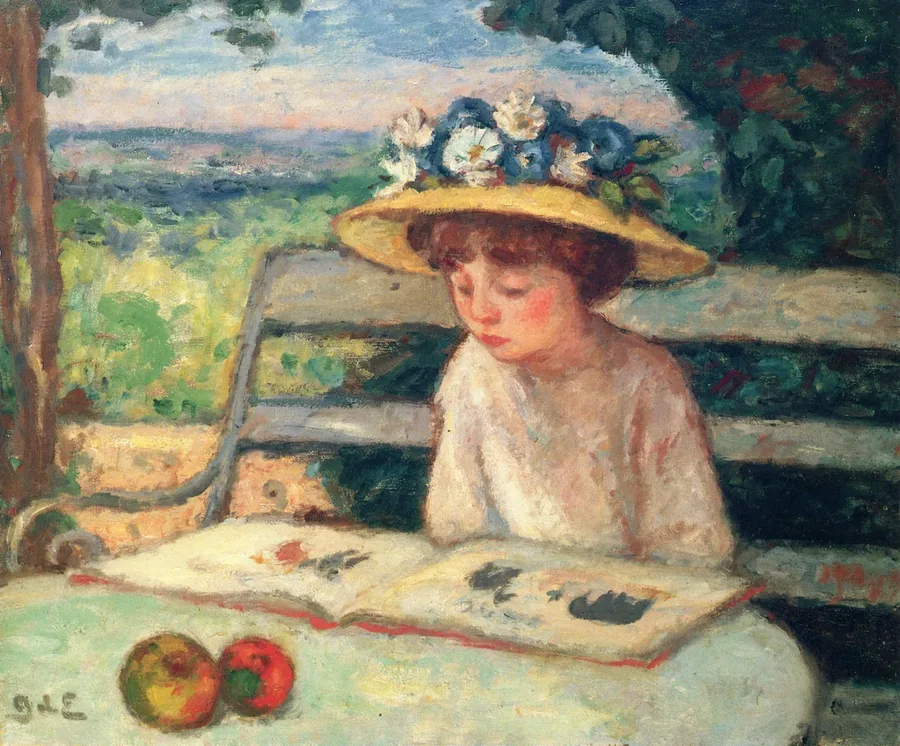
In the large panel for the dining room on Boulevard Haussmann, the terrace of the Beaulieu mill—M. Viau's property in Vilenne—forms the backdrop. It overlooks a bend in the Seine, whose shimmering waters glisten in the sun. Amidst the greenery, the red roofs and white facades of Poissy appear in the distance. In this cheerful corner of the park, the serene splendor of a summer day unfolds.
A young woman in a pink housecoat, kneeling before a basket of flowers and surrounded by children, gestures for an adorable little girl to carry a bouquet to an older sister or friend. This figure is conversing, some distance away, with another young woman who is busy with embroidery. The two groups balance and complete each other. They demonstrate both a perfect understanding of color and a subtle sense of the rhythm of lines. To support and echo the brilliance of the flower basket, which concentrates the intensity of the chromatic harmony in the foreground, the artist has ingeniously placed a basket of multicolored wools in the right-hand group.
This detail alone reveals the decorator.
Indeed, everything—from the nuances of color to the curve of the lines—attests to an ornamental concern that is all the rarer because the author of this limpid canvas used only the resources of Life and Nature to create his work. One would search in vain for the appearance of an allegory or the hint of a symbol. And to create an ornamental work, the painter had no need to resort to any stylization. The character emerges from the arrangement of the groups and the overall layout.
Two compositions of more modest dimensions complete M. d'Espagnat's decoration. In one, two children have just left a rustic house covered in foliage and are walking hand-in-hand down a path dappled with spots of sunlight. The second shows us, at the foot of a gate enclosing a rustling meadow, a little girl on her knees, hands on the ground, watching over a chubby baby absorbed in the contemplation of a picture book. These two scenes of family intimacy are transcribed with a sure hand, without tricks or studio contrivances, in a resonant harmony of blue, pink, green, and violet.
One of the artist's merits is that he has managed to avoid, in these freely executed paintings, the cloying sentimentality of certain well-known painters of children's portraits. The name of M. Lobrichon involuntarily comes to mind when I think of the latter. And in fact, it is not easy to escape such a pitfall!
What steers M. d'Espagnat away from it are his fundamental qualities as a painter. Whether he expresses the charming awkwardness of kids, the modest grace of young women, or the passionate expansion of a motherly gesture, it is, above all, the feast of colors enlivened by light, the problem of tonal relationships, and the mystery of reflections and shadows that command his attention. His palette is more expressive than the physiognomy of his models. And herein lies the superiority of the artist's decorative works over his easel paintings. If he perseveres on the path he has entered, French art will count one more great decorator among its ranks.
OCTAVE MAUS.