

Beauty must not remain an isolated celebration in life, but must become a daily festival.
— MAETERLINCK.
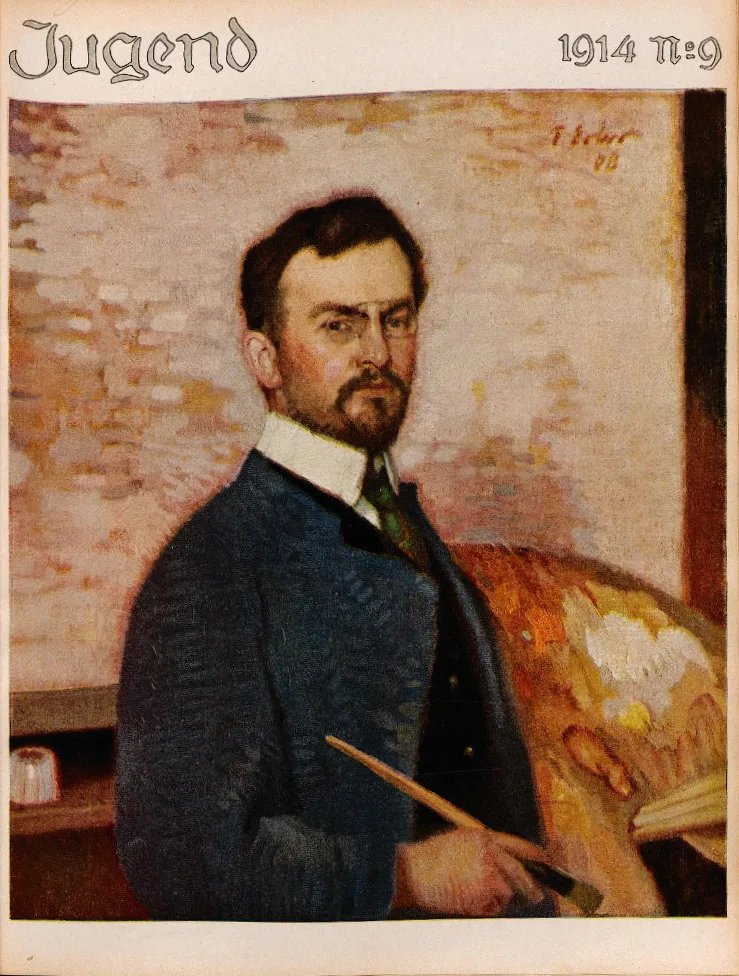
Fritz Erler is at once a subtle portraitist and an eminent decorator. I see him as a self-assured warrior, confident in his strength, much like Andrea del Castagno's portrait of the energetic, armored Pippo Spano in the Basilica of Sant'Apollonia in Florence. One feels him powerfully poised, holding his sword with both hands, his head turned to gaze fearlessly into the unknown. This is the artist confronting his work. Mr. Erler not only knows what he wants but why he wants it; he brings to mind those prodigious, visionary artists who occasionally emerge, conceiving and formulating their personal vision of beauty in its entirety.
He applies his art to everything. Whether it is a vignette, a portrait, a furniture design, an architectural concept, a poster, ceramic vases, or a grand mural, everything bears the imprint of his talent and his decorative conception. His art is all-encompassing, and even in the theater, he was one of the first to implement the long-desired reform of sets and staging.
An All-Encompassing Vision: From Theater to Decorative Arts
For the Munich Artists' Theatre, founded in 1908, Erler pioneered a new type of stage. By being less high, it magnified the actor's presence and gave their performance greater importance. A proscenium, which could be diminished or enlarged at will in the spectator's view, made it possible to situate the characters "in space." As Erler himself explained:
By pushing the entire upstage area far into the background, I made possible an unlimited play of light in the distance and, moreover, gained the ability to light the actors freely on the podium, independently of the backdrop.