
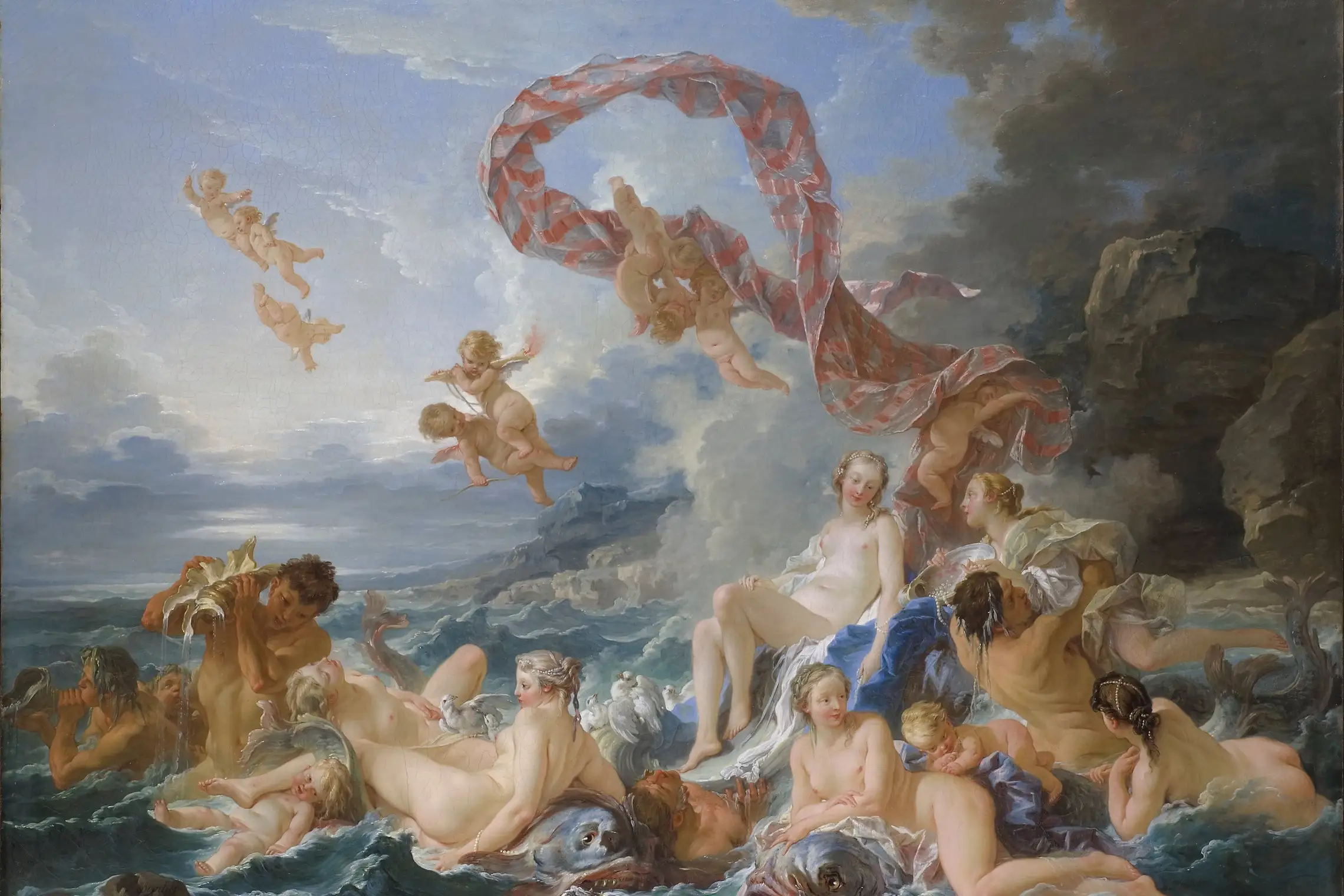
François Boucher's work possessed a "finish" that did honor to his involuntary respect for art. However, by involving him once again in the hasty creation of tapestry models through his inspection of the Gobelins manufactory, Madame de Pompadour was, without intending to, preparing the inevitable and irremediable decline of her painter.
Henceforth, to satisfy the daily demands of an art form he loved, an art where his fantasy and taste had produced decorative masterpieces, and to which he instinctively felt the soft, gentle, and blended harmonies of his painting were marvelously suited, he would incessantly repeat his pastorals and mythologies of yesteryear. He returned again and again to subjects like Aminta and Sylvia, The Fortune Teller, The Fisherman, Aurora and Cephalus, and Venus and Vulcan.
And yet, one cannot say that this man lacked invention. Who could possibly count all of Boucher's drawings? This incredible and ever-flowing facility of conception and draftsmanship is perhaps the best of him. This, along with the supple, rounded, and distinctly personal grace of what have been called his "bare-bottomed Cupids," defines his unique genius.
The Dawn of Art Criticism and the Judgment of Boucher
Art criticism had just been born, and it was terrible to Boucher. No one had less thought to foresee it than he, and no one was less equipped to resist it. No one had less considered, as this gallant creator of pleasant things, the need to infuse his works with reason and philosophy. Until then, Boucher had dealt with amateurs, who first look for beauties and charms before they look for flaws.
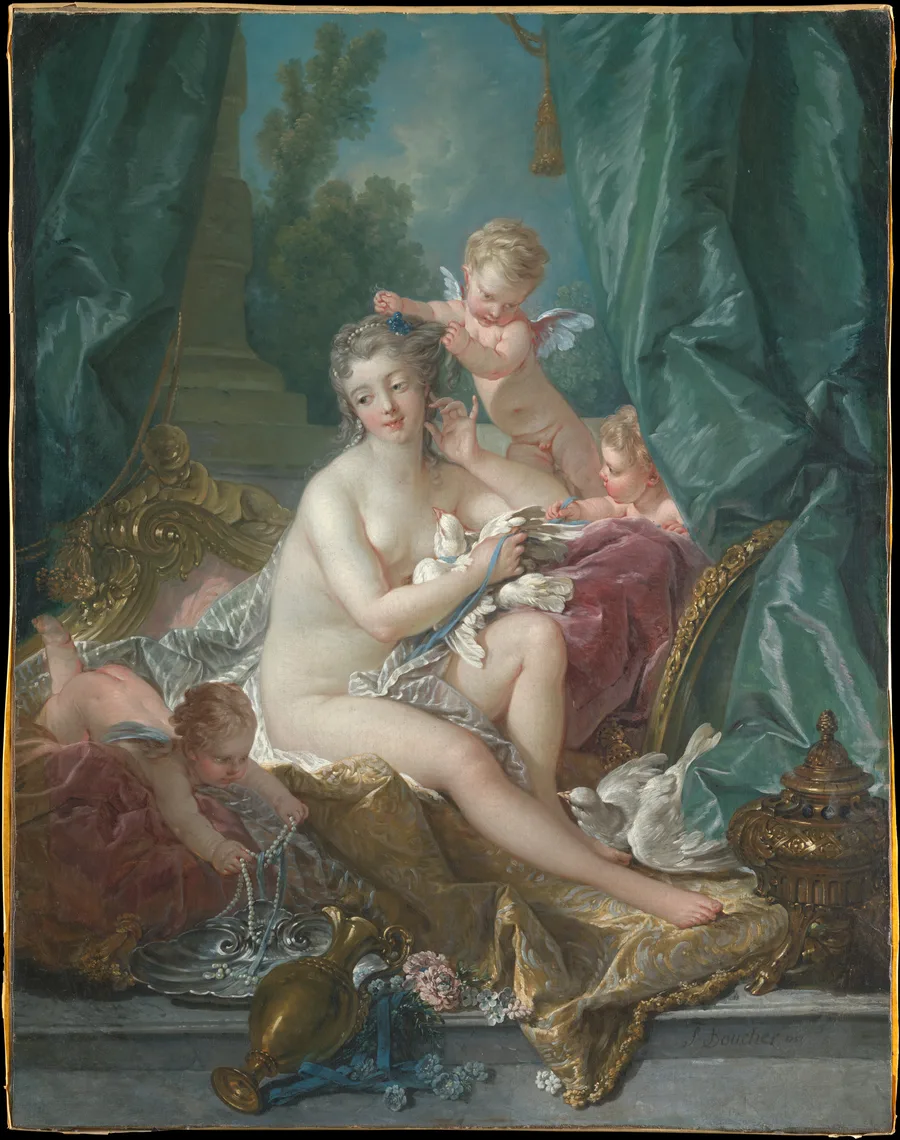
In contrast, art criticism is a literary exercise, exaggerated by nature and consequently unjust, since it only makes its mark and gets itself heard by looking at weaknesses before seeing the beauties. This new kind of literature, which could not fail to blossom in an era where discussion was springing from the earth and taking hold of everything, had an easy target for its debut with the Neptune and Amymone, the Jupiter and Callisto, and the Angelica and Medoro from the painter's premature old age.
What was he still doing at the Salons of 1763, 1765, and 1767? Well, what of it, you cruel people! He painted because he had always painted; he drew because he had always drawn, and he would paint and draw until his final hour. You, Grimm, and you, Diderot, you reviled in him a world that you claimed to want to annihilate. If you were just, you would remember the master of 1740.
It is precisely because he remembered that master that Louis XV, even after Madame de Pompadour had disappeared, appointed Boucher as his First Painter upon the death of Carle Vanloo. The new officeholder would not keep the position for long, as he would die five years later and "would concern himself little with the details of the post." But Louis XV did the right thing, for Boucher was the man of his reign.
Boucher was and will remain the painter of Louis XV, just as Louis XV and Madame de Pompadour were the king and queen of Boucher. Neither Vien nor Bouchardon can compare; these "severe and antique" artists, these reformers, though encouraged by the Pompadour, can be claimed by Louis XVI, dead or alive. But Louis XV, that is Boucher. Neither Voltaire, nor Rousseau, nor the greatest nor the loudest figures will ever give as just and perfect an idea of the manners, the soft powder, and the voluptuous carefree spirit of that century as the painter whose life M. Mantz has recounted.
A Critique of Modern Biography
The book is written in a charming style; never has Paul Mantz used a more beautiful language, a more French phrasing, with turns more supple and brilliant. As he is a master writer, and as he has learned from the best sources, he knows that radiance befits the 18th century, and he carries you from one end of this special study to the other as easily as one would follow Diderot to the end of one of his Salons.
And yet, I must note here a remark that obsesses me. Like the mocking accompaniment to Don Juan's serenade, a gay and gentle irony follows the development of Boucher's triumphant life from the first page to the last. Ah, Mantz, ah, my friend, it is not in this tone that, around 1847, in our fine days, you would have spoken of Boucher, the painter of dimpled graces, the favorite artist of the favorite. Mantz, Mantz, Raphael and Leonardo have spoiled you; you no longer believe in Boucher enough.
The Goncourt brothers, they believe, and they truly delight in the air that he breathed. One feels in their writing more faith and more true love for the man's manner and his milieu. This is an undeniable extra magic in their analysis of the painter. I truly believed in my dear provincial artists, and I feel youthful enough to believe that I still do. The charm, the sparkle that you bring to your narrative or your judgments, you borrow them from yourself, but no longer from the tender illusion that emanates from the character being described.
As you say, you are writing history: you write it with an excellent rightness, justice, and accuracy. You declare with great reason that these "masters whom we are accustomed to considering very frivolous are entitled to the historian's curiosity, since they were adored." And, in truth, my friend, one would have to not be French to not, even today, adore these frivolous figures.
But do not push the philosophy of history too far in this corner of art, and do not place the names of Montesquieu, Voltaire, and Diderot too close to the name of François Boucher. For then Boucher will no longer be my Boucher. I will imagine that these great philosophers of the 18th century, who adored Boucher and his kind as Dante loved Giotto, as Ariosto loved Titian, as Erasmus loved your Holbein, as Richelieu and Fénelon esteemed Poussin—that these philosophers, who made our modern world, instinctively adored the false, the pretty, the conventional, the spoiled, the opposite of sound and solid sense, the opposite of true nature, of true sincerity; that their reason as well as their taste was on the wrong path.
They reveled in dreams, in chinoiserie, in the libertine and the unhealthy. From this, one could deduce that the social state they created, in the measure and image of such a perverted ideal, could only produce utopias without grandeur or poetry, delivered in advance to all the licenses of human coarseness.
The True Nature of Boucher's Art
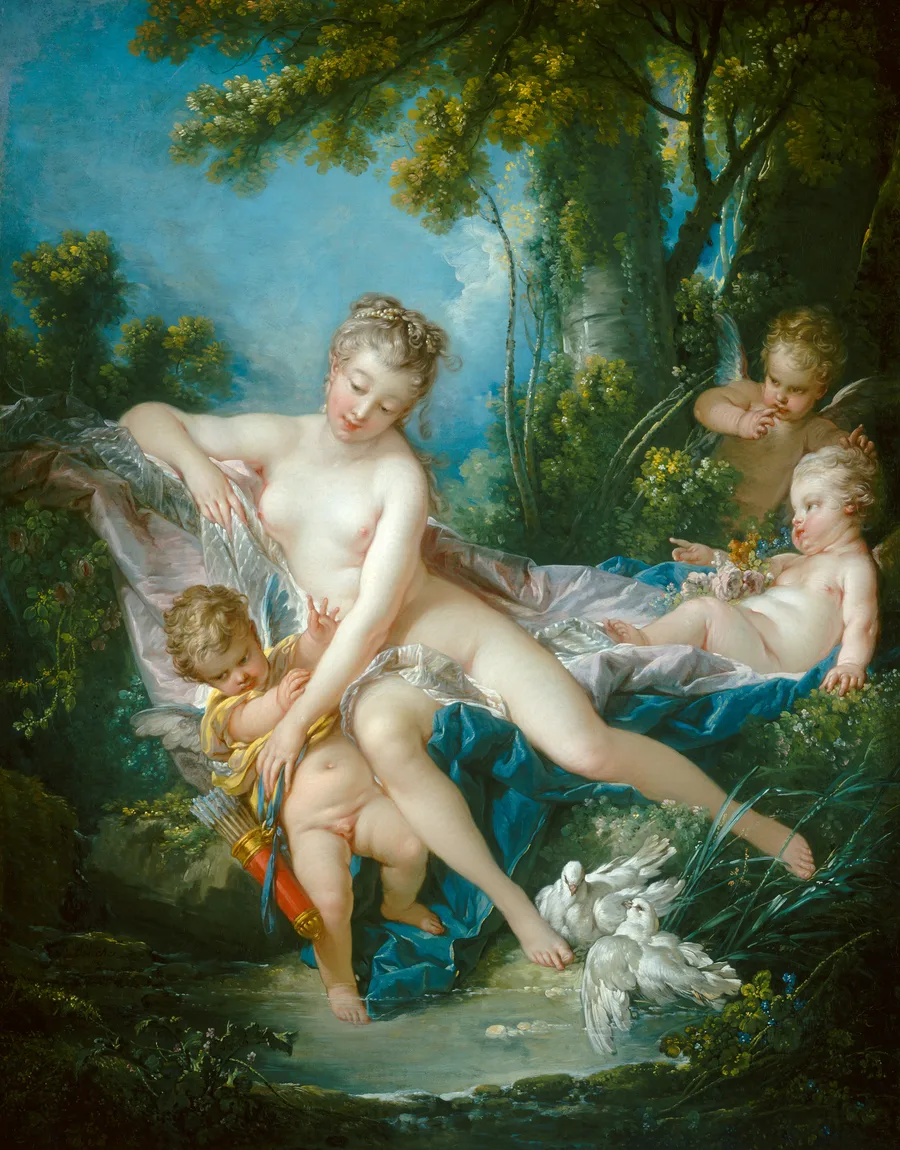
As for me, I prefer to see in François Boucher only the painter in love with plump nymphs and comic-opera shepherdesses—shepherdesses with well-fitted bodices, fine legs, and small, white, well-washed feet. I see the man of bluish-green landscapes, full of mills and rustic bridges; the improviser of a fairy-tale world, rose-colored, where the uninhibited and unfaithful caprices of ancient mythology frolic.
He was the one who most turned and returned, from every angle, the unveiled figure of Venus and wrote, through the adventures of the goddess, the most complete history that any artist has ever told. He was, after all, a painter of fine lineage, with a beautiful and free brush, who, in his good years, knew smiling harmony. This was not, alas, only the Flemish harmony derived from Rubens through Watteau, which benefited him from the start.
Rather, it was the harmony that the decadent Italians—the swift and abundant decorators of the 17th and 18th centuries like Pietro da Cortona, Luca Giordano, and Solimena—had taught to the Coypels, to Lemoyne, to Natoire, to Trémolières. As a shrewd courtier, he gently guided this harmony toward insipidity, to bring it into accord with the spirit and letters of his century.
Boucher's Ideal Form
As for his voluptuous feminine forms—rounded and chubby, plump, coquettish, dainty, and soft—one cannot in good conscience ask him to borrow them from the ideal of the 16th century, for the reason that Boucher never had and never claimed to have what is called an ideal. His forms quite simply have their precedents in the Andromedas and bathers of Lemoyne, or in the women of Giordano, whose ancestral kinship with our Boucher one cannot fail to recognize at the Palazzo Medici Riccardi in Florence. At most, they might trace back to the beautiful Roman women of Guido Reni.
And could it have been otherwise in a century where the President de Brosses, a good judge in these matters, openly placed Guido Reni far above Raphael?
The Challenge of Illustrating an 18th-Century Master
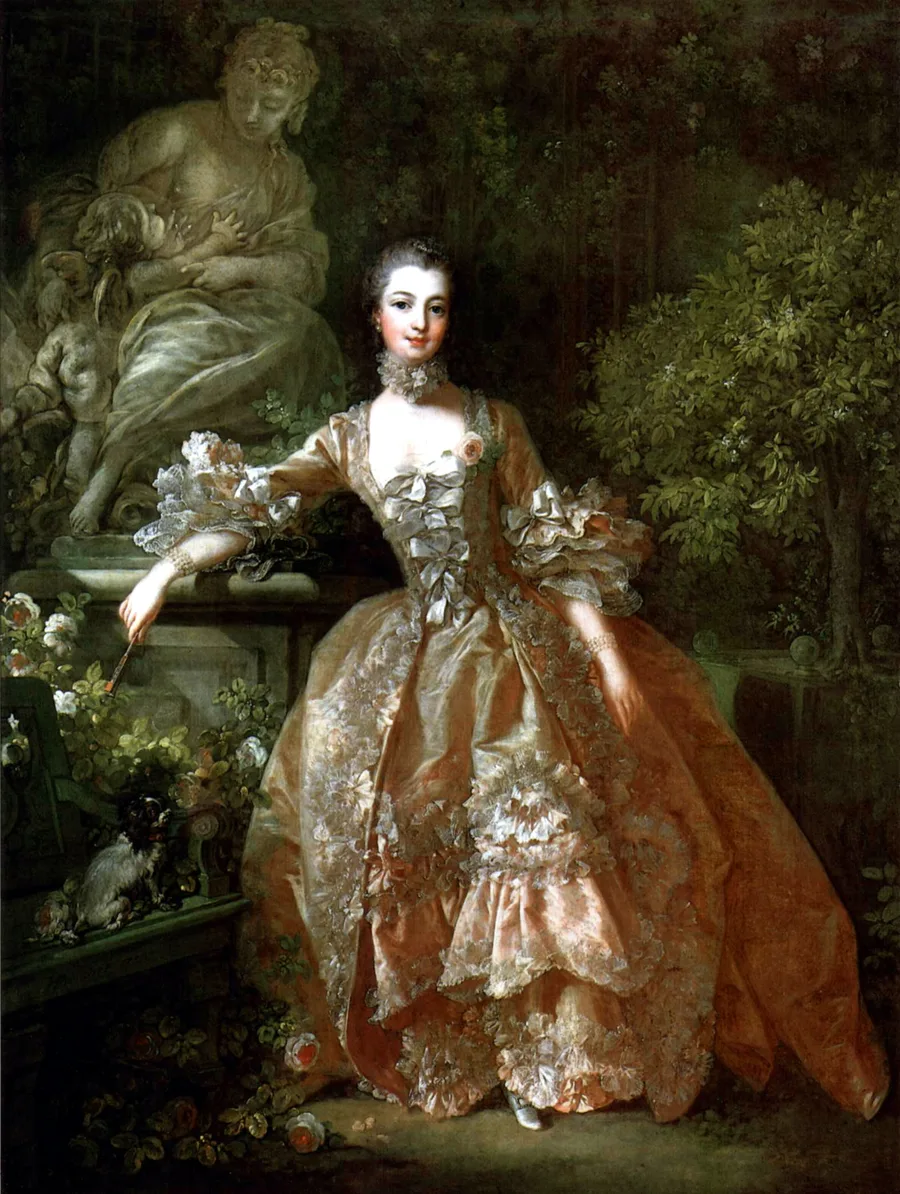
I have said that the book is magnificent—magnificent for the beauty and taste of its characters, a true example of the renowned skill of the Quantin printing house, and worthy of representing it in the most important libraries. As for the innumerable prints that decorate it, which are intended to give the most complete idea of Boucher's talent in its infinitely varied facets, I wish to briefly state my opinion here, for they pose a question that will surely arise again in the illustration of any book of a similar nature.
Entrusted to a group of young and intelligent artists, who have proven themselves elsewhere and have often translated our contemporary masters with undeniable fidelity, the prints present as a whole a perhaps inevitable flaw: they are far too much of their own century, and not enough of Boucher's. Their general coloring is much more reminiscent of the vivid tones of Henri Lévy or some other of our contemporaries than the soft, clear, slightly faded harmony and the round, mellow drawing of Lemoyne's student.
What is the remedy for this? I know of hardly any, for to ask young engravers, imbued whether they like it or not with the principles and admirations of their time, to become, for a fleeting occasion and without conviction, pasticheurs in form and spirit of another century whose education was so different from our own—that is asking a great deal, in truth. I do not know if it would be enough to have the express direction of an artist more particularly steeped in the master's taste, who would be charged with bringing the battalion of his translators back to a unity of style and coloration, to the exactness of the essential type.
However, what happens? It is that these young engravers, with all their talent, with the freedom and spirit they put into their vignettes—and perhaps even because of the independence of that spirit—do, without thinking, a great disservice to their art. They should not forget that conscience and sincerity are the absolute laws of this art, and that they must henceforth compete with scientific reproductions.
Engravers must strive to equal and even surpass these reproductions, by adding to the punctual clairvoyance of the human eye the appeal of the superior interpretation of its intelligence. This is necessary, or engraving is condemned without recourse. In the volume that concerns us, the only prints where we amateurs truly find our Boucher again—be it his painting, his drawings, or the etchings or burin engravings executed in his time after his work—we owe to the Dujardin heliogravure process.
These are the only ones we look at with confidence, the only ones that can make us appreciate the master's qualities and flaws, the only useful supporting documents for Paul Mantz's text. And we say this not without regret for our country and for that French school of engraving of which we were so proud, and which, in Boucher's own time, produced artists of the caliber of Cars, Daullé, Desplaces, Drevet, Duchange, Fessard, Cochin, Balechou, Le Bas, and Demarteau.