
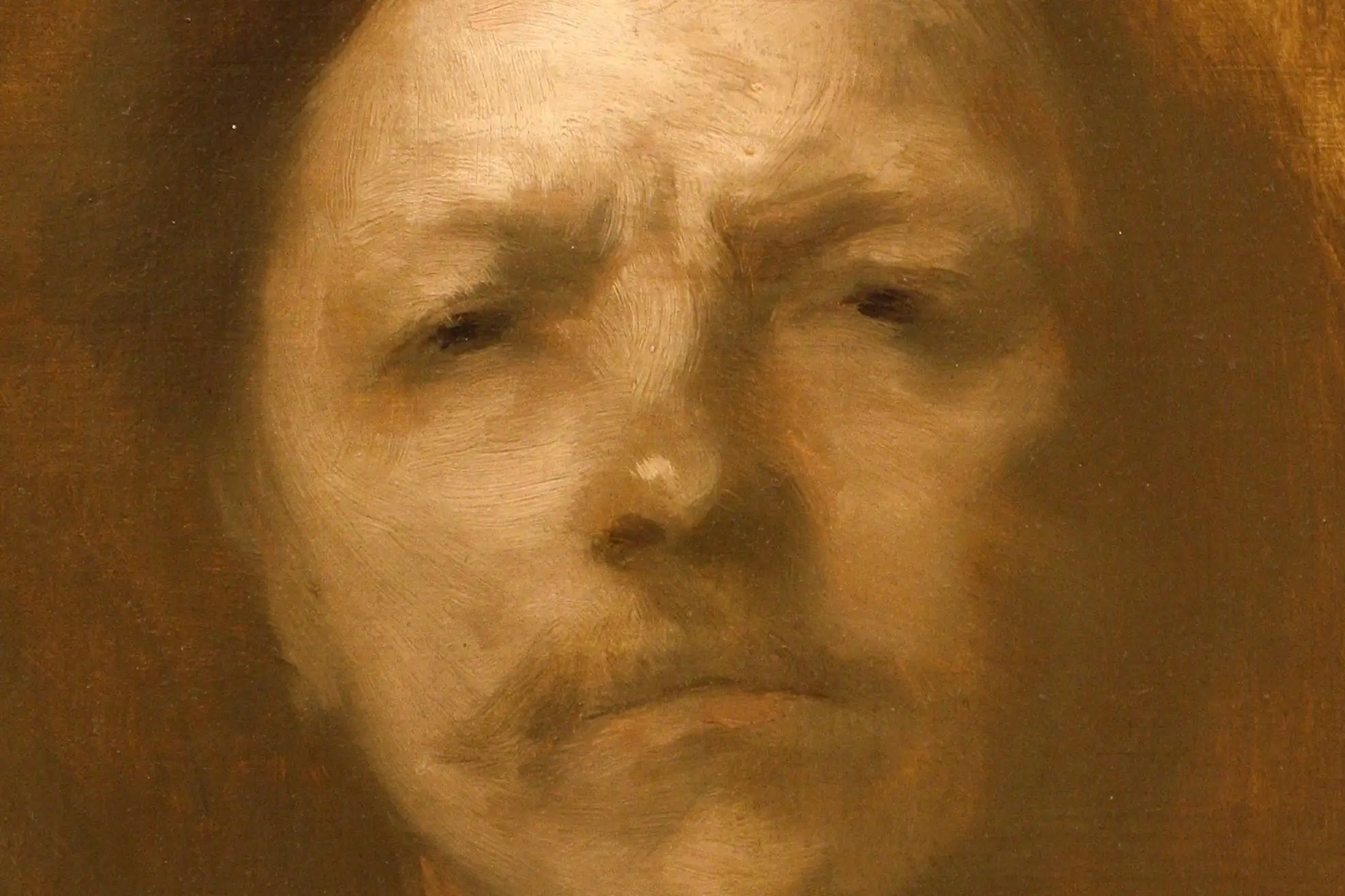

Eugène Carrière seems to have worked without any awareness of Impressionism. His points of reference are to be found with Rembrandt and Velasquez, and he bears no resemblance to any of his contemporaries. At most, one might think of Ricard or Whistler, only to quickly realize that the analogy is entirely external—a relative similarity in appearance rather than one of essential connection.
Carrière's ideal is a narrow one. But if his singular genius does not extend far, it digs deep. He seems to have adopted the principle that the concentrated effort of contemplation on a single point of the universe penetrates the secrets of eternal laws as much as, and better than, the dispersive and generalizing effort of a soul eager to grasp everything and seize the multiplicity of forms and subjects. Carrière possessed an exceptional will. Instead of employing it to embrace everything, and thus risking superficiality in the pursuit of brilliance, he put it to work eliminating what did not seem indispensable to him. In doing so, he expressly deprived himself of what is called "the joy of painting."
A Painter of the Inner World
It is useless to try to estimate the true value of Eugène Carrière's art without first measuring the full degree of psychological elements he sought to express through the forms of painting. He is by no means a literary painter, for he never attempted to suggest through line, tone, and modeling an idea reserved for other languages. But he is an analytical and subjectivist painter who never represents the visible aspects of life for their own sake, but rather to evoke a second, inner, and entirely mental reality for which these aspects are symbols.
There is the painter who, seduced by the joy of life, wants to paint everything, finding radiant motifs everywhere and, as Novalis says, playing with forms and appearances. Then there is the painter who wishes to choose from nature only those elements suited to making the desires of his soul tangible. The first is dominated by his vision, which constitutes his entire intellectuality; the other dominates his vision and places it at the service of his meditation. Eugène Carrière is this second type of painter. This is why very few subjects are sufficient for him. Having found nothing more synthetic and more compelling than the mystery of the face in his wife, his children, and a few contemporaries, he has held to these themes, deducing from them all his general ideas on the physiognomy of life.
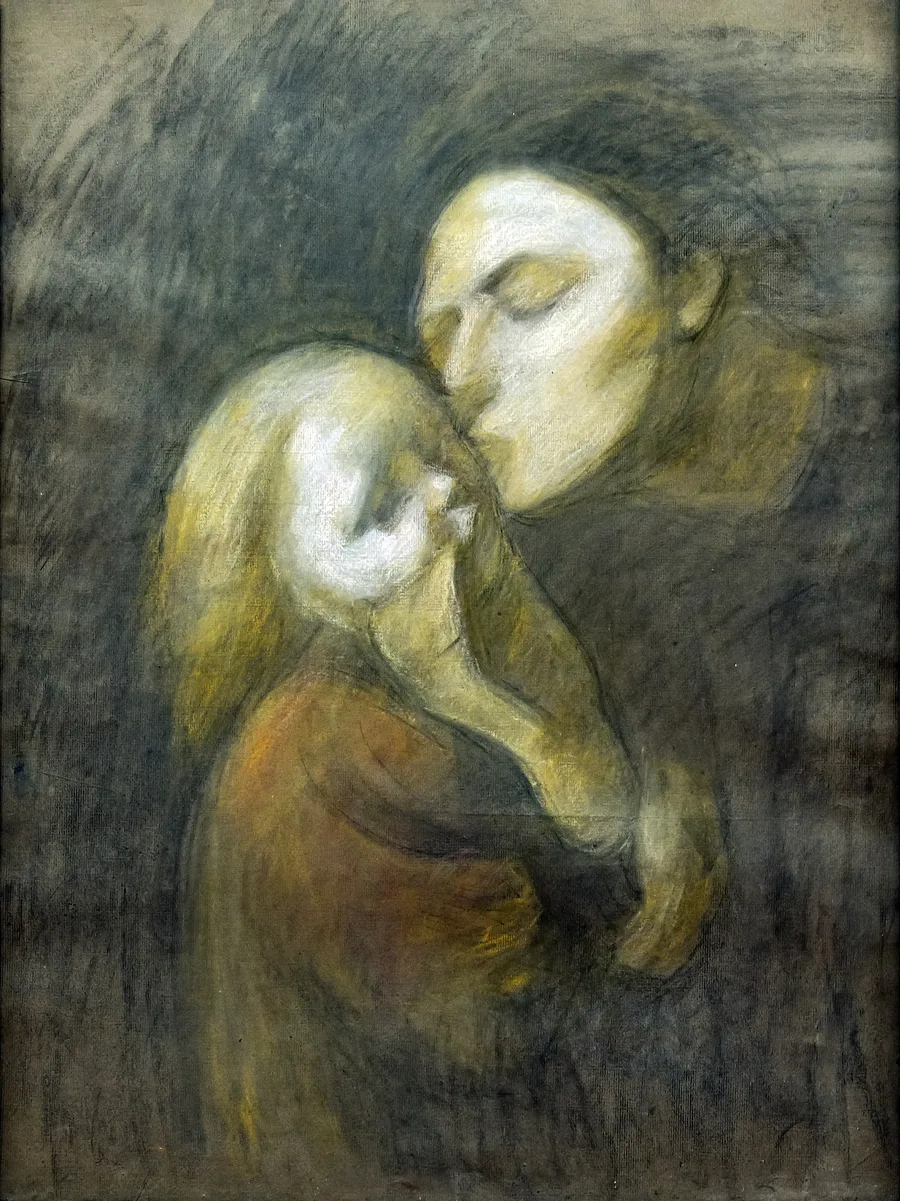
It is always dangerous to speak of the philosophy or ideology of a visual artist. But in our time, no one is more deserving of such a discussion than Eugène Carrière. It is this quality, far more than any differences in technique, that irremediably isolates him from an era in which Impressionism has revitalized the dogma of exteriority and the cult of appearances, preaching distrust against any preponderance of the idea in painting.
Carrière uses painting to reveal his personality, but he does not subordinate the medium to it. He is a great painter, but above all, he is a man who expresses his thoughts with the preoccupation of having lived his life to the fullest, and he is drawn to all that is profound. To understand that he does not limit his entire duty and power as a man to the act of painting well, one need only read his few writings: a preface for a Rodin exhibition, lectures at the Muséum, and published letters. These are the pages of a great prose writer. In them, he immediately achieved excellence of form and the finest qualities of language because he translated the absolute coherence of his personal ideas with a condensed simplicity. If these few admirable pages were to be the sole survivors of a total destruction of his paintings, they would still attest, under the name of Eugène Carrière, to someone who was truly great and who knew how to get to the bottom of things.